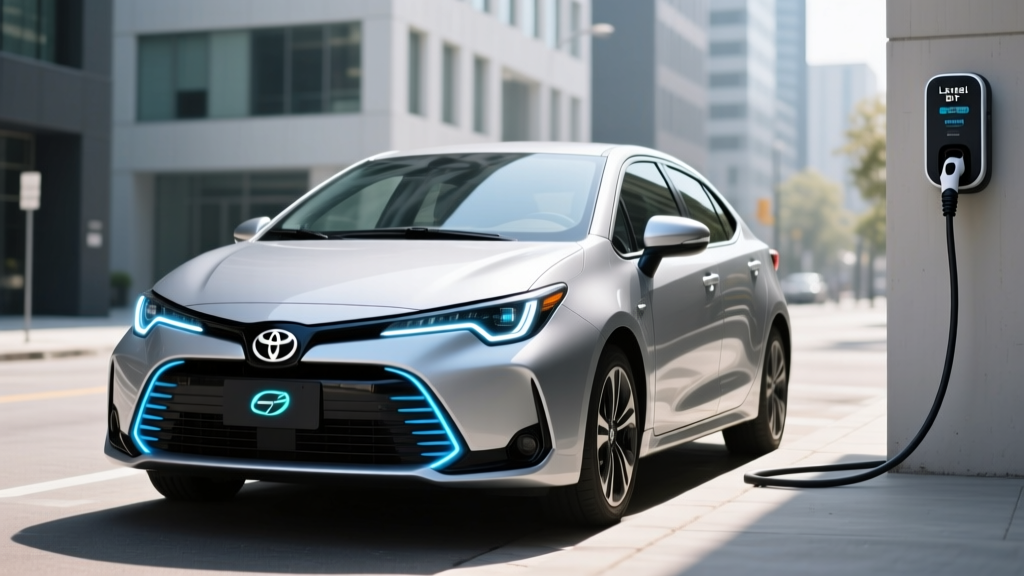
The short answer: As of early 2026, Toyota has not officially released a vehicle badged as the "Toyota Corolla EV" in the United States. The company has confirmed an electric compact sedan concept (the Toyota IMV 0 and next-gen bZ series) that could carry Corolla branding by the 2027-2028 model year, but no US-spec Corolla EV is currently available for purchase. If you're searching for an electrified Corolla today, the 2026 Toyota Corolla Hybrid (50 MPG combined, ~$24,000 MSRP) is the real option. Below, we examine what's known, what's speculated, and how to decide whether to wait or buy now.
Where the Toyota Corolla EV Stands in 2026
Toyota's path to a battery-electric Corolla has been deliberately slow. While competitors like Hyundai (Ioniq 6), Tesla (Model 3), and Chevrolet (upcoming Bolt successor) have fielded compact electric sedans, Toyota has prioritized hybrids and plug-in hybrids across its compact lineup. The global Corolla nameplate has never received a dedicated battery-electric (BEV) variant in the US market.
What Toyota has done:
- bZ4X crossover (2023-present): Toyota's first mass-market BEV, built on the e-TNGA platform. The 2026 bZ4X carries a 71.4 kWh battery (NMC chemistry), an EPA-estimated 252 miles of range (FWD), and starts at approximately $37,500 MSRP.
- Corolla Hybrid (2026 model year): A 1.8-liter four-cylinder paired with Toyota's fifth-generation hybrid system, rated at 50 MPG combined by the EPA, with a starting MSRP around $24,000.
- Concept previews: Toyota has shown next-gen BEV concepts at Japan Mobility Show and CES, hinting at a compact electric sedan arriving globally around 2027, potentially on a revised e-TNGA or a new dedicated EV architecture.
The honest reality: if a Toyota Corolla EV arrives in the US, the earliest realistic model year would be 2028. Toyota typically reveals production vehicles 12-18 months before dealer delivery, and as of this writing, no official US announcement, pricing, or EPA certification exists for a Corolla-badged BEV.
What We Can Estimate: Specs Based on Toyota's BEV Trajectory
While no official Corolla EV spec sheet exists, we can project reasonable numbers based on the bZ4X platform and Toyota's stated battery roadmap. These are analyst estimates, not confirmed specifications.
| Attribute | Estimated Figure | Basis |
|---|---|---|
| Battery capacity | 55-65 kWh usable (NMC or LFP) | Smaller sedan = smaller pack than bZ4X |
| EPA range (est.) | 230-280 miles | Lighter weight, lower drag than bZ4X |
| Peak DC fast charge | ~150 kW | bZ4X peaks at ~150 kW; Toyota has not adopted 800V architecture |
| 10-80% DC charge time | ~30 minutes (est.) | bZ4X achieves ~30 min; Corolla EV likely similar |
| Level 2 AC charge rate | 7.2-11 kW onboard charger | Industry standard for this segment |
| Horsepower | 150-200 HP (single motor FWD) | Consistent with Corolla positioning |
| 0-60 mph | ~7.0-8.0 seconds | Comfort-oriented, not performance |
| Estimated base MSRP | $28,000-$34,000 | Must undercut bZ4X to fit Corolla positioning |
| Connector | NACS (expected, per Toyota's 2024 announcement) | Toyota confirmed NACS adoption for future US BEVs |
Key takeaway on charging: The bZ4X's charging performance has been a known weak point — it peaks at roughly 150 kW but sustains that rate only briefly before tapering. On a 150 kW DC fast charger, real-world sessions often average closer to 90-110 kW across the full 10-80% curve. If the Corolla EV inherits this architecture, expect adequate but not class-leading charging. Competitors like the Hyundai Ioniq 6 (with its 800V system) can sustain 230+ kW and hit 10-80% in about 18 minutes.
Corolla EV vs. Corolla Hybrid vs. bZ4X: The Real Comparison
Since the Corolla EV doesn't exist yet, the practical question is: what should you buy today? Here's how Toyota's current electrified options stack up.
| Metric | 2026 Corolla Hybrid LE | 2026 bZ4X XLE (FWD) | Corolla EV (Projected) |
|---|---|---|---|
| Powertrain | 1.8L HEV | BEV (71.4 kWh NMC) | BEV (~60 kWh est.) |
| EPA Range / Efficiency | 50 MPG combined | 252 mi / 114 MPGe | ~250 mi (est.) |
| Starting MSRP | ~$24,000 | ~$37,500 | ~$30,000 (est.) |
| Federal tax credit (§30D) | None (HEV ineligible) | Varies; battery sourcing rules apply | TBD — depends on sourcing |
| Fuel/energy cost per mile | ~$0.07 (at $3.50/gal) | ~$0.04 (home L2 at $0.13/kWh) | ~$0.04 (est.) |
| Maintenance (5-yr est.) | ~$2,500 | ~$1,500 | ~$1,500 (est.) |
| Drivetrain warranty | 10 yr / 150,000 mi (hybrid system) | 8 yr / 100,000 mi (EV battery) | 8 yr / 100,000 mi (est.) |
The cost reality
At 15,000 miles per year, the Corolla Hybrid costs roughly $1,050/year in fuel. A BEV like the bZ4X, charged primarily at home on a Level 2 charger at the US average residential rate of ~$0.16/kWh and consuming roughly 30 kWh/100 miles, costs about $720/year in electricity. That's a ~$330 annual energy savings for the EV — but the bZ4X's $13,500 higher MSRP takes decades to offset purely on fuel savings alone.
A Corolla EV priced around $30,000 would narrow that gap considerably. If it qualifies for the full §30D federal tax credit (up to $7,500, subject to MSRP caps of $55,000 for sedans, buyer income limits of $150,000 single / $300,000 joint, and critical-mineral/battery-component sourcing requirements), the effective price could drop into the mid-$20,000s — making the math genuinely compelling. But that's a big "if." Toyota's current bZ4X has faced challenges meeting the battery-sourcing requirements that took effect in 2024, and there's no guarantee a future Corolla EV would qualify.
Real-World Ownership: What First-Time EV Buyers Need to Know
If you're considering waiting for a Corolla EV — or buying any BEV — here are the ownership factors that spec sheets don't capture:
Home charging is non-negotiable for most owners
Roughly 80% of EV charging happens at home. A Level 2 home charger (240V, typically 32-48 amps delivering 7.7-11.5 kW) will fully replenish a ~60 kWh battery overnight in 6-8 hours. Installation costs range from $500-$2,500 depending on whether your electrical panel needs an upgrade (a 200-amp panel is usually required). If you live in an apartment without charging access, or park on the street, relying solely on public DC fast charging is both more expensive ($0.30-$0.50/kWh at networks like Electrify America or EVgo) and time-consuming.
Cold weather cuts range 20-35%
Lithium-ion batteries lose efficiency in cold temperatures, and cabin heating draws significant energy. A Corolla EV with an EPA-estimated 260 miles might deliver only 170-210 real-world miles in sustained sub-freezing highway driving. This is physics, not a defect — it applies to every BEV. If your winters are harsh and your commute is long, a hybrid or PHEV eliminates this variable.
Insurance costs 15-25% more for BEVs
EVs cost more to insure on average due to higher repair costs (battery pack replacement, specialized body shop requirements, and limited parts availability). A Corolla Hybrid might cost $1,200-$1,500/year to insure; a Corolla EV would likely run $1,500-$1,900/year depending on your profile and state. Get quotes before committing.
Depreciation uncertainty
The used-EV market has been volatile. Tesla's aggressive price cuts in 2023-2024 hammered resale values across the segment. Toyota's brand strength may help a Corolla EV hold value better than average, but BEV depreciation remains harder to predict than the Corolla Hybrid's well-established curve.
Common Misconceptions About the Toyota Corolla EV
| Myth | Fact |
|---|---|
| "The Corolla EV is available now." | No Corolla-badged BEV exists in the US as of 2026. The closest Toyota BEV is the bZ4X crossover. |
| "It will definitely get the $7,500 tax credit." | Credit eligibility depends on battery-sourcing and critical-mineral rules that change annually. Toyota's past BEVs have had mixed eligibility. Check IRS.gov before assuming. |
| "An EV always saves money vs. a hybrid." | At 50 MPG and ~$24,000, the Corolla Hybrid's total cost of ownership can beat a $30,000+ BEV for drivers who don't have cheap home charging or who drive fewer than 10,000 miles/year. |
| "Toyota's BEVs charge as fast as a Tesla or Hyundai." | The bZ4X peaks at ~150 kW, which is slower than Tesla's ~250 kW (V3 Supercharger) or Hyundai's 800V architecture (~240 kW sustained). Expect Toyota's compact BEV to be adequate, not class-leading. |
| "I can wait for the Corolla EV and it'll be here soon." | Realistic US availability is 2028 at the earliest. Toyota has not announced pricing, specs, or a reveal date for a Corolla-badged BEV. |
Decision Framework: Should You Wait or Buy Now?
Buy the 2026 Corolla Hybrid now if:
- You need a vehicle within the next 6 months
- Your budget is under $28,000
- You lack reliable home charging access
- You regularly drive in extreme cold (below 20°F) with long commutes
- You want predictable, proven depreciation and low insurance costs
- Your daily commute is under 40 miles — the hybrid's 50 MPG already costs pennies per mile
Consider the bZ4X (or another compact BEV) now if:
- You have a garage or driveway with Level 2 charging capability
- Your budget allows $35,000-$42,000 after incentives
- You want zero tailpipe emissions and lower maintenance costs
- Your daily driving is under 200 miles and you rarely road-trip in winter
- You want NACS access to Tesla Superchargers (standard on 2026 bZ4X)
Wait for a potential Corolla EV if:
- Your current vehicle has 2+ years of useful life remaining
- You specifically want a compact electric sedan under $32,000
- You're willing to accept uncertainty on specs, pricing, tax credit eligibility, and availability
- You can monitor Toyota's announcements through 2027 without urgency
Cost Breakdown: What 5 Years of Ownership Actually Costs
| Category | Corolla Hybrid LE | bZ4X XLE (FWD) |
|---|---|---|
| Purchase price (MSRP) | $24,000 | $37,500 |
| Federal tax credit | $0 | $0-$7,500 (varies) |
| Fuel / electricity (5 yr) | $5,250 | $3,600 |
| Maintenance (5 yr) | $2,500 | $1,500 |
| Insurance (5 yr est.) | $6,500 | $8,500 |
| Estimated resale value (5 yr) | -$12,000 | -$16,000 |
| Net 5-year cost | ~$26,250 | ~$27,600-$35,100 |
The Corolla Hybrid wins on pure economics for most buyers today. The bZ4X narrows the gap if you secure the full tax credit and have cheap home charging — but the higher insurance and steeper depreciation erode the advantage. A future Corolla EV priced closer to $28,000 with credit eligibility would shift this math meaningfully.
Frequently Asked Questions
Is Toyota making a Corolla EV?
Toyota has not officially announced a Corolla-badged battery-electric vehicle for the US market as of early 2026. The company has confirmed next-generation BEV concepts globally, and a compact electric sedan wearing the Corolla name is plausible for the 2028 model year, but no production timeline, specs, or pricing have been confirmed.
What is Toyota's current electric car?
The 2026 Toyota bZ4X is Toyota's only all-electric vehicle sold in the US. It's a compact crossover SUV with a 71.4 kWh NMC battery, EPA-estimated 252 miles of range (FWD), and a starting MSRP of approximately $37,500. It supports NACS charging and can access Tesla Superchargers with an adapter or native NACS port on newer builds.
Is the Corolla Hybrid better than waiting for an EV?
For most buyers who need a vehicle now, yes. The 2026 Corolla Hybrid delivers 50 MPG combined at ~$24,000 with Toyota's proven hybrid reliability and a 10-year/150,000-mile hybrid-system warranty. The total cost of ownership is well-established and low-risk. Waiting for an unannounced EV introduces years of uncertainty with no guarantee of pricing, tax credit eligibility, or availability.
Will a Toyota Corolla EV qualify for the $7,500 tax credit?
It's impossible to confirm until Toyota publishes battery-sourcing details and the IRS evaluates eligibility under current §30D rules. The credit requires the vehicle's MSRP to be under $55,000 (sedans), the buyer's AGI to be under $150,000 (single) or $300,000 (joint), and specific percentages of critical minerals and battery components to be sourced from the US or free-trade-agreement partners. These thresholds tighten annually. Consult a tax professional before making a purchase decision based on credit eligibility.
How does the Corolla EV compare to a Tesla Model 3 or Hyundai Ioniq 6?
If it arrives at the projected ~$30,000 price point, a Corolla EV would undercut the Tesla Model 3 (starting ~$39,000) and Hyundai Ioniq 6 (starting ~$38,000) significantly. However, both competitors currently offer 300+ miles of EPA range, faster DC charging (Tesla at 250 kW peak, Hyundai at ~240 kW on 800V), and more mature software ecosystems. The Corolla EV would trade cutting-edge specs for Toyota's reliability reputation and a lower entry price.
What should I buy if I want an affordable EV right now?
If your budget is under $35,000 and you want a BEV today, consider the Chevrolet Equity EV (starting ~$33,000, ~315 mi range), the Nissan Leaf (starting ~$29,000, up to 212 mi, though CHAdeMO charging limits public access), or a used Tesla Model 3. If you're flexible on powertrain, the Corolla Hybrid at $24,000 and 50 MPG remains the lowest-risk electrified purchase in Toyota's lineup.