The Short Answer
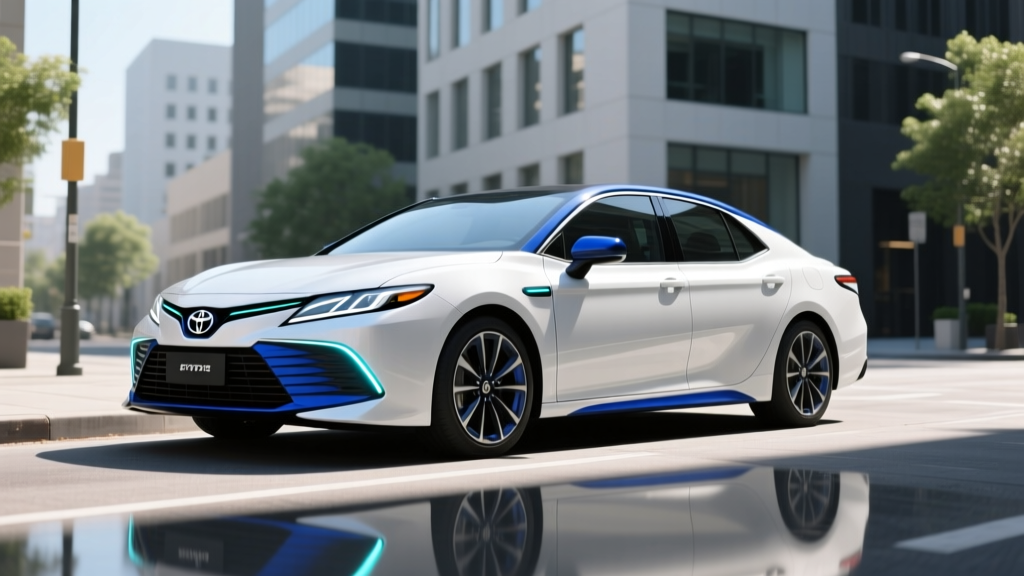
As of 2026, there is no fully electric Toyota Camry. Toyota sells the Camry exclusively as a hybrid (HEV) — no plug, no battery-electric variant. If you want a Toyota electric sedan with similar size and comfort, the closest option is the Toyota bZ4X (a crossover, EPA range up to 252 miles, starting around $37,000) or the upcoming Toyota Crown Signia. For a true midsize electric sedan rivaling the Camry's footprint, you'll need to look at competitors like the Tesla Model 3, Hyundai Ioniq 6, or BMW i4.
Why There Is No Electric Camry in 2026
Toyota's strategy has been to keep the Camry nameplate on its proven hybrid powertrain while building its EV lineup under the bZ series and other new nameplates. The current-generation Camry (ninth generation, launched for 2025) comes standard with a 2.5-liter four-cylinder hybrid system producing 225 horsepower (FWD) or 232 hp (AWD). Toyota has not announced a battery-electric Camry for any upcoming model year.
This isn't an oversight — it's deliberate. Toyota has consistently argued that hybrids deliver the best balance of emissions reduction, affordability, and infrastructure independence for the mass sedan market. The Camry Hybrid achieves an EPA-estimated 51 MPG combined (LE trim), which Toyota positions as near-EV efficiency without range or charging concerns.
For buyers specifically searching for a "Toyota Camry electric car," the practical question becomes: do you want the exceptional efficiency of the Camry Hybrid, or do you actually need a zero-tailpipe-emission EV? The answer changes everything about your purchase.
2026 Toyota Camry Hybrid: The Specs That Matter
Since the Camry Hybrid is what Toyota actually sells, here are the numbers buyers need:
| Specification | 2026 Camry Hybrid LE | 2026 Camry Hybrid SE/XSE (AWD) |
|---|---|---|
| Powertrain | 2.5L 4-cyl hybrid (FWD) | 2.5L 4-cyl hybrid (AWD) |
| Horsepower | 225 hp | 232 hp |
| EPA MPG (City / Hwy / Combined) | 53 / 50 / 51 | 44 / 43 / 44 |
| Fuel Tank | 13.2 gal | 13.2 gal |
| Estimated Total Range | ~673 miles | ~581 miles |
| 0-60 mph | ~7.2 sec | ~6.9 sec |
| Starting MSRP | ~$29,990 | ~$32,590 |
| Federal Tax Credit | None (not a PHEV/BEV) | None (not a PHEV/BEV) |
| Powertrain Warranty | 5 yr / 60,000 mi | 5 yr / 60,000 mi |
| Hybrid Battery Warranty | 10 yr / 150,000 mi | 10 yr / 150,000 mi |
Source: fueleconomy.gov and Toyota Motor Corporation press materials.
The Camry Hybrid LE's 51 MPG combined is remarkable for a midsize sedan. On a 15,000-mile/year driving schedule, that translates to roughly 294 gallons per year — about $880 in fuel at $3.00/gallon. That's genuinely competitive with the electricity cost of running an EV in many markets.
Camry Hybrid vs. Midsize Electric Sedans: A Cost Comparison
If you're cross-shopping a Camry Hybrid against actual electric vehicles, here's how the five-year ownership math compares. We're using the Tesla Model 3 (Rear-Wheel Drive, EPA 341 miles, ~$39,990 base) and Hyundai Ioniq 6 (SE Standard Range, EPA 240 miles, ~$38,650 base) as EV benchmarks.
| 5-Year Cost Factor | Camry Hybrid LE | Tesla Model 3 RWD | Hyundai Ioniq 6 SE |
|---|---|---|---|
| Base MSRP | $29,990 | $39,990 | $38,650 |
| Federal §30D Tax Credit | $0 | Up to $7,500* | Up to $7,500* |
| Effective Purchase Price | $29,990 | $32,490 | $31,150 |
| Fuel/Energy (5 yr, 15k mi/yr) | ~$4,400 | ~$2,700** | ~$2,850** |
| Maintenance (5 yr est.) | ~$2,200 | ~$900 | ~$1,000 |
| Insurance (5 yr avg.) | ~$7,500 | ~$9,800 | ~$8,200 |
| Estimated 5-Yr Total Cost | ~$44,090 | ~$45,890 | ~$43,200 |
* §30D credit eligibility depends on MSRP caps, buyer income limits, battery sourcing requirements, and point-of-sale transfer rules. Verify at IRS.gov before purchasing.
** EV energy cost assumes $0.15/kWh average home charging. Public DC fast charging is significantly more expensive — often $0.35-$0.50/kWh.
The Camry Hybrid holds its own economically. The EV advantage in fuel and maintenance is real but partly offset by higher insurance premiums and upfront cost. The tax credit narrows the gap considerably for eligible buyers, but it's not guaranteed — battery component and critical-mineral sourcing rules under §30D have tightened through 2026.
What If You Really Want a Toyota EV?
If your priority is a Toyota badge with a plug, your 2026 options are:
- Toyota bZ4X: All-electric compact crossover. EPA range up to 252 miles (FWD, 71.4 kWh battery). Peak DC fast charging around 150 kW (10-80% in approximately 30 minutes). Starting MSRP around $37,000. Real-world highway range drops to roughly 200-215 miles in cold weather.
- Toyota bZ (sedan concept): Toyota has previewed electric sedan concepts, but no production midsize electric sedan wearing a Camry-like badge is confirmed for the 2026 model year.
- Toyota RAV4 Plug-in Hybrid (Prime): 42 miles of electric-only range, 38 MPG combined after the battery depletes. A genuine bridge option if you want some EV driving without full commitment.
The bZ4X is the closest Toyota EV to the Camry's price bracket, but it's a crossover — taller, shorter wheelbase, and with less rear-seat room than the Camry. Its 252-mile EPA range is adequate for most commutes but falls short of the Model 3's 341 miles or Ioniq 6's Long Range variant at 361 miles.
Real-World Ownership Considerations for First-Time EV Buyers
If you're researching a "Camry electric car" because you're considering your first EV, here are the practical factors that will determine whether an EV actually works for you:
Home Charging Access Is Non-Negotiable
Without Level 2 home charging (240V, typically 32-48 amps / 7.7-11.5 kW), EV ownership becomes significantly less convenient and more expensive. Public DC fast charging costs 2-3x more per kWh than home charging and adds 20-40 minutes to your routine several times per week. If you live in an apartment without charging access or lack a garage/driveway, the Camry Hybrid's 51 MPG with zero infrastructure requirements is a genuine advantage.
Cold Weather Range Loss Is Real
EVs lose 20-35% of their EPA-estimated range in sustained freezing temperatures, based on testing by AAA and real-world owner data. A 252-mile bZ4X could deliver as little as 165-200 miles on a cold winter highway drive. The Camry Hybrid's fuel efficiency drops in cold weather too, but far less dramatically — perhaps 5-10% — and you can refuel in five minutes at any gas station.
Driving Patterns Favor Hybrids for Some Buyers
If you regularly drive 300+ miles in a single day (road trips, rural routes, towing), the Camry Hybrid's 673-mile total range and 5-minute refueling remain difficult to beat. Even the fastest-charging EVs require 20-30 minute stops every 200-250 miles on the highway, adding roughly an hour to a 600-mile trip.
Common Misconceptions
| Myth | Fact |
|---|---|
| "The Camry comes in an electric version." | No. The 2026 Camry is sold exclusively as a hybrid (HEV) — no plug-in or battery-electric variant exists. |
| "Hybrids aren't real EVs." | The Camry Hybrid uses an electric motor for low-speed driving and assist, but it cannot plug in. It's an HEV, not a PHEV or BEV. |
| "EVs always save more money." | Not always. The Camry Hybrid's $29,990 starting price, zero tax credit, and 51 MPG can match or beat EV total cost for buyers without home charging or who drive high annual miles on highways. |
| "I need an EV to reduce my carbon footprint." | A 51-MPG hybrid produces roughly half the CO₂ of the average gas car. Depending on your local electricity grid, a hybrid's emissions can be comparable to an EV charged on coal-heavy power. |
Decision Framework: What Should You Actually Buy?
Choose the Toyota Camry Hybrid If:
- You lack reliable home charging access (apartment, street parking, no 240V outlet)
- You regularly drive 300+ miles in a day or live in a charging-desert region
- Your budget is firm at $30,000-$35,000 and you don't qualify for the §30D tax credit
- You live in extreme cold climates where EV range loss would be punishing
- You want Toyota's reliability track record and 10-year hybrid battery warranty
Choose a True EV (Model 3, Ioniq 6, etc.) If:
- You have Level 2 home charging and drive under 250 miles per day
- You qualify for the full $7,500 §30D tax credit (check income caps and sourcing rules at IRS.gov)
- You want zero tailpipe emissions and lower per-mile energy cost
- Your daily commute is under 80 miles round-trip (most Americans' is)
- You value instant torque, one-pedal driving, and over-the-air updates
Choose the Toyota bZ4X If:
- You want a Toyota-badged EV specifically and accept crossover packaging
- Your daily driving is under 200 miles and you have home charging
- You're comfortable with ~252 miles EPA range and a ~30-minute DC fast-charge time
Federal Tax Credit Reality for 2026
The §30D Clean Vehicle Credit can deliver up to $7,500 at point of sale for qualifying new EVs, but the Camry Hybrid does not qualify — it's a conventional hybrid, not a plug-in. For EVs that do qualify, the rules in 2026 include:
- MSRP caps: Vans, SUVs, and pickups up to $80,000; sedans up to $55,000
- Buyer income limits: $150,000 single / $225,000 head of household / $300,000 joint MAGI
- Battery sourcing: Increasingly strict critical-mineral and battery-component requirements that disqualify some models
- Point-of-sale transfer: Eligible buyers can apply the credit as a down-payment reduction at the dealer
Always verify current eligibility on IRS.gov and confirm with your tax professional before relying on the credit in your purchase math.
Frequently Asked Questions
Will Toyota ever make an electric Camry?
Toyota has not announced a battery-electric Camry. The company is investing heavily in EVs under new nameplates (bZ series) while maintaining hybrid powertrains on its core sedans. A future electric sedan from Toyota is possible but unlikely to carry the Camry name based on current strategy.
Is the Camry Hybrid considered an electric car?
No. The Camry Hybrid is a conventional hybrid (HEV). It uses an electric motor alongside a gasoline engine but cannot be plugged in and has no electric-only driving range beyond brief low-speed maneuvering. It is not a plug-in hybrid (PHEV) or battery-electric vehicle (BEV).
How does Camry Hybrid fuel cost compare to charging an EV?
At 51 MPG combined and $3.00/gallon gas, the Camry Hybrid costs about $0.088 per mile in fuel. An EV at $0.15/kWh home charging and 3.5 miles/kWh costs about $0.043 per mile. The EV saves roughly $675/year on 15,000 miles — meaningful but not overwhelming given the Camry's lower purchase price.
What's the cheapest way to get a Toyota with an electric powertrain?
The Toyota Prius (hybrid, starting ~$28,500, up to 57 MPG combined) is the most affordable electrified Toyota. For a plug-in, the RAV4 Prime PHEV starts around $44,000 with 42 miles of electric range. The bZ4X is Toyota's most affordable full EV at approximately $37,000.
Does the Camry Hybrid qualify for any tax credits?
No. The federal §30D Clean Vehicle Credit applies only to plug-in vehicles (BEVs and PHEVs). Conventional hybrids like the Camry Hybrid are not eligible. Some states offer small incentives for hybrids, but these vary widely — check your state's energy office for details.