The Quick Answer: Toyota's 3-Row EV in 2026
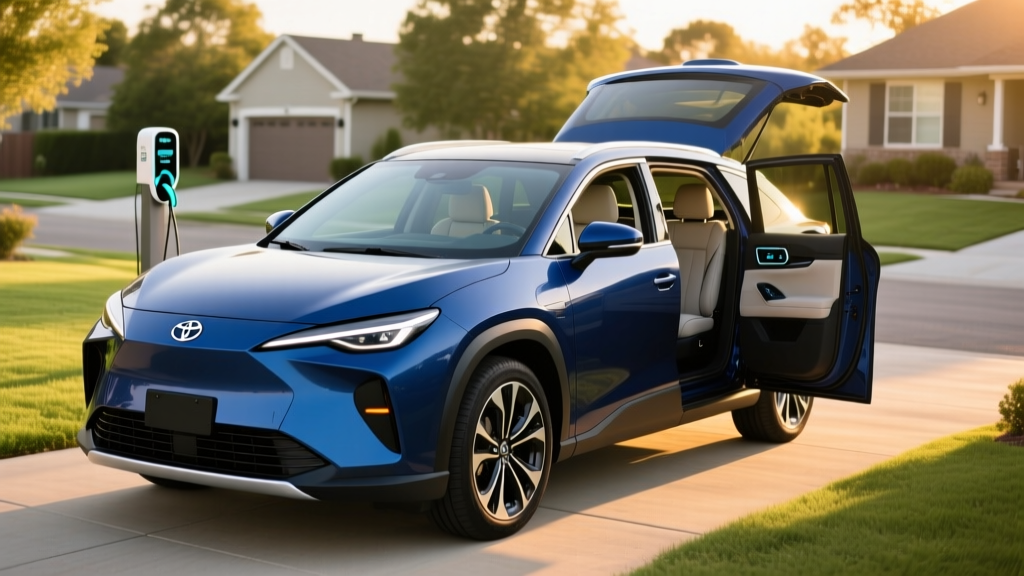
Toyota's first three-row electric SUV is the 2026 bZ5x (badged as the bZ Large SUV in some markets), built on a dedicated EV platform co-developed with Subaru. It targets an EPA-estimated range of approximately 280–310 miles depending on trim and drivetrain, with a usable battery capacity around 90–100 kWh. Pricing is expected to start near $50,000–$53,000 before incentives, positioning it against the Kia EV9, Hyundai Ioniq 9, and Tesla Model X. Toyota's hybrid 3-row alternative, the Grand Highlander Hybrid, starts around $40,000 and delivers 35 MPG combined — a critical comparison point we'll break down below.
Note: As of early 2026, Toyota has confirmed the bZ Large SUV for production. Some specs below are based on Toyota's announced targets and platform data. Final EPA certifications may vary. Always verify with fueleconomy.gov before purchasing.
Range, Battery, and Charging: What the Numbers Actually Mean
Toyota's approach to the bZ5x mirrors its cautious, longevity-first EV strategy: a large NMC (nickel manganese cobalt) lithium-ion pack with conservative buffer management to prioritize long-term state of health over peak range bragging rights.
| Specification | Estimated / Announced |
|---|---|
| Battery Chemistry | NMC (Nickel Manganese Cobalt) |
| Usable Battery Capacity | ~92–100 kWh |
| EPA Range (est.) | 280–310 mi (trim-dependent) |
| Real-World Highway Range | ~240–270 mi (70+ mph, moderate temps) |
| Cold-Weather Range (20°F) | ~210–245 mi (est. 20–25% loss) |
| Peak DC Fast Charge Rate | ~200–250 kW |
| 10–80% DC Fast Charge Time | ~25–30 minutes (est.) |
| Level 2 Charge Rate | ~11.5 kW (onboard charger) |
| Level 2 Full Charge Time | ~9–10 hours |
| Drivetrain | RWD (base) / AWD (available) |
| Estimated Horsepower | ~300 HP (RWD) / ~400 HP (AWD) |
| 0–60 mph (est.) | ~5.5s (AWD) |
Real-World Range Reality Check
The EPA sticker is a starting point, not a guarantee. On a 300-mile family road trip at sustained 75 mph speeds, expect the AWD bZ5x to deliver closer to 250 miles before you'll want to stop. In freezing temperatures with cabin heat running, that drops further to roughly 215–235 miles. Toyota's thermal management system includes a heat pump (expected standard), which mitigates cold-weather losses compared to resistive heating — but physics still applies. Plan charging stops accordingly on winter road trips.
The DC fast charging curve matters as much as the peak number. Like most large-battery EVs, the bZ5x will likely sustain its peak ~200–250 kW rate only between roughly 10–50% state of charge, then taper progressively. A 10–80% session should take about 25–30 minutes at a capable 350 kW station (Electrify America, EVgo, or a NACS-equipped Tesla Supercharger if Toyota adopts the adapter). Charging from 80–100% adds significant time due to cell-balancing taper — don't plan your road trip around it.
bZ5x vs. Gas and Hybrid: The Cost and Efficiency Showdown
Toyota's own showroom is the bZ5x's toughest competition. The Grand Highlander Hybrid seats seven or eight, starts around $40,000, and returns an EPA-estimated 35 MPG combined. The Sienna minivan (hybrid-only) hits 36 MPG. So why go electric?
| Metric | Toyota bZ5x (EV, est.) | Grand Highlander Hybrid | Grand Highlander (Gas Turbo) |
|---|---|---|---|
| Starting MSRP | ~$50,000–$53,000 | ~$40,000 | ~$39,000 |
| EPA Efficiency | ~85–90 MPGe | 35 MPG combined | 24 MPG combined |
| Energy/Fuel Cost per Mile | ~$0.04–$0.06 (home L2) | ~$0.10 (at $3.50/gal) | ~$0.15 (at $3.50/gal) |
| Annual Fuel/Energy (15k mi) | ~$600–$900 | ~$1,500 | ~$2,190 |
| Maintenance (annual avg.) | ~$300–$500 | ~$600–$900 | ~$700–$1,000 |
| CO₂ Emissions (tailpipe) | Zero | Low | Higher |
| Federal Tax Credit (§30D) | Up to $7,500 (if eligible) | $0 | $0 |
At $0.13/kWh (national average residential electricity rate), charging a ~95 kWh battery from empty to full costs roughly $12.35 at home. That's the equivalent of filling a tank for the price of two gallons of gas. Over 15,000 miles per year, the bZ5x saves an estimated $1,200–$1,500 annually on energy versus the gas-only Grand Highlander, and $600–$900 versus the hybrid.
However, the EV's higher purchase price means the break-even point is roughly 5–7 years for the EV vs. hybrid comparison, depending on your electricity rate, annual mileage, and whether you qualify for the federal tax credit. If you drive more than 15,000 miles per year or have access to cheap overnight electricity (under $0.10/kWh), the math shifts faster in the EV's favor.
5-Year Cost of Ownership Breakdown
| Cost Category (5 Years) | bZ5x (EV, est.) | Grand Highlander Hybrid |
|---|---|---|
| Purchase Price (base) | $51,500 | $40,000 |
| Federal Tax Credit (§30D) | –$7,500 (if eligible) | $0 |
| Effective Purchase | $44,000 | $40,000 |
| Home Charger Install (L2) | $1,200–$2,500 | $0 |
| Energy/Fuel (75,000 mi) | $3,500–$4,500 | $7,500 |
| Maintenance (5 yr) | $1,800–$2,500 | $3,500–$4,500 |
| Insurance (5 yr avg.) | $9,000–$11,000 | $7,000–$8,500 |
| Estimated Depreciation | $18,000–$22,000 | $14,000–$17,000 |
| Est. 5-Year Total | $60,000–$68,000 | $58,500–$64,500 |
Key ownership notes: EV insurance premiums run 15–25% higher than comparable gas/hybrid models due to repair costs and battery replacement risk. Depreciation for EVs has been volatile — early Toyota bZ4X models saw steep drops, though Toyota's brand loyalty may help the bZ5x hold value better. The IRS §30D tax credit can close the purchase gap significantly, but eligibility depends on MSRP caps (SUVs: $80,000), buyer income limits ($300K joint / $150K single), and battery critical-mineral sourcing requirements that change annually.
Real-World Ownership: Charging Access, Climate, and Daily Life
Home Charging Is the Make-or-Break Factor
With a ~95 kWh battery, Level 1 charging (120V household outlet at ~1.4 kW) would take over 65 hours for a full charge — essentially unusable as a primary strategy. A Level 2 home charger (240V, 48A circuit delivering ~11.5 kW) is practically mandatory, adding roughly 30–35 miles of range per hour and fully replenishing the battery overnight.
Home L2 installation costs typically run $1,200–$2,500 if your electrical panel has capacity. If you need a panel upgrade from 100A to 200A service, add $1,500–$3,000. Consult a licensed electrician — this is not a DIY project.
Apartment and Street-Parking Realities
If you lack dedicated home parking with electrical access, owning a large-battery EV like the bZ5x becomes significantly more challenging. Public DC fast charging costs $0.30–$0.50/kWh at most networks, pushing your per-mile cost to $0.08–$0.13 — eroding much of the EV cost advantage. Workplace charging or reliable nearby public chargers can make it work, but factor this into your decision honestly.
Cold Climate Considerations
In northern-tier states where winter temperatures regularly dip below freezing, expect 20–30% range reduction. Battery preconditioning (heating the pack before a DC fast charge session) is critical for maintaining charge speed in cold weather — confirm the bZ5x supports navigation-linked preconditioning before buying in cold climates.
Common Misconceptions About Toyota's 3-Row EV
| Myth | Fact |
|---|---|
| "The bZ5x will get 400 miles of range." | Toyota targets ~280–310 mi EPA. Claims above 350 mi are not supported by announced specs. Large SUVs with 3 rows carry weight and aero penalties. |
| "I can charge it on a regular wall outlet overnight." | A 120V outlet adds only ~3–4 miles per hour. You'd gain ~35 miles overnight — barely covering a school run. A Level 2 charger is essential for this vehicle. |
| "It qualifies for the full $7,500 tax credit automatically." | §30D eligibility requires meeting MSRP caps, buyer income limits, and battery sourcing rules that tighten annually. Check IRS.gov for current-year requirements and confirm the specific VIN qualifies. |
| "Toyota EVs are unreliable because of the bZ4X recall." | The 2022–2023 bZ4X wheel-hub bolt issue was resolved. The bZ5x uses an entirely different, dedicated large-vehicle platform. Toyota's battery warranty is expected at 8 years / 100,000 miles. |
| "It's a Toyota, so it will have a hybrid option too." | The bZ5x is a battery-electric vehicle only. Toyota sells the Grand Highlander for hybrid buyers. These are separate product lines. |
How It Stacks Up Against the 3-Row EV Competition
The bZ5x enters a segment that already has established players. Here's how the key specs compare:
| Spec | Toyota bZ5x (est.) | Kia EV9 | Hyundai Ioniq 9 | Tesla Model X |
|---|---|---|---|---|
| Base MSRP | ~$51,500 | $54,900 | ~$56,000 | $79,990 |
| EPA Range | ~280–310 mi | 279–304 mi | ~300–335 mi | 311–335 mi |
| Battery (usable) | ~92–100 kWh | 99.8 kWh | 110.3 kWh | 100 kWh |
| Peak DC Charge | ~200–250 kW | 236 kW | ~250 kW | 250 kW |
| 10–80% Charge | ~25–30 min | ~24 min | ~24 min | ~25 min |
| Seating | 7 | 6–7 | 6–7 | 5–7 |
| Cargo (behind 3rd row) | ~18–20 cu ft (est.) | 20.2 cu ft | ~21 cu ft | 15.8 cu ft |
The bZ5x's likely advantage is pricing and Toyota's dealer network — critical for family buyers who want local service support. The Kia EV9 and Ioniq 9 offer slightly more range and cargo volume on paper, but at higher starting prices. The Tesla Model X is in a different price tier entirely and competes more on performance and Supercharger access than value.
Decision Framework: Should You Buy the bZ5x, a Hybrid, or a Rival EV?
Choose the Toyota bZ5x if:
- You have reliable Level 2 home charging (garage or dedicated parking spot with 240V access)
- Your daily driving is under 80 miles round-trip, with occasional 200–250 mile road trips
- You want a 3-row EV with Toyota dealer support and strong long-term reliability expectations
- You qualify for the §30D federal tax credit (check income, MSRP, and sourcing rules)
- You value lower operating costs and plan to keep the vehicle 5+ years
Choose the Grand Highlander Hybrid instead if:
- You lack home charging access (apartment, street parking, no 240V option)
- You regularly drive 300+ miles between stops or tow heavy loads
- Your budget is closer to $40,000–$45,000 and you can't wait for price drops
- You live in a rural charging desert with limited DC fast charger infrastructure
- You want the lowest-stress ownership experience with no charging behavior changes
Consider the Kia EV9 or Ioniq 9 if:
- You need maximum 3-row cargo volume and slightly more range
- You're willing to pay a $3,000–$5,000 premium over the bZ5x's expected base price
- You prefer Kia/Hyundai's infotainment and interior design language
Frequently Asked Questions
When will the Toyota bZ5x (3-row EV) be available to buy?
Toyota has confirmed the bZ Large SUV for production, with deliveries expected to begin in late 2025 or early 2026 as a 2026 model-year vehicle. Availability will vary by dealer. Contact your local Toyota dealer for allocation timelines.
Will the bZ5x use the NACS (Tesla) charging connector or CCS?
Toyota has announced a transition to the NACS connector for its future EVs in North America. The bZ5x is expected to ship with NACS natively or include a CCS-to-NACS adapter, enabling access to Tesla Supercharger stations. Verify connector type at purchase, as early production vehicles may vary.
What is the expected battery warranty?
Toyota is expected to offer a battery warranty of 8 years / 100,000 miles with a capacity retention threshold (typically 70% state of health). This aligns with industry standards and federal requirements. Toyota's historical battery reliability in hybrids suggests conservative degradation curves, but long-term EV data is still limited.
Can the bZ5x tow?
Specific towing capacity has not been finalized. Comparable 3-row EVs like the Kia EV9 tow up to 5,000 lbs with AWD. Expect the bZ5x AWD to be in the 3,500–5,000 lb range. Note that towing significantly reduces range — plan for a 30–50% range reduction when towing at highway speeds.
Is the bZ5x eligible for the $7,500 federal EV tax credit?
Eligibility depends on several factors under IRS §30D rules: the vehicle MSRP must be under $80,000 (SUV cap), your modified adjusted gross income must be under $300,000 (joint) or $150,000 (single), and the battery must meet critical-mineral and component sourcing requirements that tighten each year. The credit can now be transferred to the dealer at point of sale as an upfront discount. Always confirm eligibility for the specific VIN with your tax professional and the dealer before purchase.
How does the bZ5x compare to the Toyota Sienna minivan?
The Sienna is a hybrid-only minivan starting around $37,000 with 36 MPG combined and seating for up to eight. It's significantly cheaper, has no charging needs, and offers more cargo volume. The bZ5x trades those advantages for lower operating costs, instant torque, zero tailpipe emissions, and a quieter cabin. If you don't need the third row daily and prioritize efficiency on a budget, the Sienna remains a strong choice.