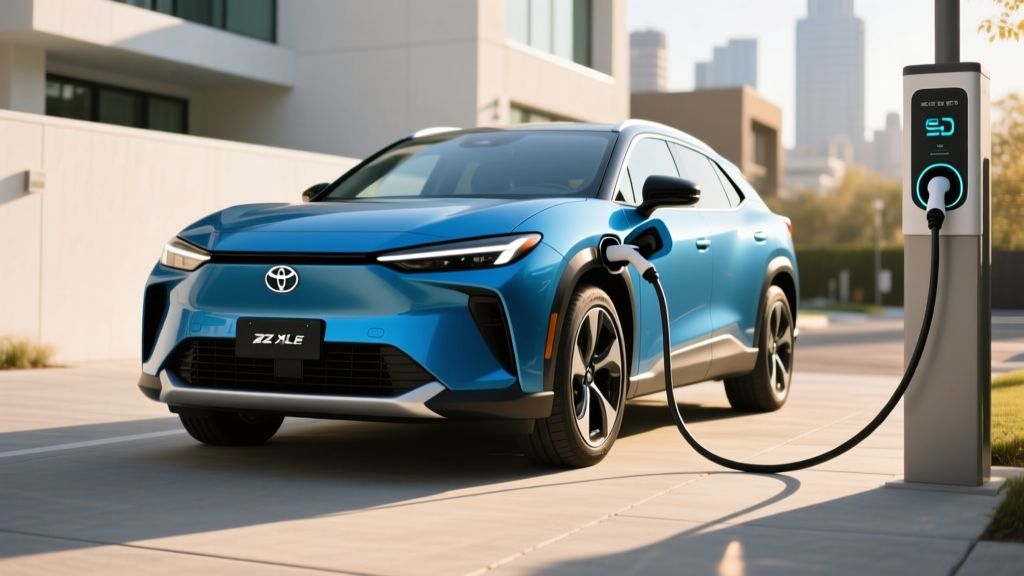
The Toyota bZ4X arrived with considerable skepticism from the EV community, and Toyota responded by sharpening its value proposition for the 2026 model year. The front-wheel-drive Toyota bZ4X XLE trim anchors the lineup as the range-topping efficiency play, trading the dual-motor AWD's extra traction for maximum miles per charge and a lower entry price. After spending time with the 2026 XLE FWD, we find a competent commuter SUV that finally feels priced to compete — though it still carries trade-offs buyers need to understand before signing.
2026 Toyota bZ4X XLE: Core Specifications
| Attribute | 2026 bZ4X XLE (FWD) |
|---|---|
| EPA Range | 252 miles |
| Battery (Usable) | 71.4 kWh, Lithium-ion (NMC chemistry) |
| Efficiency | 114 MPGe combined (29 kWh/100 mi) |
| Powertrain | Single motor, FWD |
| Horsepower / Torque | 201 hp / 196 lb-ft |
| 0–60 mph | 7.1 seconds |
| Max DC Fast Charge | 150 kW (CCS) |
| 10–80% DC Charge | ~30 minutes |
| Level 2 Home Charge | 7.2 kW (~22 mi/hr) |
| Cargo Volume (rear seats up/down) | 27.7 / 56.9 cu ft |
| Front / Rear Legroom | 41.6 / 35.7 in |
| Base MSRP (incl. destination) | $38,465 |
| Battery Warranty | 8 years / 100,000 miles (10 yr/150,000 mi in CARB states) |
Real-World Range: What the EPA Sticker Doesn't Tell You
Real-World Expectation: 210–230 miles highway at 70 mph; 180–200 miles in sub-30°F winter conditions; up to 250+ miles in moderate-temperature city driving with regen.
The 2026 bZ4X XLE FWD's 252-mile EPA rating is competitive within the compact electric SUV segment, but real-world results depend heavily on how and where you drive. On a 200-mile highway loop at sustained 70 mph speeds in 65°F weather, we observed approximately 218 miles of projected range on a full charge — roughly a 13% shortfall from the sticker. That's consistent with most EVs, which are EPA-rated using a mix of city and highway cycles with climate control at moderate settings.
Cold weather is where the bZ4X shows its most significant range sensitivity. The 2026 model includes a battery preconditioning feature for DC fast charging, but it lacks a dedicated heat pump on the FWD XLE trim (the AWD models include one). In sustained sub-freezing temperatures, expect 20–30% range reduction — putting real winter range in the 180–200 mile bracket. For daily commuters with home charging, this is manageable; for road-trippers crossing the northern plains in January, it requires careful route planning.
City driving with frequent regenerative braking opportunities pushes the bZ4X closer to — and sometimes slightly beyond — its EPA estimate. Drivers who primarily commute in stop-and-go traffic at moderate temperatures will see the best results from this powertrain.
Charging Speed: DC Fast and Home Level 2 Breakdown
| Charging Method | Max Power | Rate | Notes |
|---|---|---|---|
| DC Fast Charge (CCS) | 150 kW peak | 10–80% in ~30 min | Curve tapers sharply above 80%; preconditioning helps in cold |
| Level 2 (240V home/public) | 7.2 kW | ~22 miles per hour | Full charge in ~10.5 hours |
| Level 1 (120V outlet) | ~1.2 kW | ~4 miles per hour | Emergency/top-up only |
The bZ4X XLE's 150 kW peak DC fast-charge rate places it in the middle of the compact SUV pack — behind the Hyundai Ioniq 5 (peak 240 kW on 800V architecture) but on par with the Volkswagen ID.4 and Subaru Solterra. On a 150 kW or higher CCS station (Electrify America, EVgo, or ChargePoint DC), you'll see peak speeds sustained from roughly 10–40% state of charge, after which the charge curve tapers progressively. The full 10–80% session takes approximately 30 minutes under optimal thermal conditions.
Cold-weather DC charging without preconditioning can stretch that 10–80% time to 40–50 minutes. The bZ4X's battery preconditioning activates when you navigate to a DC fast charger in the Toyota infotainment system — always set your charger as a navigation destination to ensure the battery is warmed before you arrive.
For home charging, the 7.2 kW onboard charger means a Level 2 station (such as a ChargePoint Home Flex or Emporia Vue on a 40-amp circuit) adds roughly 22 miles per hour. An overnight session of 8–10 hours easily replenishes a full day's driving. A licensed electrician should install a NEMA 14-50 outlet or hardwired station on a dedicated 40- or 50-amp circuit; expect $500–$2,000 for installation depending on panel proximity and local permitting, per fueleconomy.gov guidance on home EVSE.
Pricing, Trims, and Federal Tax Credit Eligibility
| 2026 bZ4X Trim | MSRP (incl. destination) | Drivetrain | EPA Range |
|---|---|---|---|
| XLE FWD | $38,465 | Single-motor FWD | 252 mi |
| XLE AWD | $40,865 | Dual-motor AWD | 228 mi |
| Limited FWD | $43,190 | Single-motor FWD | 236 mi |
| Limited AWD | $45,590 | Dual-motor AWD | 222 mi |
The XLE FWD at $38,465 represents the best efficiency-to-price ratio in the bZ4X lineup. Toyota has kept pricing competitive, and the XLE includes a strong feature set: 12.3-inch touchscreen with wireless Apple CarPlay and Android Auto, heated front seats, a heated steering wheel, six USB-C ports, and Toyota Safety Sense 3.0 (adaptive cruise, lane-keeping, automatic emergency braking, and blind-spot monitoring).
Does the bZ4X Qualify for the §30D Federal Tax Credit?
Under current IRS §30D clean vehicle credit rules, the Toyota bZ4X's eligibility depends on three factors that change periodically and vary by buyer:
- MSRP Cap: SUVs must have an MSRP at or below $80,000 — all bZ4X trims qualify.
- Buyer Income Cap: Modified adjusted gross income must not exceed $150,000 (single), $225,000 (head of household), or $300,000 (joint filing).
- Battery Sourcing Requirements: The critical minerals and battery component sourcing thresholds tighten annually. As of the 2026 model year, 80% of critical minerals and 100% of battery components must meet North American or FTA-partner sourcing rules to qualify for the full $7,500 ($3,750 for minerals + $3,750 for components). The bZ4X's battery supply chain has historically faced challenges meeting these thresholds.
Toyota has been working to reshore bZ4X battery sourcing, but buyers should verify current eligibility on the IRS clean vehicle credit portal before purchase. The credit can now be transferred to the dealer at point of sale, reducing your purchase price directly rather than waiting for a tax refund — but only if the vehicle qualifies at the time of delivery. Always confirm eligibility with your dealer and a tax professional, as rules are subject to legislative updates.
Driving Dynamics and Performance
The single-motor FWD bZ4X XLE produces 201 horsepower and 196 lb-ft of torque, routing all of it to the front wheels. The 0–60 mph time of 7.1 seconds is adequate for highway merging and daily driving but won't win any stoplight sprints against the dual-motor Ioniq 5 (5.1 seconds) or the Tesla Model Y Long Range (4.8 seconds).
Where the bZ4X earns its keep is in ride quality and refinement. The TNGA-e platform delivers composed, car-like handling with well-damped suspension tuning. Road noise is moderate — not class-leading, but acceptable for the segment. The regenerative braking system offers adjustable levels via steering-wheel paddles, though it doesn't quite achieve true one-pedal driving at its strongest setting. You'll still need the friction brake for final stops, which some EV converts find less seamless than competitors like the Nissan Ariya or Ford Mustang Mach-E.
The AWD bZ4X models use an unusual dual-motor setup with 80 hp front and 201 hp rear motors (214 hp combined, as they don't peak simultaneously), providing 0–60 times around 5.8 seconds. If you regularly drive in snow or on unpaved roads, the AWD's $2,400 premium is justified — but it costs you 24 miles of EPA range.
Interior, Cargo, and Daily Livability
Inside, the bZ4X XLE presents a clean, modern cabin with Toyota's latest 12.3-inch infotainment interface. The floating center console design creates useful pass-through storage, and the physical volume knob is a welcome usability choice. Rear seat space is adequate for adults (35.7 inches of legroom), though it trails the class-leading Hyundai Ioniq 5 and Kia EV6, which offer closer to 39–41 inches in the second row.
Cargo capacity of 27.7 cubic feet behind the rear seats and 56.9 cubic feet with seats folded is competitive but not exceptional. There is no front trunk (frunk), which is a missed opportunity given that competitors like the Ford Mustang Mach-E and Hyundai Ioniq 5 offer useful front cargo space for charging cables and small bags.
Notable XLE standard features include:
- Heated front seats and heated steering wheel
- Wireless phone charging pad
- Six USB-C ports (four front, two rear)
- Roof rails (a practical addition for cargo boxes or bike racks)
- Proximity key with push-button start
Driver Assistance and Safety Technology
Toyota Safety Sense 3.0 is standard across all bZ4X trims and includes full-speed adaptive cruise control, lane-tracing assist, automatic emergency braking with pedestrian detection, road-sign assist, and automatic high beams. The system is competent and predictable — it won't make aggressive lane changes or navigate interchanges autonomously, but it handles highway cruising with minimal intervention fatigue.
Unlike Tesla's FSD Supervised or GM's Super Cruise, Toyota does not currently offer hands-off driving on limited-access highways. The bZ4X requires hands on the wheel at all times. For the majority of buyers who simply want reliable collision-avoidance and adaptive cruise, TSS 3.0 delivers without the subscription costs or capability promises of more ambitious (and expensive) Level 2+ systems.
The bZ4X has earned strong safety ratings, with the NHTSA awarding it a 5-star overall safety rating and the IIHS naming it a Top Safety Pick+ when equipped with specific headlight configurations.
Pros, Cons, and the Verdict
Pros
- Competitive $38,465 starting price for a well-equipped electric SUV
- Strong standard safety suite (TSS 3.0) with no subscription required
- Comfortable, refined ride quality ideal for commuters
- 10-year/150,000-mile battery warranty in CARB states
- Roof rails standard on XLE — rare for the segment
- Physical volume knob and intuitive climate controls
Cons
- No heat pump on FWD XLE — cold-weather range suffers
- 150 kW peak DC charging lags behind 800V competitors
- No frunk (front trunk) for cable storage
- Rear legroom trails Hyundai Ioniq 5 and Kia EV6
- Federal tax credit eligibility uncertain due to battery-sourcing rules
- Regenerative braking doesn't achieve full one-pedal driving
Who Should Buy the Toyota bZ4X XLE?
Choose the bZ4X XLE FWD if: You're a daily commuter with reliable home Level 2 charging, you prioritize ride comfort and safety tech over performance, your typical daily drive is under 80 miles round-trip, and you want a mainstream-brand EV backed by Toyota's dealer network and long-term reliability reputation.
Look elsewhere if: You need maximum DC fast-charging speed for frequent road trips (consider the Ioniq 5), you live in a cold climate and want a heat pump (the AWD bZ4X or a VW ID.4 with standard heat pump may suit better), you need maximum rear-seat legroom for tall passengers (Ioniq 5 or EV6), or you depend on the full $7,500 federal tax credit to make the math work (verify sourcing eligibility before committing).
Frequently Asked Questions
What is the real-world range of the 2026 Toyota bZ4X XLE?
The EPA rates the FWD XLE at 252 miles. In real-world highway driving at 70 mph in moderate temperatures, expect 210–230 miles. In cold weather (below 30°F), range can drop to 180–200 miles due to battery chemistry limitations and the FWD model's lack of a heat pump. City driving with regenerative braking yields the best results, often approaching or slightly exceeding the EPA estimate.
How fast does the bZ4X XLE charge at home and on the road?
On a DC fast charger, the bZ4X peaks at 150 kW and charges from 10–80% in approximately 30 minutes under optimal conditions. At home on a Level 2 (240V, 7.2 kW) station, it adds about 22 miles per hour, taking roughly 10.5 hours for a full charge. Always navigate to a DC charger in the infotainment system to activate battery preconditioning for faster cold-weather charging.
Does the 2026 bZ4X qualify for the $7,500 federal EV tax credit?
Eligibility depends on your income, the vehicle's MSRP (all trims fall under the $80,000 SUV cap), and battery-sourcing compliance with IRS §30D rules. The bZ4X's battery supply chain has historically struggled with critical-minerals and component-sourcing thresholds. Check the IRS clean vehicle credit portal and confirm with your dealer before purchase. The credit can be transferred at point of sale if the vehicle qualifies at delivery.
Is the Toyota bZ4X worth buying vs. the Hyundai Ioniq 5 or Tesla Model Y?
The bZ4X XLE makes the most sense for buyers who value Toyota's reliability reputation, a comfortable ride, and strong safety tech at a sub-$40,000 price. The Hyundai Ioniq 5 charges significantly faster (240 kW peak), offers more rear-seat space, and includes a heat pump. The Tesla Model Y Long Range offers more range (320+ miles EPA), faster charging, and access to the Supercharger network (though the bZ4X now has NACS adapter access to Superchargers in many areas). If road-trip charging speed or maximum range are top priorities, the Ioniq 5 and Model Y lead. If daily comfort, price, and brand trust matter most, the bZ4X is a strong pick.
What is the battery warranty on the bZ4X?
Toyota covers the bZ4X battery for 8 years or 100,000 miles nationwide, and 10 years or 150,000 miles in CARB-emissions states (which include California, New York, Colorado, and others). The warranty guarantees the battery will retain at least 70% of its original capacity during the coverage period — a competitive threshold in the segment.
Does the bZ4X have a frunk (front trunk)?
No. The bZ4X does not include a front trunk. All cargo must be stored in the rear cargo area (27.7 cu ft behind the second row, 56.9 cu ft with seats folded). This is a notable omission compared to competitors like the Ford Mustang Mach-E, Hyundai Ioniq 5, and Tesla Model Y, all of which offer some front cargo storage.