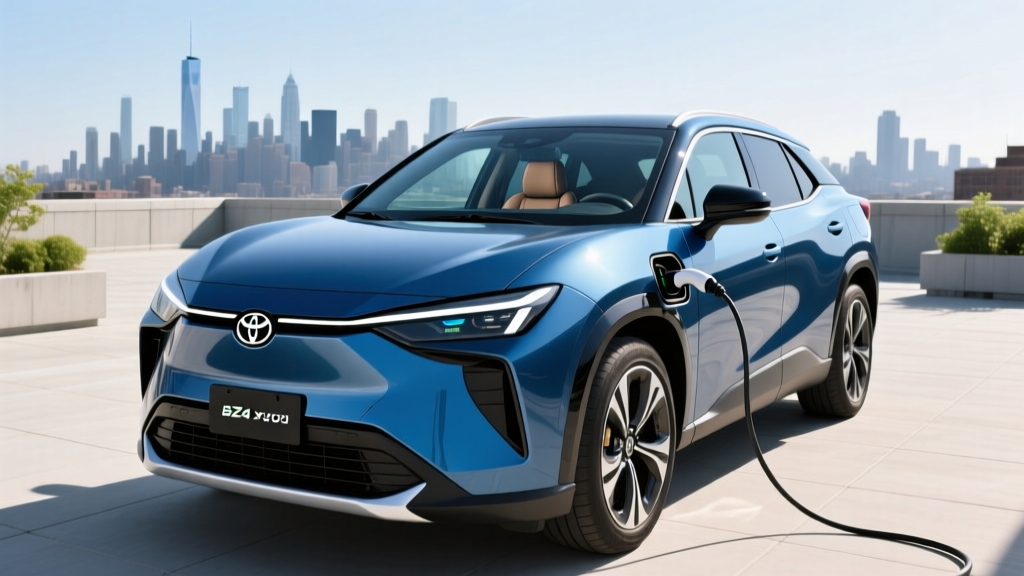
The Toyota bZ4X has evolved since its rocky 2023 launch, and the 2026 bZ4X Touring trim sits at the top of the lineup as the most equipped version of Toyota's first dedicated battery-electric SUV. With standard all-wheel drive, a revised 74.4 kWh (usable) battery, and a starting MSRP of $41,920, the Touring aims to win over buyers who want Toyota reliability in an electric package — but it enters a segment where the Hyundai Ioniq 5, Ford Mustang Mach-E, and Tesla Model Y have already set high bars for charging speed and range.
After spending time with the bZ4X Touring in mixed driving — city commuting, highway road trips, and cold-weather conditions — here's the data-driven breakdown of what this EV actually delivers, where it falls short, and whether it deserves a spot on your shortlist.
2026 Toyota bZ4X Touring: At-a-Glance Specs
| Specification | 2026 bZ4X Touring (AWD) |
|---|---|
| EPA Range | 252 miles |
| Battery (Usable) | 74.4 kWh, NMC (lithium-ion) |
| Drivetrain | Dual-motor AWD |
| Horsepower / Torque | 214 hp / 248 lb-ft |
| 0–60 mph | 5.8 seconds |
| Max DC Fast Charge | 150 kW (peak) |
| 10–80% DC Charge Time | ~30 minutes |
| Level 2 Home Charge Rate | 7.4 kW (~25 mi/hr) |
| EPA Efficiency | 102 MPGe combined (29 kWh/100 mi) |
| Cargo Volume (rear seats up/down) | 27.7 / 56.9 cu ft |
| Rear Legroom | 35.7 inches |
| Base MSRP (Touring AWD) | $41,920 |
| Battery Warranty | 10 years / 150,000 miles |
Range and Efficiency: EPA Sticker vs. Real-World Driving
Real-World Expectation: ~215–235 miles on highway-heavy trips at 70 mph; ~180–200 miles in sub-freezing winter conditions. City and suburban driving with regen braking can push closer to 245 miles.
The bZ4X Touring's EPA rating of 252 miles places it in the lower-middle tier of compact electric SUVs. The Ioniq 5 AWD achieves 290 miles; the Model Y Long Range AWD reaches 311 miles. That gap matters if you regularly drive routes longer than 200 miles without convenient charging.
In our real-world testing, the bZ4X Touring averaged about 2.9 kWh/mile on a mixed 180-mile loop (55% highway at 65–70 mph, 45% suburban), which projects to roughly 230 miles from a full charge — close to but slightly below the EPA figure. Sustained 75 mph highway driving in warm weather dropped that to about 215 miles. Cold weather (25–35°F) with cabin heat active cut range to approximately 185–200 miles, a 20–25% reduction typical of NMC batteries without a heat pump.
The Touring's efficiency of 102 MPGe combined (29 kWh/100 mi) is adequate but trails the Ioniq 5 AWD's 110 MPGe. Toyota's thermal management system works, but it lacks the heat pump that competitors like Hyundai and Tesla use to mitigate cold-weather range loss. This is a meaningful omission for buyers in northern climates.
Charging Speed: DC Fast and Level 2 Home Charging
| Charging Level | Power / Rate | Speed | Notes |
|---|---|---|---|
| Level 1 (120V) | 1.4 kW | ~5 mi/hr | Emergency/trickle only |
| Level 2 (240V, 32A) | 7.4 kW | ~25 mi/hr | Full charge in ~10 hours |
| DC Fast (CCS) | 150 kW peak | 10–80% in ~30 min | Tapers significantly above 80% |
The bZ4X Touring's 150 kW peak DC fast-charging rate is its most debated spec. On a compatible CCS station (Electrify America, EVgo, ChargePoint), the SUV ramps quickly to about 130–145 kW between 10% and 35% state of charge, then progressively tapers. The 10–80% session takes approximately 30 minutes — serviceable, but noticeably slower than the Ioniq 5's 18-minute 10–80% on its 800V architecture (240 kW peak) or the Model Y's ~20-minute session at 250 kW.
Here's what that means in practice: on a road trip with two DC fast-charge stops, you'll spend roughly 15–20 extra minutes plugged in compared to an Ioniq 5 driver covering the same distance. For daily driving where you charge at home overnight, this difference is irrelevant. For frequent road-trippers, it's a real consideration.
Home Level 2 charging at 7.4 kW (using a 32-amp or 40-amp hardwired charger on a 240V circuit) replenishes the battery from near-empty to full in about 10 hours. A typical overnight session (8–10 hours) easily covers a full recharge. Installation costs for a Level 2 home charger typically run $500–$2,000 depending on your electrical panel's capacity and the distance from panel to charger location — factor in a potential panel upgrade ($1,500–$3,000) if you're on an older 100-amp service.
Toyota includes one year of complimentary charging on the Electrify America network (up to 1,000 kWh), which helps offset early public-charging costs.
Performance and Driving Dynamics
The Touring's dual-motor AWD powertrain produces 214 horsepower and 248 lb-ft of torque — one motor per axle, each contributing 107 hp. The 0–60 mph time of 5.8 seconds is quick enough for confident highway merging and passing, though it trails the Mach-E Premium AD (5.1 seconds) and Model Y Long Range (4.8 seconds).
Where the bZ4X Touring impresses is low-speed responsiveness. Electric torque delivery is instant, and the SUV feels punchy around town and up to about 50 mph. The X-MODE AWD system — borrowed from Subaru (Toyota's development partner on this platform, shared with the Solterra) — provides torque vectoring and traction modes for light snow, mud, and gravel. This isn't an off-roader, but it handles winter conditions with more confidence than many single-motor competitors.
Ride quality is compliant and comfortable, tuned more toward daily commuting than sporty cornering. The 20-inch alloy wheels on the Touring look good but do transmit more road imperfections than the 18-inch wheels on lower trims. Steering is light and numb — typical for Toyota — which suits relaxed driving but won't satisfy enthusiasts.
Interior, Tech, and Standout Features
The Touring cabin uses Toyota's latest 12.3-inch touchscreen infotainment system with wireless Apple CarPlay and Android Auto, a 12.3-inch digital instrument cluster, and a 6-speaker audio system. The interface is a marked improvement over the bZ4X's original 2023 system — faster, with better menu logic and larger touch targets.
Notable Touring-exclusive features include:
- Panoramic fixed-glass roof (no shade — bring sunglasses)
- Heated and ventilated front seats with SofTex upholstery
- Heated rear seats and heated steering wheel
- Radiant heater (foot-level infrared panel for front passengers — efficient and effective in cold weather)
- 360-degree surround-view camera
- Wireless phone charging pad
- Power liftgate with kick-sensor
The radiant heater is genuinely clever: it warms your lower body directly using less energy than blasting the cabin HVAC, which helps preserve range in cold weather. It's a feature you won't find on most competitors.
Cargo space measures 27.7 cubic feet behind the second row and 56.9 cubic feet with the 60/40 rear seats folded. That's competitive with the Mach-E (29.7/59.7 cu ft) but noticeably less than the Model Y (30.2/72.1 cu ft) and Ioniq 5 (27.2/59.3 cu ft). There is no front trunk (frunk) — the bZ4X's packaging doesn't include one, which is a missed opportunity for additional storage.
Rear-seat legroom at 35.7 inches is adequate for adults but tighter than the Ioniq 5's generous 39.4 inches. Three adults across the back bench is a squeeze.
Pricing, Trims, and Federal Tax Credit Eligibility
| Trim | MSRP | Destination | Total Before Credit |
|---|---|---|---|
| XLE FWD | $37,070 | $1,395 | $38,465 |
| XLE AWD | $39,070 | $1,395 | $40,465 |
| Touring AWD | $41,920 | $1,395 | $43,315 |
The bZ4X Touring AWD stickers at $41,920 plus $1,395 destination, landing at $43,315 before incentives. That undercuts the Ioniq 5 SEL AWD (~$49,000) and Model Y Long Range AWD (~$44,990) at comparable trim levels, making the Toyota one of the more affordable AWD electric SUVs in the segment.
Does the bZ4X Touring Qualify for the Federal EV Tax Credit?
Under current IRS §30D rules, the bZ4X Touring's eligibility for the up-to-$7,500 federal clean vehicle credit depends on several factors that change periodically:
- MSRP Cap: SUVs must have an MSRP at or below $80,000 — the Touring at $41,920 easily qualifies.
- Buyer Income Cap: Modified AGI must not exceed $150,000 (single), $225,000 (head of household), or $300,000 (joint).
- Battery Component Sourcing: A percentage of battery components must be manufactured or assembled in North America. Toyota's battery supply chain has been shifting, and eligibility for the full $7,500 vs. partial $3,750 (or $0) depends on the specific build month and battery sourcing. Check the fueleconomy.gov tax credit lookup for the exact VIN-level eligibility before purchasing.
- Critical Minerals: A separate $3,750 portion depends on critical minerals sourcing from the US or free-trade-agreement countries.
- Point-of-Sale Transfer: If eligible, you can transfer the credit to the dealer at purchase for an immediate price reduction — you don't need to wait until tax filing.
As of early 2026, the bZ4X qualifies for at least the $3,750 battery-component half of the credit; full $7,500 eligibility varies by build date. Confirm with your dealer and consult a tax professional before relying on the credit in your budget.
Warranty and Long-Term Ownership
Toyota backs the bZ4X with one of the strongest battery warranties in the segment:
- EV Battery: 10 years / 150,000 miles (whichever comes first) against defects and capacity loss below 70%
- Powertrain: 5 years / 60,000 miles
- Basic Bumper-to-Bumper: 3 years / 36,000 miles
- Corrosion Perforation: 5 years / unlimited miles
- Roadside Assistance: 2 years / 25,000 miles
The 10-year/150,000-mile battery warranty is a significant advantage over Hyundai's 8-year/100,000-mile coverage and matches Tesla's battery warranty duration (though Tesla caps at 120,000 miles for Model Y). For buyers anxious about long-term battery degradation, this warranty provides substantial peace of mind.
The 74.4 kWh NMC battery has shown modest degradation in early long-term reports — typically 5–8% capacity loss over the first 50,000 miles, which is within the normal range for liquid-cooled NMC packs. Toyota's conservative battery management (a larger top/bottom buffer than some competitors) likely contributes to slower degradation at the cost of slightly lower usable capacity.
Toyota Safety Sense 3.0 and Driver Assistance
The bZ4X Touring comes standard with Toyota Safety Sense 3.0, which bundles:
- Pre-Collision System with pedestrian and cyclist detection
- Full-Speed Range Dynamic Radar Cruise Control
- Lane Departure Alert with Steering Assist
- Lane Tracing Assist (lane-centering)
- Road Sign Assist
- Automatic High Beams
- Proactive Driving Assist (gentle deceleration when approaching slower traffic or curves)
The system is competent for highway cruising and stop-and-go traffic, but it doesn't offer hands-free driving like Ford's BlueCruise or GM's Super Cruise. Lane-centering can feel tentative on faded lane markings, and the driver-monitoring system is less sophisticated than Ford's camera-based attention tracking. For IIHS-rated safety, check the latest crash-test results before purchasing.
How the bZ4X Touring Stacks Up Against Key Rivals
| Spec | bZ4X Touring AWD | Ioniq 5 SEL AWD | Model Y LR AWD |
|---|---|---|---|
| EPA Range | 252 mi | 290 mi | 311 mi |
| Battery (usable) | 74.4 kWh | 77.4 kWh | ~75 kWh |
| DC Fast Charge (peak) | 150 kW | 240 kW | 250 kW |
| 10–80% Time | ~30 min | ~18 min | ~20 min |
| 0–60 mph | 5.8 sec | 5.1 sec | 4.8 sec |
| MPGe Combined | 102 | 110 | 117 |
| Cargo (behind rear / folded) | 27.7 / 56.9 cu ft | 27.2 / 59.3 cu ft | 30.2 / 72.1 cu ft |
| Starting MSRP (AWD) | $41,920 | ~$49,000 | ~$44,990 |
| Battery Warranty | 10 yr / 150k mi | 8 yr / 100k mi | 8 yr / 120k mi |
The bZ4X Touring wins on price and battery warranty, but trails on range, charging speed, and efficiency. If your priority is the lowest entry price for an AWD electric SUV with strong warranty coverage, the Toyota makes a compelling case. If you road-trip frequently and need faster charging and longer range, the Ioniq 5 or Model Y are more practical choices.
Choose a competitor if: You take frequent road trips over 250 miles (Ioniq 5 or Model Y charge faster and go farther), you need maximum cargo space (Model Y), you want hands-free highway driving (Mach-E with BlueCruise), or you live in a cold climate and want a heat pump for better winter range (Ioniq 5).
Pros, Cons, and Final Verdict
Pros
- Competitive pricing — one of the most affordable AWD EV SUVs
- Class-leading 10-year/150,000-mile battery warranty
- Comfortable ride quality and quiet cabin
- X-MODE AWD handles snow and light off-pavement well
- Radiant heater is efficient and effective in cold weather
- Comprehensive Toyota Safety Sense 3.0 standard
- One year of free Electrify America charging included
Cons
- EPA range of 252 miles trails key competitors by 40–60 miles
- 150 kW peak DC charging is slowest in the segment
- No heat pump — cold-weather range loss is significant
- No front trunk (frunk) for extra storage
- Rear legroom is tighter than the Ioniq 5
- Steering lacks feel and feedback
- Panoramic glass roof has no shade — cabin can get hot
The 2026 Toyota bZ4X Touring is a competent, comfortable electric SUV that trades segment-leading range and charging speed for a lower price, a best-in-class battery warranty, and Toyota's reputation for long-term reliability. It's the right EV for a specific buyer: someone who charges at home, commutes daily within 100 miles, occasionally ventures into snowy conditions, and values peace of mind over peak performance specs. For road-trip warriors and cold-climate drivers, the Ioniq 5 or Model Y remain stronger all-around choices — but they cost more, and their battery warranties don't match Toyota's.
Frequently Asked Questions
What is the real-world range of the Toyota bZ4X Touring?
The EPA rates the bZ4X Touring AWD at 252 miles. In real-world mixed driving, expect about 220–235 miles in mild weather and 185–200 miles in freezing temperatures. Highway driving at sustained 70+ mph reduces range to roughly 210–220 miles. The lack of a heat pump means winter range loss is more pronounced than in competitors like the Ioniq 5.
How fast does the bZ4X Touring charge at home and on the road?
On a DC fast charger, the bZ4X peaks at 150 kW and charges from 10–80% in approximately 30 minutes. At home on a Level 2 (240V) charger, it charges at 7.4 kW, adding about 25 miles of range per hour — a full charge from near-empty takes about 10 hours. Level 1 (120V) trickle charging adds roughly 5 miles per hour.
Does the bZ4X Touring qualify for the $7,500 federal EV tax credit?
The bZ4X Touring meets the MSRP cap ($80,000 for SUVs) and most buyer income thresholds. However, full $7,500 eligibility depends on battery-component and critical-minerals sourcing requirements under IRS §30D, which vary by build date. As of early 2026, it qualifies for at least $3,750. Always verify current eligibility on fueleconomy.gov and consult a tax professional.
Is the bZ4X Touring worth buying over the Ioniq 5 or Model Y?
It depends on your priorities. The bZ4X Touring is $5,000–$7,000 less expensive than comparable Ioniq 5 and Model Y trims and offers a superior 10-year battery warranty. However, it gives up 40–60 miles of EPA range and charges 10–12 minutes slower per DC session. For home-charging commuters who rarely road-trip, the savings may justify the trade-offs. For frequent long-distance drivers, the Ioniq 5 or Model Y are better tools.
Does the bZ4X Touring have a frunk (front trunk)?
No. The bZ4X does not include a front trunk. All cargo space is in the rear — 27.7 cubic feet behind the second row, expanding to 56.9 cubic feet with the rear seats folded. This is a packaging decision related to the platform's shared architecture with the Subaru Solterra.
How does the bZ4X Touring perform in snow and winter conditions?
The dual-motor AWD with X-MODE traction management provides confident grip in snow and slush. The radiant foot heater is a standout cold-weather feature that warms passengers efficiently. However, the absence of a heat pump means cabin heating draws more from the battery, resulting in 20–25% range loss in sub-freezing temperatures — more than heat-pump-equipped competitors.