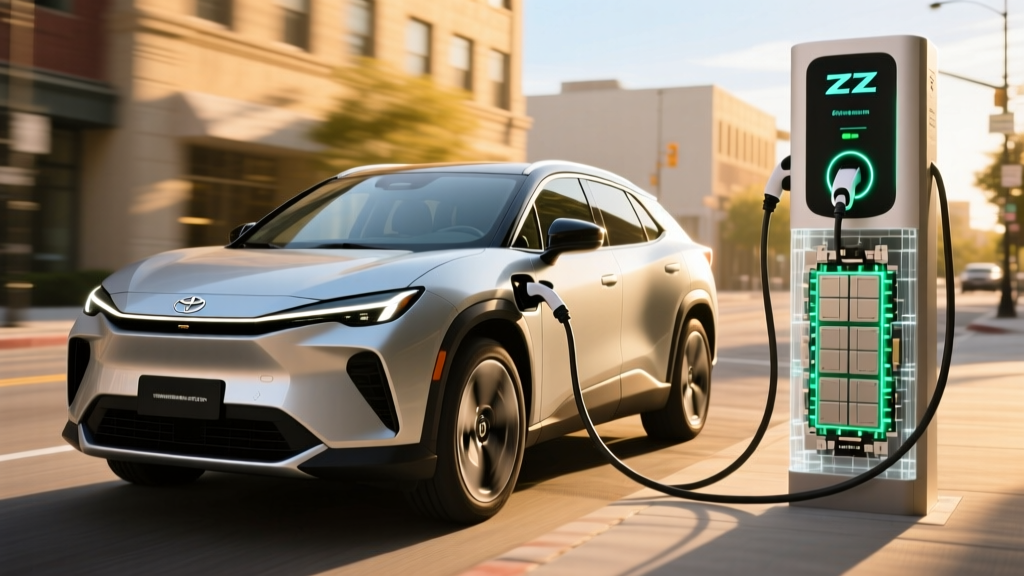
Toyota's first dedicated battery-electric vehicle has had a rocky road since its 2023 debut, but the 2026 bZ4X arrives with meaningful updates that address many early criticisms. If you've been searching whether the Toyota bZ4X is a good car, the honest answer depends heavily on your driving habits, charging access, and what you expect from a compact electric SUV. It's not the longest-range or fastest-charging EV in its class, but it offers Toyota's renowned reliability reputation, a comfortable ride, and a price point that — with the right incentives — undercuts key competitors.
After spending time with the 2026 model across city commutes, highway stretches, and DC fast-charging stops, here's the data-driven verdict every buyer needs before signing a lease or purchase agreement.
2026 Toyota bZ4X at a Glance: Key Specifications
| Specification | FWD | AWD |
|---|---|---|
| EPA Range | 252 miles | 228 miles |
| Battery (usable) | 71.4 kWh, NMC lithium-ion | |
| Max DC Fast Charge | 150 kW (FWD) / 150 kW (AWD) | |
| 10–80% DCFC Time | ~30 minutes | |
| Level 2 Home Charge Rate | 7.2 kW (~25 mi/hr) | |
| Horsepower | 201 hp | 214 hp |
| 0–60 mph | 7.1 sec | 6.5 sec |
| MPGe (combined) | 131 MPGe | 119 MPGe |
| Efficiency | 26 kWh/100 mi | 28 kWh/100 mi |
| Drivetrain | Single motor FWD | Dual motor AWD |
| Base MSRP (2026) | $37,070 (XLE FWD) | |
| Battery Warranty | 10 years / 100,000 miles | |
Real-World Range: What the EPA Sticker Doesn't Tell You
EPA Estimate: 252 miles (FWD XLE) / 228 miles (AWD)
Real-World Expectation: In mixed city/highway driving at 65–70°F, expect roughly 230–240 miles from the FWD model. Sustained highway speeds above 70 mph drop that to around 200–215 miles. In freezing temperatures (below 32°F), plan for 170–195 miles due to cabin heating demands and battery chemistry limitations — a roughly 20–25% reduction typical of NMC packs without a dedicated heat pump on lower trims.
The 71.4 kWh usable battery uses NMC (nickel manganese cobalt) chemistry, which offers strong energy density but is more temperature-sensitive than LFP alternatives found in some Tesla and BYD models. Toyota equips the bZ4X with a battery preconditioning function, but unlike Hyundai's Ioniq 5 or Tesla's Supercharger preconditioning, it's less aggressive — meaning your first DC fast-charge stop on a cold morning may start at lower kW rates until the pack warms up.
For daily commuting under 60 miles round-trip, the bZ4X's real-world range is more than adequate, and you'll rarely dip below 40% State of Charge (SoC). Road trippers covering 300+ mile legs will need to plan at least one charging stop, which brings us to the next critical question.
Charging Speed: DC Fast and Home Level 2
| Charging Level | Power | Speed / Time | Use Case |
|---|---|---|---|
| Level 1 (120V household) | ~1.4 kW | ~4–5 mi/hr | Overnight trickle; emergency top-ups |
| Level 2 (240V home/public) | 7.2 kW | ~25 mi/hr; 0–100% in ~10 hrs | Daily home charging; overnight full charge |
| DC Fast Charge | Peak 150 kW | 10–80% in ~30 min | Road trips; quick top-ups |
The bZ4X's 150 kW peak DC fast-charge rate is where it falls behind rivals. The Hyundai Ioniq 5 peaks at 240 kW on 800V architecture and hits 10–80% in roughly 18 minutes. The Tesla Model Y can sustain high charge rates on the Supercharger network, often completing 10–80% in 20–25 minutes.
Toyota's charge curve is relatively flat through the middle range — you'll see close to 150 kW from roughly 15–55% SoC, then a gradual taper to around 60–80 kW through 80%. Above 80%, charging slows significantly to protect the NMC cells, dropping below 30 kW. This is normal for the chemistry, but it means you won't want to linger past 80% on road trips. Plan your stops to arrive at roughly 10–15% and depart at 75–80% for the best time efficiency.
For home charging, the 7.2 kW onboard charger is standard and competitive. On a 32-amp Level 2 circuit (the most common home install), a full charge takes roughly 10 hours — perfect for overnight replenishment. If you're installing a home charger, budget $500–$1,200 for the equipment and $800–$2,500 for electrician labor, depending on whether your panel needs an upgrade. A licensed electrician should always handle the final installation and permitting.
Performance and Driving Dynamics
The FWD bZ4X delivers 201 horsepower from a single front-mounted motor, reaching 60 mph in 7.1 seconds — adequate for merging and passing but noticeably slower than the Tesla Model Y Long Range (5.0 seconds) or Ioniq 5 RWD (7.3 seconds, but with more cargo versatility). The AWD variant adds a rear motor for 214 combined horsepower and a 6.5-second 0–60 time, with the added benefit of genuine all-weather traction.
Where the bZ4X shines is ride comfort. Toyota tuned the suspension for compliance over sportiness, and the result is a quiet, composed SUV that absorbs potholes and highway expansion joints better than the firmer-riding Ioniq 5 or Volkswagen ID.4. Steering is light and predictable — this is not a driver's EV, but it's an excellent commuter and family hauler.
Regenerative braking offers multiple levels selectable via paddle shifters behind the steering wheel. The strongest setting provides near one-pedal driving in city traffic, though it doesn't quite bring the car to a complete stop without touching the brake pedal — unlike Nissan's e-Pedal or Tesla's Hold mode. Toyota calls this system "regenerative braking with boost" rather than true one-pedal, and some owners find the transition between regen and friction braking slightly abrupt at very low speeds.
Interior, Cargo Space, and Technology
The bZ4X cabin is a significant step up from Toyota's earlier EV efforts (the short-lived RAV4 EV). Materials are soft-touch on the upper dashboard and door panels, though some lower trim pieces feel hard and plasticky for a vehicle approaching $45,000 as-tested. The 12.3-inch touchscreen runs Toyota's latest multimedia system, which supports wireless Apple CarPlay and Android Auto, over-the-air updates, and a reasonably responsive native navigation system.
Passenger space is generous for the compact SUV class:
- Front legroom: 42.1 inches
- Rear legroom: 35.6 inches
- Cargo (behind rear seats): 27.7 cu ft
- Cargo (rear seats folded): 56.9 cu ft
Those cargo numbers trail the Ioniq 5 (27.2 / 59.3 cu ft — similar behind seats but more with seats flat) and the Model Y (30.2 / 72.1 cu ft), which remains the class benchmark for interior volume. The bZ4X does not offer a front trunk (frunk), which is a missed opportunity given the packaging advantages of a dedicated EV platform.
The Toyota Safety Sense 3.0 suite is standard across all trims and includes adaptive cruise control with stop-and-go, lane-keeping assist, automatic emergency braking with pedestrian detection, and road-sign assist. This is an SAE Level 2 driver-assistance system — meaning you must keep your hands on the wheel and eyes on the road at all times. It does not drive the car for you. Toyota also offers a Traffic Jam Assist feature on higher trims that permits brief hands-off operation at speeds under 25 mph, but this is still a supervised system requiring driver attention.
Pricing, Trims, and Federal Tax Credit Eligibility
| Trim | MSRP | Est. After §30D Credit* | Drivetrain |
|---|---|---|---|
| XLE FWD | $37,070 | $29,570 | Single motor FWD |
| XLE AWD | $39,120 | $31,620 | Dual motor AWD |
| Limited FWD | $42,570 | $35,070 | Single motor FWD |
| Limited AWD | $44,620 | $37,120 | Dual motor AWD |
*Federal tax credit amounts shown assume full $7,500 eligibility under IRS §30D. Actual eligibility depends on buyer income limits ($150K single / $300K joint MAGI), vehicle MSRP caps ($80,000 for SUVs — all bZ4X trims qualify), battery critical-mineral and component sourcing requirements, and point-of-sale transfer availability. Consult a tax professional before purchase.
For 2026, Toyota has kept bZ4X pricing competitive, and the vehicle remains under the $80,000 MSRP cap for SUVs. Battery sourcing compliance has been a moving target under evolving IRS guidance, so confirm with your dealer that the specific VIN you're purchasing qualifies for the full credit at the point of sale. Many buyers can apply the credit as an instant rebate at purchase rather than waiting for a tax filing — a significant cash-flow advantage.
Destination charges, dealer add-ons, and state/local fees can add $1,500–$3,000 to your out-of-pocket cost. Some states offer additional rebates (California's CVRP, Colorado's state credit, etc.) that can stack with the federal incentive — check your state's energy office for current programs.
Pros and Cons: The Honest Assessment
Pros
- Competitive pricing after federal tax credit — under $30K for FWD XLE
- Excellent ride comfort and quiet cabin for the class
- 10-year/100,000-mile battery warranty exceeds most rivals
- Toyota Safety Sense 3.0 standard on every trim
- AWD variant offers genuine all-weather capability
- Strong dealer network for service and support
Cons
- 150 kW DC fast-charge peak lags behind Ioniq 5 (240 kW) and Model Y
- Real-world highway range drops below 210 miles (FWD)
- No front trunk (frunk) — wasted packaging potential
- Cargo volume trails Tesla Model Y significantly
- Infotainment, while improved, isn't as intuitive as Tesla or Hyundai's
- Cold-weather range loss is pronounced without a standard heat pump on XLE
How It Stacks Up Against Key Competitors
The bZ4X competes in the most crowded EV segment: compact electric crossovers priced between $35K and $50K. Here's how it compares on the metrics that matter most to buyers:
| Metric | Toyota bZ4X FWD | Hyundai Ioniq 5 SE | Tesla Model Y LR | VW ID.4 Pro S |
|---|---|---|---|---|
| EPA Range | 252 mi | 303 mi | 320 mi | 291 mi |
| Peak DCFC | 150 kW | 240 kW | ~250 kW | 175 kW |
| 10–80% Time | ~30 min | ~18 min | ~22 min | ~28 min |
| Base MSRP | $37,070 | $42,600 | $44,990 | $43,995 |
| Cargo (rear up) | 27.7 cu ft | 27.2 cu ft | 30.2 cu ft | 30.3 cu ft |
| Battery Warranty | 10 yr/100K mi | 10 yr/100K mi | 8 yr/120K mi | 8 yr/100K mi |
The bZ4X wins on base price and battery warranty length but trails on range and charging speed. If your priority is the lowest entry cost and Toyota brand trust, it's a strong pick. If you take frequent road trips or need maximum range, the Ioniq 5 or Model Y serve better — though at higher prices before incentives.
Who Should Buy the Toyota bZ4X?
Choose the bZ4X if:
- Your daily commute is under 60 miles round-trip and you can charge at home overnight
- You value Toyota's reliability track record and extensive dealer network
- You want an AWD electric SUV under $32,000 (after federal credit)
- Road trips are occasional, not weekly — you can tolerate 30-minute charge stops
- Ride comfort matters more to you than sporty handling or maximum cargo space
Look elsewhere if:
- You regularly drive 250+ miles between charging stops (get a Model Y or Ioniq 5)
- You need maximum cargo volume for family gear (Model Y offers 72 cu ft)
- You live in extreme cold and need every mile of range (consider a heat-pump-equipped rival)
- Fastest possible DC charging is a priority (Ioniq 5's 800V system is meaningfully quicker)
Frequently Asked Questions
Is the Toyota bZ4X a good car for daily commuting?
Yes, for most commuters. With 230+ real-world miles in mixed driving and a comfortable, quiet ride, the bZ4X excels as a daily driver. If you charge at home on Level 2, you'll start every morning with a full battery and rarely think about range. The 25–28 kWh/100 mi efficiency translates to roughly $0.04–$0.06 per mile on average residential electricity rates — far cheaper than gasoline.
Does the Toyota bZ4X qualify for the $7,500 federal tax credit?
The bZ4X qualifies under IRS §30D rules, as its MSRP is well under the $80,000 SUV cap. However, your personal eligibility depends on income limits ($150,000 single / $300,000 joint modified AGI), battery critical-mineral and component sourcing compliance (which can change yearly), and whether you have sufficient tax liability or use the point-of-sale transfer option. Always verify the specific VIN's eligibility with your dealer and a tax professional before purchase.
How long does the bZ4X battery last?
Toyota warranties the bZ4X's battery pack for 10 years or 100,000 miles (whichever comes first), guaranteeing it will retain at least 70% of original capacity during that period. NMC chemistry in liquid-cooled packs like this typically degrades 1.5–2.5% per year under normal use, meaning you can expect roughly 85–90% capacity retention at the 5-year mark. Avoid routinely charging to 100% or draining below 10% to maximize longevity — keeping SoC between 20–80% for daily use is ideal.
How does the bZ4X perform in cold weather?
Expect a 20–25% range reduction in sustained freezing temperatures, bringing the FWD model to roughly 170–195 real-world miles. This is due to cabin heating demands and the NMC battery's reduced efficiency in cold conditions. The Limited trim includes a heat pump (standard on AWD models), which recovers some efficiency by scavenging ambient and powertrain heat rather than using resistive heating. Preconditioning the battery while still plugged in at home helps mitigate cold-weather charging slowdowns.
Can I tow with the Toyota bZ4X?
Toyota rates the bZ4X at a modest 1,500-pound towing capacity when properly equipped — enough for a small utility trailer or a pair of dirt bikes, but not suitable for boat trailers or campers. If you need serious towing, look at the Ford F-150 Lightning (7,700 lb), Rivian R1S (7,700 lb), or even the Hyundai Ioniq 5 (up to 2,300 lb on some trims).
Is the bZ4X better than the Subaru Solterra?
The bZ4X and Subaru Solterra are mechanically identical — co-developed on the same e-TNGA platform with the same battery and motors. The Solterra adds standard AWD and slightly more ground clearance (8.3 vs 8.1 inches) for light off-road use, while the bZ4X offers a FWD option for better range and a lower starting price. Choose based on brand preference, dealer proximity, and whether you need FWD efficiency or standard AWD.
Final Verdict
Is the Toyota bZ4X a good car? For the right buyer — a home-charging commuter who values comfort, Toyota reliability, and aggressive post-credit pricing — it's a genuinely compelling choice. It's not the EV that wins spec-sheet battles against the Ioniq 5 or Model Y on range and charging speed, but it doesn't need to. At under $30,000 after the federal credit, with a 10-year battery warranty and a ride quality that outclasses its peers, the bZ4X makes electric ownership accessible and stress-free for the majority of drivers who don't need 300+ miles of range.
If road trips, maximum cargo, or the fastest possible charging are non-negotiable, spend the extra $5,000–$8,000 on an Ioniq 5 or Model Y. But if you want a comfortable, well-built electric SUV for daily life at a price that makes financial sense today, the 2026 bZ4X earns its place on your shortlist.