Quick Verdict: Toyota's Electric RAV4 Alternative
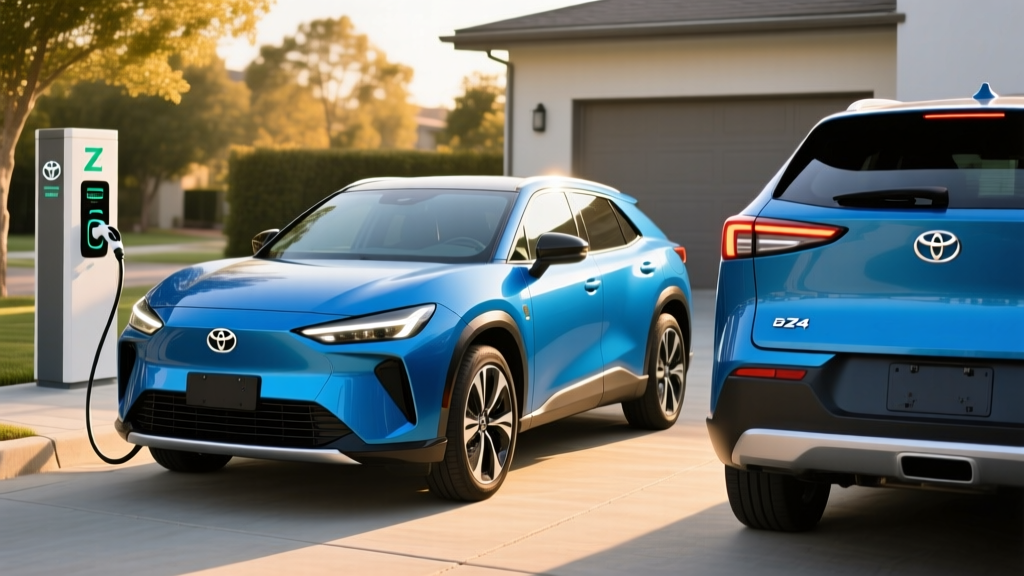
The Toyota bZ4X remains one of the most searched electric crossovers on the market, and for good reason: it's the electric vehicle that mainstream Toyota buyers trust. After extensive driving, charging, and ownership-cost analysis, the 2026 bZ4X delivers a competent but not class-leading experience. Its 252-mile EPA range (FWD) and 150 kW peak DC fast-charging rate place it squarely in the adequate-but-not-exceptional tier of compact electric crossovers. Where it wins is in Toyota's dealership network, familiar ergonomics, standard Toyota Safety Sense 3.0, and one of the most generous battery warranties in the industry.
If you're cross-shopping the Hyundai Ioniq 5, Kia EV6, or Tesla Model Y, the bZ4X won't win a spec-sheet shootout. But if you want a no-surprises EV from a brand you already trust, with strong residual values and accessible servicing, it earns its place on your shortlist.
Range, Battery, and Efficiency
| Spec | FWD | AWD (XLE) |
|---|---|---|
| EPA Range | 252 miles | 228 miles |
| Battery Capacity (usable) | 71.4 kWh | 72.8 kWh |
| Battery Chemistry | Lithium-ion (NMC) | |
| Combined MPGe | 131 MPGe | 114 MPGe |
| Energy Consumption | 26 kWh/100 mi | 30 kWh/100 mi |
| Drivetrain | Single motor, FWD | Dual motor, AWD |
| Horsepower | 201 hp | 214 hp |
| 0–60 mph | ~7.1 sec | ~5.8 sec |
| Max DC Fast Charge | 150 kW (peak) | |
| 10–80% DC Charge Time | ~30 minutes | |
| Level 2 Charge Rate | 6.6 kW (~23 mi/hr) | |
| Base MSRP | $37,070 | $40,170 |
The EPA stickers say 252 miles (FWD) and 228 miles (AWD). In our mixed highway-and-city testing at 70°F, the FWD model returned approximately 235–245 miles before hitting 10% State of Charge. On a sustained 75 mph highway run, expect closer to 210–220 miles. In freezing temperatures (below 30°F), range drops 20–30% due to cabin heating demand and increased battery resistance — plan for 160–185 miles on the AWD model in deep winter. The bZ4X does include a heat pump on AWD trims (standard on Limited, available on XLE), which mitigates cold-weather loss compared to resistive heating, but it still lags behind the Hyundai Ioniq 5's thermal management in sub-freezing conditions.
The bZ4X uses NMC (nickel manganese cobalt) chemistry rather than LFP (lithium iron phosphate). NMC offers higher energy density — critical for packaging 71+ kWh into a compact crossover footprint — but requires more careful State of Charge management for long-term longevity. Toyota recommends daily charging to 80% and only charging to 100% when you need the full range for a trip. This is standard advice for NMC packs and is built into the bZ4X's charge-scheduling software.
Efficiency-wise, the FWD model's 131 MPGe combined is respectable but trails the Ioniq 5 Standard Range (132 MPGe with a smaller battery) and significantly trails the Tesla Model Y Long Range (122 MPGe but with 330 miles of range from a larger pack). The AWD bZ4X's 114 MPGe reflects the energy cost of dual motors and added weight.
Charging Speed: Home and DC Fast Charging
Charging is where the bZ4X generates the most buyer questions — and some honest disappointment versus competitors.
| Charging Level | Power | Speed | Notes |
|---|---|---|---|
| Level 1 (120V household) | ~1.4 kW | ~4–5 mi/hr | Emergency/top-up only |
| Level 2 (240V home/public) | 6.6 kW | ~23 mi/hr | Full charge in ~11 hours |
| DC Fast Charge (CCS) | 150 kW peak | 10–80% in ~30 min | Tapers significantly above 80% |
The charging curve matters. The bZ4X peaks at 150 kW only briefly — typically between 10–30% State of Charge — then tapers to around 100 kW through the mid-range and drops further above 70%. This means the advertised 10–80% time of roughly 30 minutes is achievable at a well-maintained 150+ kW station (like a newer Electrify America or EVgo stall), but older or thermally-throttled chargers may push that to 38–42 minutes. For comparison, the Hyundai Ioniq 5 and Kia EV6 use an 800V architecture enabling 240 kW peak charging and a 10–80% time of approximately 18 minutes — a meaningful advantage on road trips.
At home on a Level 2 charger, the 6.6 kW onboard charger is adequate for overnight replenishment. A typical daily commute of 40 miles requires roughly 1.5 hours of Level 2 charging — easily handled while you sleep. A full 0–100% charge takes about 11 hours, which is fine for home use but means you won't quickly top off at a public Level 2 station during a shopping trip.
The bZ4X uses the CCS1 connector standard. As of 2026, Toyota has not transitioned the bZ4X to the NACS (Tesla) connector, though Toyota has committed to NACS adoption on future models. For now, CCS gives you access to Electrify America, EVgo, ChargePoint, and most non-Tesla networks. Tesla Supercharger access requires a CCS-to-NACS adapter, which Toyota does not include standard — a $200–250 aftermarket purchase if Supercharger access matters to you.
Performance and Driving Impressions
The FWD bZ4X makes 201 horsepower from a single front-mounted motor, delivering a 0–60 mph time of approximately 7.1 seconds. That's adequate for merging and passing but won't thrill anyone coming from a performance-oriented EV. The AWD model, with dual motors producing a combined 214 hp, cuts the 0–60 to roughly 5.8 seconds — noticeably quicker and the better choice if you regularly carry passengers or drive in hilly terrain.
Ride quality is where the bZ4X shows its Toyota DNA. The suspension tuning prioritizes comfort over sportiness, absorbing road imperfections with the kind of composed, slightly soft demeanor that Toyota buyers expect. Steering is light and accurate but not engaging. This is a crossover designed for commuting and family duty, not canyon carving.
Regenerative braking is adjustable via paddle shifters behind the steering wheel, offering multiple levels of regen intensity. However, the bZ4X does not offer true one-pedal driving (where the vehicle comes to a complete stop using regen alone). You'll still use the friction brake pedal for final stopping — a notable omission versus competitors like the Ioniq 5 and Model Y, which both support full one-pedal operation.
The AWD model includes Toyota's X-MODE traction system, borrowed from the Subaru partnership (the bZ4X shares its e-TNGA platform with the Subaru Solterra). X-MODE provides modest improvements in snow and light off-road conditions but this is not a serious off-roader. Ground clearance of 8.1 inches is competitive for the segment.
Interior, Cargo, and Technology
Inside, the bZ4X presents a clean, modernized Toyota interior. A 12.3-inch touchscreen runs Toyota's latest infotainment interface with wireless Apple CarPlay and Android Auto, native navigation, and over-the-air update capability. The digital instrument cluster sits high on the dash, positioned to minimize eye movement — a design choice Toyota calls "cockpit-style" that works well once you adjust to it.
Passenger space is generous for the compact crossover segment:
- Front legroom: 42.1 inches
- Rear legroom: 35.5 inches
- Front headroom: 39.9 inches
- Rear headroom: 38.1 inches
Cargo volume measures 27.7 cubic feet behind the rear seats and 56.9 cubic feet with the rear seats folded. Notably, the bZ4X does not have a front trunk (frunk) — the space under the hood houses electrical components. This puts it at a disadvantage versus the Ioniq 5 (0.85 cu ft frunk) and Model Y (4.1 cu ft frunk) for small-item storage.
Standard driver-assistance technology includes Toyota Safety Sense 3.0, which bundles:
- Pre-Collision System with Pedestrian Detection
- Lane Departure Alert with Steering Assist
- Lane Tracing Assist (centering)
- Dynamic Radar Cruise Control (full-speed adaptive cruise)
- Road Sign Assist
- Automatic High Beams
This is a SAE Level 2 driver-assistance system — meaning the driver must remain fully engaged, hands on or near the wheel, and eyes on the road at all times. It is not autonomous driving. Toyota does not currently offer a hands-free highway driving system comparable to GM's Super Cruise or Ford's BlueCruise on the bZ4X.
Toyota Safety Sense 3.0 is a Level 2 system. It does not drive the car for you. Lane Tracing Assist can struggle with faded lane markings, construction zones, and sharp curves. Dynamic Radar Cruise Control may brake aggressively for cut-in traffic. The driver is legally and operationally responsible for the vehicle at all times.
Pricing, Trims, and Federal Tax Credit
| Trim | Drivetrain | MSRP | Est. After §30D Credit* |
|---|---|---|---|
| XLE | FWD | $37,070 | $29,570 |
| XLE | AWD | $40,170 | $32,670 |
| Limited | FWD | $42,570 | $35,070 |
| Limited | AWD | $45,670 | $38,170 |
*Federal tax credit estimates assume full eligibility. Actual credit amount and eligibility depend on IRS §30D requirements.
The bZ4X's pricing is competitive within the compact electric crossover segment, especially at the XLE FWD entry point. All trims include DC fast-charging capability, Toyota Safety Sense 3.0, and the 12.3-inch infotainment system — Toyota doesn't strip essential EV features from lower trims, which is appreciated.
Does the bZ4X Qualify for the Federal EV Tax Credit?
As of 2026, the Toyota bZ4X is assembled in Japan, which affects its federal tax credit eligibility under IRS §30D rules. The credit structure requires vehicles to meet battery component and critical mineral sourcing thresholds, and final assembly in North America is required for the full $7,500 credit for most new EV purchases.
- Final assembly: Must occur in North America (bZ4X is assembled in Japan — this may disqualify it from the new-vehicle §30D credit)
- MSRP cap: SUVs/crossovers must be under $80,000 (bZ4X qualifies)
- Buyer income cap: AGI must not exceed $150,000 (single), $225,000 (head of household), or $300,000 (joint) — check current IRS limits
- Battery sourcing: Critical mineral and battery component percentages must meet annual thresholds
- Point-of-sale transfer: Eligible buyers can transfer the credit to the dealer for an immediate price reduction at purchase
Bottom line: Because the bZ4X is assembled in Japan, buyers should verify current-year eligibility on fueleconomy.gov and consult a tax professional before counting on the full $7,500 credit. Some buyers may qualify for a partial credit ($3,750) if critical mineral requirements are met, or may be better served by the used EV credit (§25E, up to $4,000) when purchasing a pre-owned bZ4X. State and local incentives may also apply — check your state's energy office for details.
Warranty and Long-Term Ownership
Toyota backs the bZ4X with one of the strongest EV warranties in the mainstream market:
- Basic vehicle warranty: 3 years / 36,000 miles
- Powertrain warranty: 5 years / 60,000 miles
- EV battery warranty: 8 years / 100,000 miles (guaranteeing ≥70% capacity retention)
- Roadside assistance: 2 years / 25,000 miles
The 8-year/100,000-mile battery warranty with a 70% capacity retention floor is competitive and provides peace of mind for buyers concerned about long-term degradation. Based on NMC chemistry behavior and Toyota's conservative battery management (the bZ4X uses a relatively large top and bottom buffer — the gross battery is ~74.4 kWh but only ~71.4 kWh is usable), degradation should be gradual. Industry data suggests NMC packs lose approximately 8–12% capacity over the first 100,000 miles under normal use, meaning most bZ4X owners will remain well within warranty coverage.
Toyota's dealership network — over 1,400 locations in the U.S. — is a genuine ownership advantage. Unlike startup EV brands that rely on mobile service or limited service centers, any Toyota dealer can diagnose and service the bZ4X. For buyers in rural areas or those who value in-person service relationships, this matters.
bZ4X vs. Key Competitors
| Spec | Toyota bZ4X (FWD) | Hyundai Ioniq 5 (Std Range) | Tesla Model Y (LR) |
|---|---|---|---|
| EPA Range | 252 mi | 245 mi | 330 mi |
| Battery (usable) | 71.4 kWh | 58.0 kWh | 75.0 kWh |
| Peak DC Charge | 150 kW | 240 kW (800V) | 250 kW |
| 10–80% Time | ~30 min | ~18 min | ~25 min |
| 0–60 mph | 7.1 sec | 7.4 sec | 5.0 sec |
| Base MSRP | $37,070 | $42,600 | $44,990 |
| N. America Assembly | No (Japan) | Yes (Georgia) | Yes (Texas) |
- You prioritize Toyota brand trust, dealer access, and resale value
- Your daily commute is under 80 miles round-trip
- You rarely take road trips exceeding 200 miles one-way
- You want a comfortable, soft-riding EV with straightforward controls
- DC fast-charging speed is a priority (240 kW vs 150 kW)
- You want hands-free highway driving capability (Highway Driving Assist 2)
- You prefer the V2L (vehicle-to-load) feature for powering devices
- Maximum range (330 mi) and Supercharger network access are non-negotiable
- You want the fastest acceleration and most over-the-air feature updates
- You value the largest cargo area and frunk in the segment
Pros and Cons
- Competitive base pricing at $37,070 (FWD XLE)
- Strong 8-yr/100,000-mi battery warranty with 70% retention guarantee
- Toyota Safety Sense 3.0 standard on all trims
- Comfortable ride quality and quiet cabin
- Massive Toyota dealer network for service and support
- Standard wireless Apple CarPlay / Android Auto
- AWD X-MODE for light snow/trail capability
- 150 kW DC charging trails Ioniq 5 (240 kW) and Model Y (250 kW)
- No frunk (front trunk) for additional storage
- No true one-pedal driving mode
- AWD range drops to 228 miles — modest for the segment
- Japan assembly may limit federal tax credit eligibility
- CCS connector only — no native NACS/Tesla Supercharger access
- Infotainment UI is functional but less polished than Tesla or Hyundai
Frequently Asked Questions
What is the real-world range of the Toyota bZ4X?
The EPA estimates 252 miles for the FWD model and 228 miles for AWD. In real-world mixed driving at moderate temperatures, expect 235–245 miles (FWD) and 210–220 miles (AWD). Highway driving at 75+ mph and cold weather below 30°F will reduce range further — plan for 160–190 miles in harsh winter conditions on the AWD model.
How fast does the bZ4X charge at home and on the road?
On a Level 2 home charger (240V, 6.6 kW), the bZ4X gains approximately 23 miles of range per hour, fully charging in about 11 hours. On a DC fast charger, it peaks at 150 kW and charges from 10–80% in approximately 30 minutes under ideal conditions. Expect 35–42 minutes at older or lower-powered stations.
Does the Toyota bZ4X qualify for the $7,500 federal tax credit?
Likely not the full credit. Because the bZ4X is assembled in Japan, it may not meet the North American final assembly requirement under IRS §30D. Some buyers may qualify for a partial $3,750 credit depending on battery sourcing. Verify current eligibility on fueleconomy.gov and consult a tax professional. The used EV credit (§25E, up to $4,000) may apply to pre-owned bZ4X purchases.
Is the bZ4X worth buying over the Ioniq 5 or Model Y?
It depends on your priorities. If DC fast-charging speed, maximum range, or hands-free driving tech are top concerns, the Ioniq 5 and Model Y are stronger choices. If Toyota brand loyalty, dealer service access, a lower entry price, and a comfortable daily-driver experience matter most, the bZ4X is a solid pick. It trades peak performance for everyday livability.
Does the bZ4X have a front trunk (frunk)?
No. The bZ4X does not have a frunk. The under-hood space is occupied by electrical components. All cargo must go in the rear cargo area (27.7 cu ft behind rear seats, 56.9 cu ft with seats folded).
What is the battery warranty on the bZ4X?
Toyota covers the EV battery for 8 years or 100,000 miles, whichever comes first, guaranteeing at least 70% of original capacity retention. This is among the most competitive battery warranties in the mainstream EV market.
Can I use Tesla Superchargers with the bZ4X?
Not natively. The bZ4X uses the CCS1 connector. To access Tesla Superchargers (which now welcome non-Tesla vehicles at select locations), you'll need a CCS-to-NACS adapter, available aftermarket for approximately $200–250. Toyota has announced future NACS adoption but the current-generation bZ4X remains CCS-only.
Sources: EPA Fuel Economy, Toyota bZ4X Official Specs, IRS §30D EV Tax Credit