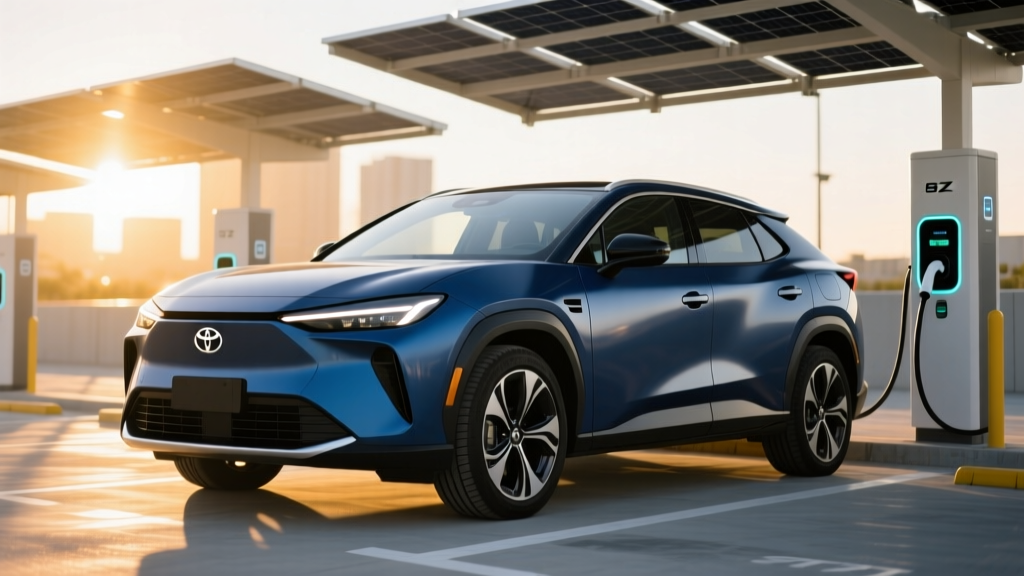
Toyota's bZ4X has been a polarizing entry in the electric compact-SUV segment since its debut. For 2026, the question most buyers ask isn't just about range or tech — it's about value. With shifting federal incentive rules under IRS §30D, changing battery-sourcing requirements, and aggressive competition from the Hyundai Ioniq 5, Kia EV6, and Tesla Model Y, understanding the Toyota bZ4X incentives landscape is critical before signing a purchase agreement.
This review covers the 2026 bZ4X end-to-end: real-world range versus the EPA sticker, DC fast-charging reality (including the taper above 80% SoC), total cost after federal and state incentives, and whether this is the right EV for your garage. We've driven it, charged it, and run the numbers.
2026 Toyota bZ4X at a Glance: Core Specs
| Spec | FWD | AWD |
|---|---|---|
| EPA Range | 252 mi | 228 mi |
| Battery (usable) | 71.4 kWh, NMC | 71.4 kWh, NMC |
| Horsepower | 201 hp | 214 hp |
| 0–60 mph | 7.1 sec | 6.5 sec |
| Max DC Fast Charge | 150 kW | 150 kW |
| 10–80% DC Time | ~30 min | ~30 min |
| Level 2 Charge Rate | 7.2 kW | 7.2 kW |
| MPGe (combined) | 119 MPGe | 104 MPGe |
| Efficiency | 28 kWh/100 mi | 32 kWh/100 mi |
| Base MSRP | $37,070 | $40,380 |
Real-World Range: What the EPA Sticker Doesn't Tell You
EPA Estimate: 252 miles (FWD) / 228 miles (AWD)
Real-World Expectation: ~210–230 miles mixed highway driving (FWD); ~185–210 miles (AWD). In cold weather (below 32°F), expect an additional 15–25% reduction, putting winter FWD range closer to 170–195 miles.
The bZ4X uses a 71.4 kWh usable NMC (nickel-manganese-cobalt) battery pack supplied by Panasonic. NMC offers higher energy density than LFP chemistry, which helps keep the pack compact, but it doesn't tolerate sustained 100% SoC storage as well — Toyota recommends daily charging to 80% for longevity.
On a 70-mph highway loop in moderate temperatures, the FWD bZ4X typically delivers 3.3–3.6 miles per kWh, translating to roughly 230 miles before you'll want to find a charger. The AWD model, with its second 80 kW rear motor, sacrifices about 20–30 miles of real-world range for the traction benefit. If your commute is mostly stop-and-go city driving where regenerative braking recovers energy, you'll trend closer to the EPA figure. Sustained highway speeds above 75 mph and cold weather are where the gap widens.
Charging Speeds: DC Fast Charging and Home Level 2
| Charging Level | Power / Rate | Miles Added per Hour | Notes |
|---|---|---|---|
| Level 1 (120V) | ~1.4 kW | ~5 mi/hr | Emergency/trickle only |
| Level 2 (240V, 32A) | 7.2 kW | ~26 mi/hr | Full charge in ~10 hours |
| DC Fast (CCS or NACS*) | Peak 150 kW | — | 10–80% in ~30 min |
*For 2026, Toyota has begun transitioning to the NACS (Tesla-style) charge port on new production. Early 2026 bZ4X units may still carry CCS1; confirm with your dealer. NACS-equipped bZ4X models gain native access to Tesla Supercharger V3/V4 stalls, significantly expanding the fast-charging network.
The bZ4X peaks at 150 kW on DC fast charging, but — and this is the critical detail most spec sheets gloss over — it doesn't hold that peak for long. The charge curve tapers noticeably after 50% SoC, and by 80% you're pulling closer to 40–50 kW. The 10–80% time of roughly 30 minutes is competitive but not class-leading; the Hyundai Ioniq 5's 800V architecture can do 10–80% in about 18 minutes at a 350 kW charger.
At home on a Level 2 wall connector (7.2 kW), a full charge from empty takes approximately 10 hours. That's overnight-friendly for most owners. If your electrical panel supports a 48A circuit, note that the bZ4X's onboard charger caps at 7.2 kW (32A), so investing in a higher-amperage charger won't speed things up.
Pricing, Trims, and 2026 Toyota bZ4X Incentives
Toyota offers the 2026 bZ4X in two main trims: the base XLE and the more feature-rich Limited. Both are available in FWD and AWD.
| Trim | Drivetrain | MSRP (incl. destination) | Est. After §30D Credit |
|---|---|---|---|
| XLE | FWD | $37,070 | ~$29,570* |
| XLE | AWD | $40,380 | ~$32,880* |
| Limited | FWD | $43,190 | ~$35,690* |
| Limited | AWD | $46,500 | ~$39,000* |
*After-credit pricing assumes full $7,500 federal §30D credit eligibility and point-of-sale transfer. Actual eligibility depends on buyer income, battery sourcing, and MSRP cap compliance. Confirm with your tax professional and reference IRS §30D guidelines.
Federal Tax Credit Eligibility (§30D) for the bZ4X
The bZ4X is an SUV for §30D purposes, meaning the MSRP cap is $80,000 — all trims clear this easily. However, qualifying for the full $7,500 credit requires meeting two separate $3,750 components:
- Critical Minerals Requirement ($3,750): A percentage of the battery's critical minerals must be sourced from the US or a free-trade-agreement country. Toyota has worked to secure compliant supply chains for the 2026 model year, but final determination varies by production batch.
- Battery Components Requirement ($3,750): Battery components must be manufactured or assembled in North America. Additionally, any vehicle with battery components from a "foreign entity of concern" (FEOC) is disqualified entirely.
- Buyer Income Caps: Modified AGI must not exceed $150,000 (single), $225,000 (head of household), or $300,000 (joint).
As of early 2026, the bZ4X has qualified for at least a partial credit ($3,750) for most buyers, with full $7,500 eligibility on select production runs. Toyota dealers should be able to pull the specific VIN's credit status through the IRS energy credit portal. Always verify before purchase — battery sourcing rules tighten annually.
For state-level incentives (California's CVRP, Colorado's innovative motor vehicle credit, etc.), check your local energy office. These stack on top of the federal credit in many cases and can bring an XLE FWD into the mid-$20,000s.
Performance and Driving Impressions
The FWD bZ4X sends 201 hp and 196 lb-ft of torque to the front wheels via a single motor. The 0–60 mph time of 7.1 seconds is adequate for merging and passing but won't win any stoplight sprints. The AWD model adds a rear motor for 214 hp combined and 248 lb-ft, dropping the 0–60 to 6.5 seconds.
Ride quality is a strong point. The TNGA-C platform delivers composed, slightly firm suspension tuning that absorbs highway imperfections well. Steering is light and precise — this is a comfortable commuter, not a sporty handler. Toyota's X-MODE with Grip Control on AWD trims provides genuine light-off-road capability for snow and gravel, a practical advantage over many EV crossovers.
Regenerative braking is adjustable via paddle shifters behind the wheel, offering four levels of regen intensity. It doesn't quite achieve true one-pedal driving at the lowest speeds (the car creeps rather than holding fully), but level 3 or 4 provides strong deceleration for most daily driving.
Interior, Tech, and Cargo
The bZ4X cabin seats five with generous front-row space: 41.2 inches of front legroom and 38.0 inches in the rear. Cargo volume is 27.7 cubic feet behind the second row and 56.9 cubic feet with the rear seats folded — competitive with the segment, though the Hyundai Ioniq 5 offers slightly more at 27.2/59.3 cu ft.
There is no frunk (front trunk). Toyota uses that space for power electronics and HVAC components. If front cargo storage is a priority, the Ioniq 5 and Tesla Model Y both offer front trunks.
The 12.3-inch touchscreen (standard on all 2026 trims) runs Toyota's latest infotainment interface with wireless Apple CarPlay and Android Auto, native navigation with EV route planning, and cloud-connected voice assistant. The system is responsive, though the menu structure takes some learning. Physical climate controls are minimal — most HVAC adjustments go through the touchscreen, which some drivers find distracting.
Toyota Safety Sense 3.0 is standard and includes:
- Pre-Collision System with Pedestrian Detection
- Full-Speed Range Dynamic Radar Cruise Control
- Lane Departure Alert with Steering Assist
- Lane Tracing Assist (Level 2 lane centering)
- Road Sign Assist
- Proactive Driving Assist (low-speed gentle braking/steering)
Pros, Cons, and the Competition
- Comfortable, quiet ride quality
- Standard Toyota Safety Sense 3.0
- AWD with X-MODE for snow/gravel
- Strong build quality and reliability reputation
- 10-year/100,000-mile battery warranty
- Below $80K MSRP — SUV credit cap compliant
- Range trails class leaders (Ioniq 5: 318 mi)
- DC fast charging peaks at 150 kW — slower than 800V rivals
- No frunk
- Partial §30D credit eligibility on some VINs
- Touchscreen-heavy climate controls
- Rear visibility hindered by thick C-pillars
How It Stacks Up
The bZ4X competes directly with the Hyundai Ioniq 5 (318 mi range, 240 kW charging, ~$42,475 base), Kia EV6 (310 mi, 233 kW, ~$42,900), Volkswagen ID.4 (291 mi, 170 kW, ~$39,735), and Tesla Model Y (310 mi, 250 kW, ~$44,990). Against this group, the bZ4X's advantages are price, Toyota's reliability track record, and ride comfort. Its disadvantages are range and charging speed. For buyers who drive under 200 miles daily and charge at home, the bZ4X's range is sufficient. For frequent road-trippers, the Ioniq 5 or Model Y offer meaningfully faster DC charging and longer legs between stops.
Warranty and Battery Longevity
Toyota backs the bZ4X with:
- Basic Warranty: 3 years / 36,000 miles
- Powertrain Warranty: 5 years / 60,000 miles
- EV Battery Warranty: 8 years / 100,000 miles (capacity retention above 70%)
The 70% capacity-retention threshold is industry-standard. Based on degradation data from earlier Toyota hybrid and EV platforms, NMC packs in Toyota's thermal management system typically lose 8–12% capacity over the first 100,000 miles under normal use — well within the warranty floor. Toyota's battery management system (BMS) includes a conservative top/bottom buffer (roughly 4–5% at each end) that is not user-accessible, protecting the cells from extreme SoC stress.
Who Should Buy the 2026 Toyota bZ4X?
Choose the bZ4X if: You want a comfortable, well-built EV crossover for daily commuting under 200 miles, you charge primarily at home, you value Toyota's reliability reputation and dealer network, and you qualify for at least the partial federal credit.
Look elsewhere if: You regularly drive more than 250 miles between charges, you need the fastest possible DC charging for road trips, you want a frunk, or you need guaranteed full $7,500 credit eligibility — in those cases, test-drive the Ioniq 5, EV6, or Model Y.
Frequently Asked Questions
What is the real-world range of the Toyota bZ4X?
The EPA rates the FWD bZ4X at 252 miles and the AWD at 228 miles. In mixed highway driving at 70 mph, expect roughly 210–230 miles from the FWD and 185–210 from the AWD. Cold weather (below freezing) can reduce these figures by another 15–25%.
How fast does the bZ4X charge?
On a DC fast charger, it peaks at 150 kW and charges from 10–80% in about 30 minutes, with tapering above 50% SoC. At home on Level 2 (240V, 32A), it charges at 7.2 kW, adding roughly 26 miles of range per hour — a full charge takes about 10 hours.
Does the 2026 Toyota bZ4X qualify for the federal EV tax credit?
The bZ4X clears the $80,000 SUV MSRP cap. However, the full $7,500 §30D credit depends on battery-critical-mineral sourcing and component manufacturing requirements, which vary by production batch. Many 2026 bZ4X VINs qualify for at least $3,750; some qualify for the full amount. Your dealer can verify the exact credit for a specific VIN via the IRS portal. Buyer income caps also apply ($150K single / $300K joint).
How much does the bZ4X cost after incentives?
With the full $7,500 federal credit applied at point of sale, the base XLE FWD drops from $37,070 to roughly $29,570. State incentives in states like California, Colorado, and Massachusetts can reduce the cost further. Always confirm eligibility with a tax professional and reference current IRS rules.
Is the bZ4X worth buying vs. the Ioniq 5 or Model Y?
It depends on your priorities. The bZ4X wins on starting price, ride comfort, and Toyota's reliability brand. The Ioniq 5 and Model Y win on range, charging speed, and cargo versatility (both have frunks). If your daily driving is under 200 miles and you charge at home, the bZ4X's range and charging are perfectly adequate. If you road-trip frequently, the faster-charging rivals save meaningful time.
What battery chemistry does the bZ4X use?
The 2026 bZ4X uses an NMC (nickel-manganese-cobalt) lithium-ion battery with 71.4 kWh of usable capacity. NMC provides higher energy density than LFP, keeping the pack lighter and more compact, but Toyota recommends keeping daily charges at 80% for optimal longevity.
Sources: EPA Fueleconomy.gov, IRS §30D Clean Vehicle Credit, Toyota bZ4X Official Specs.