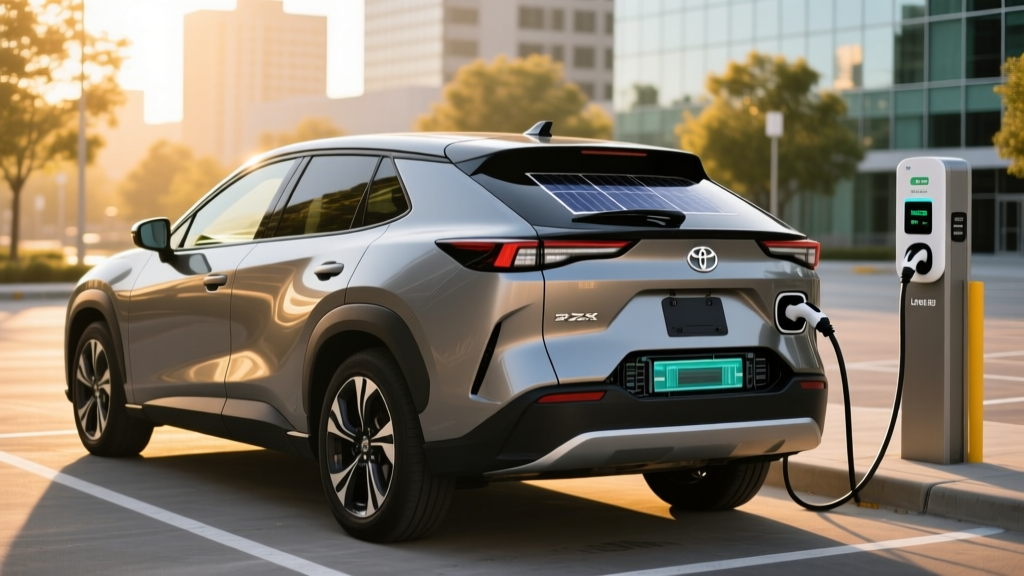
If you're researching Toyota bZ4X financing, you're likely weighing whether Toyota's mainstream electric crossover makes financial sense against a crowded field of competitors. The bZ4X occupies a specific niche: a conservatively styled, practical compact EV with Toyota's reputation for reliability, competitive pricing, and a usable real-world range that falls short of its segment leaders but delivers where it counts for daily drivers. This guide breaks down every cost factor — from MSRP and federal tax credit eligibility to charging infrastructure costs and five-year ownership economics — so you can model your financing with exact numbers.
2026 Toyota bZ4X Pricing by Trim
Toyota has streamlined the bZ4X lineup for the 2026 model year, maintaining the two-trim structure while adjusting pricing modestly. Here's what you'll see on the window sticker before any incentives are applied:
| Trim | Drivetrain | Base MSRP | Destination | Total Before Incentives |
|---|---|---|---|---|
| XLE FWD | Single-motor FWD | $32,675 | $1,395 | $34,070 |
| XLE AWD | Dual-motor AWD | $35,895 | $1,395 | $37,290 |
| Limited FWD | Single-motor FWD | $39,475 | $1,395 | $40,870 |
| Limited AWD | Dual-motor AWD | $42,175 | $1,395 | $43,570 |
The bZ4X's MSRP positions it squarely under the IRS §30D $55,000 SUV cap, which is the first threshold for federal tax credit eligibility. All trims clear that bar with headroom. The real financing question is whether you'll qualify for the full $7,500, a partial $3,750, or nothing — and that depends on the battery sourcing, critical minerals requirements, and your personal income.
Federal Tax Credit Eligibility (IRS §30D)
The federal EV tax credit under IRS §30D is no longer a simple "buy an EV, get $7,500" proposition. For 2026, the bZ4X's eligibility hinges on three parallel requirements:
- Battery component sourcing: A percentage of battery components must be manufactured or assembled in North America. This threshold increases annually. The bZ4X's battery supply chain has evolved since its 2023 launch, and Toyota has worked to localize production — but the exact credit amount ($7,500 if both thresholds met, $3,750 if only one) depends on the current model year's compliance.
- Critical minerals sourcing: A percentage of critical minerals (lithium, cobalt, nickel, manganese) must be extracted or processed in the U.S. or a free-trade-agreement country. This percentage also increases yearly.
- Buyer income caps: Modified adjusted gross income (MAGI) must not exceed $150,000 (single), $225,000 (head of household), or $300,000 (joint filers).
- Point-of-sale transfer: As of 2024, you can transfer the credit to the dealer at purchase, reducing your financed amount upfront rather than waiting to claim it on your tax return. This is a significant financing advantage — it effectively lowers your loan principal.
Practical financing impact: If you qualify for the full $7,500 credit and apply it at point of sale, the XLE FWD drops from $34,070 to an effective $26,570 — a price that competes with well-equipped compact gas crossovers. Even at the $3,750 partial credit, the XLE FWD nets to roughly $30,320, which remains compelling for an EV with Toyota's warranty backing.
| Trim | MSRP + Dest. | With $3,750 Credit | With $7,500 Credit |
|---|---|---|---|
| XLE FWD | $34,070 | $30,320 | $26,570 |
| XLE AWD | $37,290 | $33,540 | $29,790 |
| Limited FWD | $40,870 | $37,120 | $33,370 |
| Limited AWD | $43,570 | $39,820 | $36,070 |
Verify current-year sourcing compliance and your personal eligibility with a tax professional and the IRS clean vehicle credit page before finalizing your purchase.
Range, Battery, and Efficiency
The bZ4X uses a 71.4 kWh lithium-ion battery (NMC chemistry — nickel manganese cobalt), which is modest for the segment but paired with conservative energy management. Toyota prioritizes longevity and thermal stability over maximum energy density, which shows in the range figures:
EPA Estimated Range: 252 miles (XLE FWD) / 228 miles (XLE AWD) / 236 miles (Limited FWD) / 222 miles (Limited AWD)
Real-World Expectation: In mixed driving at moderate temperatures, expect 220–240 miles from the FWD models and 200–215 miles from AWD trims. Sustained highway driving at 75+ mph reduces this to approximately 190–210 miles (FWD) due to the bZ4X's relatively high aerodynamic drag. In freezing temperatures (below 32°F), plan for a 20–30% reduction — meaning an AWD Limited could deliver as little as 155–175 miles on a cold highway run. The bZ4X's heat pump (standard on Limited, available on XLE) helps mitigate cabin-heating energy draw, but battery chemistry still loses efficiency in cold.
Efficiency ratings from fueleconomy.gov place the FWD model at 119 MPGe combined (29 kWh/100 mi), while the AWD drops to 102 MPGe combined (33 kWh/100 mi). These are mid-pack figures — the Hyundai Ioniq 5 and Tesla Model Y both achieve higher MPGe ratings, meaning they extract more miles from each kWh.
Charging Speed: DC Fast and Home Level 2
Charging speed is often the deal-breaker for EV buyers, and the bZ4X delivers adequate but unremarkable performance here:
| Charging Level | Power | Speed / Time | Notes |
|---|---|---|---|
| Level 1 (120V household) | ~1.4 kW | ~3–4 miles per hour | Emergency/trickle only; full charge in ~50+ hours |
| Level 2 (240V home/public) | Up to 7.2 kW (32A) / 11.5 kW (48A) | ~21 mi/hr (7.2 kW) / ~33 mi/hr (11.5 kW) | Full charge in ~7–10 hours depending on amperage |
| DC Fast Charge | Peak 150 kW (FWD) / 150 kW (AWD) | 10–80% in ~30 minutes | Peak rate sustained briefly; tapers significantly above 60% SoC |
Charging curve reality: The bZ4X peaks at 150 kW on a capable DC fast charger, but like most EVs, that peak is short-lived. In real-world testing, the charge rate typically holds between 100–130 kW from 10% to roughly 50% state of charge, then tapers progressively. From 60% to 80%, you'll see rates drop to 50–70 kW. This means the advertised 10–80% time of approximately 30 minutes is achievable under ideal conditions (preconditioned battery, warm ambient temperature, a non-congested 150+ kW station), but plan for 35–40 minutes in less-than-ideal scenarios. Competitors like the Hyundai Ioniq 5 (which supports 800V architecture and peaks at 240 kW) complete the same 10–80% session in roughly 18 minutes.
The bZ4X uses a CCS1 connector for DC fast charging and a J1772 inlet for Level 2. With Toyota's 2025 adoption of NACS for future models, current bZ4X owners can access Tesla Supercharger stations using a Tesla-approved CCS-to-NACS adapter, which significantly expands the available public charging network. Toyota includes one year of complimentary charging on the EVgo network with new bZ4X purchases.
Performance and Drivetrain
| Spec | XLE/Limited FWD | XLE/Limited AWD |
|---|---|---|
| Motor Configuration | Single front motor | Dual motor (front + rear) |
| Horsepower | 201 hp | 214 hp |
| Torque | 196 lb-ft | 248 lb-ft |
| 0–60 mph | ~7.1 seconds | ~5.8 seconds |
| Top Speed | 112 mph | 112 mph |
The AWD bZ4X uses Subaru co-developed dual-motor torque vectoring (a product of the Toyota-Subaru EV partnership), which provides confident traction in rain and light snow. It is not a serious off-roader and is rated for zero towing capacity — if you need to haul a trailer, look to the Ford Mustang Mach-E (up to 1,500 lbs with the GT) or the Hyundai Ioniq 5 (up to 2,300 lbs with the tow package).
Interior Space, Cargo, and Technology
The bZ4X rides on Toyota's e-TNGA platform with a 112.2-inch wheelbase, which yields generous interior room for its compact footprint:
- Front legroom: 42.1 inches
- Rear legroom: 35.5 inches
- Cargo volume (behind rear seats): 27.7 cubic feet
- Cargo volume (rear seats folded): 56.9 cubic feet
- No front trunk (frunk): The bZ4X does not offer a frunk, which is a missed opportunity given competitors like the Ioniq 5 and Model Y both provide front storage.
Infotainment: A 12.3-inch touchscreen runs Toyota's latest Audio Multimedia system with wireless Apple CarPlay and Android Auto, cloud-based navigation, and over-the-air updates. The system is responsive and logically laid out, though it lacks the app ecosystem richness of Tesla's interface. A 7-inch digital gauge cluster sits behind the steering wheel, positioned to reduce eye refocusing.
Driver assistance: Toyota Safety Sense 3.0 comes standard on every bZ4X and includes adaptive cruise control with stop-and-go, lane tracing assist, automatic emergency braking with pedestrian detection, blind-spot monitoring, and rear cross-traffic alert. This is an SAE Level 2 driver-assist system — it requires continuous driver engagement and hands on the wheel. It does not offer hands-free highway driving like GM's Super Cruise or Ford's BlueCruise.
Standout feature: The bZ4X offers an available radiant heater in the lower dash panel (Limited trim) that warms occupants' legs directly, reducing reliance on the energy-intensive cabin heat system and preserving range in cold weather. This is a clever efficiency trick borrowed from Toyota's hybrid playbook.
Warranty and Long-Term Ownership Costs
Toyota backs the bZ4X with one of the strongest warranty packages in the EV segment:
- Basic vehicle warranty: 3 years / 36,000 miles
- Powertrain warranty: 5 years / 60,000 miles
- EV battery warranty: 8 years / 100,000 miles (capacity retention guarantee — Toyota warrants the battery will retain at least 70% of original capacity)
- Corrosion perforation: 5 years / unlimited miles
- Complimentary maintenance: 2 years / 25,000 miles (ToyotaCare)
The 70% capacity retention threshold over 8 years/100,000 miles is a transparent commitment. Toyota's track record with hybrid battery longevity (the Prius battery routinely exceeds 200,000 miles with minimal degradation) suggests the bZ4X's NMC pack should perform well, particularly given Toyota's conservative thermal management approach. That said, NMC chemistry does degrade faster than LFP under sustained high state-of-charge storage — so if you habitually charge to 100% and leave the car parked for days, expect accelerated capacity loss. Toyota's battery management system includes a buffer (you never actually access the full 71.4 kWh), which protects against the most damaging charge extremes.
Insurance costs for the bZ4X run slightly above segment average. Expect annual premiums of $1,600–$2,200 depending on your state, driving record, and coverage level — roughly 15–20% higher than a comparably priced RAV4 Hybrid. Get quotes before committing, as EV insurance varies widely by carrier.
Five-Year Total Cost of Ownership
Here's a modeled five-year / 75,000-mile ownership cost for the XLE FWD with the $7,500 federal credit applied at point of sale, compared against a similarly equipped Toyota RAV4 Hybrid XLE ($33,500 MSRP):
| Cost Category | bZ4X XLE FWD | RAV4 Hybrid XLE |
|---|---|---|
| Purchase price (after incentives) | $26,570 | $33,500 |
| Fuel / electricity (75,000 mi) | $3,375 (home charging @ $0.14/kWh) | $5,625 (gas @ $3.50/gal, 40 MPG) |
| Maintenance (5 years) | $1,200 | $2,800 |
| Insurance (5 years) | $9,500 | $7,500 |
| Estimated depreciation | $8,200 | $9,800 |
| Total 5-Year Cost | $48,845 | $59,225 |
Assumptions: 15,000 miles/year, $0.14/kWh average home electricity, 85% home charging / 15% public DC fast charging at $0.40/kWh, $3.50/gallon regular unleaded, average national insurance rates. Your actual costs will vary by state, utility rate, and driving habits.
The bZ4X's lower purchase price (after the tax credit) and dramatically lower fueling and maintenance costs create a meaningful five-year advantage — even with higher insurance premiums. The key caveat: this model assumes reliable home charging access. If you'll rely exclusively on public DC fast charging, your electricity cost rises to roughly $5,400 over five years, narrowing the gap considerably.
Pros and Cons
Pros
- Competitive pricing under $35K before incentives; strong value after tax credit
- Toyota's 8-year/100,000-mile battery warranty with 70% retention guarantee
- Standard Toyota Safety Sense 3.0 across all trims
- Comfortable ride quality and quiet cabin at highway speeds
- AWD model co-developed with Subaru — confident in rain and light snow
- Point-of-sale tax credit transfer reduces financed amount immediately
- Radiant heater (Limited) is a clever cold-weather efficiency feature
Cons
- Real-world range (190–240 mi) trails segment leaders like Ioniq 5 (303 mi) and Model Y (310+ mi)
- DC fast charging peaks at 150 kW and tapers early — 30+ min for 10–80%
- No front trunk (frunk) — competitors offer one
- Zero towing capacity
- Infotainment lacks native app ecosystem; no Tesla-style UI polish
- AWD range penalty is significant (222 mi EPA vs 252 mi FWD)
- Cold-weather range loss can push AWD below 175 miles in freezing conditions
Who Should Buy the Toyota bZ4X?
Choose the bZ4X if:
- You're a commuter driving 30–60 miles round-trip with reliable home Level 2 charging
- You value Toyota's reliability reputation and dealer network over maximum range
- You qualify for the full $7,500 federal tax credit and want a sub-$27,000 EV
- You want a practical daily driver, not a road-trip-focused vehicle
- You live in a moderate climate where cold-weather range loss is manageable
Look elsewhere if:
- You regularly drive 250+ miles between charging stops (road-trip use case)
- You need fast DC charging for frequent highway travel (Ioniq 5 or Model Y charge significantly faster)
- You need towing capacity (consider the Mach-E, Ioniq 5, or Rivian R2)
- You want maximum cargo space and a frunk (Model Y offers 76 cu ft total)
- You live in a region with extreme cold and lack home charging
Frequently Asked Questions
What is the real-world range of the Toyota bZ4X?
The EPA rates the bZ4X XLE FWD at 252 miles and the AWD at 228 miles. In real-world mixed driving, expect 220–240 miles (FWD) or 200–215 miles (AWD). Highway driving at sustained speeds above 70 mph and cold weather below freezing will reduce these figures by 15–30%. For daily commuting under 80 miles round-trip, the bZ4X's range is more than sufficient with home charging.
How fast does the bZ4X charge at home and on the road?
On a Level 2 home charger (240V, 48A), the bZ4X charges at up to 11.5 kW, adding roughly 33 miles of range per hour — a full charge in about 7 hours overnight. On DC fast chargers, it peaks at 150 kW and achieves 10–80% in approximately 30 minutes under ideal conditions, though the charge curve tapers significantly above 60% state of charge, making real-world sessions closer to 35–40 minutes.
Does the Toyota bZ4X qualify for the $7,500 federal EV tax credit?
The bZ4X's MSRP (all trims under $44,000) clears the IRS §30D SUV cap of $55,000. Whether you receive the full $7,500, a partial $3,750, or no credit depends on your income (caps at $150K single / $300K joint), the current battery sourcing compliance for the specific model year, and your tax liability. You can transfer an eligible credit to the dealer at point of sale, reducing your financed amount. Consult the IRS clean vehicle credit page and a tax professional for your specific situation.
Is the Toyota bZ4X worth buying vs. the Hyundai Ioniq 5 or Tesla Model Y?
It depends on your priorities. The bZ4X wins on base price (especially after the tax credit), Toyota's reliability reputation, and warranty strength. The Ioniq 5 offers significantly faster charging (18 min 10–80%), more range (up to 303 mi EPA), and a frunk. The Model Y delivers the most range, the Supercharger network, and far more cargo space. If your priority is lowest cost of entry and Toyota dealer support, the bZ4X is a strong pick. If you road-trip frequently or need maximum range and charging speed, the Ioniq 5 or Model Y better serve those needs.
What is the battery replacement cost for the bZ4X?
Out-of-warranty battery replacement for the bZ4X is estimated between $12,000 and $18,000 including labor, based on current NMC pack pricing for a 71.4 kWh unit. However, Toyota's 8-year/100,000-mile battery warranty (with a 70% capacity retention guarantee) and Toyota's track record with battery longevity suggest most owners will never face an out-of-pocket replacement. Battery module-level repairs (replacing individual degraded cells rather than the full pack) may also reduce costs as the EV service ecosystem matures.
Can I finance the bZ4X through Toyota Financial Services?
Yes. Toyota Financial Services offers conventional auto loans and lease programs for the bZ4X. If you qualify for the federal tax credit and elect the point-of-sale transfer, the credit reduces your capitalized cost (lease) or the effective purchase price (loan), which lowers your monthly payment. As of early 2026, Toyota has periodically offered promotional APR rates (as low as 1.9–3.9% for well-qualified buyers) on the bZ4X to move inventory — check with your local dealer for current financing incentives, which change frequently.