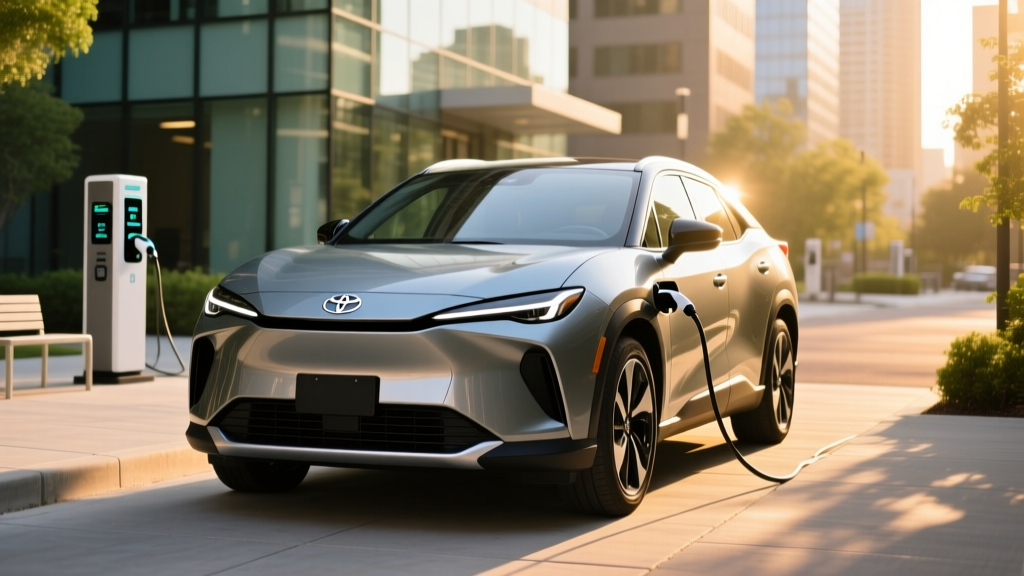
If you are researching Toyota EV financing in 2026, the conversation starts and ends with one vehicle: the Toyota bZ4X. As Toyota's only mass-market battery-electric model currently on US dealer lots, the bZ4X is the lens through which every loan term, lease offer, and total-cost-of-ownership calculation must be viewed. The sticker price is only the opening move. What you actually pay over five years depends on federal tax-credit eligibility, your local utility rates, insurance premiums, and how Toyota's EV resale values are shaking out in a volatile market.
This guide walks through the real numbers — MSRP by trim, the IRS §30D credit mechanics as they stand in 2026, a five-year cost projection, and the fuel/maintenance savings versus a comparably priced gas crossover like the Toyota RAV4. No marketing gloss, just the math a serious buyer needs before signing anything.
2026 Toyota bZ4X: Price, Specs, and Trim-Level Starting Point
Financing any EV starts with the transaction price. For the 2026 model year, Toyota continues to offer the bZ4X in two primary trims with front-wheel-drive and all-wheel-drive configurations. Here are the baseline figures that will anchor your loan or lease paperwork:
| Attribute | Value |
|---|---|
| Base MSRP (XLE FWD) | $38,465 (incl. destination) |
| Limited AWD MSRP | $48,115 (incl. destination) |
| Battery Capacity | 71.4 kWh usable (NMC lithium-ion) |
| EPA Range (XLE FWD) | 252 miles |
| Real-World Range Note | Expect ~210–230 mi highway; ~180–200 mi in freezing temps |
| Combined MPGe | 114 MPGe |
| Peak DC Fast Charge | 150 kW (CCS1 connector) |
| 10–80% DCFC Time | ~30 minutes |
| Level 2 Charge Rate | 7.2 kW (~25 mi/hr) |
| 0–60 mph | 7.1 seconds (FWD) / 5.8 seconds (AWD) |
| Horsepower | 201 hp (FWD) / 214 hp (AWD) |
| Battery/Powertrain Warranty | 8 years / 100,000 miles |
Federal Tax Credit Eligibility: IRS §30D Rules for 2026
The single biggest variable in Toyota EV financing is whether the bZ4X qualifies for the federal clean-vehicle credit under IRS §30D. As of 2026, the rules are stringent and have tightened considerably since the Inflation Reduction Act took effect. The credit is up to $7,500, but it is not automatic — it depends on your income, the vehicle's MSRP, and battery-component/critical-mineral sourcing requirements that shift annually.
- Maximum credit: $7,500 ($3,750 for battery components + $3,750 for critical minerals)
- Buyer income caps (AGI): $150,000 single / $225,000 head of household / $300,000 married filing jointly
- Vehicle MSRP cap: $55,000 for sedans; $80,000 for SUVs/pickups/vans (bZ4X qualifies as SUV)
- Battery component sourcing: Increasing percentage must be manufactured or assembled in North America (threshold rises each year through 2029)
- Critical mineral sourcing: Increasing percentage must be extracted or processed in the US or a free-trade-agreement country
- Foreign Entity of Concern (FEOC) restriction: Vehicles with battery components from a FEOC are disqualified; critical-mineral FEOC restrictions phase in progressively
- Point-of-sale transfer: Buyers may transfer the credit to the dealer at purchase, reducing the purchase price directly (if eligible)
How Point-of-Sale Transfer Changes Your Financing
If you qualify, the §30D credit can be transferred to the dealership at the time of purchase. This means instead of waiting to claim $7,500 on your next tax return, the dealer reduces the vehicle's purchase price by that amount at closing. For financing, this effectively lowers your loan principal. On a $38,465 bZ4X XLE, a full $7,500 point-of-sale transfer drops your financed amount to roughly $30,965 — a meaningful difference on a 60- or 72-month loan.
5-Year Total Cost of Ownership: bZ4X vs. RAV4 Gas Baseline
To understand what Toyota EV financing actually costs you over time, we need to compare the bZ4X against a reasonable gas alternative. The Toyota RAV4 LE AWD (MSRP ~$31,000, EPA 30 MPG combined) is the natural benchmark — similar size, same brand, same buyer cross-shopping the two.
| Cost Category | bZ4X XLE FWD (EV) | RAV4 LE AWD (Gas) |
|---|---|---|
| Purchase Price (MSRP) | $38,465 | $31,000 |
| Federal Tax Credit (§30D) | −$3,750 to −$7,500* | $0 |
| Effective Purchase Price | $30,965–$34,715 | $31,000 |
| Fuel / Energy (75k mi) | $2,700–$4,500** | $8,125*** |
| Maintenance (5 years) | $1,200–$1,800 | $3,000–$4,000 |
| Insurance (5 years) | $9,500–$12,000 | $7,000–$9,000 |
| Depreciation (est. 5-yr) | $14,000–$18,000 | $10,000–$13,000 |
| Estimated 5-Year TCO | $48,365–$68,515 | $49,125–$57,125 |
* Credit amount depends on battery sourcing compliance at time of purchase. ** Assumes $0.12–$0.20/kWh home charging mix; DCFC adds cost. *** Assumes $3.25/gal regular, 30 MPG combined, 75,000 miles.
The numbers reveal a nuanced picture. With a full $7,500 credit, the bZ4X's effective purchase price undercuts the RAV4, and fuel/maintenance savings compound over five years. However, higher insurance premiums and steeper EV depreciation erode those gains. With only a partial credit or no credit, the bZ4X costs noticeably more to own. Your specific electricity rate, driving pattern, and credit eligibility determine which column wins.
Charging vs. Gas: The Per-Mile Cost Math
The most common claim in EV ownership is that "electricity is cheaper than gas." That is directionally true for most US drivers, but the exact savings depend entirely on how and where you charge. Let's run the real math for the bZ4X.
bZ4X efficiency: ~30 kWh per 100 miles (derived from 114 MPGe EPA rating)
Home Level 2 charging (national avg ~$0.16/kWh): $0.048/mile
Home charging (off-peak utility rate ~$0.09/kWh): $0.027/mile
Public DC fast charging (~$0.40/kWh avg): $0.12/mile
RAV4 gas (30 MPG combined, $3.25/gal): $0.108/mile
Annual fuel cost at 15,000 miles:
bZ4X home charging: $720 | bZ4X public DCFC only: $1,800 | RAV4 gas: $1,625
If you charge primarily at home on a standard residential rate, the bZ4X costs roughly half as much per mile as the RAV4. But if you rely exclusively on public DC fast chargers — common for apartment dwellers without home charging access — the cost advantage nearly disappears. At Electrify America or EVgo pay-as-you-go rates of $0.40–$0.48/kWh, you may actually spend more per mile than a 30-MPG gas crossover. This is why home Level 2 charging access is the single most important financial variable in EV ownership.
Maintenance Savings: Where EVs Genuinely Cost Less
Electric vehicles eliminate several recurring maintenance items that gas owners accept as routine. The bZ4X has no engine oil, no transmission fluid to flush, no spark plugs, no timing belt, and no exhaust system. Regenerative braking significantly reduces brake pad and rotor wear — many EV owners report original brake pads lasting 80,000+ miles.
| Service Item | bZ4X (EV) | RAV4 (Gas) |
|---|---|---|
| Oil Changes (every 10k mi) | $0 | $525–$750 |
| Transmission Fluid | $0 | $150–$250 |
| Engine Air Filter | $0 | $100–$150 |
| Brake Pads/Rotors | $0–$300 | $600–$1,000 |
| Tire Rotation/Replacement | $800–$1,200* | $700–$1,000 |
| Cabin Air Filter | $100–$150 | $100–$150 |
| Coolant / Misc. | $100–$200 | $300–$500 |
| Total Estimated | $1,100–$1,850 | $2,475–$3,750 |
* EV tires tend to wear faster due to higher vehicle weight and instant torque. Budget for slightly more frequent tire replacement.
Over five years, you can reasonably expect to save $1,200–$2,000 on maintenance with the bZ4X compared to the RAV4. Toyota's 8-year/100,000-mile battery and powertrain warranty provides additional peace of mind against major drivetrain repairs during ownership.
The Insurance Reality: Expect to Pay More
Here is where the EV cost story gets less rosy. Insurance premiums for the bZ4X — and EVs broadly — run 15–30% higher than equivalent gas vehicles. According to industry data, the average annual EV insurance premium sits around $1,900–$2,400 compared to $1,400–$1,800 for a gas RAV4, depending on your state, driving record, and coverage level.
The reasons are structural, not arbitrary:
- Higher repair costs: EV battery packs and power electronics are expensive to replace after collision damage. Even minor rear-end impacts can trigger battery-safety inspections that total the vehicle.
- Specialized labor: Fewer body shops have high-voltage-certified technicians, raising labor rates for EV repairs.
- Higher vehicle values: Insurers base comprehensive/collision premiums on replacement cost, and the bZ4X's MSRP exceeds the RAV4's.
- Parts availability: EV-specific body panels, battery modules, and inverter assemblies can have longer lead times, increasing rental-car and storage costs during claims.
Before finalizing your Toyota EV financing, get insurance quotes for the exact bZ4X trim you are considering. The premium gap may narrow as the EV repair ecosystem matures, but for 2026 buyers, budget an extra $400–$700 per year versus a gas equivalent.
Depreciation and Resale Value: The Moving Target
EV depreciation has been one of the most volatile segments of the used-car market since 2022. Early adopters of vehicles like the bZ4X experienced steeper-than-expected value loss, driven by several converging factors:
- Tesla price cuts: Aggressive Model Y and Model 3 price reductions in 2023–2024 compressed used EV values across all brands.
- Lease returns: A growing wave of off-lease EVs flooded the used market, increasing supply.
- Consumer range expectations: The bZ4X's 252-mile EPA range, while adequate for most daily driving, falls below the 300+ mile threshold that many used-EV buyers now expect.
- Technology obsolescence: Rapid advances in charging speed, battery chemistry, and ADAS features make older EVs feel dated faster than gas cars.
Industry estimates from sources like Kelley Blue Book and iSeeCars suggest the bZ4X retains approximately 45–55% of its MSRP after five years, compared to 55–65% for a RAV4 over the same period. On a $38,465 bZ4X, that translates to roughly $17,000–$21,000 in depreciation versus $10,000–$13,000 for the RAV4.
State, Local, and Utility Incentives: The Regional Wildcard
Beyond the federal §30D credit, many states, municipalities, and electric utilities offer additional incentives that can materially change your Toyota EV financing math. These vary enormously by region and change frequently, so treat the following as a framework, not a guarantee:
- State purchase rebates: States like California (CVRP), Colorado, Massachusetts, New York, and others offer $1,000–$5,000 rebates for new EV purchases, often with income-based tiers that provide larger amounts to lower-income buyers.
- Utility charging rebates: Many electric utilities offer $250–$1,000 rebates for home Level 2 charger installation, plus time-of-use rate plans that reduce charging costs by 30–50% during off-peak hours.
- HOV lane access: States including California, Colorado, Florida, Georgia, and Maryland offer free or discounted HOV/carpool lane access for EVs — a significant commute-time benefit that does not show up on a spreadsheet but has real economic value.
- Registration fee offsets: Some states charge higher annual EV registration fees (to replace lost gas-tax revenue) that partially offset incentive benefits. Check your state's DMV for current EV registration costs.
To find incentives specific to your ZIP code, the Alternative Fuels Data Center (US Department of Energy) maintains a searchable database of federal, state, and local incentives. Your utility's website will list any charger-installation rebates or EV-specific rate plans.
Financing the bZ4X: Loan, Lease, or Cash?
With the cost picture assembled, the financing decision comes down to your priorities and risk tolerance. Here is how the three main paths compare for the bZ4X:
Purchase with Auto Loan
Best if you plan to keep the vehicle 5+ years and qualify for the §30D credit. Apply the credit as a point-of-sale transfer to reduce your loan principal. A 60-month loan at current rates (~6–7% APR) on a credit-adjusted $31,000–$34,700 principal yields monthly payments in the $600–$680 range. You own the asset outright and capture any residual value, but you bear the depreciation risk.
Lease
Toyota Financial Services has periodically offered competitive bZ4X leases with money factors that effectively subsidize the monthly payment. Leasing shifts residual-value risk to the lessor — attractive given EV depreciation uncertainty. The §30D credit may be claimed by the lessor (Toyota) and passed through as a lease incentive, though this is not guaranteed. Typical 36-month leases may land in the $350–$500/month range depending on incentives and down payment.
Cash Purchase
Eliminates interest costs entirely and simplifies the §30D credit claim (file on your tax return if not transferred at point of sale). Best for buyers with available capital who want the lowest possible total expenditure and plan to drive the bZ4X well beyond the warranty period.
Frequently Asked Questions
How much does it really cost to own a Toyota bZ4X over 5 years?
Depending on tax-credit eligibility, electricity rates, and insurance costs, total 5-year ownership for the bZ4X XLE FWD ranges from roughly $48,000 to $69,000 over 75,000 miles. With the full $7,500 federal credit and low-cost home charging, TCO can match or beat a gas RAV4. Without the credit and with high insurance and DCFC reliance, the bZ4X costs significantly more.
Do I qualify for the $7,500 federal EV tax credit on the bZ4X?
Possibly, but you must meet all criteria: your AGI must fall below IRS thresholds ($150k single / $300k joint), the vehicle MSRP must be under $80,000 (bZ4X qualifies), and the battery must meet 2026-specific sourcing requirements for components and critical minerals. Check the IRS qualified vehicle list before committing. Rules change annually, and the bZ4X's eligibility has varied by model year.
How much do I save on fuel and maintenance versus a gas Toyota?
With home charging at $0.16/kWh, expect to save $900–$1,100 per year on energy versus a 30-MPG RAV4 at $3.25/gallon. Maintenance savings add another $250–$400 per year from eliminated oil changes, reduced brake wear, and fewer fluid services. Combined annual savings of $1,200–$1,500 are realistic for a home-charging scenario.
Are EVs more expensive to insure than gas cars?
Yes, typically 15–30% more. The bZ4X will generally cost $400–$700 more per year to insure than a RAV4, driven by higher repair costs, specialized labor requirements, and elevated replacement values. Always get a binding quote before purchase to budget accurately.
How well does the Toyota bZ4X hold its resale value?
Current projections estimate the bZ4X retains 45–55% of MSRP after five years, compared to 55–65% for the RAV4. EV depreciation remains volatile and is influenced by Tesla pricing, new-model competition, and shifting consumer range expectations. Leasing or buying CPO can mitigate this risk.
Can I charge the bZ4X at Tesla Superchargers?
The bZ4X uses the CCS1 connector. Toyota has not adopted the NACS (Tesla) connector for the bZ4X as of 2026. You can access Tesla Superchargers equipped with the Magic Dock CCS adapter, but coverage is limited to select stations. For reliable DCFC access, rely on Electrify America, EVgo, and ChargePoint networks with the bZ4X's native CCS1 plug.