The Short Answer: Is a Toyota All Electric Vehicle Right for You?
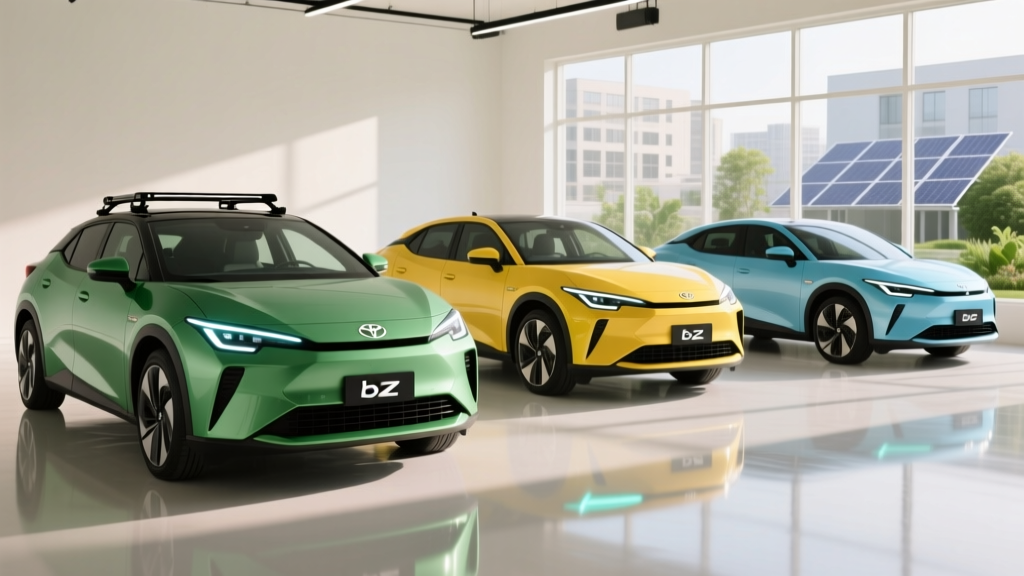
Toyota's current all-electric lineup centers on the bZ4X crossover (EPA range up to 252 miles, starting around $38,465) and the newly expanded bZ series. If you're a current Toyota hybrid owner considering going fully electric, the bZ4X offers familiar ergonomics and Toyota Safety Sense 3.0, but with slower DC fast-charging speeds (peak ~150 kW) and less real-world highway range than rivals like the Hyundai Ioniq 5 or Tesla Model Y. It's best for buyers who prioritize brand loyalty, dealer proximity, and moderate daily commutes over cutting-edge EV performance.
Toyota built its reputation on hybrid dominance with the Prius and RAV4 Hybrid. But when shoppers search for a Toyota all electric vehicle, they're asking whether the brand that perfected electrification via hybrids can deliver a competitive battery-electric (BEV) product. The answer requires separating Toyota's cautious engineering approach from the spec-sheet realities of its bZ lineup.
Toyota's 2026 All-Electric Lineup: What You Can Actually Buy
As of the 2026 model year, Toyota's battery-electric offerings available to US buyers include:
| Model | EPA Range | Battery (kWh) | Peak DC Charge | 0-60 mph | Starting MSRP |
|---|---|---|---|---|---|
| bZ4X XLE (FWD) | 252 mi | 71.4 kWh (NMC) | ~150 kW | 7.1 sec | $38,465 |
| bZ4X Limited (AWD) | 228 mi | 71.4 kWh (NMC) | ~150 kW | 6.5 sec | $43,215 |
| bZ Compact SUV (announced) | ~300 mi (est.) | TBD | TBD | TBD | TBD |
Note: The bZ Compact SUV has been announced by Toyota but final US specs, pricing, and availability remain preliminary as of early 2026. Check Toyota's official bZ page for updates.
bZ4X Charging: Speeds, Connectors, and the Curve
Charging speed is where the bZ4X diverges most noticeably from segment leaders. Here's what the numbers look like across charging levels:
| Level | Power (kW) | Miles Added/Hour | Time (10–80%) | Connector |
|---|---|---|---|---|
| Level 1 (120V outlet) | ~1.4 kW | ~4 mi/hr | ~50+ hours | J1772 / NACS |
| Level 2 (240V home) | ~7.2 kW | ~22 mi/hr | ~9.5 hours | J1772 / NACS |
| DC Fast Charge | Peak ~150 kW | ~500 mi/hr (peak) | ~30 min | CCS1 (NACS via adapter) |
kW vs. kWh reminder: kW (kilowatts) measures power — how fast energy flows into the battery. kWh (kilowatt-hours) measures energy capacity — the size of the "tank." The bZ4X has a 71.4 kWh battery and accepts up to ~150 kW of charging power.
The bZ4X's DC fast-charging curve is its weakest competitive point. While peak rate hits ~150 kW at a low state of charge, the rate tapers significantly above 60% SoC. A 10–80% session takes approximately 30 minutes at a capable 150+ kW station. By comparison, the Hyundai Ioniq 5 (with its 800V architecture) accomplishes the same in roughly 18 minutes at a 350 kW charger. If you road-trip frequently, this difference adds up.
For 2026, Toyota continues transitioning to the NACS (Tesla-style) connector on new vehicles. The bZ4X may ship with CCS1 or NACS depending on production date. Toyota has confirmed NACS adoption, and adapters are available for accessing the Tesla Supercharger network — a significant practical advantage for public charging access.
Cost Breakdown: bZ4X vs. RAV4 Hybrid vs. RAV4 Gas
The most common question from Toyota loyalists: does going all-electric actually save money compared to the RAV4 Hybrid they already know and trust? Let's run the numbers over a 5-year, 75,000-mile ownership period.
| Cost Factor | bZ4X XLE (BEV) | RAV4 Hybrid XLE | RAV4 Gas LE (AWD) | |
|---|---|---|---|---|
| MSRP (approx.) | $38,465 | $33,575 | $30,425 | |
| Fed. Tax Credit (§30D) | Up to $7,500* | $0 | $0 | |
| Effective Purchase Price | ~$30,965 | $33,575 | $30,425 | |
| Fuel/Energy (5 yr) | ~$3,200 (home charging) | ~$6,800 | ~$8,500 | |
| Maintenance (5 yr) | ~$1,500 | ~$3,200 | ~$3,800 | |
| Insurance (5 yr est.) | ~$9,500 | ~$7,800 | ~$7,500 | |
| 5-Year Total Cost | ~$45,165 | ~$51,375 | ~$50,225 |
*Federal §30D tax credit eligibility depends on MSRP caps, buyer income limits, battery critical-mineral sourcing, and point-of-sale transfer rules. Verify current eligibility at IRS.gov before purchasing. Credit amounts and rules are subject to change.
Key takeaways from this comparison:
- The tax credit closes the gap. With the full $7,500 credit applied at point of sale, the bZ4X's effective price undercuts the RAV4 Hybrid.
- Energy savings are substantial if you charge primarily at home on residential electricity rates (~$0.13–0.17/kWh national average).
- Insurance costs more for the bZ4X — EV-specific policies tend to run 15–25% higher than comparable gas/hybrid models.
- Maintenance is genuinely cheaper — no oil changes, no transmission fluid, fewer brake replacements due to regenerative braking.
EV vs. Hybrid vs. Gas: The Decision Framework
Toyota offers all three powertrains across many nameplates. Here's how to determine which makes sense for your situation:
Choose the bZ4X (all-electric) if:
- You have reliable home charging access (garage or driveway with 240V capability)
- Your daily commute is under 80 miles round-trip
- You qualify for the §30D federal tax credit (income and sourcing requirements)
- You road-trip fewer than 4–5 times per year, or travel along well-served charging corridors
- You want the lowest per-mile operating cost and minimal scheduled maintenance
Choose the RAV4 Hybrid if:
- You live in an apartment or lack home charging access
- You frequently drive 300+ miles in a day through rural areas
- You live in extreme cold climates where EV range drops 20–30%
- You want a lower purchase price without depending on tax credit eligibility
- You want maximum flexibility with zero route planning
Choose a RAV4 Plug-In Hybrid (RAV4 Prime) if:
- You want electric-only commuting (42 miles EPA) with gas-engine backup
- You can charge at home but still take long road trips regularly
- You want the best of both worlds without range compromise
Real-World Ownership: What First-Time EV Buyers Must Know
Switching from a gas Toyota to a Toyota all electric vehicle involves practical adjustments that spec sheets don't capture:
Home Charging Is Non-Negotiable for Most Owners
Over 80% of EV charging happens at home. If you can install a Level 2 (240V) charger, the bZ4X will replenish fully overnight. Budget $500–$1,500 for the charger unit and $800–$2,500 for electrician installation, depending on whether your electrical panel needs an upgrade (older homes with 100-amp service may require a $2,000–$4,000 panel upgrade to support a 40-amp EV circuit).
Public Charging: Plan Ahead
Toyota's partnership with charging networks gives bZ owners access to Electrify America, EVgo, and (via NACS adapter) the Tesla Supercharger network. However, reliability varies. On a 300-mile road trip, expect to stop once for 25–35 minutes at a DC fast charger. Apps like PlugShare and A Better Routeplanner are essential tools.
Cold Climate? Expect Less Range
Lithium-ion batteries lose efficiency in cold temperatures. In sustained sub-freezing conditions, the bZ4X's 252-mile EPA range can drop to 180–200 miles. The bZ4X includes a battery preconditioning feature to mitigate this during charging, but range reduction is a physical reality of current battery chemistry — not a defect.
Battery Warranty and Longevity
Toyota covers the bZ4X battery with an 8-year/100,000-mile warranty against capacity loss below 70% of original capacity. Toyota's NMC battery chemistry has demonstrated moderate degradation rates in early bZ4X fleet data, with most owners reporting 90%+ state of health after 30,000 miles. Full battery replacement (if ever needed outside warranty) is estimated at $12,000–$18,000, though this is rare within a typical ownership cycle.
Common Toyota EV Misconceptions — Corrected
| Myth | Fact |
|---|---|
| "Toyota doesn't make real EVs." | The bZ4X is a fully electric, dedicated-platform BEV — not a converted gas car. It's sold in all 50 states. |
| "EV batteries need replacing every few years." | Modern NMC and LFP batteries are designed for 15+ years of service. The bZ4X carries an 8-year/100,000-mile battery warranty. |
| "I'll save $7,500 no matter what." | The §30D credit has income caps ($150K single / $300K joint), MSRP caps ($55K sedans / $80K SUVs), and battery-sourcing requirements. Not every buyer or trim qualifies. |
| "The bZ4X charges as fast as a Tesla." | The bZ4X peaks at ~150 kW. A Tesla Model Y on V3 Superchargers sustains ~250 kW. The difference means ~12 extra minutes per charging stop on road trips. |
| "EVs are worse in winter." | EVs start instantly in cold (no cranking), and cabin heat is immediate. Range does drop 20–30%, but preconditioning and seat/steering-wheel heating offset comfort concerns. |
Federal Tax Credit: What Toyota EV Buyers Need to Verify
The IRS §30D Clean Vehicle Credit can reduce your effective purchase price by up to $7,500 — but eligibility is not guaranteed. Key requirements for 2026:
- MSRP Cap: SUVs (including the bZ4X) must have an MSRP at or below $80,000
- Income Cap: Modified AGI must not exceed $150,000 (single) or $300,000 (married filing jointly)
- Battery Sourcing: Critical minerals and battery components must meet escalating domestic-content thresholds — Toyota has been working to qualify, but verify the specific VIN's eligibility at the point of sale
- Point-of-Sale Transfer: You can transfer the credit to the dealer for an immediate price reduction rather than claiming it on your tax return
- Final Assembly: Vehicle must undergo final assembly in North America
Always confirm eligibility with your dealer and cross-reference with the IRS before signing paperwork. Tax credit rules change, and consulting a tax professional is recommended for your specific situation.
Toyota EV Safety and Driver Assistance
The bZ4X comes standard with Toyota Safety Sense 3.0, which includes:
- Pre-Collision System with Pedestrian Detection
- Full-Speed Range Dynamic Radar Cruise Control
- Lane Departure Alert with Steering Assist
- Lane Tracing Assist
- Road Sign Assist
- Proactive Driving Assist (low-speed braking support)
The bZ4X earned the IIHS Top Safety Pick+ designation in its tested configuration. Consult IIHS.org for detailed crash-test scores.
Frequently Asked Questions
Does Toyota make a fully electric SUV I can buy today?
Yes. The Toyota bZ4X is a fully electric compact SUV available now in all 50 states, with EPA range up to 252 miles (FWD) and a starting MSRP of $38,465. Toyota has also announced additional bZ models, but those are not yet available for purchase.
How does the bZ4X range compare to the RAV4 Hybrid?
The bZ4X offers up to 252 miles of EPA-rated electric range. The RAV4 Hybrid gets about 40 MPG combined, giving it roughly 570 miles on a 14.5-gallon tank. For daily driving under 80 miles, the bZ4X covers most needs with home charging. For long road trips, the RAV4 Hybrid still offers greater range and faster refueling.
Can I charge a Toyota bZ4X at Tesla Superchargers?
Toyota is transitioning to the NACS connector. Depending on your bZ4X's production date, it may come with CCS1 or NACS. If CCS-equipped, a NACS adapter enables access to the Tesla Supercharger network, which adds over 25,000 fast-charging stalls to your options.
How much does it cost to charge the bZ4X at home?
Charging the 71.4 kWh battery from empty to full at the national average electricity rate of ~$0.15/kWh costs approximately $10.70 — equivalent to roughly $0.04–0.05 per mile. That's about one-third the per-mile fuel cost of a gas RAV4 at $3.50/gallon.
What happens if the bZ4X battery degrades?
Toyota warranties the battery for 8 years or 100,000 miles against capacity loss below 70%. Early real-world data suggests typical degradation of 5–10% over the first 30,000–50,000 miles. Complete battery failure is rare; individual cell modules can sometimes be replaced rather than the entire pack.
Is the Toyota bZ4X eligible for the $7,500 federal tax credit?
Potentially — but eligibility depends on your income, the vehicle's MSRP, battery-sourcing compliance, and final assembly location. Always verify with the IRS and your dealer before purchase. Rules are subject to change; consult IRS.gov for the latest requirements.
The Bottom Line: Who Should Buy a Toyota All Electric Vehicle?
The bZ4X isn't the longest-range, fastest-charging, or most technologically advanced EV in its class. But it is a competent, comfortable, and well-built electric crossover from a brand millions of Americans already trust. If you're a Toyota loyalist with home charging, a moderate commute, and tax-credit eligibility, the bZ4X delivers meaningful fuel savings and a smooth transition to electric driving. If you prioritize maximum range, ultra-fast charging, or hands-free highway driving, competitors like the Ioniq 5, Model Y, or Equinox EV may better match your needs.
Before deciding, test-drive the bZ4X, verify your tax-credit eligibility, get a quote for home charger installation, and honestly assess your driving patterns. The right EV is the one that fits your life — not just a spec sheet.