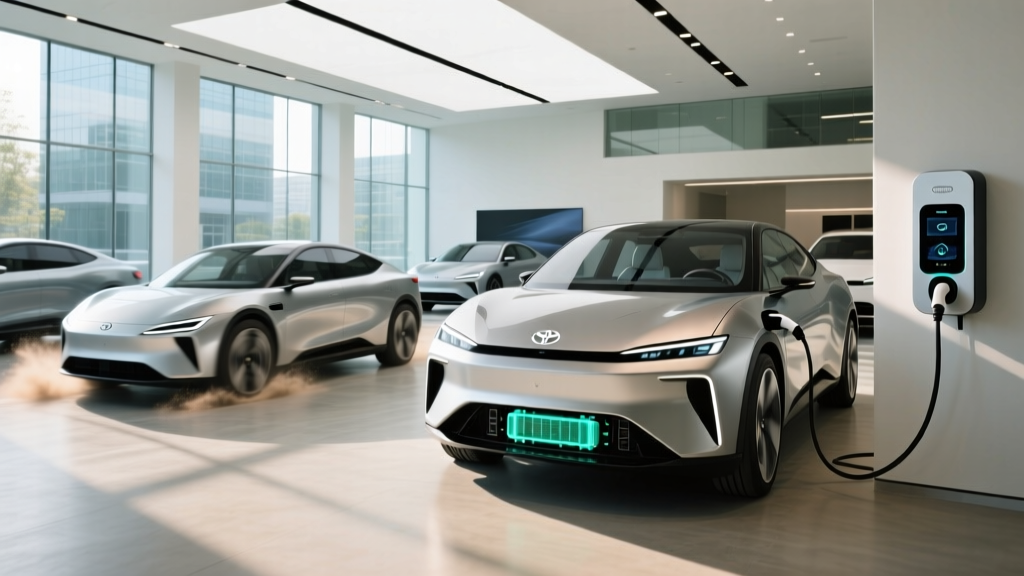
Toyota's all-electric lineup in 2026 centers on the bZ4X crossover and the newly expanded bZ series. The bZ4X delivers an EPA-estimated 252 miles of range (FWD), charges at up to 150 kW DC (10–80% in roughly 30 minutes), and starts near $37,070 before incentives. Toyota's approach favors proven reliability and hybrid breadth over EV-only dominance — making the bZ4X a pragmatic pick for buyers who want Toyota's dealer network and warranty backing, but not the longest range or fastest charging in the segment.
Toyota's All-Electric Lineup: What You Can Actually Buy
Toyota has historically leaned heavily into hybrids (the RAV4 Hybrid, Camry Hybrid, Highlander Hybrid) and was cautious on full battery-electric vehicles. As of the 2026 model year, Toyota's dedicated BEV offerings for the U.S. market include:
| Model | Body Style | Battery (kWh usable) | EPA Range | Peak DC Charge | 10–80% Time | 0–60 mph | Starting MSRP |
|---|---|---|---|---|---|---|---|
| bZ4X FWD | Compact SUV | ~71.4 kWh (NMC) | 252 mi | 150 kW | ~30 min | 6.9 sec | $37,070 |
| bZ4X AWD | Compact SUV | ~72.8 kWh (NMC) | 228 mi | 150 kW | ~30 min | 5.8 sec | $40,120 |
| bZ Woodland (AWD) | Rugged SUV | ~72.8 kWh (NMC) | ~260 mi (est.) | 150 kW | ~30 min | ~5.5 sec | $42,900 (est.) |
The bZ Woodland, announced as a more rugged, outdoors-oriented variant, is expected for the 2026 model year with slight range and powertrain refinements. Specs marked as estimated are preliminary per Toyota's announcements; final EPA certification may differ.
Real-World Range Reality: The bZ4X FWD's EPA rating of 252 miles is the sticker number. In real-world highway driving at 70–75 mph, expect roughly 210–230 miles. In cold weather (below 30°F), range can drop 20–30%, bringing usable range down to 175–200 miles before you'll want to find a charger. Toyota does not currently offer an LFP (lithium iron phosphate) battery option — all bZ models use NMC chemistry, which offers higher energy density but is more sensitive to extreme cold and benefits from preconditioning before DC fast charging.
bZ4X Charging: Speeds, Connectors, and Infrastructure
Charging speed is where the bZ4X faces stiff competition. Hyundai's Ioniq 5 and Kia's EV6, built on 800-volt architectures, can peak at over 230 kW and complete a 10–80% charge in under 20 minutes. The bZ4X operates on a conventional 400-volt platform, capping its practical advantage at public DC fast chargers.
| Charging Level | Power (kW) | Connector | Speed (miles/hour) | Typical Use Case |
|---|---|---|---|---|
| Level 1 (120V) | ~1.4 kW | J1772 | ~4 mi/hr | Emergency/overnight trickle |
| Level 2 (240V, 48A) | ~11.5 kW | J1772 / NACS* | ~34 mi/hr | Home/workplace daily charging |
| DC Fast Charge | Up to 150 kW | CCS1 / NACS* | Up to ~430 mi/hr (peak) | Road trips, public stations |
*For 2026, Toyota has adopted the NACS (North American Charging Standard) port on new vehicles, replacing CCS1. Adapter availability for legacy CCS chargers varies — confirm with your dealer. Tesla Supercharger network access is available via NACS or adapter depending on model year.
The charge curve matters more than the peak number. The bZ4X sustains close to its 150 kW peak from roughly 10–40% State of Charge, then tapers progressively. From 60–80%, speeds drop to roughly 60–80 kW, which is why the 10–80% time stretches to around 30 minutes. If you're planning road trips, budget 35–40 minutes per stop to account for real-world conditions and charger availability.
Toyota All Electric vs. Gas and Hybrid: Cost Comparison
Toyota dominates the hybrid market for good reason — models like the RAV4 Hybrid achieve 40 MPG combined without any charging infrastructure. So how does the bZ4X stack up financially against Toyota's own gas and hybrid options?
| Cost Factor | bZ4X FWD (EV) | RAV4 Hybrid AWD | RAV4 Gas AWD |
|---|---|---|---|
| Starting MSRP | $37,070 | $34,375 | $31,675 |
| Fuel/Energy (5 yr) | ~$4,200 (home L2, $0.14/kWh avg) | ~$9,400 (40 MPG, $3.50/gal) | ~$11,700 (30 MPG, $3.50/gal) |
| Maintenance (5 yr) | ~$1,800 | ~$3,200 | ~$3,800 |
| Estimated Insurance (5 yr) | ~$9,500 | ~$7,800 | ~$7,500 |
| Federal Tax Credit | Up to $7,500* | None | None |
| Est. 5-Year Total | ~$45,070 | ~$54,775 | ~$54,675 |
*Federal §30D tax credit eligibility depends on MSRP caps, buyer income limits, and battery critical-mineral sourcing requirements. Per IRS guidelines, credits can now be transferred at the point of sale to reduce the purchase price directly. Always verify current-year eligibility with your tax professional.
The math favors the bZ4X over five years if you qualify for the full federal credit and charge primarily at home on residential electricity rates. If you rely exclusively on public DC fast charging (averaging $0.35–$0.50/kWh), your energy costs climb to roughly $7,000–$9,000 over five years — narrowing the gap with the RAV4 Hybrid significantly.
Federal Tax Credits and Incentives: What Toyota EV Buyers Qualify For
§30D Federal EV Tax Credit Requirements (2026):
- Vehicle MSRP cap: SUVs must be under $80,000; sedans under $55,000 — all bZ4X trims qualify
- Buyer income cap: Modified AGI ≤ $150,000 (single), $225,000 (head of household), $300,000 (joint)
- Battery sourcing: Critical minerals and battery components must meet phased percentage thresholds from U.S. or FTA-partner nations — this requirement tightens annually
- Point-of-sale transfer: You can transfer the credit to the dealer to reduce your purchase price at signing rather than waiting for a tax refund
- One credit per vehicle: The credit is non-refundable but can be applied to tax liability or transferred
The bZ4X's battery sourcing compliance has been a moving target as supply chains shift. Toyota has worked to meet critical-mineral thresholds, but the exact credit amount ($3,750 for meeting minerals requirements alone, $7,500 for meeting both minerals and component requirements) can vary by model year and production batch. Check the fueleconomy.gov tax credit tracker for the specific VIN you're considering.
Real-World Ownership: What First-Time Toyota EV Buyers Must Know
Buying your first EV is different from buying a gas car. Here's what actually matters once you take delivery:
Home charging is non-negotiable for most owners. A Level 2 home charger (240V, 48-amp circuit) adds roughly 34 miles of range per hour of charging. Overnight, that's a full battery every morning. Installation costs range from $500–$2,500 depending on your electrical panel's capacity and the distance from panel to garage. If your home has a 100-amp panel, you may need a $1,500–$3,000 upgrade to 200 amps — factor this into your budget before purchase.
Public charging reliability varies. Networks like Electrify America and EVgo have improved uptime, but outages and broken connectors remain a real frustration. The bZ4X's NACS compatibility opens the Tesla Supercharger network, which consistently rates highest for reliability in owner surveys. If your area has limited public charging, the bZ4X's 252-mile range means you'll need to plan road trips carefully — especially in winter or mountainous terrain.
Maintenance is genuinely lower. No oil changes, no transmission fluid, no spark plugs. Brake pads last far longer thanks to regenerative braking (many EV owners report 80,000+ miles on original pads). You'll still need tire rotations, cabin air filter replacements, and wiper fluid. Toyota's EV battery warranty covers 8 years/100,000 miles against defects and excessive capacity loss (typically defined as dropping below 70% State of Health).
Insurance costs more. EV insurance premiums run 15–25% higher than comparable gas vehicles due to higher repair costs and battery replacement risk. Get quotes from your insurer before committing — the difference can be $200–$400/year.
Common Toyota EV Myths vs. Facts
| Myth | Fact |
|---|---|
| "Toyota doesn't make real electric cars" | The bZ4X is a dedicated BEV platform. Toyota also offers the bZ Woodland for 2026. Toyota's strategy includes BEVs, PHEVs, HEVs, and hydrogen — they haven't gone all-in on EVs like some rivals, but their EVs are production vehicles sold at scale. |
| "The bZ4X has terrible range" | 252 miles EPA is competitive with base-trim rivals (the base Ioniq 5 gets 220 mi RWD Standard Range, 303 mi Long Range). It's not class-leading, but it covers most daily driving and moderate road trips. |
| "EV batteries need replacing every few years" | Modern NMC batteries degrade slowly. Industry data shows average degradation of 1–2% per year. Toyota warranties the battery at 8 years/100,000 miles. Full replacement (rarely needed) costs $8,000–$14,000. |
| "You can't drive an EV in cold weather" | You can, but range drops 20–30% in sub-freezing temperatures. Preconditioning the battery while plugged in mitigates this. A heat pump (standard on bZ4X) helps cabin efficiency. |
| "Charging takes too long" | At home on Level 2, charging happens while you sleep — zero active time. On road trips, a 30-minute DC fast charge every 200 miles is comparable to a gas stop with a meal break. |
Decision Framework: Is a Toyota All-Electric Vehicle Right for You?
Choose the Toyota bZ4X if:
- You have reliable home Level 2 charging access
- Your daily commute is under 80 miles round-trip
- You value Toyota's dealer network, warranty, and reliability track record
- You qualify for the federal tax credit (income and sourcing requirements met)
- You take 2–4 road trips per year and can plan around 200-mile charging intervals
Choose a Toyota Hybrid (RAV4 Hybrid, Camry Hybrid) instead if:
- You lack home charging and public infrastructure near you is sparse
- You regularly drive in extreme cold (below 10°F) where range loss compounds
- You take frequent long road trips and don't want to plan charging stops
- You want lower upfront cost without depending on tax credit qualification
Look at competitors (Hyundai Ioniq 5, Tesla Model Y, Kia EV6) if:
- You need 300+ miles of EPA range for your driving patterns
- You want the fastest possible DC charging (800V platforms, sub-20-minute stops)
- You prioritize the latest ADAS or infotainment technology
Frequently Asked Questions
Does Toyota have an all-electric SUV available now?
Yes. The bZ4X is currently on sale at U.S. Toyota dealers as a compact all-electric SUV with FWD and AWD options. The bZ Woodland variant is expected for the 2026 model year with enhanced off-road capability and slightly revised range estimates.
How long does the bZ4X battery last?
Toyota warranties the high-voltage battery for 8 years or 100,000 miles against defects and excessive degradation. Based on industry NMC battery data, most owners can expect 85–90% capacity retention after 100,000 miles. Complete battery replacement is rarely needed but costs approximately $8,000–$14,000 if required out of warranty.
Can the Toyota bZ4X use Tesla Superchargers?
2026 model-year bZ4X vehicles with the NACS port can access Tesla Superchargers directly. Earlier model years with CCS1 ports require a Toyota-approved adapter. Always verify your specific vehicle's connector and the Supercharger station's compatibility before relying on the network.
Is the bZ4X eligible for the $7,500 federal tax credit?
The bZ4X meets the MSRP cap (under $80,000 for SUVs). Buyer eligibility depends on income limits ($150K single / $300K joint) and battery sourcing compliance, which can vary by production batch. Check the fueleconomy.gov database for your specific vehicle's credit status, and consult a tax professional for personal eligibility.
How does the bZ4X compare to the RAV4 Hybrid?
The bZ4X offers lower fueling and maintenance costs over five years (especially with the tax credit), but the RAV4 Hybrid has no range limitations, no charging requirements, and a lower starting price. The RAV4 Hybrid gets 40 MPG combined; the bZ4X achieves 131 MPGe combined per EPA data. Choose EV for daily savings with home charging; choose hybrid for maximum flexibility.
What's the real-world range of the bZ4X in winter?
In temperatures below 30°F, expect 20–30% range reduction. The FWD model's 252-mile EPA rating drops to roughly 175–200 miles of usable range in cold conditions. Preconditioning the battery while plugged in and using seat/steering wheel heaters instead of cabin heat can recover some of that loss.
Sources: fueleconomy.gov (EPA range and efficiency data), IRS §30D credit rules, Toyota Motor Corporation U.S.A. product specifications. Pricing and incentives reflect 2026 model year information available at time of publication; verify with your dealer and tax advisor.