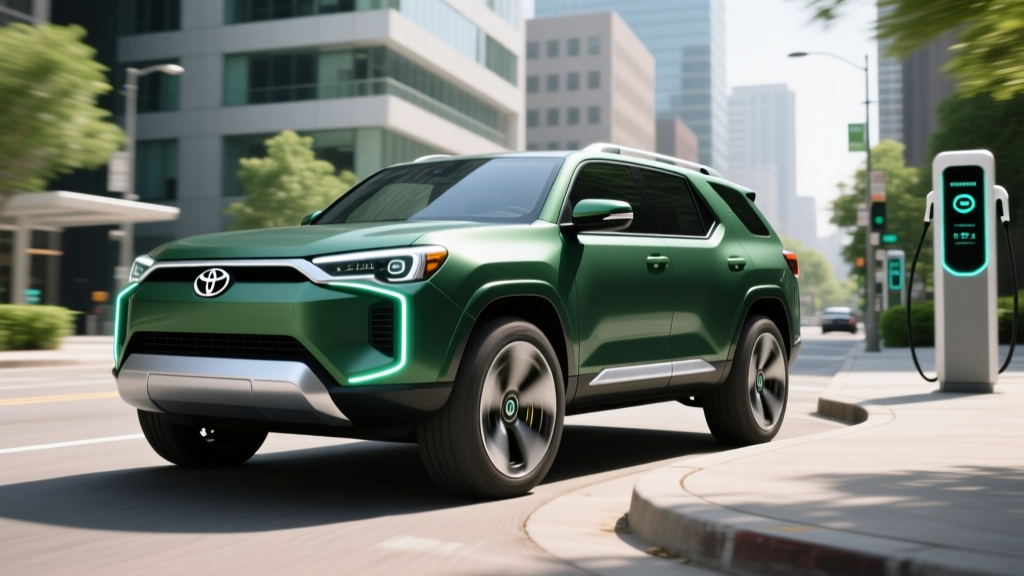
Is There a Toyota 4Runner Electric?
As of early 2026, Toyota has not announced an electric 4Runner. The sixth-generation 4Runner (introduced for the 2025 model year) is available exclusively with the i-Force MAX hybrid powertrain — a turbocharged 2.4-liter four-cylinder paired with a 48-hp electric motor integrated into the transmission. Toyota has committed to offering an electrified option across its entire lineup, but the 4Runner's body-on-frame architecture and off-road mission make a full battery-electric variant a complex engineering challenge that has not yet materialized.
If you're searching for a "Toyota 4Runner electric," you're likely weighing two questions: whether to wait for a possible BEV 4Runner, or whether the current i-Force MAX hybrid delivers enough electrified efficiency to justify buying now. This guide breaks down both paths with hard data.
The Current 4Runner: i-Force MAX Hybrid Explained
The 2025–2026 Toyota 4Runner uses the TNGA-F platform shared with the Tacoma, Land Cruiser, and Sequoia. The i-Force MAX hybrid pairs a 2.4-liter turbocharged inline-four with a motor-generator and a compact 1.87 kWh nickel-metal hydride (NiMH) battery pack positioned between the frame rails. Total system output is 326 horsepower and 465 lb-ft of torque — a significant jump from the outgoing 4.0L V6's 270 hp.
This is a mild hybrid, not a plug-in hybrid (PHEV). You cannot charge it from a wall outlet, and there is no electric-only driving mode. The electric motor assists during acceleration, smooths the start-stop system, and enables modest regenerative braking. The result is improved low-end torque for off-road crawling and a meaningful bump in fuel economy.
| Metric | i-Force MAX Hybrid | Previous Gen 4.0L V6 (2024) |
|---|---|---|
| Horsepower | 326 hp | 270 hp |
| Torque | 465 lb-ft | 278 lb-ft |
| EPA City MPG | ~23 MPG (est. 4WD) | 16 MPG |
| EPA Highway MPG | ~24 MPG (est. 4WD) | 19 MPG |
| EPA Combined MPG | ~23 MPG (est. 4WD) | 17 MPG |
| Battery Type | 1.87 kWh NiMH | N/A |
| Plug-In Capable? | No | No |
| Towing Capacity | 6,000 lbs | 5,000 lbs |
The EPA has not finalized all 2026 4Runner fuel-economy ratings at publication time; the figures above reflect Toyota's preliminary estimates and early fueleconomy.gov listings for the 4WD configuration. Rear-wheel-drive variants may return 1–2 MPG more. Compared to the outgoing V6, the hybrid delivers roughly a 35% improvement in combined fuel economy.
Why a Full-Electric 4Runner Is Complicated
Toyota's global EV strategy has been cautious, and the 4Runner sits at the intersection of several engineering constraints that make a battery-electric version particularly challenging:
Body-on-frame architecture: The TNGA-F platform was designed with hybrid and ICE powertrains in mind. Packaging a large battery pack (likely 100+ kWh for acceptable range) beneath a ladder-frame chassis without compromising ground clearance, approach/departure angles, or suspension articulation is a significant hurdle. Competitors like the Rivian R1S and GMC Hummer EV solved this with dedicated skateboard EV platforms, not retrofitted frames.
Off-road durability: The 4Runner's core buyer expects rock-crawling capability, water fording, and extreme articulation. Exposed battery packs face puncture risk on trails, and cold-weather range loss (typically 20–30% below freezing) is a liability for backcountry use where charging infrastructure is nonexistent.
Weight and payload: A 100+ kWh battery pack adds 1,200–1,500 lbs. The current 4Runner's curb weight is approximately 4,700 lbs. Adding battery mass would push the vehicle toward 6,000+ lbs, straining the frame, suspension, and braking systems while eroding payload and towing margins.
Toyota's battery supply chain: Toyota has prioritized LFP (lithium iron phosphate) and NMC (nickel manganese cobalt) battery production for high-volume models like the bZ4X and upcoming next-gen EVs. Allocating large packs to a relatively low-volume model like the 4Runner (roughly 120,000–140,000 US units annually) may not be a near-term priority.
What Would an Electric 4Runner Need to Offer?
If Toyota does engineer a BEV 4Runner, here's the spec sheet it would need to compete in the midsize electric SUV segment:
| Spec | Hypothetical EV 4Runner | Rivian R1S (Dual-Motor) | Je Wrangler 4xe (PHEV) |
|---|---|---|---|
| EPA Range | 300–330 mi | 352 mi (Max Pack) | 22 mi electric + gas |
| Battery Capacity | ~100–110 kWh | 149 kWh (Max) | 17.3 kWh |
| DC Fast Charge (Peak kW) | ~200–250 kW | 200 kW | N/A (Level 2 only) |
| 10–80% Charge Time | ~25–30 min | ~30 min | ~2 hr (Level 2) |
| 0–60 mph | ~5.5 sec | 5.0 sec | 6.0 sec |
| Towing Capacity | 5,000–6,000 lbs | 7,700 lbs | 3,500 lbs |
| Ground Clearance | 9.0+ in | 14.9 in (max) | 10.8 in |
| Base MSRP (Est.) | $55,000–$65,000 | $79,900 | $51,795 |
The Wrangler 4xe is a plug-in hybrid, not a BEV, but it's instructive: Jeep proved that off-road buyers will accept electrification if capability is preserved. The 4xe offers 22 miles of electric-only range and can ford 30+ inches of water. A full BEV 4Runner would need to match or exceed that ruggedness while solving the charging-infrastructure gap on trails.
Real Costs: i-Force MAX Hybrid vs. Hypothetical BEV
Let's compare what owning the current hybrid 4Runner actually costs versus what a hypothetical electric version might look like over five years and 75,000 miles.
| Cost Factor | 4Runner i-Force MAX Hybrid | Hypothetical EV 4Runner |
|---|---|---|
| Purchase Price (MSRP, mid-trim) | $55,000 | $62,000 (est.) |
| Federal Tax Credit (§30D) | $0 (not a BEV/PHEV) | Up to $7,500* |
| Effective Purchase Price | $55,000 | $54,500 (est.) |
| Fuel/Energy Cost (75k mi) | $9,400 (gas at $3.50/gal, 23 MPG) | $3,600 (electric at $0.16/kWh, 2.5 kWh/mi) |
| Maintenance (5 yr) | $3,200 (oil, filters, brakes) | $1,400 (no oil, regen saves brakes) |
| Insurance (5 yr avg) | $8,500 | $9,800 (EVs cost ~15% more to insure) |
| Estimated Depreciation | $22,000 | $28,000 (higher upfront, faster depreciation) |
| Total 5-Year Cost | $98,100 | $97,300 (est.) |
*The §30D federal tax credit has strict eligibility requirements including MSRP caps ($80,000 for SUVs), buyer income limits ($300,000 joint / $150,000 single), and battery critical-mineral sourcing rules. Verify eligibility at IRS.gov before purchase. Credit may be transferred to the dealer at point of sale as of 2024+.
The numbers are remarkably close. The hybrid's lower purchase price, zero tax-credit dependency, and strong resale value offset the EV's fuel and maintenance savings. The EV pulls ahead only if you have reliable home charging, drive mostly in stop-and-go conditions (where regen braking and electric efficiency shine), and plan to keep the vehicle beyond five years.
Common Misconceptions About a 4Runner EV
| Myth | Fact |
|---|---|
| "The i-Force MAX is a plug-in hybrid." | It's a conventional hybrid. The 1.87 kWh battery charges only via the engine and regenerative braking — no plug, no electric-only mode. |
| "Toyota is releasing an electric 4Runner in 2026." | No official announcement exists. Toyota's EV roadmap includes next-gen bZ models and a potential electric Tacoma, but the 4Runner BEV is unconfirmed. |
| "An electric 4Runner would be worse off-road." | Not necessarily. EVs deliver instant torque at zero RPM, which is ideal for rock crawling. The Rivian R1S and Hummer EV demonstrate strong off-road capability. The challenge is battery protection and remote charging. |
| "I can't get any electrified 4Runner now." | The i-Force MAX hybrid is available across most trims (TRD Off-Road, Limited, TRD Pro, Platinum) for 2025–2026. |
| "The hybrid 4Runner qualifies for a tax credit." | Conventional hybrids (non-plug-in) do not qualify for the §30D federal EV credit. Only BEVs and PHEVs with sufficient battery capacity are eligible. |
Decision Framework: Should You Buy Now or Wait?
Buy the i-Force MAX Hybrid 4Runner Now If:
- You need a rugged, body-on-frame SUV within the next 6–12 months
- You regularly drive off-road or in remote areas where charging infrastructure is sparse
- You tow boats, trailers, or campers (6,000-lb capacity is best-in-class for the segment)
- You live in a cold climate where EV range loss (20–30% below freezing) would be a liability
- You value Toyota's historical resale value — the 4Runner consistently retains 60–70% of its value after five years
- You don't have access to home Level 2 charging and rely on public infrastructure
Wait for a Potential Electric 4Runner (or Consider Alternatives) If:
- You have Level 2 home charging and drive primarily on-road with occasional light trails
- You want to eliminate fuel costs and reduce maintenance (no oil changes, fewer brake replacements)
- You're open to competitors like the Rivian R1S, Ford Bronco (potential future PHEV), or the current Wrangler 4xe PHEV
- Your current vehicle still has useful life and you can afford to wait 2–4 years for Toyota's EV roadmap to clarify
- You want the §30D federal tax credit and your income/sourcing profile qualifies
What First-Time EV Buyers Should Know (If You Go Electric Instead)
If you're considering pivoting from the 4Runner search to an existing electric or plug-in hybrid SUV, here are the practical realities:
Home charging is non-negotiable for most owners. Over 80% of EV charging happens at home. A Level 2 (240V) home charger adds roughly 25–35 miles of range per hour of charging and costs $500–$2,500 installed depending on your electrical panel capacity. If your home has a 100-amp panel, a $1,500–$3,000 upgrade to 200 amps may be required. Consult a licensed electrician for your specific situation.
kW vs. kWh — know the difference. Kilowatts (kW) measure power — how fast you charge. Kilowatt-hours (kWh) measure energy — how much the battery holds. A 100 kWh battery charged at 10 kW takes 10 hours. A DC fast charger at 150 kW can refill 50% of that same battery in roughly 20 minutes.
Real-world range is less than the EPA sticker. Highway driving at 75+ mph reduces range by 10–15%. Cold weather (below 32°F) can cut range by 20–30% due to battery chemistry and cabin heating demands. A 300-mile EPA rating may deliver 210–250 real-world miles in winter highway conditions.
Charging speed tapers above 80%. DC fast chargers deliver peak kW only in the 10–60% state-of-charge window. Above 80%, the battery management system slows charging to protect cell health. Plan road-trip stops around 10–80% charges for the fastest turnaround.
Frequently Asked Questions
Will Toyota make a fully electric 4Runner?
Toyota has not announced a BEV 4Runner. The company has committed to 30 BEV models globally by 2030, and an electric body-on-frame SUV is plausible, but no timeline or specifications have been confirmed. Toyota's current strategy for the 4Runner is the i-Force MAX hybrid.
Is the 4Runner i-Force MAX a plug-in hybrid?
No. The i-Force MAX is a conventional (non-plug-in) hybrid. It has a small 1.87 kWh battery that charges through regenerative braking and the gasoline engine. There is no plug, no electric-only driving mode, and no EV range rating.
What's the best electrified off-road SUV I can buy today?
The Jeep Wrangler 4xe (PHEV, 22 miles electric-only, $51,795 base) is the most capable electrified off-roader currently available. For a full BEV, the Rivian R1S (352 miles range, $79,900+) offers excellent trail capability but at a premium price. The GMC Hummer EV SUV is another option at over $90,000.
Does the hybrid 4Runner qualify for any tax credits?
The i-Force MAX hybrid does not qualify for the §30D federal new clean vehicle credit, which applies only to BEVs and PHEVs meeting battery sourcing and critical mineral requirements. Some states offer hybrid incentives — check your state's energy office for current programs.
How much does it cost to fill up a 4Runner hybrid vs. an electric SUV?
At 23 MPG combined and $3.50/gallon gas, filling the 4Runner's 19.0-gallon tank costs roughly $66.50 for about 437 miles of range. An electric SUV consuming 2.5 kWh/mi charged at $0.16/kWh (national home average) would cost about $16 to cover the same 437 miles — a savings of roughly $50 per fill-up equivalent. Public DC fast charging at $0.35–$0.50/kWh narrows this gap significantly.
Should I wait for Toyota's next-gen EV platform?
Toyota has announced a next-generation EV platform with improved battery energy density and a target 750 km (~466 mile) range for future models, expected around 2027–2028. However, whether this platform will underpin a 4Runner-sized SUV — and when it would reach the US market — remains unconfirmed. If you need a vehicle now, the hybrid 4Runner is a proven, capable option.