Quick Answer: What Is the Towing Capacity of Electric Vehicles?
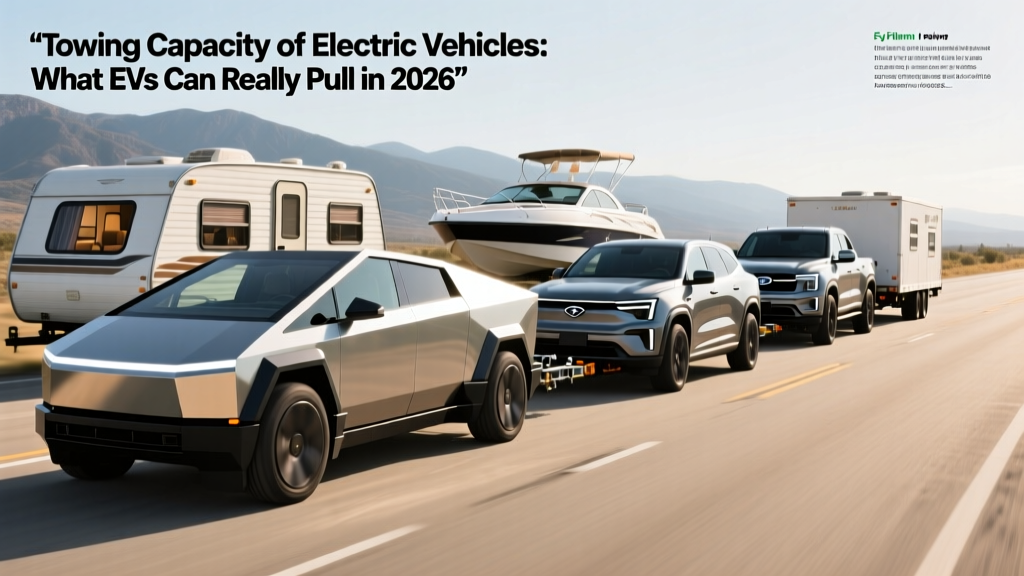
The towing capacity of electric vehicles in 2026 spans from 1,500 lbs (compact crossovers like the Hyundai Ioniq 5) to 13,000 lbs (Chevrolet Silverado EV). The most popular EV trucks — the Ford F-150 Lightning and Rivian R1T — max out at 7,700–11,000 lbs, rivaling mid-range gas half-tons. However, towing at max capacity typically cuts real-world EV range by 40–55% compared to EPA estimates, making trip planning and charging logistics the true differentiator versus gas trucks.
Electric motors deliver peak torque from zero RPM, giving EVs an inherent advantage in trailer acceleration and low-speed maneuvering. But towing exposes the energy-density gap between batteries and gasoline in stark terms. A gallon of gas holds roughly 33.7 kWh of energy and weighs 6.3 lbs; a 130 kWh battery pack stores the same energy but weighs over 1,200 lbs. That physics reality shapes everything below — from which EV can pull your boat to what your fuel savings actually look like when a 6,000-lb travel trailer is on the hitch.
EV Towing Capacity by Model: The 2026 Lineup
Here is the current landscape of electric vehicles rated for towing, organized by vehicle class. All figures reflect manufacturer-published maximum towing capacities for properly equipped models.
| Vehicle | Class | Max Tow (lbs) | Battery (kWh) | EPA Range (mi) | Est. Range Towing (mi) | MSRP (base tow-equipped) |
|---|---|---|---|---|---|---|
| Chevrolet Silverado EV 4WT | Full-size truck | 13,000 | ~200 (Ultium, NMC) | 450 | ~200–250 | $55,000 |
| Ford F-150 Lightning (Ext. Range) | Full-size truck | 10,000 | 131 (NMC) | 320 | ~150–180 | $62,995 |
| Rivian R1T Dual-Motor Max | Mid-size truck | 11,000 | 141 (NMC) | 352 | ~160–200 | $87,900 |
| Tesla Cybertruck AWD | Full-size truck | 11,000 | ~123 (NMC) | 340 | ~170–200 | $81,895 |
| GMC Sierra EV Denali | Full-size truck | 12,000 | ~200 (Ultium, NMC) | 440 | ~220–260 | $99,495 |
| Hyundai Ioniq 5 (AWD w/tow pkg) | Mid-size SUV | 3,500 | 84 (NMC) | 290 | ~145–175 | $52,600 |
| Kia EV9 (AWD Land) | 3-row SUV | 5,000 | 100 (NMC) | 280 | ~140–170 | $65,395 |
| Volvo EX90 Twin Motor | 3-row SUV | 5,000 | 111 (NMC) | 300 | ~150–180 | $80,595 |
| BMW iX xDrive50 | Mid-size SUV | 3,500 | 111.5 (NMC) | 324 | ~160–195 | $87,250 |
"Est. Range Towing" reflects real-world testing and owner reports showing 40–55% range reduction at highway speeds (65–70 mph) with a mid-weight trailer. Aerodynamic drag dominates above 50 mph — a boxy travel trailer hits harder than a low-profile utility trailer of equal weight.
EV vs. Gas Truck Towing: Torque, Range, and Cost Compared
The decision to tow with an EV versus a gas or diesel truck comes down to three competing factors: torque delivery, range under load, and cost per mile.
| Factor | EV Truck (F-150 Lightning Ext.) | Gas Truck (F-150 3.5L EcoBoost) | Diesel (F-250 6.7L Power Stroke) |
|---|---|---|---|
| Peak Torque | 775 lb-ft (instant) | 500 lb-ft | 1,200 lb-ft |
| Max Tow Capacity | 10,000 lbs | 14,000 lbs | 20,000 lbs |
| Range (unloaded) | 320 mi (EPA) | ~480 mi (36-gal tank) | ~500 mi (48-gal tank) |
| Range (towing 7,000 lbs) | ~150–180 mi | ~250–300 mi | ~300–350 mi |
| Cost per Mile (towing) | ~$0.18–$0.28 (DC fast) | ~$0.30–$0.40 | ~$0.28–$0.38 |
| Refuel/Recharge Time (towing range) | 45–60 min (10–80% at 150+ kW) | 5–8 min | 5–8 min |
| Trailer Sway Control | Standard (software-based) | Available | Available |
The EV's instant torque is genuinely useful — merging onto a highway with a 5,000-lb trailer feels effortless in an F-150 Lightning or Rivian R1T, with no downshift hunting or turbo spool-up delay. But the range gap under load is severe. A gas truck that loses 30–40% of its range while towing still has 250+ miles between fill-ups. An EV truck in the same scenario may need a charge every 150 miles, and DC fast charging a 131 kWh pack from 10–80% at a 150 kW station takes 45–60 minutes — not counting the time to navigate a large truck-and-trailer through a charging station not designed for rigs.
Real-World Towing Range: Why the EPA Number Drops by Half
The single biggest shock for first-time EV towers is range loss. Multiple independent tests — including those by EPA's fueleconomy.gov methodology and real-world towing loops by automotive reviewers — consistently show the following pattern:
- Light trailer (1,500–3,000 lbs, low-profile): 20–30% range loss
- Medium trailer (4,000–6,000 lbs, travel trailer): 40–50% range loss
- Heavy trailer (7,000+ lbs, boxy RV): 50–60% range loss
This isn't a defect — it's physics. Aerodynamic drag increases with the square of speed. A travel trailer essentially doubles the vehicle's frontal area, and at 70 mph, the energy required to push that combined shape through the air dwarfs rolling resistance. Regenerative braking recovers far less energy with a trailer in tow because the combined mass requires longer stopping distances and the trailer's brakes (if equipped) don't feed energy back to the tow vehicle's battery.
Cold weather compounds this. Towing a 5,000-lb trailer at 65 mph in 30°F weather can push range loss to 60–65%, as the battery also diverts energy to thermal management. For this reason, if you plan to tow frequently in winter, an EV with a heat pump (standard on most 2026 trucks and SUVs) and a large battery pack (130+ kWh) is essential.
Cost Breakdown: Towing with an EV vs. Gas
The economics of EV towing depend heavily on where and how you charge. Home Level 2 charging at residential electricity rates is dramatically cheaper than gas. Public DC fast charging narrows the gap or even exceeds gas costs in some regions.
| Cost Category | EV Truck (Home L2 + Occasional DCFC) | Gas Truck (3.5L V6) | Diesel Truck (6.7L) |
|---|---|---|---|
| Purchase Price (tow-equipped) | $55,000–$88,000 | $50,000–$72,000 | $65,000–$90,000 |
| Federal Tax Credit (§30D) | Up to $7,500 (if eligible) | $0 | $0 |
| Energy Cost per Mile (unloaded) | $0.04–$0.06 (home) / $0.14–$0.20 (DCFC) | $0.18–$0.24 | $0.17–$0.22 |
| Energy Cost per Mile (towing) | $0.10–$0.15 (home) / $0.25–$0.35 (DCFC) | $0.30–$0.45 | $0.28–$0.40 |
| Maintenance (annual, towing use) | $200–$400 (tires, cabin filter, fluid top-offs) | $600–$1,000 (oil, trans fluid, filters) | $700–$1,200 (oil, DEF, fuel filters) |
| Brake Wear | Minimal (regen handles most deceleration) | Standard replacement every 30–50k mi | Standard replacement every 30–50k mi |
| Insurance (annual, towing use) | $1,800–$2,600 | $1,400–$2,000 | $1,500–$2,200 |
Over five years of mixed use (70% unloaded commuting, 30% towing), an F-150 Lightning owner charging primarily at home can save $4,000–$7,000 in energy and maintenance costs versus a gas F-150. However, insurance premiums for EV trucks run 15–30% higher on average, partially offsetting those savings. If you rely primarily on public DC fast charging while towing, the per-mile cost advantage shrinks to nearly zero.
Regarding the federal §30D clean vehicle credit: as of 2026, eligibility requires meeting MSRP caps ($80,000 for trucks/vans/SUVs), buyer income limits ($300,000 joint / $150,000 single AGI), and critical-mineral and battery-component sourcing requirements that change annually. The credit can now be transferred at point of sale to reduce the purchase price directly. Verify current-year eligibility with a tax professional before committing.
Charging Logistics While Towing: The Real Bottleneck
Range loss gets the headlines, but charging infrastructure is where EV towing either works or fails. Here's what first-time buyers must evaluate:
Trailer-Friendly Charging Stations Are Still Rare
Most public DC fast chargers are designed for passenger cars pulling into a standard parking space. Pulling a 20-foot trailer through a crowded Electrify America or EVgo station often means unhitching, finding a pull-through spot (increasingly available at newer stations and travel centers), or blocking multiple spaces. Networks like Tesla Supercharger and Electrify America have been adding pull-through stalls, but coverage is uneven — especially in rural corridors.
Charge Speed Matters More When Towing
When your usable range drops to 150 miles, you'll be charging more frequently. The difference between a truck that peaks at 150 kW (older platforms) versus 350+ kW (newer 800V architectures like the Silverado EV and Hyundai/Kia E-GMP) is significant:
- 150 kW peak: 10–80% in ~45 min (131 kWh pack)
- 250 kW peak: 10–80% in ~30 min
- 350 kW peak (800V): 10–80% in ~20 min
Remember that peak kW is not sustained kW. Most charge curves taper significantly above 80% State of Charge (SoC), and towing in hot weather can further reduce charge speed as the battery thermal management system diverts cooling capacity. Always precondition your battery (most EVs do this automatically when a charger is set in navigation) before arriving at a DC fast station.
Home Charging Is Non-Negotiable for Regular Towers
If you tow frequently, a home Level 2 charger (240V, 40–80 amps) is essential. Recharging a depleted 131 kWh battery overnight at 11.5 kW (48A) takes roughly 11–12 hours — enough to wake up with a full pack every morning. Relying solely on public charging for towing duty is expensive, time-consuming, and logistically painful.
Common EV Towing Myths vs. Facts
| Myth | Fact |
|---|---|
| "EVs can't tow heavy loads." | The Chevy Silverado EV tows 13,000 lbs and the F-150 Lightning tows 10,000 lbs — competitive with gas half-tons in the same class. |
| "Towing destroys the battery." | Towing increases cycle depth and heat generation, but modern liquid-cooled battery packs with active thermal management handle high-load discharge well. Battery degradation from occasional towing is minimal — expect 1–2% additional degradation over 100,000 miles vs. non-towing use. |
| "Regen braking doesn't work with a trailer." | Regen works, but effectiveness is reduced. The combined vehicle mass means more kinetic energy to manage, and the trailer's own brakes (electric or surge) handle a portion of deceleration. Most EV trucks automatically reduce regen aggressiveness when a trailer is detected. |
| "You need a special license to tow with an EV." | No. Standard driver's license towing endorsements (where required by state for trailers over 10,000 lbs) apply equally to EV and gas vehicles. |
| "EV tow ratings are inflated." | EPA and SAE J2807 testing standards apply to EVs the same as gas vehicles. However, some manufacturers rate tow capacity for the lightest trim — adding options and passengers reduces payload capacity, which affects the practical tow limit. |
Decision Framework: Should You Tow with an EV?
Choose an EV truck or SUV for towing IF:
- You tow 5 or fewer times per year (weekend boat trips, occasional camper haul) and primarily drive unloaded — the daily commuting savings offset the towing inconvenience
- You have home Level 2 charging and can wake up with a full battery every morning
- Your typical towing routes are under 200 miles round-trip or pass through corridors with reliable DC fast charging and pull-through stalls
- You value instant torque, quiet operation, and the ability to use the truck as a mobile power source (Pro Power Onboard in the F-150 Lightning provides up to 9.6 kW of 240V output — enough to power a camper or job site)
- You qualify for the §30D federal tax credit, narrowing the price gap with gas trucks
Stick with a gas or diesel truck IF:
- You tow frequently and long-distance (cross-country RV trips, weekly horse trailer hauls over 300 miles)
- Your towing routes pass through rural areas with sparse charging infrastructure
- You need over 10,000 lbs of tow capacity regularly — heavy-duty diesel trucks (F-250/350, Ram 2500/3500) still dominate here with 15,000–22,000 lb ratings and 300+ mile range under load
- You cannot install a home charger (apartment, no garage, electrical panel limitations)
- Time is money — commercial towers who can't afford 30–60 minute charging stops during a workday
What First-Time EV Buyers Should Know About Towing
If you're considering an EV specifically because you want a daily driver that can also tow on weekends, here are the practical realities to budget for:
- Buy more battery than you think you need. If your trailer cuts range by 50%, a 320-mile EPA truck becomes a 160-mile truck with a trailer. Choose the largest battery option available (extended range, max pack) even if your unloaded commute doesn't require it.
- Invest in a quality home Level 2 charger. A 48-amp hardwired unit (like the ChargePoint Home Flex or Emporia Level 2) on a 60-amp circuit delivers ~11.5 kW — enough to fully recharge most EV trucks overnight. Budget $800–$1,500 for equipment and licensed electrician installation, plus potential panel upgrade costs ($1,000–$3,000 if you need a 200-amp service upgrade).
- Get a weight-distribution hitch. EV trucks are heavy (F-150 Lightning: ~6,200 lbs curb weight), but proper weight distribution and sway control remain critical for safe towing. The added mass of the battery pack does not eliminate the need for hitch setup.
- Plan charging stops before you leave. Use apps like A Better Routeplanner (ABRP) with your trailer profile to simulate range and identify DC fast chargers along your route that can accommodate a truck-and-trailer combination.
- Factor in tire costs. EV trucks are heavy and produce instant torque. Expect tire replacement every 25,000–35,000 miles under mixed towing use, at $250–$400 per tire for LT-rated rubber.
Frequently Asked Questions
Can an electric vehicle tow a travel trailer?
Yes. Mid-size and full-size EV trucks (Rivian R1T, F-150 Lightning, Silverado EV) can tow travel trailers in the 4,000–8,000 lb range. However, expect 40–55% range reduction at highway speeds, and plan charging stops accordingly. A travel trailer's boxy aerodynamics cause more range loss than a low-profile utility trailer of the same weight.
Does towing reduce an EV's battery lifespan?
Minimally. Modern EV battery packs use active liquid cooling that manages heat during high-load discharge. Occasional towing adds negligible degradation — studies and owner data suggest 1–2% additional capacity loss over 100,000 miles. Battery warranties typically cover 8 years/100,000 miles with a 70% capacity retention threshold, and towing does not void this warranty.
What is the best EV for towing a boat?
For boats under 5,000 lbs, the Ford F-150 Lightning Extended Range offers the best combination of tow capacity (10,000 lbs), range (320 mi EPA), and value ($62,995 base for the extended-range XLT). For lighter boats under 3,500 lbs, the Hyundai Ioniq 5 with the factory tow package (3,500-lb rating, $52,600) is a practical crossover option.
Can you charge an EV while a trailer is hooked up?
Yes, but access depends on the charging station. Pull-through stalls at newer Supercharger and Electrify America locations allow you to charge without unhitching. At standard pull-in stalls, you'll need to unhitch or position carefully. Plan ahead using station photos on PlugShare or the network's app.
How does payload affect EV towing capacity?
Every pound of payload (passengers, cargo in the bed/cabin) reduces available tow capacity. The F-150 Lightning's max payload is ~1,800 lbs. If you have four passengers and bed cargo totaling 1,200 lbs, your practical tow capacity drops accordingly. Always calculate Gross Combined Weight Rating (GCWR) — the manufacturer's maximum for vehicle + passengers + cargo + trailer combined.
Are there electric heavy-duty trucks for towing over 15,000 lbs?
Not in the consumer market as of 2026. The Silverado EV's 13,000-lb rating is the consumer ceiling. For 15,000+ lb towing (large fifth wheels, horse trailers, commercial loads), diesel heavy-duty trucks (F-350, Ram 3500) remain the practical choice with ratings up to 22,000+ lbs and established refueling infrastructure.