The Totaled Cybertruck Problem: Why Repair Costs Are Skyrocketing
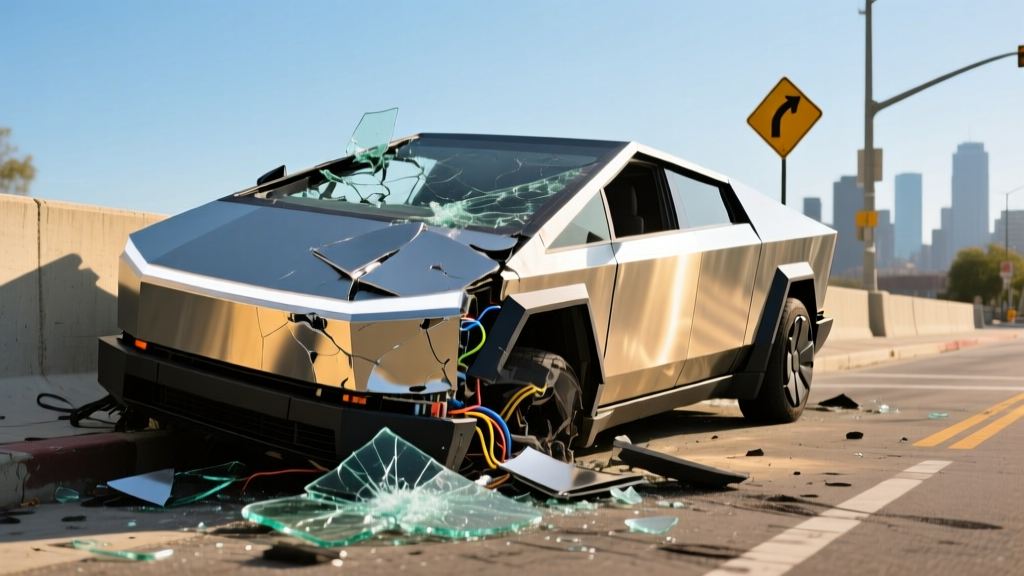
Search "totaled Cybertruck" and you'll find a growing gallery of mangled stainless steel — front-end collisions, rollovers, and parking-garage mishaps that turn Tesla's angular truck into an insurance write-off. The Cybertruck's exoskeleton design, while visually striking, creates unique repair challenges that are pushing insurance premiums higher and total-loss thresholds lower than many buyers anticipated.
This isn't just about crash aesthetics. The Cybertruck's cold-rolled stainless steel body panels can't be bent back into shape like conventional aluminum or steel. Tesla's own repair guidelines often mandate full panel replacement rather than repair, and the integrated structural battery pack means even moderate undercarriage damage can trigger a total-loss declaration. For a vehicle starting at $79,990, that math gets ugly fast.
| Specification | AWD (Dual-Motor) | Cyberbeast (Tri-Motor) |
|---|---|---|
| EPA Range | 340 miles | 320 miles |
| Battery (usable) | ~123 kWh, NMC | ~123 kWh, NMC |
| 0-60 mph | 3.9 sec | 2.6 sec |
| Horsepower | 600 hp | 845 hp |
| Peak DC Charge Rate | 250 kW | 250 kW |
| 10-80% DC Time | ~28 min | ~28 min |
| Level 2 Charge Rate | 11.5 kW (~34 mi/hr) | 11.5 kW (~34 mi/hr) |
| Towing Capacity | 11,000 lbs | 11,000 lbs |
| Base MSRP | $79,990 | $99,990 |
Real-World Range: What the EPA Number Doesn't Tell You
Tesla's claimed efficiency is approximately 2.0 kWh/mile (50 MPGe combined per fueleconomy.gov), which is poor by EV standards. For comparison, the Rivian R1T with the Large Pack achieves 73 MPGe combined. The Cybertruck's energy consumption means you'll spend more per mile charging than most EV owners — and on long road trips, you'll stop more often.
The practical implication for totaled-vehicle scenarios: a Cybertruck with battery damage isn't just losing a $20,000-$30,000 component. It's losing the structural core of a vehicle that already consumes more energy per mile than its competitors, making insurers quicker to declare it a total loss rather than risk a compromised battery pack in a heavy, high-torque vehicle.
Why Cybertrucks Get Totaled at Lower Damage Thresholds
Three engineering decisions make the Cybertruck more likely to receive a salvage title after a collision that a conventional truck might survive:
1. Stainless Steel Exoskeleton
The 30X cold-rolled stainless steel panels are ultra-hard (roughly 3x harder than conventional automotive steel) but cannot be reshaped once deformed. A fender-bender that wrinkles a panel requires full replacement. Tesla authorized repair centers stock limited panel inventory, driving up both cost and wait times.
2. Structural Battery Pack
The Cybertruck uses a structural battery pack that serves as a stressed member of the chassis. Any collision that transmits force through the floor pan — side impacts, undercarriage strikes, rollovers — can compromise cell integrity. Tesla's own service documentation mandates pack replacement if deformation sensors trigger, and a replacement pack runs $20,000-$30,000 before labor.
3. 48-Volt Architecture and Integrated Electronics
The Cybertruck pioneered a 48V low-voltage system (replacing the industry-standard 12V), with custom controllers and wiring harnesses. Water intrusion from flood damage or collision-related harness damage often requires full electrical system replacement rather than spot repairs.
Charging Speed and Infrastructure
The Cybertruck's 800V-class architecture supports up to 250 kW on DC fast chargers, though real-world charging curves tell a more nuanced story. Peak rate is only sustained between roughly 10-35% state of charge; above 60%, the curve tapers significantly. A 10-80% session takes approximately 28 minutes at a V3 Supercharger, but plan for 40+ minutes if you arrive at a lower state of charge or are using a non-Tesla 150 kW station.
| Charging Method | Power (kW) | Miles Added per Hour | Notes |
|---|---|---|---|
| Level 1 (120V outlet) | 1.4 kW | ~3-4 mi/hr | Emergency/trickle only |
| Level 2 (240V, 48A) | 11.5 kW | ~34 mi/hr | Full charge in ~11 hours |
| DC Fast (V3 Supercharger) | 250 kW peak | ~150 mi in 15 min | Curve tapers above 60% |
| DC Fast (CCS adapter, 150 kW station) | ~130 kW sustained | ~75 mi in 15 min | Adapter required for non-Tesla networks |
For home charging, a Wall Connector on a 60A circuit delivers the full 11.5 kW, adding roughly 34 miles of range per hour. Given the Cybertruck's high energy consumption, overnight charging from 20-80% takes approximately 7-8 hours — adequate for most daily use but slower than lighter EVs on the same circuit.
Pricing, Tax Credits, and Insurance Costs
The 2026 Cybertruck AWD starts at $79,990 (including destination), while the tri-motor Cyberbeast commands $99,990. Both trims exceed the IRS §30D MSRP cap of $80,000 for pickup trucks, meaning neither qualifies for the $7,500 federal tax credit at base price — though a minimally optioned AWD at exactly $79,990 technically clears the threshold if the buyer meets all other requirements.
| Trim | Base MSRP | §30D Credit Eligible? | Effective Price (if eligible) |
|---|---|---|---|
| AWD Dual-Motor | $79,990 | Barely — at base MSRP only, subject to income/sourcing rules | ~$72,490 |
| Cyberbeast Tri-Motor | $99,990 | No — exceeds $80K truck cap | $99,990 |
Even for the AWD at base price, eligibility requires the buyer to fall under IRS income caps ($150K single / $300K joint), and the vehicle must meet critical-mineral and battery-component sourcing requirements that shift annually. Per IRS.gov §30D guidelines, always verify eligibility with a tax professional before purchase.
Insurance: The Real Cost Shock
Insurance premiums for the Cybertruck average 40-60% higher than comparable trucks like the Ford F-150 Lightning or Rivian R1T. Industry data from major carriers shows annual premiums in the $3,200-$5,000 range for the AWD trim, driven by the total-loss dynamics described above. Some owners report quotes exceeding $6,000/year in high-density urban areas. Tesla Insurance is available in many states and may offer competitive rates for drivers with clean records and high Safety Scores, but it is not universally available.
Who Should (and Shouldn't) Buy a Cybertruck
- You need 11,000-lb towing and a 6-foot bed with a powered tonneau cover
- You want tri-motor performance (Cyberbeast's 2.6-sec 0-60 is supercar territory)
- You have garage/home charging and mostly drive in regions with robust Supercharger coverage
- You accept higher insurance costs and potential total-loss risk as a trade-off for the design
- Efficiency matters — the Rivian R1T and F-150 Lightning use significantly less energy per mile
- You live in an area with limited Tesla body-shop authorization (repair wait times stretch months)
- You need proven long-term reliability data (the platform launched in late 2023)
- Insurance quotes in your area push total ownership cost beyond your budget
Pros and Cons at a Glance
- Best-in-class towing at 11,000 lbs among electric pickups
- Cyberbeast performance is unmatched (845 hp, 2.6 sec 0-60)
- Stainless exoskeleton resists minor scratches and dents
- Supercharger network access (most reliable DC network in the US)
- Frunk + vault + sail-pillar storage offers flexible cargo options
- High total-loss probability due to structural battery + unibody design
- Poor efficiency (~2.0 kWh/mile) means higher charging costs
- Insurance premiums 40-60% above segment average
- Limited authorized body shops create long repair wait times
- No federal tax credit on Cyberbeast; borderline on AWD base
Warranty Coverage
Tesla covers the Cybertruck with a 4-year/50,000-mile limited vehicle warranty and an 8-year/120,000-mile battery and drive unit warranty (whichever comes first). The battery warranty guarantees retention of at least 70% of original capacity over the coverage period. Given the truck's ~123 kWh NMC pack, that means Tesla will address degradation below ~86 kWh within the warranty window.
Notably, the stainless steel body panels carry the same 4-year/50,000-mile corrosion warranty, though the 30X alloy is inherently resistant to traditional rust. Cosmetic issues like surface staining or fingerprint etching are not covered.
Frequently Asked Questions
What is the real-world range of the Cybertruck?
The EPA rates the AWD at 340 miles and the Cyberbeast at 320 miles. In real-world highway driving at 70-75 mph, expect 270-290 miles (AWD) and 250-270 miles (Cyberbeast). Cold weather (below freezing) can reduce range an additional 20-30%, bringing effective winter highway range down to 200-230 miles for the AWD.
How fast does the Cybertruck charge?
On a Tesla V3 Supercharger, the Cybertruck peaks at 250 kW and charges from 10-80% in approximately 28 minutes. On a Level 2 home charger (240V, 48A), it charges at 11.5 kW, adding about 34 miles of range per hour. A full Level 2 charge from near-empty takes about 11 hours.
How much does a Cybertruck cost after tax credits?
The AWD starts at $79,990 — technically under the $80,000 IRS truck cap, so it may qualify for the $7,500 §30D credit if the buyer meets income limits ($300K joint / $150K single) and the vehicle satisfies battery-sourcing requirements. The Cyberbeast at $99,990 does not qualify. Verify current-year rules at IRS.gov before relying on credit eligibility.
Why do so many Cybertrucks get totaled?
The combination of a structural battery pack (expensive to replace if compromised), stainless steel panels that cannot be reshaped (requiring full replacement), and a high base MSRP means that moderate collisions often exceed the total-loss threshold set by insurers. A $15,000-$20,000 repair bill on an $80,000 vehicle triggers a salvage title more readily than on a cheaper truck.
Is the Cybertruck worth buying vs. the F-150 Lightning or Rivian R1T?
It depends on your priorities. The Cybertruck offers best-in-class towing (11,000 lbs vs. the Lightning's 10,000 lbs and the R1T's 11,000 lbs) and unmatched Cyberbeast performance. However, the F-150 Lightning is significantly more efficient, cheaper to insure, has broader body-shop support, and qualifies for the full $7,500 tax credit on multiple trims. The Rivian R1T offers superior efficiency, a more refined interior, and established repair networks. If you prioritize design, Tesla's Supercharger network, and raw performance, the Cybertruck is compelling — but factor in the insurance premium and total-loss risk before signing.
Does the Cybertruck qualify for the federal EV tax credit?
The AWD Dual-Motor at its $79,990 base MSRP technically falls under the IRS §30D cap of $80,000 for pickup trucks, making it potentially eligible for up to $7,500. The Cyberbeast at $99,990 does not qualify. All buyers must also meet modified adjusted gross income limits, and the vehicle must satisfy critical-mineral and battery-component sourcing thresholds that change annually. Point-of-sale transfer is available at participating dealers. Always confirm with a tax professional.