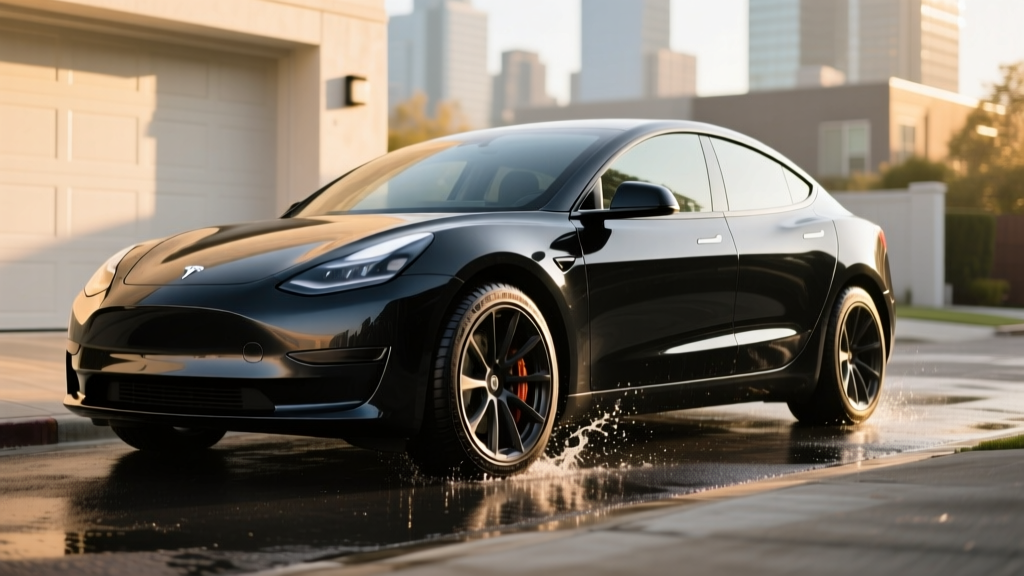
Your Tesla Model 3's tires are the single most underrated variable in its range, efficiency, and ride character. Swap from the factory rubber to a higher-rolling-resistance set and you can lose 10-20 miles of EPA-rated range. Go the other direction with a low-rolling-resistance touring tire and you might claw back a few miles at the cost of wet grip or treadwear. Below, we break down the best tires for Tesla Model 3 variants (RWD, Long Range AWD, and Performance), explain how tire choice interacts with the car's weight, instant torque, and regen braking, and reconcile the Model 3's EPA range with what you'll actually see once you roll off the lot on fresh rubber.
2026 Tesla Model 3: Quick Specs Before You Shop Tires
Before picking tires, anchor your expectations to the car's actual mass, powertrain, and efficiency envelope. The current-generation Model 3 ("Highland" refresh) carries over into 2026 with three trims. Here's what you're putting rubber under:
| Spec | RWD | Long Range AWD | Performance |
|---|---|---|---|
| EPA Range | 272 mi | 363 mi | 315 mi |
| Battery (usable) | ~57.5 kWh LFP | ~77 kWh NMC | ~77 kWh NMC |
| Motor / Drivetrain | Single rear, RWD | Dual-motor AWD | Dual-motor AWD |
| Horsepower | ~271 hp | ~346 hp | ~510 hp |
| 0-60 mph | 5.8 sec | 4.2 sec | 2.9 sec |
| Efficiency (MPGe) | 132 MPGe | 131 MPGe | 116 MPGe |
| Curb Weight | ~3,862 lb | ~4,034 lb | ~4,065 lb |
| Factory Wheel Sizes | 18" / 19" | 18" / 19" | 19" / 20" |
| Base MSRP | $38,990 | $44,990 | $52,990 |
Why Tires Matter More on a Model 3 Than a Gas Car
Three EV-specific traits amplify tire choice on the Model 3:
- Instant torque, heavy curb weight. A 4,000-lb sedan with 300+ lb-ft available at 0 rpm scrubs tread faster than a similarly sized ICE sedan. Expect 25,000-35,000 miles on performance summer tires, 40,000-55,000 on grand-touring all-seasons.
- No engine noise. Road noise dominates the cabin. Tires with acoustic foam liners (Michelin Acoustic, Pirelli PNCS, Continental ContiSilent) measurably reduce interior dB at highway speed.
- Range sensitivity to rolling resistance. Tesla's factory Michelin Pilot Sport EV and Hankook iON evo are tuned for low CRR (coefficient of rolling resistance). Switching to a conventional UHP tire of the same size can cost 10-15 miles of range per charge — meaningful on road trips, invisible on a commute.
For the full efficiency baseline, cross-reference the official DOE Fuel Economy EV guide before shopping.
Best Tires for Tesla Model 3 by Use Case
Best for Maximum Range: Michelin e.Primacy
Michelin's EV-focused touring tire is the lowest-rolling-resistance option widely available in 235/45R18 and 235/40R19. Independent tests show a 4-7% efficiency gain over standard UHP rubber — roughly 12-20 miles of recovered range on a Long Range AWD. Trade-offs: softer sidewall, less aggressive cornering grip, and a speed rating (H or V) below what the Performance trim can exploit. Ideal for RWD and Long Range commuters who prioritize kWh/100mi over lap times.
Best All-Around: Michelin Pilot Sport EV
This is the OE tire on many Long Range and Performance Model 3s for good reason. It balances low rolling resistance with genuine dry/wet grip, carries an Acoustic foam variant for noise reduction, and handles the car's mass under hard regen without excessive squirm. Available in 18"-20" fitments. Treadwear typically lands around 35,000-45,000 miles on a Model 3 — shorter than the UTQG suggests, because EV weight and torque punish shoulders.
Best for Wet & Snow: Continental ExtremeContact DWS 06 Plus
A three-peak mountain snowflake (3PMSF)-rated all-season that actually handles light winter duty without a dedicated winter set. Slightly higher rolling resistance than the Pilot Sport EV (budget ~5-8 miles of range loss vs. OE), but class-leading wet braking and confident cold-weather behavior. A smart pick for Model 3 owners in the Midwest and Northeast who don't want to swap to dedicated winters.
Best for Performance Trim: Pirelli P Zero PZ5 (Tesla-marked T0/T1)
Tesla-homologated P Zeros carry the T0 or T1 sidewall marking, meaning Pirelli tuned the compound and casing specifically for Model 3 Performance weight and suspension tuning. PNCS acoustic foam is standard on these fitments. Expect maximum dry grip, excellent steering response, and ~20,000-30,000 miles of tread life if you actually use the car's 510 hp. This is the tire to run if you care about the 2.9-second 0-60 and track-day capability.
Best Value: Hankook iON evo
Hankook's EV-native tire punches well above its price, offering low rolling resistance, acoustic foam, and competitive wet grip at roughly 20-30% less than Michelin or Pirelli. It's increasingly OE on European-market Teslas and is a strong replacement option for cost-conscious owners. Treadwear is a slight step down from the Pilot Sport EV, but cost-per-mile often wins.
Tire Size, Wheel Size, and the Range Penalty
The Model 3's 18" Aero wheel with 235/45R18 tire is the efficiency king. Moving to the 19" Sport wheel (235/40R19) typically costs 15-25 EPA miles on Long Range AWD. The 20" Performance wheel (235/35R20) on the Performance trim drops range further, to 315 EPA miles from a 340+ mi baseline on 18s.
| Wheel | Tire Size | EPA Range | Efficiency | Trade-off |
|---|---|---|---|---|
| 18" Aero | 235/45R18 | 363 mi | ~25 kWh/100mi | Best range, softer ride |
| 19" Sport | 235/40R19 | 338 mi | ~27 kWh/100mi | Sharper handling, more road noise |
| 20" (Perf) | 235/35R20 | 315 mi | ~29 kWh/100mi | Max grip, harsher ride, highest tire cost |
If you're considering upsizing for looks, know that every 10 lb of added unsprung weight per corner costs roughly 1-2% efficiency and degrades ride quality noticeably.
Charging, Range, and the Tire Swap Interaction
Tire rolling resistance doesn't just change the EPA sticker — it changes your charging behavior on road trips. A 5% efficiency penalty means 5% more time at Superchargers over a 1,000-mile trip. Here's the Model 3's charging baseline to plan around:
| Charging Type | Peak Rate | Time / Rate |
|---|---|---|
| DC Fast Charge (Supercharger V3/V4) | ~250 kW (LR/Perf), ~170 kW (RWD) | 10-80% in ~25-30 min (LR/Perf) |
| Level 2 Home (11.5 kW onboard) | 11.5 kW | ~44 mi/hr; full charge in 7-9 hr |
| Level 1 (120V household) | ~1.4 kW | ~5 mi/hr; emergency/top-up only |
Long Range and Performance trims use NMC chemistry with an 80% daily charge recommendation; the RWD's LFP pack can (and should) be charged to 100% regularly for accurate BMS calibration. See Tesla's official battery care guidance.
Pricing, Tax Credits, and Total Tire Ownership Cost
Tire cost over 5 years/60,000 miles is non-trivial on a Model 3. Budget accordingly:
| Tire Type | Per-Tire Cost | Sets Needed | 5-Yr Total |
|---|---|---|---|
| OE UHP (Pilot Sport EV, P Zero) | $280-$360 | 1.5-2 sets | $1,700-$2,900 |
| EV Touring (e.Primacy, iON) | $220-$290 | 1-1.5 sets | $900-$1,750 |
| Performance Summer (Cup 2, P Zero Trofeo) | $350-$450 | 2+ sets | $2,800-$3,600+ |
On the vehicle itself, the 2026 Model 3 Long Range AWD and Performance trims typically qualify for the full IRS §30D federal EV tax credit (up to $7,500), provided buyer income stays under $150k single / $300k joint, and the vehicle is assembled in North America with compliant battery sourcing. The RWD trim's credit eligibility fluctuates with battery-sourcing rules — always verify on the IRS clean vehicle credit page or with your tax professional before purchase. The point-of-sale transfer option lets you apply the credit as a down payment reduction at delivery.
Warranty, Maintenance, and EV-Specific Tire Care
Tesla's vehicle warranty covers 4 years/50,000 miles bumper-to-bumper and 8 years/120,000 miles (Long Range/Performance) or 8 years/100,000 miles (RWD) on the battery and drive unit. Tires are covered by the tire manufacturer, not Tesla — keep your purchase receipts.
EV-specific tire maintenance rules:
- Rotate every 6,000-7,500 miles. AWD Model 3s wear rear tires faster under hard acceleration; RWDs wear rears faster under regen and acceleration combined. Skipping rotation shaves 20-30% off tire life.
- Alignment checks annually. Tesla's factory alignment specs are aggressive for handling; even minor curb contact can push toe out of spec and cause rapid inner-shoulder wear.
- Cold pressures matter more on EVs. Check pressures monthly; a 3 psi drop costs ~1% range and accelerates shoulder wear. Target the door-jamb placard pressure, not the tire sidewall max.
- Acoustic foam tires require specific repair procedures. Not every tire shop can patch a foam-lined tire correctly. Confirm before buying.
Who the Model 3 Suits — and Which Tire Matches That Use Case
- Commuters covering 40-150 miles/day who want max efficiency (RWD + e.Primacy)
- All-weather daily drivers in snow-belt states (Long Range AWD + Continental DWS 06 Plus)
- Driving enthusiasts who autocross or track the car (Performance + P Zero or Cup 2)
- Tech-forward buyers who want OTA updates, Supercharger access, and a minimalist cabin
- You need more than 23 cu ft of cargo space (Model Y offers 76 cu ft)
- You regularly carry 4 adults on long trips — rear headroom is tight for 6-footers
- You tow — Model 3 is not rated for towing in the US
- You want Apple CarPlay/Android Auto (Tesla uses its own UI exclusively)
Frequently Asked Questions
What is the real-world range of the Tesla Model 3?
EPA ratings are 272 mi (RWD), 363 mi (Long Range AWD), and 315 mi (Performance). In real-world mixed driving at 65-75 mph with mild weather, expect 85-95% of EPA. In sub-freezing winter, budget 70-80% of EPA, especially on short trips where cabin heat cycles on and off. Tire choice can shift these figures ±5-8%.
How fast does the Model 3 charge at home and on the road?
DC fast charging peaks at ~250 kW on Long Range and Performance (10-80% in roughly 25-30 minutes on a V3/V4 Supercharger), and ~170 kW on the RWD. Home Level 2 on a 48-amp circuit delivers up to 11.5 kW, or about 44 miles of range per hour — enough to refill overnight from any daily driving load.
Does the 2026 Model 3 qualify for the federal EV tax credit?
The Long Range AWD and Performance trims generally qualify for the full $7,500 §30D credit, subject to buyer income caps ($150k single / $300k joint), MSRP limits ($55k for sedans), and battery critical-mineral and North American assembly rules. The RWD's eligibility varies with sourcing — verify at irs.gov before committing. Credits can be transferred at point of sale as a down-payment reduction.
Is the Model 3 worth buying vs. competitors like the Hyundai Ioniq 6 or BMW i4?
Model 3 wins on Supercharger network access, software/OTA maturity, and efficiency per kWh. The Ioniq 6 undercuts on price and offers 800V architecture for faster peak charging. The BMW i4 delivers a more traditional luxury interior and CarPlay but costs more and has lower range per dollar. If Supercharger access and software are priorities, the Model 3 remains the benchmark in its class.
What are the biggest pros and cons of the Model 3?
Pros: class-leading efficiency, Supercharger network, rapid OTA improvements, strong safety ratings (NHTSA 5-star), low running costs. Cons: minimalist interior isn't for everyone, rear seat is snug for tall adults, no CarPlay/Android Auto, panel-gap variability, and tire wear is higher than comparable ICE sedans due to weight and torque.
Do I need Tesla-marked (T0/T1) tires?
No, but Tesla-homologated tires are tuned for the Model 3's specific weight distribution, suspension geometry, and noise targets. Non-marked equivalents from the same model line (Pilot Sport EV, P Zero PZ5) usually perform within a few percent, but you may notice small differences in NVH and steering feel.
Can I put all-season tires on a Model 3 Performance?
Yes. Many Performance owners swap to Continental DWS 06 Plus or Michelin Pilot Sport All-Season 4 for year-round usability. You'll sacrifice some dry grip and extend tread life significantly. Just confirm load rating (XL) and speed rating (Y or W) match the placard.