Quick Answer: Does a tiny electric boat qualify for EV tax credits?
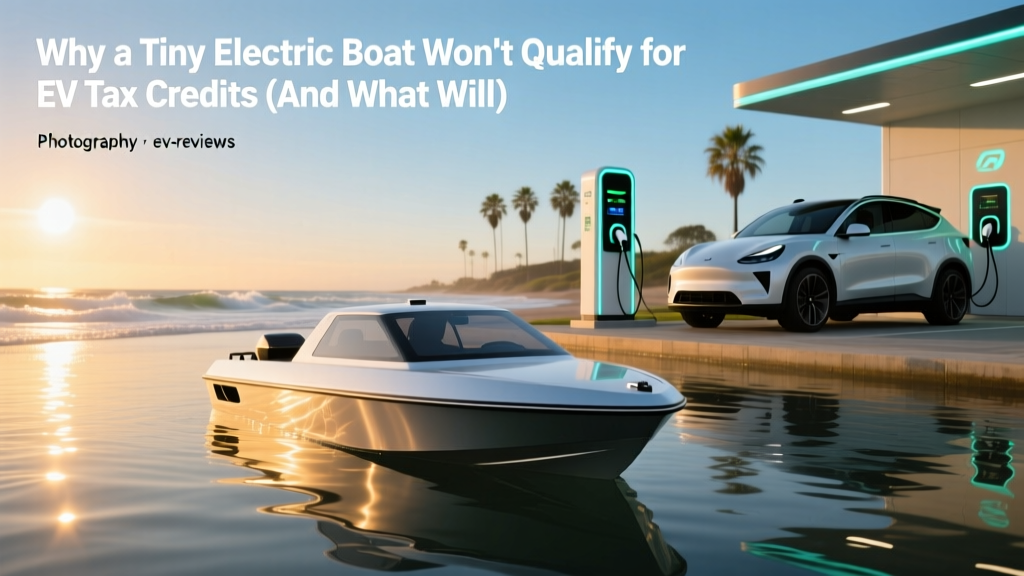
No. The federal §30D Clean Vehicle Credit applies exclusively to highway-capable, four-wheeled motor vehicles with a gross vehicle weight rating (GVWR) under 14,000 pounds. Electric boats, marine vessels, e-bikes, golf carts, and off-road vehicles are categorically excluded — regardless of battery size, price, or whether they're street-legal adjacent. If you're researching electric mobility options and came across "tiny electric boat," know that marine electrification falls outside both the tax credit framework and most EV charging infrastructure.
What the §30D Tax Credit Actually Covers
The IRS §30D Clean Vehicle Credit provides up to $7,500 for qualifying new plug-in electric vehicles and fuel cell vehicles purchased in 2026. The requirements are strict and specific:
- Vehicle type: Must be a four-wheeled, highway-capable vehicle (cars, SUVs, trucks, vans)
- GVWR: Under 14,000 lbs for the $7,500 credit; heavier commercial vehicles fall under §45W instead
- MSRP caps: Vans, SUVs, and pickups capped at $80,000; sedans and other body styles at $55,000
- Buyer income limits: Modified AGI ≤ $150,000 (single), $225,000 (head of household), $300,000 (married filing jointly)
- Battery sourcing: Critical minerals and battery components must meet escalating North American/free-trade-partner thresholds
- Final assembly: Must occur in North America
A tiny electric boat — whether a 10-foot dinghy with a Torqeedo outboard or a 20-foot pontoon — fails the first requirement immediately. It has zero wheels and isn't highway-capable. No exceptions exist for marine applications under §30D.
Electric Boats vs. Electric Cars: A Cost Reality Check
If you're weighing electric mobility purchases, here's how a typical tiny electric boat compares to an entry-level EV in 2026:
| Category | Tiny Electric Boat (e.g., 12-ft with 6 kW motor) | Entry-Level EV (e.g., 2026 Chevy Equinox EV LT) | Gas Car Baseline (2026 Honda Civic LX) |
|---|---|---|---|
| Purchase Price | $8,000–$18,000 (hull + motor + battery) | ~$33,600 MSRP | ~$24,000 MSRP |
| Federal Tax Credit | $0 (ineligible) | Up to $7,500 (if sourcing/income rules met) | $0 |
| Effective Price After Credit | $8,000–$18,000 | ~$26,100 | $24,000 |
| Battery Capacity | 3–10 kWh (typically LFP or lead-acid) | 85 kWh usable (NMC) | N/A |
| Range/Endurance | 10–25 miles at cruising speed | 315 mi EPA (real-world ~270 mi highway) | ~400 mi (35 MPG combined, 12.4-gal tank) |
| Charging/Fueling | 120V household outlet, 4–8 hours | Level 2 home (11.5 kW) or DC fast (150 kW peak) | Gas station, 3 minutes |
| Annual "Fuel" Cost | $50–$150 (electricity for seasonal use) | $550–$750 (12,000 mi/yr at $0.14/kWh) | $1,500–$1,800 (12,000 mi/yr at $3.30/gal) |
| Maintenance (Annual) | $200–$500 (winterization, impeller, lower unit) | $300–$500 (cabin filter, tire rotation, wipers) | $600–$900 (oil, filters, spark plugs, belts) |
The electric boat wins on annual energy cost, but it's a recreational purchase — not daily transportation. The EV, after the tax credit, approaches gas-car pricing while delivering 300+ miles of range and access to the full charging ecosystem.
Real-World Ownership: What First-Time EV Buyers Should Know
If your search for "tiny electric boat" reflects broader interest in electric vehicles, here's what separates EV ownership from gas-car assumptions:
Home Charging Is Non-Negotiable for Most Owners
Over 80% of EV charging happens at home. A Level 2 (240V) home charger adds 25–40 miles of range per hour, depending on the vehicle's onboard charger (typically 7.2–11.5 kW). Installation costs vary:
- Best case: $500–$1,200 if your panel has capacity and the run is short
- Typical: $1,200–$2,500 with a 50-amp circuit and moderate wire run
- Panel upgrade needed: $2,500–$5,000+ if you're adding a 200-amp service
Without home charging, you're reliant on public Level 2 stations ($0.20–$0.40/kWh) or DC fast chargers ($0.35–$0.60/kWh), which erodes the fuel-cost advantage and adds time overhead.
Cold Weather Cuts Range 20–40%
Lithium-ion batteries lose efficiency below freezing. A vehicle rated at 300 miles EPA may deliver 180–240 miles at 20°F, depending on whether it has a heat pump (which reduces HVAC energy draw by ~50%). If you live in northern climates, budget for real-world winter range, not the sticker.
Charging Speed Isn't Linear
A "250 kW capable" EV doesn't charge at 250 kW for the entire session. Most vehicles peak between 10–30% state of charge, then taper. A typical 10–80% session at a 150 kW DC fast charger takes 20–30 minutes, but 80–100% can take another 30+ minutes due to cell-balancing and thermal limits. Plan road trips around 10–80% charges.
Decision Framework: What Should You Actually Buy?
If your goal is... Then consider:
- Recreational boating on a lake: A tiny electric boat is a valid purchase — just don't expect tax incentives. Budget $10,000–$20,000 for a quality setup with a Torqeedo or ePropulsion motor and lithium battery pack.
- Daily commuting under 40 miles round-trip: A 2026 EV like the Chevy Equinox EV ($33,600, 315 mi EPA) or Hyundai Ioniq 5 ($42,500, 303 mi EPA) makes financial sense if you have home charging and meet §30D income/sourcing rules.
- Frequent long-distance travel (300+ mi trips monthly): A plug-in hybrid (PHEV) like the Toyota RAV4 Prime (42 mi electric-only, 38 MPG gas) offers flexibility without range anxiety, though the $7,500 credit no longer applies to PHEVs with small batteries under current sourcing rules.
- No home charging access (apartment/street parking): Delay the EV purchase or prioritize a PHEV. Public charging costs and time overhead make pure EV ownership frustrating without reliable home or workplace Level 2 access.
- Off-road or marine use only: Electric ATVs, UTVs, and boats exist but are niche products with no federal incentives. Evaluate them as recreational purchases, not transportation investments.
Common Misconceptions About EV Credits and Electric Vehicles
| Myth | Fact |
|---|---|
| "Any electric vehicle qualifies for the $7,500 tax credit." | Only four-wheeled, highway-capable vehicles under 14,000 lbs GVWR, assembled in North America, with compliant battery sourcing, and sold under MSRP caps. Boats, e-bikes, and golf carts are excluded. |
| "EVs are always cheaper to own than gas cars." | EVs save on fuel and maintenance, but higher upfront costs, insurance premiums (+15–25% on average), and potential home charging installation ($1,200–$5,000) mean the break-even point is 5–8 years for most buyers. |
| "EV batteries need replacement after 5 years." | Modern NMC and LFP batteries are warrantied for 8 years/100,000 miles with a 70% capacity retention guarantee. Real-world degradation is typically 10–15% over 8 years. Replacement costs $8,000–$18,000 but is rarely needed within the warranty period. |
| "I can charge an EV from a standard 120V outlet quickly." | Level 1 (120V) charging adds 3–5 miles of range per hour. A full charge from empty takes 40–60+ hours. It's viable for PHEVs with small batteries (15–20 kWh) but impractical for BEVs with 70–100 kWh packs. |
| "Electric boats are just like electric cars but on water." | Marine electrification uses different motors (outboard/inboard), battery enclosures (waterproof, vibration-resistant), and charging standards. There's no marine equivalent to NACS/CCS fast charging, and no federal purchase incentives exist. |
The Bottom Line: Tiny Electric Boats vs. Highway EVs
If you're researching electric mobility and landed on "tiny electric boat," understand that marine EVs occupy a completely different category from highway electric vehicles. They share battery chemistry (increasingly LFP for marine use due to thermal stability) and electric motor principles, but the purchase decision, incentive landscape, and infrastructure are unrelated.
For highway transportation in 2026, EVs like the Equinox EV, Ioniq 5, and Tesla Model Y (starting at $44,990, 308 mi EPA) offer compelling value after the §30D credit — if you have home charging, meet income limits, and choose a model with compliant battery sourcing. Verify eligibility at fueleconomy.gov before purchasing, as the credit can now be transferred to the dealer at point of sale, reducing your out-of-pocket cost immediately.
For recreational boating, electric outboards are a legitimate upgrade from gas — quieter, zero exhaust fumes, lower maintenance — but evaluate them as you would any marine purchase: based on your lake, usage patterns, and budget, not federal tax policy.
Frequently Asked Questions
Can I get any tax credit for an electric boat or marine motor?
No federal tax credit exists for electric boats under §30D or any other current provision. Some states offer rebates for marine electrification (California's CARB has explored clean-marine incentives), but these are rare and jurisdiction-specific. Check your state's environmental agency for local programs.
What's the cheapest EV that qualifies for the full $7,500 credit in 2026?
The 2026 Chevy Equinox EV LT ($33,600 MSRP) and select trims of the Tesla Model 3 Rear-Wheel Drive ($38,990) remain eligible for the full credit, assuming the buyer meets income limits and the vehicle's battery sourcing complies with 2026 critical-mineral thresholds. Always verify on the IRS clean vehicle credit page before purchase.
Do electric boats use the same batteries as electric cars?
Sometimes. Marine applications increasingly use LFP (lithium iron phosphate) cells due to their thermal stability and longer cycle life — the same chemistry found in the Tesla Model 3 RWD and Ford F-150 Lightning Standard Range. However, marine battery packs are housed in waterproof, vibration-dampened enclosures and lack the sophisticated thermal management systems of automotive packs.
How long does a tiny electric boat battery last?
Quality marine lithium packs (LFP) are rated for 2,000–3,000 charge cycles before reaching 80% capacity. With seasonal use (50–100 cycles per year), that's 20–30 years of service life. Lead-acid marine batteries last 3–5 years with proper maintenance.
Is it worth buying an electric boat over a gas outboard?
For small lakes, no-wake zones, and fishing where silence matters, yes. Electric outboards (Torqeedo, ePropulsion) cost 2–3x more upfront but eliminate fuel, oil changes, and winterization of the lower unit. For high-speed or long-distance boating, gas remains more practical due to energy density and refueling speed.