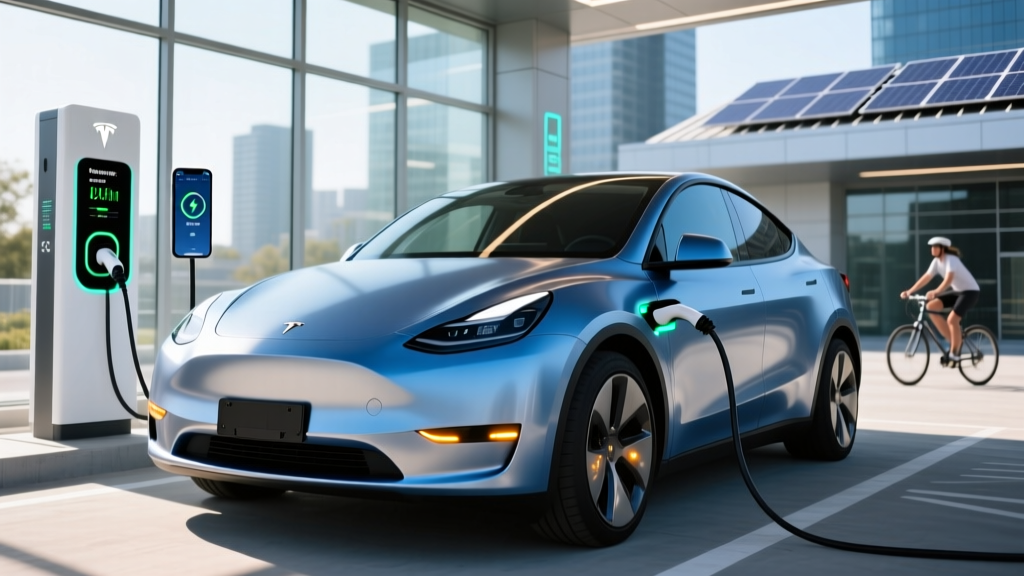
If you've searched for the time to recharge Tesla vehicles — specifically the best-selling Model Y — you've likely found conflicting numbers. Marketing materials quote peak charge rates, forums debate real-world taper, and home-charging speeds depend on your electrical panel. This review cuts through the noise with exact 2026 figures for the Tesla Model Y Long Range AWD, covering DC fast charging, Level 2 home replenishment, real-world range, pricing after federal incentives, and whether it still earns its spot against a growing list of rivals.
2026 Tesla Model Y at a Glance: Core Specifications
| Attribute | 2026 Tesla Model Y Long Range AWD |
|---|---|
| EPA Range | 320 miles |
| Battery (Usable) | ~75 kWh, NMC (2170 cells) |
| Max DC Fast Charge | 250 kW peak |
| 10–80% DC Fast Charge | ~25 minutes (preconditioned) |
| Level 2 Home Charge Rate | 11.5 kW (~44 mi/hr) |
| 0–60 mph | 4.8 seconds |
| Horsepower | 384 hp (dual motor) |
| Drivetrain | AWD (dual motor) |
| EPA Efficiency | 122 MPGe combined / 28 kWh/100 mi |
| Cargo Volume | 30.2 cu ft (rear seats up) / 72.1 cu ft (folded) |
| Base MSRP | $44,990 |
| Battery Warranty | 8 years / 120,000 miles |
Real-World Range: What the EPA Sticker Doesn't Tell You
The 2026 Model Y Long Range carries an EPA-estimated 320 miles of range. That number is a blended city/highway test cycle, and it's useful for comparison shopping — but your actual miles will vary based on speed, temperature, and terrain.
- City / moderate climate: 310–330 miles (regen braking recovers energy in stop-and-go traffic)
- Highway at 70–75 mph: 260–285 miles (aerodynamic drag dominates at sustained speed)
- Cold weather (below 32°F): 220–260 miles (battery resistance increases, cabin heating draws power — the heat pump helps but doesn't eliminate the penalty)
- Towing (up to 3,500 lbs): 160–200 miles (expect range cut roughly in half under load)
The Model Y uses a heat pump as standard equipment, which is a meaningful advantage over resistive heating in moderate cold (30–50°F). Below freezing, however, every EV loses range — and the Model Y's ~15–30% winter penalty is typical for the segment, not exceptional.
Time to Recharge Tesla Model Y: DC Fast, Level 2, and Level 1
Charging speed is where Tesla's Supercharger network advantage shows most clearly — but the raw numbers require context. Peak charge rate (250 kW) is not sustained charge rate. The battery management system tapers current as the state of charge (SoC) climbs to protect cell longevity.
| Charging Level | Power / Rate | Speed (Miles Added) | Typical Use Case |
|---|---|---|---|
| Level 1 (120V outlet) | ~1.4 kW | ~5 mi/hr | Emergency / overnight trickle (10–15 hrs for full) |
| Level 2 (240V, 48A Wall Connector) | 11.5 kW | ~44 mi/hr | Home daily charging (~7 hrs 10–80%) |
| DC Fast (V3 Supercharger) | 250 kW peak | ~200 mi in 15 min | Road trips (10–80% in ~25 min) |
| DC Fast (V4 Supercharger) | 250 kW peak (CCS-capable) | ~200 mi in 15 min | Same as V3; newer stalls with cable management improvements |
Understanding the DC Fast-Charge Curve
When Tesla advertises "up to 200 miles in 15 minutes," that assumes you arrive at a low state of charge (around 5–10%) with a preconditioned battery. Here's what actually happens during a typical Supercharger session:
- 5–30% SoC: Peak ~250 kW — the battery accepts maximum current
- 30–60% SoC: Tapers to ~150–180 kW — still fast, but declining
- 60–80% SoC: Drops to ~80–110 kW — noticeable slowdown
- 80–100% SoC: Dramatic taper to ~30–50 kW — charging above 80% on DC is painfully slow and generally not worth the wait on road trips
This is why the industry standard metric is 10–80% charge time, which lands at approximately 25 minutes for the Model Y at a V3 Supercharger with a preconditioned pack. Cold batteries that haven't been preconditioned (via the car's navigation routing to the charger) can add 5–10 minutes to that figure.
Home Level 2 Charging: The Daily Reality
Most Model Y owners do 90%+ of their charging at home. The Tesla Wall Connector (Gen 3) delivers up to 11.5 kW on a 60A circuit (48A continuous). At that rate, you'll add roughly 44 miles of range per hour — enough to fully replenish a daily commute in well under two hours.
Installation costs vary widely. A straightforward install near your electrical panel on a 200A service runs $500–$1,500 including the $400 Wall Connector. Older homes with 100A panels may need a $2,000–$4,000 service upgrade. Always get a quote from a licensed electrician before committing.
Pricing, Trims, and Federal Tax Credit Eligibility
The 2026 Model Y lineup has been streamlined. Here's where pricing stands before and after potential incentives:
| Trim | MSRP | §30D Credit Eligibility | Effective Price (if eligible) |
|---|---|---|---|
| Long Range AWD | $44,990 | Potentially up to $7,500 | ~$37,490 |
| Performance AWD | $48,990 | Potentially up to $7,500 | ~$41,490 |
Critical caveat on the federal §30D tax credit: Eligibility depends on three factors that change frequently:
- MSRP cap: SUVs must be priced at or below $80,000 — all Model Y trims qualify
- Buyer income cap: Modified AGI must not exceed $150,000 (single) / $300,000 (joint) — check your tax situation
- Battery sourcing: Critical minerals and battery components must meet escalating North American / free-trade-partner thresholds — Tesla's supply chain has been adapting, but partial credit ($3,750) vs full credit ($7,500) depends on the current sourcing percentage for the specific build month
- Point-of-sale transfer: As of 2024+, you can transfer the credit to the dealer at purchase, reducing your out-of-pocket cost immediately rather than waiting for tax filing
Because battery-sourcing rules tighten annually, confirm the exact credit amount for your delivery window with your tax professional and Tesla's current disclosures at the point of sale. Do not assume the full $7,500 without verification.
Performance, Efficiency, and Interior Practicality
The Long Range AWD's dual-motor setup produces 384 hp and a 4.8-second 0–60 mph time. That's brisk enough for confident highway merging and genuinely quick off the line, though the Performance trim (3.5 seconds) exists for those who want sports-sedan acceleration in a crossover.
Efficiency is where the Model Y continues to shine. At 122 MPGe combined (28 kWh/100 mi), it's among the most efficient electric SUVs available. For context, that translates to roughly $0.04–$0.06 per mile on average residential electricity ($0.15/kWh nationally), compared to $0.12–$0.16 per mile for a 28 MPG gas SUV at $3.50/gallon.
Interior Space and Cargo
The 2026 refresh brought a revised interior with improved materials and a second-row touchscreen. Cargo capacity remains a strong suit:
- Rear legroom: 41.6 inches (generous for adults)
- Cargo behind second row: 30.2 cu ft
- Cargo with seats folded: 72.1 cu ft (competitive with midsize gas SUVs)
- Frunk: Small front trunk for charging cables or a bag
Technology and Driver Assistance
The 15.4-inch center touchscreen handles all vehicle controls — there are no physical buttons for climate or mirrors, which some buyers love and others find frustrating. The infotainment system is responsive, with native navigation, streaming, and over-the-air updates that periodically add features.
Standard Autopilot includes adaptive cruise control and lane-keeping. Full Self-Driving (Supervised) remains an optional add-on (approximately $8,000 or $99/month subscription as of early 2026).
Despite the "Full Self-Driving" name, FSD (Supervised) is an SAE Level 2 driver-assistance system. You must keep your hands on the wheel, eyes on the road, and remain prepared to take over at any moment. It is not autonomous driving. Only Level 4 services like Waymo operate without a driver engaged.
Warranty Coverage and Battery Longevity
Tesla covers the Model Y's battery and drive units for 8 years or 120,000 miles (whichever comes first), with a guaranteed minimum 70% capacity retention over that period. The basic vehicle warranty is 4 years / 50,000 miles.
In practice, NMC battery packs in Tesla vehicles have shown degradation curves that flatten after the initial 5–10% loss in the first year or two. Real-world data from fleet aggregators suggests most Model Y packs retain 88–93% capacity at 100,000 miles — well above the warranty floor. To maximize longevity:
- Set daily charge limit to 80% (the car's software recommends this for NMC chemistry)
- Use DC fast charging primarily for road trips, not daily routine
- Avoid letting the battery sit at 100% SoC for extended periods, especially in heat
2026 Tesla Model Y: Pros and Cons
- Supercharger network remains the most reliable DC fast-charging ecosystem in North America
- Class-leading efficiency (122 MPGe) keeps per-mile cost low
- Strong cargo capacity (72.1 cu ft) and practical crossover form factor
- Over-the-air updates continuously improve the vehicle post-purchase
- 250 kW peak DC charging with ~25 min 10–80% time
- Heat pump standard for better cold-weather efficiency
- No physical buttons — all controls via touchscreen (polarizing)
- FSD (Supervised) remains Level 2 despite the name and price
- 250 kW peak charge rate is now matched or exceeded by Hyundai/Kia's 800V architecture (350 kW capable)
- Insurance costs tend to run 15–25% higher than comparable gas SUVs
- §30D credit eligibility depends on sourcing rules that shift — not guaranteed at $7,500
- Ride quality is firm; some competitors offer more compliant suspensions
Is the Model Y Still Worth It vs. the Competition?
The Model Y's competitive moat has narrowed. The Hyundai Ioniq 5 and Kia EV6 offer 800V architecture for faster peak charging (up to 350 kW at compatible stations, 10–80% in ~18 minutes). The Ford Mustang Mach-E provides a more conventional interior layout. The Chevrolet Equinox EV undercuts on price for buyers who don't need 320 miles of range.
Where the Model Y still wins: the Supercharger network's reliability and coverage remain unmatched for cross-country travel, even as Tesla has opened the network to NACS-equipped vehicles from other brands. The efficiency advantage means fewer kWh consumed per mile, saving money over ownership. And the cargo space / performance combination is hard to beat at the price point.
- You road-trip frequently and value Supercharger reliability
- You want maximum efficiency and lowest cost-per-mile
- You need crossover cargo space with EV performance
- Fastest possible DC charging is your priority (Ioniq 5 / EV6)
- You prefer physical buttons and a traditional cockpit (Mach-E, RAV4 EV alternatives)
- Budget is the primary driver and 250+ mile range suffices (Equinox EV)
Frequently Asked Questions
What is the real-world range of the 2026 Tesla Model Y?
The EPA estimates 320 miles for the Long Range AWD. In real-world driving, expect 260–285 miles on the highway at 70–75 mph, 310–330 miles in city conditions with regenerative braking, and 220–260 miles in freezing temperatures. Towing reduces range to roughly 160–200 miles.
How long does it take to recharge a Tesla Model Y on a road trip?
At a Tesla V3 or V4 Supercharger with a preconditioned battery, 10–80% takes approximately 25 minutes. Plan for 20–30 minute stops every 200–250 miles on highway trips. Charging above 80% is significantly slower and not recommended during road-trip stops.
How fast does the Model Y charge at home?
On a Level 2 Tesla Wall Connector (11.5 kW / 48A), the Model Y adds approximately 44 miles of range per hour. A full overnight session (8 hours) replenishes roughly 350 miles — more than the battery holds. Most daily commuters need only 1–2 hours of Level 2 charging.
Does the 2026 Tesla Model Y qualify for the $7,500 federal tax credit?
The Model Y's MSRP is below the $80,000 SUV cap, so it passes the price test. However, full $7,500 credit eligibility depends on your income (under $150K single / $300K joint AGI) and whether Tesla's battery meets the current-year critical minerals and component sourcing thresholds under IRS §30D rules. The credit amount can be $3,750 or $7,500 depending on sourcing compliance. Verify at point of sale and with a tax professional.
How does the Model Y's charging speed compare to rivals?
The Model Y peaks at 250 kW, which was class-leading when introduced but is now matched or exceeded by 800V-architecture vehicles like the Hyundai Ioniq 5 (up to 350 kW at compatible chargers, 10–80% in ~18 min). However, real-world charging also depends on charger availability — Tesla's Supercharger network still has a reliability edge over third-party networks.
Is the Model Y a good family vehicle?
Yes, for most families. Rear legroom (41.6 inches) accommodates child seats and adults comfortably. Cargo space (72.1 cu ft folded) handles strollers, groceries, and luggage. The main trade-offs are the touchscreen-only controls (distracting for some parents) and the firm ride quality on rough roads.
What is the total cost to charge a Model Y per month?
At the US average residential rate of ~$0.15/kWh and driving 1,000 miles/month (28 kWh/100 mi), expect approximately $42/month in home electricity. Public DC fast charging is more expensive ($0.30–$0.50/kWh), so road-trip months will cost more. For comparison, a 28 MPG gas SUV at $3.50/gallon would cost ~$125/month for the same mileage.