The Tiffany Blue Tesla Phenomenon: Style Meets Substance
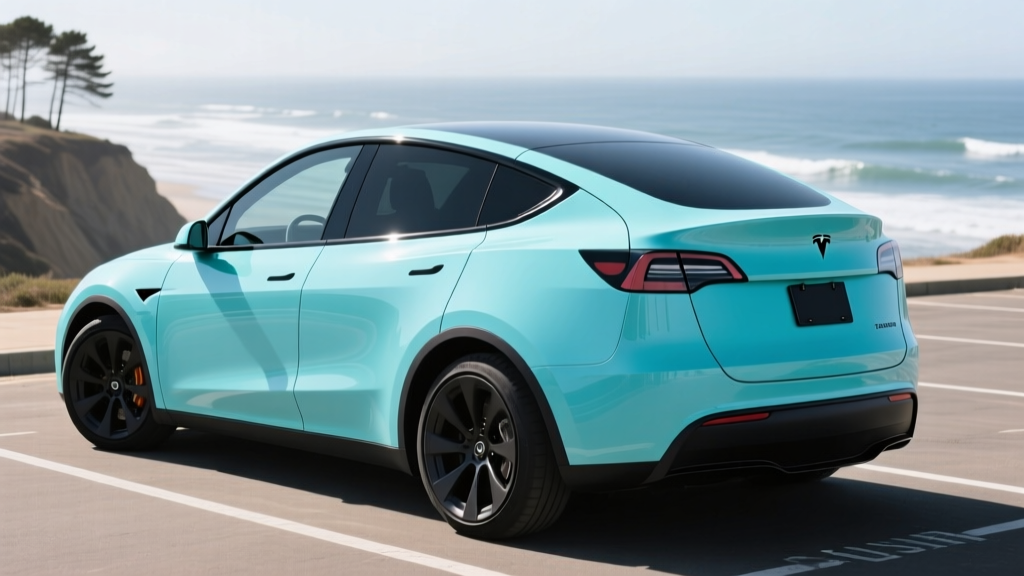
Search "Tiffany Blue Tesla" on any social platform and you'll find thousands of Model Y and Model 3 owners showcasing their cars wrapped in that iconic robin-egg turquoise. It's become one of the most requested colors at wrap shops nationwide — a pastel statement that turns Tesla's ubiquitous silhouette into a head-turner. But beneath that eye-catching vinyl sits one of the most data-dense EVs on the market. This review pairs the aesthetic phenomenon with a rigorous technical evaluation of the 2026 Tesla Model Y Long Range AWD, the variant most buyers choose before heading to the wrap shop.
We'll cover real-world range (not just the EPA sticker), charging curves at DC fast chargers, battery chemistry, federal tax credit eligibility under current IRS §30D rules, and whether the Model Y still holds up against a growing field of competitors. The wrap costs extra — the engineering underneath needs to justify the investment.
2026 Model Y Long Range AWD: Core Specifications
| Attribute | Value |
|---|---|
| EPA Estimated Range | 320 miles |
| Battery Capacity (usable) | ~75 kWh (NMC chemistry) |
| Drivetrain | Dual-Motor AWD |
| Horsepower | 384 hp combined |
| 0–60 mph | 4.8 seconds |
| Top Speed | 135 mph |
| Max DC Fast Charge Rate | 250 kW (peak) |
| 10–80% DC Fast Charge Time | ~25 minutes |
| Level 2 Home Charge Rate | 11.5 kW (~44 mi/hr) |
| EPA Efficiency | 122 MPGe combined / 28 kWh/100mi |
| Cargo Volume (rear seats up) | 30.2 cu ft |
| Cargo Volume (rear seats folded) | 72.1 cu ft |
| Rear Legroom | 41.6 inches |
| Base MSRP | $44,990 (before destination) |
| Battery Warranty | 8 years / 120,000 miles (70% retention) |
The 2026 Model Y Long Range AWD carries over the NMC (nickel manganese cobalt) battery pack architecture introduced with the Juniper refresh. Tesla does not publish exact usable kWh figures; the ~75 kWh estimate is derived from community telemetry and third-party teardowns. What matters more for daily ownership is how that capacity translates into miles and how quickly it replenishes.
Real-World Range: Beyond the EPA Sticker
Real-World Highway (70 mph, 72°F): ~275–290 miles
Real-World Mixed Commute (city + suburban): ~300–315 miles
Cold-Weather Highway (32°F, cabin heat on): ~230–255 miles
Hot-Weather Highway (95°F+, A/C max): ~280–295 miles
The EPA's 320-mile estimate assumes a blend of city and highway driving at moderate temperatures. In practice, highway-only driving at 70+ mph pushes aerodynamic drag higher and regenerative braking opportunities lower, cutting range by roughly 10–15%. Cold weather compounds this: lithium-ion cells lose efficiency below 40°F, and resistive cabin heating draws significant energy. The Model Y's standard heat pump helps mitigate winter losses compared to older resistive-heater EVs, but expect a 20–28% range reduction in freezing conditions.
For the Tiffany Blue Tesla owner planning a 250-mile highway commute in January, that means preconditioning the battery (via the Tesla app before departure) and keeping cabin temperature moderate are essential to arriving without a charge stop. In mild weather with mixed driving, hitting 300+ miles is routine.
Charging Speed: DC Fast, Level 2, and the Curve Reality
| Charging Level | Power (kW) | Speed (miles/hr) | Typical Use Case |
|---|---|---|---|
| Level 1 (120V household) | ~1.4 kW | ~5 mi/hr | Overnight trickle, emergency |
| Level 2 (240V, 48A) | 11.5 kW | ~44 mi/hr | Home daily charging |
| DC Fast (Tesla Supercharger V3/V4) | Up to 250 kW peak | Up to ~1,000 mi/hr (peak) | Road trips |
| DC Fast (CCS adapter, Electrify America) | Up to 250 kW peak | Up to ~1,000 mi/hr (peak) | Non-Tesla networks |
The charging curve matters more than peak kW. The Model Y Long Range hits its 250 kW peak only at low states of charge (roughly 5–15% SoC) and holds strong through about 40%. Above 50% SoC, the rate tapers to ~150 kW, and above 80%, it drops further to ~60–80 kW to protect battery longevity. The 10–80% time of approximately 25 minutes reflects this real-world curve, not a sustained 250 kW pull.
At home on a Level 2 Wall Connector (48 amps, hardwired to a 60-amp circuit), the Model Y adds roughly 44 miles of range per hour. An overnight session from 20% to 80% takes about 4 hours — more than sufficient for daily use. Tesla recommends charging to 80% daily for NMC batteries and reserving 100% charges for road trips to minimize long-term degradation.
Performance and Driving Dynamics
The dual-motor AWD powertrain delivers 384 horsepower and a 4.8-second 0–60 mph time. That's brisk enough to merge confidently onto any freeway and overtake without drama. The instant torque delivery — a hallmark of electric drivetrains — makes the Model Y feel quicker than the stopwatch suggests in city driving.
Ride quality improved substantially with the Juniper platform update: revised damping, acoustic glass, and improved isolation reduce the crashiness that plagued pre-2025 Model Y versions. The steering remains precise if artificially weighted, and the low center of gravity (battery pack under the floor) keeps body roll minimal through corners.
Driver Assistance: Tesla's Autopilot comes standard and is an SAE Level 2 system — meaning the driver must remain attentive with hands on the wheel at all times. Full Self-Driving (Supervised) is a $8,000 add-on (or $99/month subscription) that adds automated lane changes, traffic light recognition, and city street navigation, but it remains Level 2. The driver is always responsible. This is not autonomous driving.
Pricing, Tax Credits, and the Wrap Premium
| Item | Cost |
| Base MSRP (Long Range AWD) | $44,990 |
| Destination Fee | $1,390 |
| FSD (Supervised) Add-On | +$8,000 (optional) |
| Tiffany Blue Vinyl Wrap (professional) | $2,500–$5,000 |
| Paint Protection Film (PPF, optional) | +$1,500–$3,500 |
| Federal §30D Tax Credit (if eligible) | Up to –$7,500 |
Federal Tax Credit Eligibility (§30D): The 2026 Model Y Long Range AWD qualifies for the up-to-$7,500 federal clean vehicle credit — but only if you meet all current requirements:
- MSRP Cap: The vehicle's MSRP must not exceed $55,000 for sedans or $80,000 for SUVs/vans/pickups. The Model Y (classified as an SUV) clears this easily at $44,990 base.
- Buyer Income Cap: Modified adjusted gross income must not exceed $150,000 (single), $225,000 (head of household), or $300,000 (married filing jointly).
- Battery Sourcing: A percentage of critical minerals and battery components must be sourced from the U.S. or free-trade-agreement countries. Tesla's supply chain has progressively met these thresholds, but eligibility can shift — verify at fueleconomy.gov before purchasing.
- Point-of-Sale Transfer: As of 2024, buyers can transfer the credit to the dealer at purchase, reducing the upfront price rather than waiting for a tax refund. This effectively drops the Model Y's out-of-pocket cost to ~$38,880 before options.
The Tiffany Blue Wrap Cost: A professional full-body vinyl wrap in Tiffany Blue (or similar robin-egg turquoise — brands like 3M, Avery Dennison, and KPMF offer close matches) typically runs $2,500–$5,000 depending on shop, region, and vinyl quality. A cast-vinyl wrap with a 5–7 year lifespan from a reputable installer averages $3,500. Many owners add paint protection film (PPF) underneath the wrap for $1,500–$3,500 to preserve the factory paint for eventual resale.
Interior, Cargo, and Daily Practicality
The Juniper-refreshed Model Y interior is markedly more refined than earlier versions. Ventilated front seats, ambient lighting, a rear-seat touchscreen, and power-folding second-row seats are now standard on the Long Range trim. The 15.4-inch center touchscreen handles all infotainment, climate, and vehicle settings — there are virtually no physical buttons.
Cargo space is generous: 30.2 cubic feet behind the second row and 72.1 cubic feet with seats folded flat. The front trunk (frunk) adds additional storage for charging cables or a small bag. Rear legroom at 41.6 inches accommodates adults comfortably on longer trips — a meaningful advantage over compact EV crossovers.
Notable Drawbacks:
- No Apple CarPlay or Android Auto — Tesla's proprietary infotainment only
- Turn signal stalks removed (signals on steering wheel buttons) — polarizing among owners
- Minimal physical climate controls; everything requires screen interaction
- Rear visibility is compromised by the sloping roofline; the rear camera is essential
Pros, Cons, and the Verdict
Pros
- 320-mile EPA range with strong real-world highway efficiency
- 250 kW peak DC charging with extensive Supercharger network access
- Spacious cargo area (72.1 cu ft) and comfortable rear seating
- Eligible for up to $7,500 federal tax credit (with caveats)
- Over-the-air updates continuously add features
- Heat pump standard — better cold-weather range retention
- Strong resale value relative to EV market averages
Cons
- NMC battery requires 80% daily charge limit for longevity
- No phone integration (CarPlay/Android Auto)
- Steering-wheel turn signals require adjustment period
- Insurance premiums run 15–30% higher than comparable ICE crossovers
- Wrap adds $2,500–$5,000 on top of purchase price
- FSD (Supervised) remains Level 2 despite the "Self-Driving" name
Who Should Buy the Tiffany Blue Tesla Model Y?
Choose the Model Y Long Range AWD if:
- You want a practical family EV with 300+ real-world miles and fast DC charging
- You have home Level 2 charging access for daily replenishment
- You value the Supercharger network for road trips without adapter hassle
- You want a distinctive look and are willing to invest in a quality wrap
- Your household income falls under §30D caps and you can claim the credit
Consider competitors (Hyundai Ioniq 5, Kia EV6, Ford Mustang Mach-E) if:
- You want Apple CarPlay/Android Auto integration
- You prefer physical buttons and traditional stalks
- You want an 800V architecture for faster 10–80% charging (~18 min on Ioniq 5)
- You want LFP battery chemistry for 100% daily charging flexibility
Frequently Asked Questions
What is the real-world range of the Tiffany Blue Tesla Model Y?
The EPA rates the 2026 Model Y Long Range AWD at 320 miles. Expect ~275–290 miles on a highway-only drive at 70 mph in mild weather, and ~230–255 miles in freezing temperatures with cabin heating. The vinyl wrap adds negligible weight and does not measurably affect range.
How fast does the Model Y charge at home and on road trips?
At home on a Level 2 Wall Connector (11.5 kW), the Model Y adds ~44 miles per hour, fully replenishing overnight. On a Tesla Supercharger V3/V4, the 10–80% charge takes approximately 25 minutes, though the peak 250 kW rate only sustains at low states of charge before tapering.
Does the 2026 Model Y qualify for the $7,500 federal EV tax credit?
It can, provided the buyer's income is under IRS thresholds ($150K single / $300K joint), the MSRP is under $80,000 (it is at $44,990), and battery sourcing requirements are met at time of purchase. Verify current eligibility at fueleconomy.gov. The credit can be transferred at point of sale to reduce your purchase price directly.
Does a vinyl wrap void the Tesla warranty?
No. A professionally installed vinyl wrap does not void the vehicle, battery, or powertrain warranty. However, damage caused by improper wrap installation or removal (paint damage from low-quality vinyl or untrained installers) would not be covered. Use a reputable shop with experience wrapping Teslas.
How long does a Tiffany Blue wrap last?
Quality cast-vinyl wraps (3M 2080, Avery Supreme Wrapping Film) last 5–7 years with proper care. Avoid automatic car washes with abrasive brushes — touchless or hand wash only. Garage parking extends wrap life significantly by reducing UV exposure.
Is the Model Y worth buying vs. the Hyundai Ioniq 5 or Kia EV6?
The Model Y wins on Supercharger network access, cargo space, and software ecosystem. The Ioniq 5 and EV6 win on 800V charging speed (~18 min 10–80%), CarPlay/Android Auto, and physical controls. Test-drive both and prioritize what matters most: charging network and software (Tesla) or faster peak charging and phone integration (Hyundai/Kia).
What's the best way to care for a wrapped Tesla?
Hand wash with pH-neutral soap, avoid pressure washers within 12 inches of wrap edges, apply a wrap-safe ceramic coating for UV and contaminant protection, and never use wax-based products on matte or satin wraps. Inspect edges and seams annually for lifting.