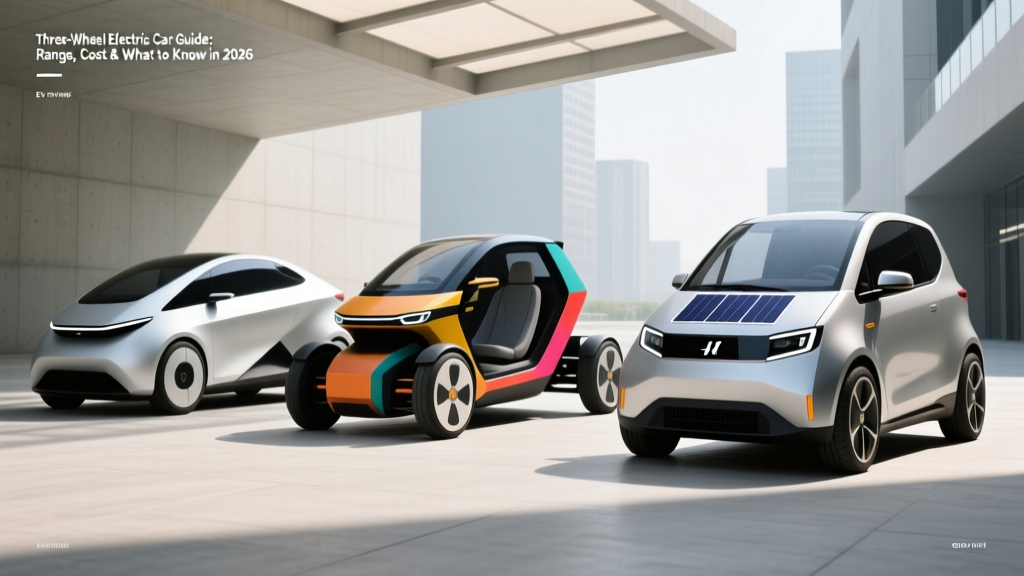
If you've been searching for a three wheel electric car, you're likely looking for an ultra-efficient, compact commuter that slips into tight parking spots and sips electricity instead of gasoline. The short answer: the market in 2026 is narrow but viable. The Aptera Launch Edition remains the most prominent fully enclosed three-wheel EV, claiming up to 400 miles of EPA-estimated range on its largest battery pack, solar body integration, and a starting price around $29,900 before incentives. Meanwhile, the Polaris Slingshot and Can-Am Spyder continue to serve the open-air, performance-oriented three-wheel segment — though neither is fully electric as of 2026. For a practical, daily-drivable three wheel electric car, Aptera is currently the primary option, but buyers need to understand the real-world trade-offs before committing.
Quick Answer: Is a Three Wheel Electric Car Worth It?
A three wheel electric car makes sense if you have a short-to-medium commute (under 60 miles round-trip), access to home Level 2 charging, and live in a mild climate. You'll save significantly on fuel and maintenance versus a gas car. However, these vehicles offer limited cargo space, reduced crash protection compared to four-wheel vehicles, and may not qualify for the full §30D federal tax credit depending on battery sourcing and your income. If you need highway-capable performance in rain and snow, or carry passengers regularly, a conventional four-wheel EV like the Chevrolet Bolt or Hyundai Kona Electric will serve you better.
What Exactly Is a Three Wheel Electric Car?
A three wheel electric car is a battery-electric vehicle (BEV) with three wheels — typically configured as two wheels in front and one in the rear (the "tadpole" layout) for stability, or one front and two rear (the "delta" layout). In the United States, most three-wheel vehicles are classified as autocycles by the NHTSA, not full passenger cars. This distinction matters enormously: autocycles are subject to different (and less stringent) crash-test standards than conventional four-wheel vehicles, though they must still meet federal motorcycle or autocycle safety requirements.
The 2026 Aptera is the headline three wheel electric car. It features a tandem two-seat layout, a drag coefficient of just 0.13 Cd (among the lowest of any production vehicle), and integrated solar panels that Aptera claims can add up to 40 miles of range per day in ideal conditions. The vehicle is built on an aluminum and composite chassis with a focus on extreme aerodynamic efficiency.
Other three-wheel vehicles on the market — the Polaris Slingshot, Can-Am Spyder, and Ryker — are powered by internal combustion engines. While aftermarket electric conversions exist, no major OEM besides Aptera currently sells a street-legal, fully enclosed three wheel electric car in the U.S. market.
Aptera 2026: Specs, Range, and Pricing Breakdown
Here's what we know about the Aptera based on the manufacturer's published specifications and pre-order configurations:
| Spec | 40 kWh Pack | 60 kWh Pack | 100 kWh Pack |
|---|---|---|---|
| EPA-Estimated Range | ~250 mi | ~400 mi | ~400+ mi |
| Battery Chemistry | NMC (est.) | NMC (est.) | NMC (est.) |
| Motor Output | 116 hp (front) | 116 hp (front) + 50 hp (rear) | 116 hp (front) + 50 hp (rear) |
| 0-60 mph | ~5.5 sec | ~3.5 sec (AWD) | ~3.5 sec (AWD) |
| DC Fast Charge (peak) | ~45 kW | ~60 kW | ~60 kW |
| Level 2 Charge Rate | ~6.6 kW | ~6.6 kW | ~6.6 kW |
| Base MSRP | ~$29,900 | ~$34,900 | ~$44,900 |
| Seating | 2 (tandem) | 2 (tandem) | 2 (tandem) |
Real-World Range Expectations
Aptera's claimed range figures benefit from its extraordinary aerodynamic efficiency (0.13 Cd). In real-world driving, expect highway range at 75 mph to drop roughly 15-20% below EPA estimates due to higher speeds, HVAC use, and terrain. Cold-weather range loss (below 32°F) could reduce usable range by an additional 20-30%, as the vehicle's battery thermal management must draw energy to keep cells warm. For the 40 kWh pack, plan for ~180-200 real-world miles in moderate conditions and ~140-160 miles in freezing weather. The solar integration may offset some loss in sunny climates, adding 10-25 miles per day depending on panel exposure and latitude.
Three Wheel EV vs. Gas Car vs. Conventional EV: Cost Comparison
How does a three wheel electric car stack up financially against a gas commuter car and a conventional four-wheel EV? Let's run the numbers over five years and 75,000 miles (15,000 miles/year):
| Cost Category | Aptera (40 kWh) | Toyota Corolla (Gas) | Chevrolet Bolt EV |
|---|---|---|---|
| Purchase Price (MSRP) | $29,900 | $22,550 | $26,500 |
| Federal Tax Credit (§30D) | Up to $3,750* | $0 | $0 (discontinued for new credit) |
| Fuel / Energy (5 yrs) | ~$2,250 | ~$7,500 | ~$2,625 |
| Maintenance (5 yrs) | ~$600 | ~$3,000 | ~$1,200 |
| Insurance (5 yrs, est.) | ~$6,000 | ~$5,500 | ~$5,800 |
| Est. 5-Year Total | ~$35,000 | ~$38,550 | ~$36,125 |
*Aptera's §30D federal tax credit eligibility depends on battery component and critical-mineral sourcing requirements under current IRS rules. The credit may be $3,750 (meeting one sourcing requirement) or $7,500 (meeting both), subject to buyer income caps ($150K single / $300K joint) and MSRP caps ($55K for cars). Verify eligibility at purchase. Point-of-sale transfer is available through registered dealers.
The Aptera's energy cost assumes home charging at $0.13/kWh and an efficiency of approximately 4.0 miles per kWh (a function of its ultra-low drag). The Corolla calculation assumes 33 MPG combined at $3.30/gallon. The Bolt assumes 3.5 mi/kWh at the same electricity rate. The Aptera wins on energy and maintenance costs, but its higher insurance estimate reflects limited crash-test data and low production volume.
Charging a Three Wheel Electric Car: What You Need
Charging a three wheel electric car follows the same principles as any BEV, but with some practical nuances:
Level 1 (120V household outlet): At roughly 1.4 kW, Level 1 adds about 5-6 miles of range per hour to the Aptera. For a 40 kWh pack, a full charge from empty takes ~28 hours. This works if your daily driving is under 30 miles and you can plug in overnight.
Level 2 (240V home charger): At the Aptera's estimated 6.6 kW onboard charger rate, Level 2 adds roughly 26 miles of range per hour. A full charge takes about 6 hours for the 40 kWh pack and 9 hours for the 60 kWh pack. This is the recommended home-charging setup.
DC Fast Charging: The Aptera's relatively modest peak DC rate (~45-60 kW) means 10-80% charging takes approximately 35-45 minutes. This is significantly slower than mainstream EVs like the Hyundai Ioniq 5 (which peaks at 240 kW and does 10-80% in ~18 minutes). For road trips, plan longer stops.
Connector: The Aptera uses the J1772 connector for Level 1/2 AC charging. For DC fast charging, confirm whether the vehicle ships with CCS1 or NACS — Aptera has indicated NACS compatibility for newer builds, which would grant access to Tesla Supercharger stations via adapter or native port.
Home Charging Install Cost
If you need a 240V outlet (NEMA 14-50) installed for Level 2 charging, budget $500-$2,000 for the electrical work, depending on your panel's proximity to the garage and whether a panel upgrade (200A service) is needed. A quality Level 2 EVSE (charger unit) costs $300-$700. Total home setup: $800-$2,700. Consult a licensed electrician for a site-specific quote.
Safety, Insurance, and Legal Considerations
This is where three wheel electric cars diverge sharply from conventional vehicles. Because the Aptera and similar autocycles are not classified as standard passenger cars by the NHTSA, they are not required to undergo the same battery of crash tests (frontal offset, side impact, rollover) that a Toyota Camry or Tesla Model 3 must pass. This doesn't mean they're unsafe — Aptera's composite monocoque structure is designed to meet and exceed FMVSS standards — but there is less independent, third-party crash data available.
Insurance implications: Expect premiums 10-25% higher than an equivalent four-wheel EV. Insurers price based on repair cost data, crash statistics, and parts availability — all of which are limited for a low-volume autocycle. Get quotes from at least three insurers before purchasing.
Licensing: In most U.S. states, an autocycle with a steering wheel and pedals (like the Aptera) can be driven with a standard driver's license. A few states may require a motorcycle endorsement. Check your state's DMV regulations before ordering.
Helmet laws: Some states require helmets for three-wheel vehicle occupants, even in enclosed autocycles. This varies by jurisdiction.
Common Misconceptions About Three Wheel Electric Cars
| Myth | Fact |
|---|---|
| "Three-wheel EVs tip over easily." | Tadpole-layout (two front wheels) autocycles like the Aptera have a wide front track and low center of gravity, making them stable in normal driving. The NHTSA classifies them as autocycles, not motorcycles, partly due to their stability profile. |
| "Solar panels on the car can fully recharge it." | Aptera's solar integration adds up to ~40 miles/day in peak sun. That's meaningful for short commutes but won't replace plug-in charging for most drivers. Expect 10-25 miles/day in typical conditions. |
| "You can't drive it on the highway." | The Aptera has a top speed of over 100 mph and is fully street-legal on all U.S. roads including interstates. It is not classified as a neighborhood electric vehicle (NEV) or golf cart. |
| "It qualifies for the full $7,500 tax credit." | §30D credit depends on battery sourcing and critical-mineral requirements. Low-volume manufacturers may face challenges meeting domestic-content thresholds. Verify at point of sale — the credit could be $0, $3,750, or $7,500. |
| "Three-wheel EVs are cheap to insure." | Limited crash data, low production volume, and specialty repair needs often make insurance more expensive than a mainstream four-wheel EV. |
Who Should (and Shouldn't) Buy a Three Wheel Electric Car?
Decision Framework
Choose a three wheel electric car (Aptera) if:
- Your daily commute is under 60 miles round-trip and you want minimal energy cost
- You have access to Level 2 home charging (garage or carport preferred for solar benefit)
- You live in a mild-to-warm climate (Southern U.S., California, Southwest) where cold-weather range loss is minimal and solar gain is maximized
- You're a solo commuter or occasionally carry one passenger
- You value extreme efficiency and aerodynamic novelty over cargo space and crash-test pedigree
- You understand this is a low-volume vehicle with limited service infrastructure
Choose a conventional four-wheel EV (Bolt, Kona Electric, Model 3) if:
- You regularly carry more than one passenger or need cargo room
- You live in a cold-winter climate (Upper Midwest, Northeast) where range loss and road conditions demand more mass and traction
- You want established service networks, widely available parts, and robust crash-test ratings from IIHS and NHTSA
- You take road trips exceeding 200 miles and need fast DC charging (150+ kW) for quick stops
- You want predictable insurance rates and resale value
Consider a plug-in hybrid (PHEV) like the Toyota Prius Prime if:
- You want electric commuting (40+ miles EV range) but need gas-engine flexibility for long trips
- You lack reliable home charging access
- You want a proven platform with nationwide dealer support
First-Time EV Buyer Checklist
If the Aptera or any three wheel electric car is your first EV, here's what you need to confirm before ordering:
- Home charging access: Do you have a garage, carport, or dedicated parking spot with access to a 240V outlet or the ability to install one? Without home charging, daily EV ownership becomes significantly less convenient.
- Electrical panel capacity: Can your home's electrical panel support a 40-amp or 50-amp circuit for Level 2 charging? Older homes with 100A service may need a panel upgrade ($1,500-$3,000).
- Commute pattern: Map your typical daily mileage. If it's under 50 miles, even the smallest Aptera battery handles it easily. If it's over 150 miles daily, you need the 60 or 100 kWh pack — or a different vehicle.
- Climate reality: If winter temperatures regularly drop below 20°F, plan for 25-35% range reduction. Preconditioning the battery while plugged in helps, but it's a real constraint.
- Tax credit verification: Use the IRS's official clean vehicle credit page to verify your income eligibility and the specific vehicle's battery-sourcing compliance. Rules can change — confirm at the time of purchase.
- Insurance quotes: Get at least three quotes specifically for the Aptera before committing. Three-wheel autocycle insurance is specialty coverage.
- Service and warranty: Confirm the manufacturer's battery and powertrain warranty (typically 8 years/100,000 miles for the battery pack on mainstream EVs) and understand where you'd get service. Low-volume manufacturers may have limited service centers.
Frequently Asked Questions
Are three wheel electric cars street-legal in all 50 states?
Most states allow autocycles like the Aptera on all public roads with a standard driver's license. However, a small number of states have restrictions or require a motorcycle endorsement. Check your state's DMV or BMV website for specific autocycle regulations before purchasing.
How long does it take to charge a three wheel electric car at home?
On a Level 2 (240V) home charger at 6.6 kW, the Aptera's 40 kWh pack charges from empty to full in approximately 6 hours. The 60 kWh pack takes about 9 hours. Overnight charging is sufficient for most daily driving needs. On a standard 120V outlet (Level 1), expect 28+ hours for a full charge.
Can I take a three wheel electric car on a road trip?
Yes, but plan carefully. The Aptera's DC fast-charging rate (~45-60 kW) means 10-80% stops take 35-45 minutes — roughly double the time of a Hyundai Ioniq 5 or Tesla Model 3 at a 150-250 kW charger. For trips over 300 miles, you'll need at least one charging stop. Use apps like PlugShare or A Better Routeplanner to map DC fast-charging stations along your route.
Is a three wheel electric car safe in a crash?
The Aptera uses a composite safety cell designed to meet FMVSS standards, but it has not been crash-tested by the NHTSA or IIHS as of early 2026. Three-wheel autocycles are exempt from some passenger-car crash-test requirements. While the engineering appears sound, buyers should be aware that independent crash data is limited compared to mainstream vehicles.
What happens if the battery needs replacement?
EV battery replacement costs vary, but NMC packs currently run approximately $120-$150 per kWh. For a 40 kWh pack, that's roughly $4,800-$6,000; for a 100 kWh pack, $12,000-$15,000. However, modern EV batteries are designed to retain 70-80% capacity after 150,000-200,000 miles. Federal law mandates a minimum battery warranty of 8 years/80,000 miles (with California-emissions states requiring 10 years/150,000 miles). Confirm Aptera's specific warranty terms at purchase.
Does the Aptera qualify for the federal EV tax credit?
Eligibility for the §30D federal clean vehicle credit ($3,750 or $7,500) depends on meeting battery-component and critical-mineral sourcing thresholds, buyer income limits ($150K single / $225K head of household / $300K joint), and MSRP caps ($55K for cars, $80K for SUVs/trucks). Because Aptera is a low-volume manufacturer, battery sourcing compliance may vary. Always verify current eligibility through the IRS clean vehicle credit page and confirm with the dealer at point of sale.