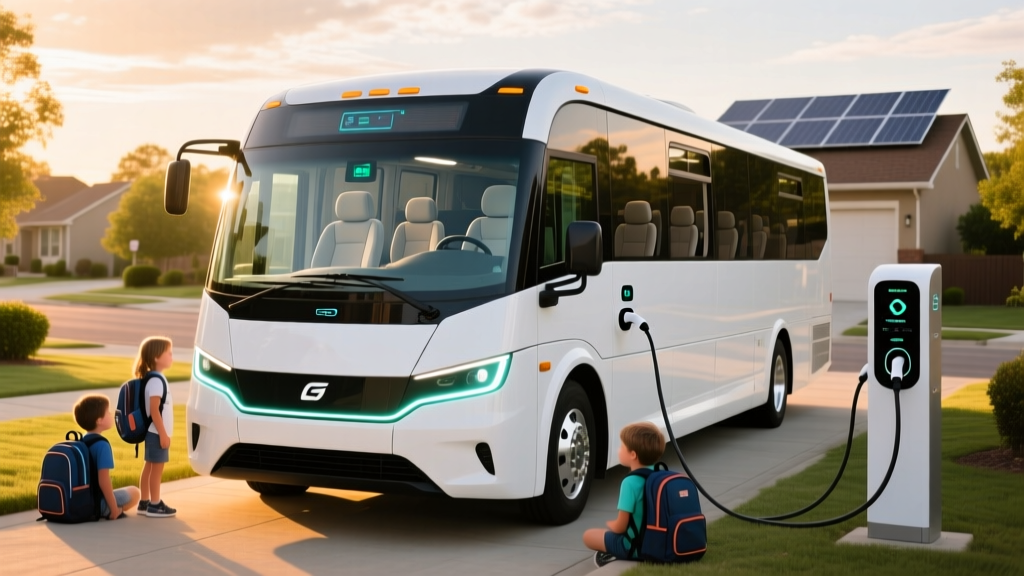
School bus electrification has moved from pilot programs to production-scale deployment, and the 2026 Thomas Saf-T-Liner eQ2 sits at the center of that shift. Built on the proven Saf-T-Liner C2 chassis and powered by a Cummins-sourced electric drivetrain paired with a massive lithium iron phosphate (LFP) battery pack, the eQ2 is engineered for the stop-and-go, twice-daily duty cycle that defines student transportation. This review breaks down the eQ2's real-world range, charging logistics, battery longevity, and total cost of ownership for fleet managers and school district transportation directors evaluating the switch from diesel.
Quick Verdict: Who Should Electrify Their Fleet?
The eQ2 is best suited for districts running fixed routes under 100 miles per day with access to depot-level Level 2 or DC fast charging. Its LFP chemistry prioritizes cycle life and thermal stability over energy density — a smart trade-off for vehicles that operate 10 months a year, five days a week, with predictable overnight downtime. If your district runs long rural routes exceeding 120 miles without mid-day charging, or operates in sustained sub-zero climates without garage storage, the eQ2 requires careful route planning. For the majority of suburban and urban school routes, however, the math works.
Range, Efficiency, and Real-World Expectations
The 2026 Thomas eQ2 carries an EPA-estimated range of 135 miles on a full charge, powered by a 226 kWh usable LFP (lithium iron phosphate) battery pack. That figure is derived from standardized transit-cycle testing, but school bus duty cycles differ meaningfully from highway cruising.
EPA Estimate: 135 miles
Expected Real-World (Stop-and-Go School Routes, Moderate Climate): 110–125 miles
Highway/Intercity Transfer Runs (65 mph sustained): ~85–95 miles
Cold Weather (Below 20°F, Cabin Heating Active): ~75–95 miles (30–40% reduction)
Regenerative braking recovers significant energy in stop-and-go school zones and neighborhood routes, partially offsetting the eQ2's 33,000-lb curb weight. However, cabin heating in cold climates draws heavily from the traction battery — districts in northern states should spec the optional diesel-fired auxiliary heater to preserve range.
Efficiency lands at approximately 2.1 kWh/mile under typical school-route conditions, translating to roughly 48 kWh per 100 miles in combined cycle testing. That figure sounds high compared to passenger EVs, but it's competitive within the Type C school bus segment — the Blue Bird Vision Electric posts similar numbers, and diesel equivalents consume roughly 0.15 gallons per mile at $3.80/gal, making the eQ2's energy cost per mile roughly one-third that of diesel on a national-average electricity rate of $0.12/kWh.
Battery Chemistry, Degradation, and Warranty
Thomas Built Buses equips the eQ2 with a 226 kWh LFP (lithium iron phosphate) battery system. The LFP choice is deliberate: compared to NMC (nickel manganese cobalt) chemistry, LFP sacrifices some energy density but gains substantially in cycle life, thermal stability, and cobalt-free sourcing. For a school bus expected to run 12–15 years and accumulate 200,000+ miles, cycle life matters more than packing extra range into a smaller volume.
| Attribute | LFP (eQ2) | NMC (Typical Passenger EV) |
|---|---|---|
| Cycle Life | 3,000–5,000+ cycles | 1,000–2,000 cycles |
| Thermal Runaway Risk | Very low | Moderate |
| Energy Density | Lower (~160 Wh/kg) | Higher (~250 Wh/kg) |
| Cobalt Content | None | Yes (supply-chain risk) |
| Cold-Weather Performance | Reduced charge acceptance below 32°F | Better low-temp charge rate |
| Daily Charging to 100% | Tolerates well | Accelerates degradation |
Thomas backs the eQ2 battery with an 8-year/100,000-mile warranty guaranteeing a minimum of 70% state-of-health (SoH) retention. In practice, LFP packs in commercial stop-and-go applications have demonstrated 80%+ SoH after 8 years of daily cycling, based on fleet data from early-adopter transit agencies. The powertrain (motor, inverter, reduction gear) carries a matching 8-year/100,000-mile warranty.
Charging: Depot Logistics and Speeds
Charging infrastructure is the single largest operational variable in school bus electrification. The eQ2 supports three charging modes:
| Level | Power (kW) | Connector | 10–80% Time | Miles Added/Hr |
|---|---|---|---|---|
| Level 2 (AC) | 19.2 kW | J1772 (Type 1) | ~8.5 hours (full) | ~8 mi/hr |
| DC Fast Charge | Peak 150 kW (CCS1) | CCS Combo 1 | ~90 minutes | ~60 mi/hr (avg) |
| DC Fast (Sustained) | ~80–100 kW avg | CCS1 | — | Tapers above 80% SoC |
The critical insight for fleet planners: overnight Level 2 depot charging is the operational default. A 19.2 kW Level 2 charger replenishes the 226 kWh pack in roughly 11–12 hours from near-empty, which aligns with a standard 3 PM–5 AM depot window. DC fast charging at 150 kW is available for mid-day top-ups or route extensions, but LFP chemistry exhibits a pronounced charge-curve taper above 80% SoC — the final 20% can take as long as the first 80%. Districts should plan to charge to 80–90% daily and only charge to 100% when maximum range is needed.
Depot charging infrastructure costs typically run $15,000–$25,000 per stall for Level 2 installations (including switchgear, conduit, and a 48-amp hardwired EVSE), scaling to $60,000–$120,000 per stall for 150 kW DC fast chargers with utility service upgrades. The EPA Clean School Bus Program has funded infrastructure grants alongside vehicle rebates, and many utilities offer make-ready programs that offset the utility-side upgrade costs.
Performance and Drivetrain
The eQ2 is powered by a Cummins-designed permanent-magnet synchronous motor producing 226 horsepower (169 kW) and 750 lb-ft of torque, routed through a single-speed reduction gear to the rear axle. This is a rear-wheel-drive (RWD) configuration — typical for Type C school buses, which prioritize low-speed torque over high-speed performance.
| Specification | Value |
|---|---|
| EPA Range | 135 miles |
| Battery (Usable) | 226 kWh, LFP |
| Motor Output | 226 hp / 750 lb-ft |
| Drivetrain | RWD, single-speed reduction |
| 0–60 mph | Not published (~30 sec est., governed to 65 mph) |
| GVWR | 33,000 lbs (Class 7) |
| Passenger Capacity | Up to 81 (72 standard) |
| Max DC Charge Rate | 150 kW (CCS1) |
| Level 2 Charge Rate | 19.2 kW (J1772) |
| Efficiency | ~2.1 kWh/mile (48 kWh/100mi) |
| Battery Warranty | 8 years / 100,000 miles (70% SoH) |
| Base MSRP | ~$395,000 (before incentives) |
Acceleration is governed by the vehicle's Class 7 rating and school-bus safety standards — 0–60 mph times are not a relevant metric for a vehicle limited to 65 mph and designed for neighborhood speeds. What matters is low-speed responsiveness: the eQ2's 750 lb-ft of instant torque makes it noticeably quicker off the line than a diesel C2 at stop signs and school-zone crossings, and regenerative braking (up to 150 kW of regen) significantly reduces service-brake wear — a meaningful maintenance savings over the vehicle's life.
Pricing, Incentives, and Total Cost of Ownership
The 2026 Thomas eQ2 carries a base MSRP of approximately $395,000, roughly 3–4× the cost of a comparable diesel Saf-T-Liner C2 (~$110,000–$130,000). However, the purchase price tells only part of the story. Federal, state, and utility incentive programs dramatically reduce effective cost:
The eQ2, as a Class 7 commercial vehicle, falls under the §45W Commercial Clean Vehicle Credit rather than the consumer §30D credit. Eligible fleets can claim up to $40,000 per vehicle (30% of the incremental cost over a comparable diesel, capped at $40,000 for vehicles over 14,000 lbs GVWR). This credit is claimed by the purchasing entity (school district or contractor) on their federal tax return. Tax-exempt entities (including public school districts) can access this credit via direct pay (elective pay) under the Inflation Reduction Act. Eligibility depends on battery component and critical-mineral sourcing requirements that tighten annually. Consult IRS.gov §45W guidance and a qualified tax professional for your district's specific situation.
| Incentive Layer | Amount | Notes |
|---|---|---|
| Base MSRP | ~$395,000 | Before options/delivery |
| Federal §45W Credit | –$40,000 | Direct pay for tax-exempt entities |
| EPA Clean School Bus Rebate | –$200,000 to –$340,000 | Varies by district priority status; competitive lottery |
| State/Utility Incentives | –$20,000 to –$75,000 | Varies widely by jurisdiction |
| Effective Net Cost (Best Case) | ~$0–$75,000 | With full EPA rebate + state/utility |
| Effective Net Cost (Typical) | ~$120,000–$175,000 | Partial incentives |
On the operating-cost side, the eQ2 delivers substantial savings. At a national-average commercial electricity rate of $0.11/kWh, fully charging the 226 kWh pack costs roughly $25. A diesel C2 covering the same 100-mile route at 6.5 mpg and $3.80/gal diesel costs $58.50 in fuel alone. Over a 180-day school year, fuel savings alone reach $6,000–$8,000 per bus. Add in eliminated oil changes, DEF fluid, DPF regeneration, transmission service, and reduced brake wear from regen, and annual maintenance savings typically run $4,000–$7,000 per bus. Over a 12-year service life, total operating savings of $120,000–$180,000 are achievable — often bringing the eQ2's lifetime cost below that of a diesel, even before incentives.
Interior, Technology, and Safety Features
The eQ2 cabin mirrors the current-generation Saf-T-Liner C2 interior with EV-specific upgrades:
- 10-inch digital instrument cluster displaying SoC, estimated range, kWh/mile, and regen intensity
- Telematics integration via Thomas's BusWatch platform — real-time GPS tracking, battery SoH monitoring, route energy consumption analytics, and predictive maintenance alerts
- Preconditioning — the HVAC system can warm or cool the cabin while plugged in at the depot, preserving battery range for the route
- Electronic stability control, ABS, and collision-mitigation braking (forward AEB) as standard
- Lane-departure warning and blind-spot monitoring available as options
- Three-point lap/shoulder belts on all passenger seats (compartmentalization + belts, per FMVSS 222)
The driver experience is notably quieter and smoother than diesel — idle vibration is eliminated, and the absence of engine noise makes student behavior easier to monitor. Drivers consistently report reduced fatigue after switching from diesel. One drawback: the eQ2's flat torque curve means engine-braking feel is different from diesel, and drivers need a brief adaptation period to modulate regen braking effectively.
Passenger capacity is up to 81 students (72 in standard 12-row configuration), with 17.5-inch seat pitch and a flat floor (no transmission hump). Cargo volume under the floor is not applicable in the traditional sense — the battery pack occupies the under-floor space between the frame rails, but exterior luggage compartments on the driver's side remain available for activity/sports equipment.
Competitive Landscape: eQ2 vs. Blue Bird Vision Electric vs. IC Bus CE Series Electric
| Spec | Thomas eQ2 | Blue Bird Vision Electric | IC Bus CE Electric |
|---|---|---|---|
| EPA Range | 135 mi | 120 mi | 120 mi |
| Battery | 226 kWh LFP | 196 kWh NMC | 210 kWh NMC |
| Peak DC Charge | 150 kW | 150 kW | 125 kW |
| Horsepower | 226 hp | 226 hp | 210 hp |
| Passenger Max | 81 | 78 | 78 |
| Base MSRP | ~$395,000 | ~$375,000 | ~$385,000 |
| Battery Warranty | 8 yr / 100k mi | 8 yr / 100k mi | 8 yr / 100k mi |
- You prioritize battery longevity and LFP thermal safety
- Your routes average 80–120 miles daily
- You want the largest battery buffer in the segment
- Your district is tax-exempt and can use §45W direct pay
- Your routes regularly exceed 120 miles without mid-day charging
- You operate in sustained sub-zero climates without indoor storage
- Budget is the top constraint and Blue Bird's lower MSRP matters
- You need NMC's better cold-weather charge acceptance
Pros and Cons
- LFP battery chemistry offers superior cycle life and thermal safety for daily cycling
- 135-mile EPA range is segment-leading for Type C electric buses
- 226 kWh pack provides a large buffer for unexpected route extensions
- Dramatic fuel and maintenance savings vs. diesel (~$10,000–$15,000/yr)
- Regenerative braking reduces brake wear significantly
- Eligible for EPA Clean School Bus rebates up to $340,000
- Quieter cabin improves student behavior monitoring
- BusWatch telematics provides actionable fleet energy data
- High upfront cost (~$395,000 before incentives)
- Real-world range drops 30–40% in extreme cold without auxiliary heater
- Depot charging infrastructure requires significant capital ($15k–$120k per stall)
- DC fast-charge taper above 80% SoC extends top-up times
- LFP chemistry has reduced charge acceptance in sub-32°F conditions
- No mid-day opportunity charging without DC infrastructure investment
- Heavier curb weight (33,000 lbs) increases tire wear vs. diesel
- Federal incentive rules (sourcing, direct pay) add administrative complexity
Frequently Asked Questions
What is the real-world range of the Thomas eQ2 electric school bus?
The EPA-estimated range is 135 miles. In real-world school-route operation (stop-and-go, moderate climate), expect 110–125 miles. Highway transfer runs at 65 mph reduce this to roughly 85–95 miles, and sustained below-20°F operation with electric cabin heat can drop range to 75–95 miles. Districts in cold climates should spec the optional diesel auxiliary heater to preserve battery range.
How fast does the eQ2 charge at a depot and on DC fast chargers?
On a 19.2 kW Level 2 depot charger (the standard fleet setup), a full charge takes roughly 11–12 hours — ideal for overnight turnaround. On a 150 kW CCS1 DC fast charger, 10–80% takes approximately 90 minutes, though LFP charge-curve taper means the last 20% is significantly slower. Most districts rely on overnight L2 charging and reserve DC fast charging for mid-day top-ups on longer routes.
How much does the eQ2 cost after federal and state incentives?
Base MSRP is approximately $395,000. With the federal §45W commercial clean vehicle credit ($40,000 via direct pay for tax-exempt entities), EPA Clean School Bus Program rebates ($200,000–$340,000 depending on priority status), and state/utility incentives ($20,000–$75,000), the effective net cost can drop to $0–$175,000 depending on your district's eligibility and grant success. Incentive availability is competitive and varies by year — consult the EPA Clean School Bus Program and your state energy office for current funding rounds.
Does the Thomas eQ2 qualify for the federal EV tax credit?
The eQ2 qualifies under the §45W Commercial Clean Vehicle Credit (not the consumer §30D credit), which provides up to $40,000 for vehicles over 14,000 lbs GVWR. Tax-exempt entities like public school districts can access this credit through the IRA's elective pay (direct pay) provision. Eligibility requires compliance with battery-component and critical-mineral sourcing rules that tighten annually. Always verify current-year requirements on IRS.gov and consult your district's tax advisor.
Is the eQ2 worth buying compared to a diesel school bus?
On pure upfront cost, diesel wins — a new C2 diesel costs roughly $110,000–$130,000 vs. $395,000 for the eQ2. But with incentives bringing the eQ2's net cost into the $120,000–$175,000 range, and annual operating savings of $10,000–$15,000 (fuel + maintenance), the eQ2 typically reaches cost parity within 5–8 years and delivers lower total cost of ownership over its 12–15 year service life. The strongest case is for districts with routes under 100 miles, depot charging access, and eligibility for EPA rebates.
How long will the eQ2 battery last, and what does replacement cost?
The LFP battery is warranted for 8 years/100,000 miles at 70% minimum SoH. Real-world fleet data suggests LFP packs in daily-cycling commercial applications retain 80%+ capacity after 8 years. Full pack replacement (if needed beyond warranty) currently costs in the range of $60,000–$90,000 including labor, though prices are trending downward. Many districts plan for a mid-life battery refresh around year 10, and LFP's longevity may push that further out.
What charging infrastructure does a school district need to install?
At minimum, one 19.2 kW Level 2 charger per bus (J1772 connector, requiring a 100-amp dedicated circuit per stall). For a 10-bus depot, expect $150,000–$300,000 in total infrastructure costs including electrical panel upgrades, trenching, conduit, EVSE hardware, and utility make-ready work. DC fast chargers add $60,000–$120,000 per stall. Most districts start with L2-only and add DC fast chargers as routes expand. Utility make-ready programs and EPA infrastructure grants can offset 50–100% of these costs.
Sources: Thomas Built Buses – eQ2 Specifications, EPA Clean School Bus Program, IRS Commercial Clean Vehicle Credit (§45W).