If you've been searching for a Tesla zero turn mower, you're not alone—this query pops up thousands of times a year as EV owners look to electrify every aspect of their lives. But here's the definitive answer: Tesla does not manufacture a zero turn mower, has never announced one, and shows no indication of entering the outdoor power equipment market. Tesla's vehicle lineup remains focused on cars, trucks, and energy storage products like the Powerwall.
That said, the impulse behind the search is valid. If you've already switched to an electric car, why burn gas on your lawn? The good news is that a growing segment of battery-electric zero turn mowers now delivers commercial-grade cutting with zero direct emissions, dramatically lower noise, and minimal maintenance. Below, we break down why Tesla isn't in this space, profile the best electric zero turn mowers you can actually buy in 2026, and give you the exact specs—battery kWh, runtime, charge times, and pricing—to make a smart purchase.
Why Tesla Doesn't Make a Zero Turn Mower
Tesla's core business revolves around on-road vehicles (Model 3, Model Y, Model S, Model X, Cybertruck) and stationary energy storage (Powerwall, Megapack). The company has never filed patents, issued press releases, or made public statements suggesting a lawn care product line. The economics also don't align: the outdoor power equipment market, while growing, is a fraction of the automotive sector Tesla operates in.
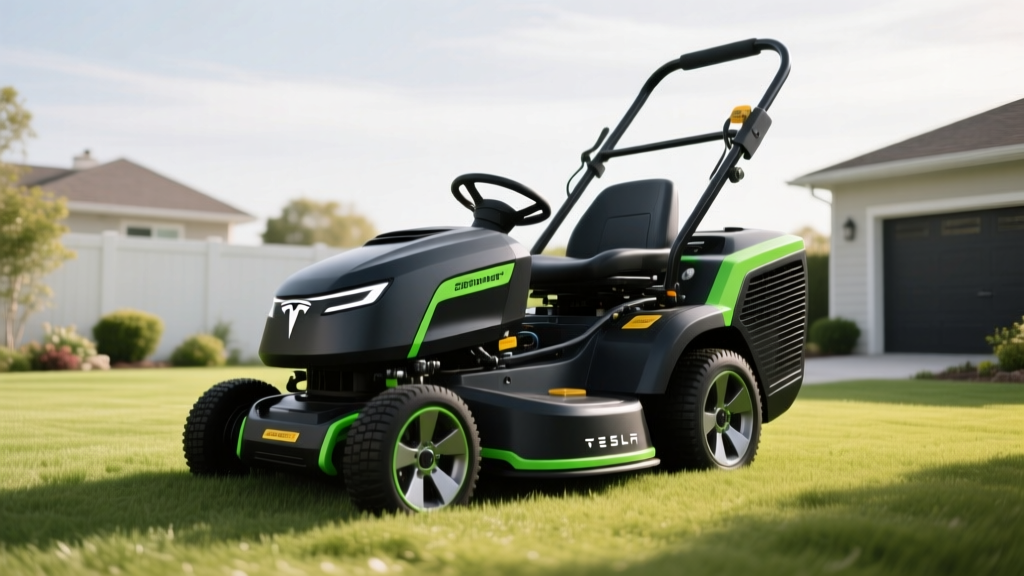
What has happened is a wave of internet memes, AI-generated concept images, and speculative forum posts imagining a "Tesla Mower" with Autopilot-style navigation, a sleek unibody design, and Supercharger compatibility. None of these are real products. If you encounter a listing for a "Tesla zero turn mower" on a marketplace or social media, it is either a mislabeled competitor product, a joke, or a scam.
The Real Electric Zero Turn Mowers You Can Buy in 2026
Several established outdoor power equipment manufacturers now offer fully battery-electric zero turn mowers for both residential and commercial use. Unlike a hypothetical Tesla mower, these are real, warrantied products available through authorized dealers. Here's how the leading models stack up on the specs that matter.
| Spec | EGO Z6 76" | Ryobi 42" Zero Turn | Gravely ProTurn EV (Commercial) |
|---|---|---|---|
| Deck Width | 76 inches | 42 inches | 60 inches |
| Battery System | EGO ARC Lithium 56V | Ryobi 48V | Lithium-ion pack (80V+) |
| Battery Capacity (Est.) | ~4.0–5.0 kWh (w/ 4× 12Ah packs) | ~2.4–3.0 kWh (w/ 4× 12Ah packs) | ~8–12 kWh (integrated) |
| Runtime (Est.) | Up to ~2.5 acres per charge | Up to ~1.5 acres per charge | Up to ~4+ acres per charge |
| Top Speed | ~8 mph | ~7 mph | ~10 mph |
| Charge Time (0–100%) | ~60 min (EGO rapid charger) | ~90–120 min | ~4–6 hours (240V) |
| Price (MSRP) | ~$8,500–$10,000 | ~$4,000–$5,500 | ~$20,000–$28,000 |
| Warranty (Battery) | 5 years (batteries & tool) | 3–5 years (varies by pack) | 3–5 years / limited hours |
| Best For | Large residential (1–3 acres) | Small-to-mid yards (≤1.5 acres) | Commercial landscaping |
Note: Battery capacity in kWh is estimated from manufacturer-published voltage and amp-hour ratings. Runtime varies significantly with grass thickness, terrain, speed, and ambient temperature. Always verify current specs with your local dealer, as configurations change by model year.
Battery Chemistry and Runtime: What You Need to Know
Electric zero turn mowers predominantly use lithium-ion NMC (nickel manganese cobalt) cells rather than the LFP (lithium iron phosphate) chemistry found in some Tesla vehicles (like the Model 3 RWD). The reason is energy density: NMC packs deliver more watt-hours per pound, which matters in a mower where weight distribution affects cutting performance and turf compaction.
Runtime is the electric mower equivalent of "range," and just like EPA range in an EV, manufacturer claims deserve a real-world adjustment:
A mower rated for "2.5 acres" on a full charge typically achieves that under ideal conditions—flat terrain, dry medium-height grass, moderate speed. Expect a 15–30% reduction in thick/wet grass, on hilly terrain, or when running at top speed continuously. In extreme summer heat (95°F+), battery thermal management can also reduce effective capacity, similar to how an EV's range drops in cold weather.
For a practical benchmark: a 0.5-acre suburban lot with standard Bermuda or fescue grass will typically require 25–40 minutes of mowing time on an electric zero turn with a 42–52" deck. Most 4–5 kWh battery systems handle this comfortably on a single charge with capacity to spare.
Charging: Speeds, Setup, and Electrical Requirements
Unlike EVs that use standardized connectors (NACS, CCS), electric mower batteries use proprietary docking systems specific to each brand's ecosystem. Here's what charging looks like in practice:
| Charging Method | Power (kW) | Typical 0–100% Time | Outlet Required |
|---|---|---|---|
| Standard Charger (included) | 0.3–0.5 kW | 6–10 hours (per pack) | Standard 120V outlet |
| Rapid Charger (EGO/purchased separately) | 0.8–1.2 kW | ~60 min (per pack) | Standard 120V outlet |
| Commercial Fast Charge (Gravely etc.) | 2–4 kW | ~2–4 hours | 240V dedicated circuit |
For residential users, the most practical approach is the same strategy used by EV owners: plug in after every use. A partial recharge from 30% to 100% on a standard charger takes 3–5 hours, meaning your mower is ready for the next session overnight. Commercial operators running multiple daily jobs should invest in rapid chargers or a multi-port charging station to minimize downtime.
Unlike home EV charger installation, which often requires a panel upgrade and a dedicated 240V/40–60A circuit (costing $800–$2,000+ with an electrician), most residential electric mower chargers plug into a standard 120V garage outlet. The exception is commercial-grade equipment, which may need a licensed electrician to install a 240V circuit in your equipment shed.
Pricing, Tax Credits, and Total Cost of Ownership
Electric zero turn mowers carry a significant upfront premium over gas equivalents—typically 40–80% more at purchase. However, the operating cost advantage is substantial.
Electric lawn mowers do NOT qualify for the federal §30D Clean Vehicle Credit, which applies only to on-road vehicles (cars, trucks, vans) meeting specific MSRP, income, and battery-sourcing requirements. There is currently no federal tax credit specifically for electric lawn equipment.
However, check your state and local utility incentive programs—some states (notably California, Colorado, and parts of the Northeast) and local utilities offer rebates of $200–$1,000+ for battery-powered outdoor equipment as part of air quality improvement initiatives. Visit DSIRE (Database of State Incentives for Renewables & Efficiency) to search your zip code.
| Cost Category | Gas Zero Turn (42"–52") | Electric Zero Turn (42"–52") |
|---|---|---|
| Purchase Price | $3,500–$5,000 | $4,500–$7,000 |
| Fuel/Energy (5 yrs) | $1,200–$1,800 (gasoline) | $150–$300 (electricity) |
| Maintenance (5 yrs) | $600–$1,000 (oil, filters, plugs, belts) | $50–$150 (blade sharpening, deck cleaning) |
| Total 5-Year Cost | $5,300–$7,800 | $4,700–$7,450 |
The electric mower reaches cost parity around year 3–4 for most residential users, and the gap widens further in years 5+ when gas engines typically require more significant repairs (carburetor rebuilds, starter replacements). The electric motor and battery system have far fewer moving parts.
Who Should Buy an Electric Zero Turn Mower (and Who Shouldn't)
✅ Buy Electric If:
- Your property is under 3 acres of mowable area
- You have access to a standard 120V outlet in your garage or shed
- Noise restrictions matter (HOA rules, early-morning mowing, neighbors)
- You want to eliminate gasoline storage, oil changes, and spark plug replacements
- You already own batteries in the same ecosystem (EGO, Ryobi) for other tools
- You value near-zero vibration and dramatically lower noise (~65–75 dB vs. 90+ dB for gas)
❌ Stick with Gas If:
- You mow 5+ acres regularly and can't afford mid-job battery swaps
- You're a commercial operator running multiple properties per day without charging access between jobs
- You frequently mow extremely tall, wet, or dense vegetation that demands sustained peak torque
- Your region has no authorized electric mower dealer for warranty service
- You need to tow heavy attachments (aeration, dethatching) beyond electric mower tow ratings
Pros and Cons of Going Electric on Your Lawn
👍 Pros
- Near-silent operation — mow at 7 AM without complaints
- No gas, no oil, no exhaust fumes — cleaner for you and the environment
- Instant torque — electric motors deliver full power from 0 RPM
- Minimal maintenance — no air filters, carburetors, belts, or oil changes
- Battery ecosystem compatibility — EGO/Ryobi packs work across dozens of tools
- Lower lifetime cost — savings compound after the 3rd year
👎 Cons
- Higher upfront cost — $1,000–$3,000 more than equivalent gas models
- Runtime limits — large properties may need spare battery packs ($200–$400 each)
- No federal tax credit — §30D does not cover off-road equipment
- Longer "refuel" time — hours to recharge vs. 2 minutes to fill a gas tank
- Battery degradation — expect 10–20% capacity loss over 5–7 years of regular use
- Limited commercial availability — fewer electric options for landscaping businesses
Frequently Asked Questions
Will Tesla ever make a zero turn mower or lawn equipment?
There is no indication that Tesla plans to enter the outdoor power equipment market. Tesla's public roadmap focuses on vehicles (including the next-generation compact platform), the Optimus humanoid robot, energy storage, and AI/autonomous driving. Any product claiming to be a "Tesla mower" is not an official Tesla product.
Can I use my Tesla Powerwall to charge an electric mower?
Not directly. The Tesla Powerwall is a home battery system designed for backup power and solar energy storage, connected to your home's electrical panel. You could theoretically run a mower charger from a circuit backed by a Powerwall during an outage, but there's no direct integration or Tesla-designed charging dock for mower batteries.
Are electric zero turn mowers powerful enough for thick Southern grass?
Modern 56V and 80V electric mowers generate torque comparable to 20–25 HP gas engines at the blade. For St. Augustine, Zoysia, or tall Bermuda grass, they perform well—though you may need to reduce speed or raise the deck height slightly in peak summer growth. The main limitation is sustained runtime under heavy load, not raw cutting power.
How long do electric mower batteries last before replacement?
Most lithium-ion mower batteries are rated for 500–1,000+ charge cycles before dropping below 80% of original capacity. At typical residential use (30–40 mows per year), that translates to roughly 10–15 years of service before noticeable degradation. Replacement packs cost $150–$400 depending on voltage and capacity. Check the manufacturer's battery warranty—EGO offers 5 years, which is among the best in the industry.
Is an electric mower better for the environment than gas?
Yes, on direct emissions. Electric mowers produce zero tailpipe emissions and zero evaporative fuel emissions (gas mowers lose fuel to evaporation). The upstream carbon footprint depends on your local electricity grid—charging from solar or wind is near-zero carbon, while a coal-heavy grid still produces fewer total emissions per mow than burning gasoline in a small, unregulated engine. According to the EPA, gas-powered lawn equipment accounts for up to 5% of total U.S. air pollution, making the switch meaningful at scale.
Where can I find state or local rebates for electric lawn equipment?
Start with the DSIRE database, maintained by the NC Clean Energy Technology Center, which catalogs state, local, and utility incentives. Also check your local electric utility's website—many offer instant rebates or seasonal promotions on battery-powered outdoor equipment. Some California air quality districts (e.g., South Coast AQMD) offer rebates of $250–$500 specifically for replacing gas mowers with electric equivalents.
The Bottom Line
A Tesla zero turn mower doesn't exist, and it likely never will. But the electric mowers available today from EGO, Ryobi, Gravely, Greenworks, and others are mature, capable products that deliver a genuinely better mowing experience for most residential users. The technology has reached the same inflection point that EVs hit around 2018–2020: the early adopter compromises have largely been solved, and the products now stand on their own merits—quieter, cleaner, cheaper to operate, and increasingly cost-competitive at purchase.
If you're an EV owner looking to complete your all-electric garage, an electric zero turn mower is a logical next step. Just don't wait for Elon to build one.