Quick Verdict: The Tesla Yoke in 2026
The Tesla yoke — the flat-topped, butterfly-style steering wheel introduced as a $1,000 option on the Model S and Model X — remains one of the most polarizing features in the EV market. After spending significant seat time with the yoke on both the 2026 Model S Long Range and Model X Long Range, the verdict is nuanced: it excels on highways and in stop-and-go traffic, demands a genuine learning curve at low speeds, and is not for every driver. Below, we break down the full ownership picture of these flagship Teslas with the yoke installed, including exact range, charging, performance, pricing, and tax-credit reality.
2026 Tesla Model S & Model X: Core Specifications
| Spec | 2026 Model S Long Range | 2026 Model S Plaid | 2026 Model X Long Range | 2026 Model X Plaid |
|---|---|---|---|---|
| EPA Range | 402 mi | 359 mi | 335 mi | 320 mi |
| Battery (usable) | ~95 kWh (NMC) | ~95 kWh (NMC) | ~95 kWh (NMC) | ~95 kWh (NMC) |
| Drivetrain | Dual-Motor AWD | Tri-Motor AWD | Dual-Motor AWD | Tri-Motor AWD |
| Horsepower | 670 hp | 1,020 hp | 670 hp | 1,020 hp |
| 0–60 mph | 3.1 sec | 1.99 sec | 3.8 sec | 2.5 sec |
| MPGe (combined) | 120 MPGe | 116 MPGe | 102 MPGe | 98 MPGe |
| Efficiency | 28 kWh/100 mi | 29 kWh/100 mi | 33 kWh/100 mi | 34 kWh/100 mi |
| Base MSRP | $79,990 | $89,990 | $79,990 | $94,990 |
| Yoke Option Cost | $1,000 (all trims) | |||
| Battery/Drive Unit Warranty | 8 years / 150,000 miles (70% minimum retention) | |||
Sources: fueleconomy.gov, Tesla.com 2026 configurator.
Real-World Range: What the EPA Sticker Doesn't Tell You
EPA Sticker (Model S LR): 402 miles
Real-World Expectation: On mixed highway driving at 70–75 mph in 65–75°F conditions, expect approximately 320–350 miles. In cold weather (below 32°F), range drops to roughly 260–290 miles due to battery resistance and cabin heating demands. City driving with heavy regen use can approach or even exceed the EPA figure.
The Model S Long Range's 402-mile EPA rating is among the highest of any production EV sold in the U.S. But EPA range is measured on a standardized dynamometer cycle that doesn't replicate sustained highway speeds or winter conditions. Tesla's NMC (nickel manganese cobalt) battery chemistry delivers strong energy density — hence the range — but is more sensitive to cold-weather capacity loss than LFP chemistry. The Model S does include a heat pump, which mitigates winter range loss compared to resistive heating, but expect a 20–30% reduction from the EPA figure in sub-freezing temperatures.
The Model X, being heavier and less aerodynamic (SUV profile, falcon-wing doors adding weight), sees a more pronounced real-world gap: its 335-mile EPA rating translates to roughly 260–290 miles on the highway in moderate weather.
Charging Speed: DC Fast Charge and Home Level 2
| Charging Level | Power / Rate | Time or Miles Added |
|---|---|---|
| DC Fast Charge (V4 Supercharger) | Peak 250 kW (NACS connector) | 10–80% in ~25 min (Model S), ~28 min (Model X) |
| DC Fast Charge (3rd-party CCS via adapter) | Peak ~150 kW (adapter-limited) | 10–80% in ~38 min |
| Level 2 Home (Tesla Wall Connector, 48A / 11.5 kW) | 11.5 kW | ~30 mi/hr (Model S), ~26 mi/hr (Model X) |
| Level 2 Home (standard 240V/32A outlet) | 7.7 kW | ~20 mi/hr (Model S), ~17 mi/hr (Model X) |
| Level 1 (120V household) | ~1.4 kW | ~3–4 mi/hr |
A critical nuance: the Model S and X peak at 250 kW only at low states of charge (roughly 10–30% SoC) and with proper battery preconditioning — which the car initiates automatically when you navigate to a Supercharger. Above 60% SoC, the charge curve tapers sharply; the 60–80% portion can take nearly as long as 10–60%. This is standard behavior for NMC cells at high charge rates but is worth understanding for road-trip planning.
For home charging, the Tesla Wall Connector on a 60A circuit (48A continuous) is the practical standard. A full overnight charge from 20% to 80% takes roughly 5 hours — easily covering any daily commute. Note: kW is the rate of power delivery; kWh is the energy stored. A 95 kWh battery charged at 11.5 kW takes approximately 8.3 hours for a full 0–100% fill.
The Yoke Itself: Daily Driving Experience
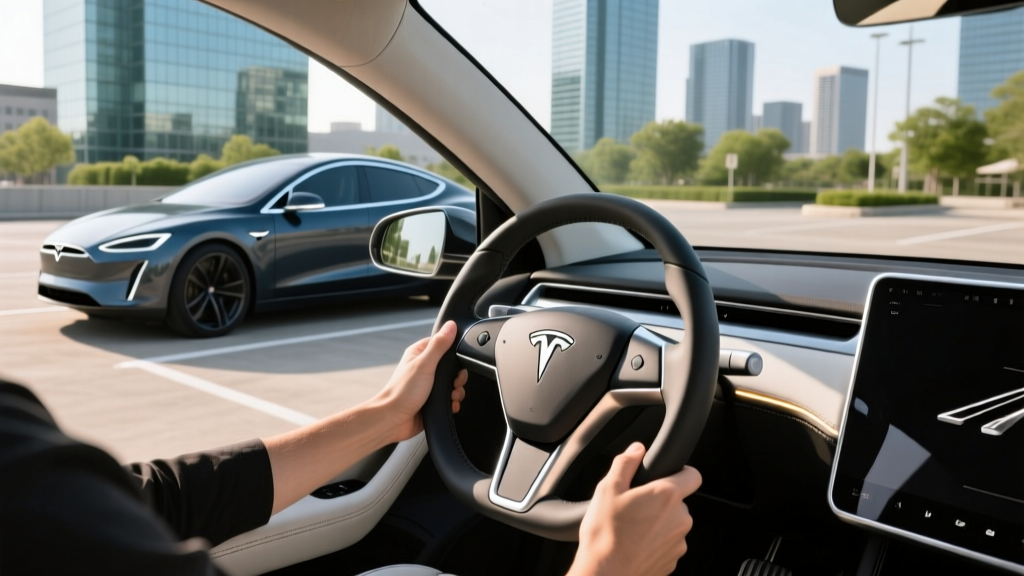
The Tesla yoke replaces the traditional round steering wheel with a rectangular, flat-topped design. Tesla's rationale: improved forward visibility (no top rim blocking the instrument cluster or road view) and a more futuristic cockpit feel. Here's how it functions in practice:
Where the Yoke Works Well
- Highway driving: Minimal steering input needed; the yoke's straight bottom and top make it easy to rest your hands at 9-and-3 without obstruction.
- Stop-and-go traffic: Small corrections are precise and the flat top gives an unobstructed view of the 12.3-inch driver display.
- Visibility: The open top genuinely improves sightlines to the dashboard and the road ahead, especially for shorter drivers.
- Touch controls: Capacitive buttons on the yoke handle turn signals, wipers, and media — reducing reliance on the center touchscreen.
Where the Yoke Falls Short
- Low-speed maneuvers: Three-point turns, tight parking, and roundabouts require hand-over-hand steering. The yoke's missing top half means you occasionally grab air. Tesla's variable-ratio steering (standard on yoke-equipped cars) reduces the number of turns lock-to-lock, but it doesn't fully eliminate the issue.
- Learning curve: Most drivers report 1–3 weeks before the yoke feels natural. Some never fully adapt.
- Emergency maneuvers: While NHTSA has not flagged the yoke as a safety concern, the lack of a full rim means instinctive grab-and-turn reactions may be slower for drivers accustomed to round wheels.
- Resale consideration: The yoke remains a niche preference; some used-car buyers may discount a yoke-equipped vehicle vs. one with a conventional wheel.
ADAS Note: The Tesla yoke does not change the SAE Level 2 classification of Autopilot or Full Self-Driving (Supervised). Despite the "FSD" name, the driver must remain fully engaged, with hands on the yoke and eyes on the road. Tesla's steering-wheel torque sensor monitors grip — the yoke's smaller contact area can occasionally trigger "hands-on" warnings more readily than a round wheel. This is not a self-driving system.
Pricing, Tax Credits, and Total Cost
| Trim | Base MSRP | With Yoke (+$1,000) | Federal §30D Credit | Effective Price (if eligible) |
|---|---|---|---|---|
| Model S Long Range | $79,990 | $80,990 | Not eligible (MSRP > $55,000 sedan cap) | $80,990 |
| Model S Plaid | $89,990 | $90,990 | Not eligible (MSRP > $55,000 sedan cap) | $90,990 |
| Model X Long Range | $79,990 | $80,990 | Up to $7,500 (SUV cap: $80,000) | ~$73,490 |
| Model X Plaid | $94,990 | $95,990 | Not eligible (MSRP > $80,000 SUV cap) | $95,990 |
Tax credit reality check: Under IRS §30D rules, the federal EV tax credit has an MSRP cap of $55,000 for sedans and $80,000 for SUVs/pickups/vans. The Model S (sedan) exceeds the $55,000 cap on all trims and does not qualify. The Model X Long Range at $80,990 with the yoke option exceeds the $80,000 SUV cap and therefore also does not qualify — even without the yoke, the $79,990 base MSRP leaves only $10 of headroom before destination fees push it over. The Model X Plaid is well above the cap.
Additionally, §30D imposes buyer income limits ($300,000 joint / $150,000 single MAGI) and battery critical-mineral and component sourcing requirements. Always verify current-year eligibility on IRS.gov and consult a tax professional before purchasing.
Cargo, Passenger Space, and Practicality
Model S: 28 cu ft of cargo space behind the rear seats (74 cu ft with rear seats folded), plus a 3.1 cu ft frunk. Rear legroom is 35.4 inches. The liftback design makes loading large items easier than a traditional sedan trunk.
Model X: Up to 88.1 cu ft of cargo volume (seats folded, five-seat config). The Model X offers optional six- or seven-seat layouts. Second-row legroom is 40.9 inches; third row is 32.7 inches (best for children). The frunk adds 6.6 cu ft. Falcon-wing rear doors require less lateral clearance than conventional doors but need overhead clearance — plan garage parking accordingly.
Neither the Model S nor Model X received the latest "Highland"-style interior refresh that the Model 3 and Model Y got, so the cabin materials and design feel slightly dated compared to Tesla's newer offerings, though build quality has improved on 2025–2026 production runs.
Pros and Cons
Pros
- Class-leading EPA range (402 mi on Model S LR)
- Access to Tesla Supercharger network (20,000+ stalls in North America)
- Tri-motor Plaid variants offer hypercar-rivaling acceleration
- Yoke improves forward visibility and dashboard sightlines
- Over-the-air updates continuously add features
- Heat pump standard for cold-climate efficiency
- Strong 8-year/150,000-mile battery warranty
Cons
- Yoke is awkward for low-speed turns and parking; genuine adaptation period
- No federal tax credit on most trims due to MSRP caps
- Interior feels dated vs. newer Tesla models and luxury rivals
- DC fast charging peaks at 250 kW (competitors now offer 350 kW)
- FSD (Supervised) remains Level 2 — not autonomous despite the name
- Model X falcon-wing doors can be slow and unreliable in freezing rain
- High insurance premiums relative to segment
Who Should Buy a Tesla with the Yoke?
Choose the Model S with yoke if: You prioritize maximum range and performance in a sedan, drive primarily on highways or in moderate-traffic commutes where the yoke's visibility and precision shine, and you value Supercharger access for road trips. The Model S Long Range remains the most range-efficient luxury EV sedan available.
Choose the Model X with yoke if: You need three-row seating and SUV cargo space, want Tesla's Supercharger ecosystem, and can accept that the federal tax credit likely won't apply. The Model X is best for families who road-trip and can charge at home.
Skip the yoke (get the round wheel) if: You frequently navigate tight urban streets, park in cramped garages, or simply prefer the familiarity and safety margin of a full-rim steering wheel. The round wheel is a no-cost option and remains the pragmatic choice for most drivers.
Look at competitors if: You need the federal tax credit (consider the BMW iX xDrive50, which starts under the $80,000 SUV cap, or the Rivian R1S). If DC fast-charge speed is paramount, the Hyundai Ioniq 5 N and Porsche Taycan offer 350 kW peak charging — substantially faster than Tesla's 250 kW ceiling.
Frequently Asked Questions
Is the Tesla yoke legal in the United States?
Yes. NHTSA has not prohibited the yoke design. It meets all applicable Federal Motor Vehicle Safety Standards (FMVSS) for steering control systems. However, some international markets have had regulatory questions; in the U.S., it is fully street-legal.
Can I swap the yoke back to a round wheel later?
Tesla has historically not offered an official post-purchase swap. Some owners have sourced round wheels through third parties or Tesla service centers at their own expense (~$500–$800 including labor), but this is not a guaranteed or officially supported option. Choose carefully at order time.
Does the yoke affect Autopilot or FSD functionality?
No. Autopilot and FSD (Supervised) function identically with the yoke or round wheel. Both are SAE Level 2 driver-assistance systems requiring active driver supervision. The yoke's torque sensor may require slightly firmer grip to avoid "apply steering torque" warnings.
What is the real-world range of the Model S with the yoke?
The yoke itself has negligible impact on range. The Model S Long Range achieves 402 miles EPA. Real-world highway driving at 70+ mph yields approximately 320–350 miles; cold weather (below freezing) drops this to 260–290 miles.
How fast does the Model S charge at home and on DC fast chargers?
On a Tesla V4 Supercharger, the Model S peaks at 250 kW, reaching 10–80% in approximately 25 minutes with preconditioning. At home on a 48A Tesla Wall Connector (11.5 kW), it adds roughly 30 miles of range per hour, fully charging overnight.
Does the Tesla Model S or Model X qualify for the $7,500 federal EV tax credit?
Generally no. The §30D credit caps sedan MSRP at $55,000 and SUV MSRP at $80,000. The Model S exceeds the sedan cap on all trims. The Model X Long Range at $79,990 base technically sits under the SUV cap, but destination fees and options (including the $1,000 yoke) push it over $80,000. Verify current rules at IRS.gov.
Is the yoke worth the $1,000 option cost?
Subjective. If you drive mostly highways and value the unobstructed view, yes. If you do a lot of city driving with tight turns, the round wheel is the safer, more practical choice at no extra cost. Test-driving a yoke-equipped Tesla at a local showroom before committing is strongly recommended.