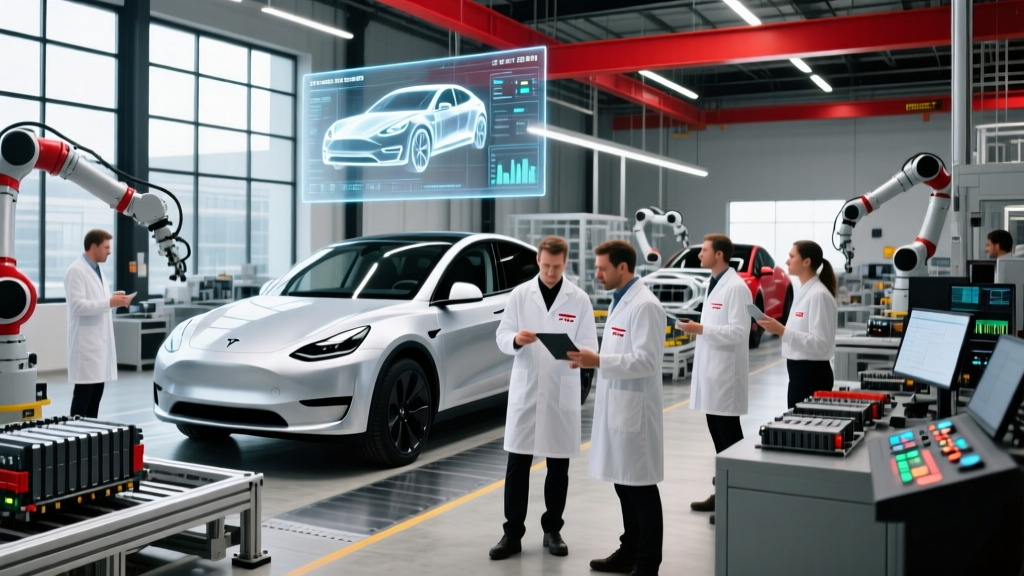
The question how many people work at Tesla comes up constantly among EV shoppers trying to gauge the company's stability, manufacturing scale, and long-term viability. As of early 2026, Tesla employs approximately 140,000 people globally, according to the company's most recent filings — down from a peak of roughly 150,000 in 2023 after significant restructuring and automation investments across its Fremont, Austin, Berlin, and Shanghai Gigafactories. That headcount reduction coincided with a push toward greater manufacturing efficiency, including increased use of mega-casting and robotic assembly.
But what does Tesla's workforce size actually mean for buyers? A company this large has the scale to iterate quickly on vehicle design, maintain an extensive Supercharger network, and keep service infrastructure growing. It also means the company can absorb supply-chain shocks better than smaller EV startups. Let's examine the vehicle at the center of Tesla's production volume — the 2026 Tesla Model Y — and evaluate what Tesla's manufacturing muscle translates to in real-world ownership.
2026 Tesla Model Y: Quick Verdict
The refreshed Model Y (internally dubbed "Juniper") remains Tesla's best-selling vehicle globally and the best-selling EV in the United States. The 2026 model year carries forward the significant redesign introduced in early 2025: a sleeker exterior with a full-width light bar, a quieter cabin with acoustic glass, ventilated front seats, and a rear touchscreen for passengers. Under the skin, the battery architecture and powertrain remain largely unchanged, but efficiency gains from improved aerodynamics and thermal management push EPA range slightly higher than the pre-refresh model.
| Spec | Long Range AWD | Performance AWD | RWD (Base) |
|---|---|---|---|
| EPA Range | 320 miles | 295 miles | 290 miles |
| Battery (usable) | ~75 kWh (NMC) | ~75 kWh (NMC) | ~60 kWh (LFP) |
| Peak DC Fast Charge | 250 kW | 250 kW | 175 kW |
| 10–80% DCFC Time | ~25 min | ~25 min | ~30 min |
| Level 2 Home Charge | 11.5 kW (~44 mi/hr) | 11.5 kW (~44 mi/hr) | 7.7 kW (~30 mi/hr) |
| 0–60 mph | 4.8 sec | 3.5 sec | 6.5 sec |
| Horsepower | 384 hp | 456 hp | 295 hp |
| Drivetrain | Dual-Motor AWD | Dual-Motor AWD | RWD |
| MPGe (combined) | 120 MPGe | 111 MPGe | 125 MPGe |
| Base MSRP | $48,990 | $53,990 | $44,990 |
Range, Battery Chemistry, and Real-World Efficiency
The 2026 Model Y Long Range AWD carries a ~75 kWh usable NMC (nickel manganese cobalt) battery pack. Tesla's NMC chemistry prioritizes energy density, which is why the Long Range achieves its 320-mile EPA rating from a relatively compact pack. The base RWD model uses an LFP (lithium iron phosphate) pack at approximately 60 kWh usable — LFP sacrifices some energy density but offers superior cycle life and can be charged to 100% daily without degradation concerns.
- City/commute driving (moderate climate): ~300–320 mi — regenerative braking and lower speeds help you match or approach the EPA sticker.
- Highway driving (70–80 mph, mild weather): ~260–280 mi — aerodynamic drag at sustained speed costs 10–15%.
- Cold weather (below 30°F, mixed driving): ~220–250 mi — battery heating and cabin HVAC draw can reduce range 20–30%. The heat pump on the Juniper refresh mitigates this better than older models.
- Cold + highway + roof cargo box: As low as ~190–210 mi in worst-case conditions.
Efficiency for the Long Range AWD sits at roughly 28 kWh/100 mi (120 MPGe combined per fueleconomy.gov). That's competitive with the Hyundai Ioniq 5 and slightly behind the BMW iX3 in efficiency terms, but the Model Y's access to the Supercharger network often matters more than raw MPGe on road trips.
Charging Speed and Infrastructure
Tesla's workforce of ~140,000 includes thousands dedicated to Supercharger deployment and maintenance — a significant competitive moat. As of 2026, there are over 6,500 Superchargers in North America, and the network has opened to non-Tesla EVs via the NACS standard, increasing utilization but also potentially increasing wait times at popular corridors.
| Charging Level | Power | Miles Added per Hour | Notes |
|---|---|---|---|
| Level 1 (120V household) | 1.4 kW | ~5 mi/hr | Emergency/trickle only |
| Level 2 (240V, 32A mobile) | 7.7 kW | ~30 mi/hr | RWD model max; overnight full charge |
| Level 2 (240V, 48A Wall Connector) | 11.5 kW | ~44 mi/hr | Long Range/Performance max; ~7 hr 10–80% |
| DC Fast (V3 Supercharger) | 250 kW peak | ~1,000 mi/hr (peak) | 10–80% in ~25 min; tapers sharply above 80% |
| DC Fast (V4 Supercharger) | 250 kW (current vehicles) | ~1,000 mi/hr (peak) | V4 posts support higher speeds for future architectures |
Charging curve reality: The Model Y Long Range peaks at 250 kW only between roughly 10–25% state of charge. From 25–60%, it sustains around 150–180 kW. Above 80%, charging drops to under 50 kW. If you're road-tripping, plan to charge to 80% and go — that last 20% takes nearly as long as the first 70%.
Preconditioning matters. Navigate to a Supercharger using the built-in navigation, and the car will warm the battery en route, enabling faster charge acceptance on arrival. Skip this step in cold weather and you may see peak rates cut by 30–40%.
Performance and Driving Dynamics
The Model Y Performance does 0–60 mph in 3.5 seconds with 456 hp from its dual-motor setup. That's genuinely quick — it will outrun most sports sedans off the line. The Long Range AWD manages 4.8 seconds with 384 hp, which is more than adequate for any real-world merge or passing situation.
The Juniper refresh brought meaningful improvements to ride quality. Tesla retuned the suspension, added frequency-selective damping, and improved sound isolation with acoustic laminated glass on all windows. At highway speeds, the 2026 Model Y is noticeably quieter than the 2023–2024 models. Steering remains precise but heavily weighted even in Comfort mode — this is a car that feels planted, not floaty.
Regenerative braking is strong enough for near one-pedal driving in most conditions, though Tesla removed the user-adjustable regen setting several years ago. The brake pedal feel remains inconsistent at the transition point between regen and friction braking — a common complaint that the 2026 refresh did not fully resolve.
Interior Space, Cargo, and Technology
The Model Y's crossover proportions deliver practical interior volume:
- Cargo behind rear seats: 30.2 cu ft
- Cargo with rear seats folded: 72.1 cu ft
- Front trunk (frunk): 4.1 cu ft
- Rear legroom: 41.6 inches
- Front headroom: 41.0 inches
That cargo capacity beats the Ford Mustang Mach-E (29.7 cu ft behind rear seats) and rivals the Hyundai Ioniq 5 (27.2 cu ft). The Model Y's liftback design and flat-folding rear seats make it genuinely useful for hauling furniture, camping gear, or a week's worth of groceries for a family of five.
The 2026 Juniper interior includes a 15.4-inch front touchscreen running Tesla's latest software, ambient lighting integrated into the dashboard and door panels, ventilated front seats (a long-requested feature), and a second 8-inch screen for rear passengers controlling climate, media, and entertainment. Build quality has improved noticeably — panel gaps are tighter, materials feel more premium, and the cabin no longer has the spartan, unfinished quality of early Fremont-built cars. Tesla's global workforce reorganization appears to have paid dividends here, with Berlin-built Model Y vehicles setting a quality benchmark that Fremont and Austin have since matched.
Autopilot and FSD (Supervised): Every Model Y ships with basic Autopilot (lane centering + adaptive cruise). Tesla's Full Self-Driving (Supervised) remains a Level 2 driver-assistance system per SAE classification — meaning the driver must remain fully engaged and responsible at all times. FSD Supervised can navigate on-ramps to off-ramps, handle city intersections, and manage stop signs, but it still makes unpredictable decisions in construction zones and unprotected left turns. The $8,000 option (or $99/month subscription) is not a self-driving system despite the marketing name.
Tesla Autopilot and FSD (Supervised) are Level 2 driver-assistance systems. The driver must continuously monitor the road, keep hands on the steering wheel (or demonstrate attentiveness via the cabin camera), and be prepared to take over instantly. This is not autonomous driving. Level 4 robotaxi services (Waymo, Zoox) operate without a driver present — Tesla does not offer this capability.
Pricing, Trim Levels, and Federal Tax Credit
| Trim | Base MSRP | Destination | Est. Max §30D Credit | Effective Price (if eligible) |
|---|---|---|---|---|
| RWD (LFP) | $44,990 | $1,390 | Up to $7,500 | ~$38,880 |
| Long Range AWD | $48,990 | $1,390 | Up to $7,500 | ~$42,880 |
| Performance AWD | $53,990 | $1,390 | Up to $7,500 | ~$47,880 |
Federal tax credit eligibility (§30D): The Model Y qualifies for up to $7,500 under current IRS rules, but eligibility depends on multiple factors that change periodically:
- MSRP cap: SUVs/crossovers must be ≤$80,000 — all Model Y trims qualify.
- Buyer income cap: Modified AGI ≤$150,000 (single) / ≤$300,000 (joint) / ≤$225,000 (head of household).
- Battery sourcing: Increasing percentages of critical minerals and battery components must be sourced from the U.S. or FTA partners. Tesla's LFP packs (CATL-sourced) may only qualify for the partial $3,750 credit depending on the current sourcing threshold. NMC packs assembled at Giga Nevada/Texas with more compliant supply chains are more likely to qualify for the full $7,500.
- Point-of-sale transfer: Buyers can transfer the credit to the dealer (Tesla) at purchase, reducing the purchase price directly — no need to wait for tax filing.
- Verification: Always confirm current eligibility on the fueleconomy.gov tax credit page and consult a tax professional before relying on credit amounts.
Tesla's massive workforce and vertical integration give it an advantage here: by controlling more of its supply chain — from seat manufacturing to software to Supercharger hardware — Tesla can adapt sourcing to meet evolving §30D requirements faster than competitors relying on third-party suppliers.
Warranty and Long-Term Ownership
- Basic vehicle warranty: 4 years / 50,000 miles
- Battery & drive unit warranty: 8 years / 120,000 miles (Long Range/Performance) — guaranteed to retain ≥70% capacity
- Battery & drive unit warranty (RWD/LFP): 8 years / 100,000 miles — ≥70% capacity retention
Tesla's battery degradation data is among the best in the industry. According to Tesla's 2025 Impact Report, Model 3/Y packs retain approximately 85% capacity after 200,000 miles on average. LFP packs in the RWD model show even slower degradation curves, making them attractive for high-mileage commuters who plan to keep the car 10+ years.
Insurance costs remain a Model Y pain point. Average annual premiums run $2,400–$3,200 depending on state, age, and driving record — significantly above the EV average and well above comparable ICE crossovers. Tesla's own insurance product (available in select states) uses real-time driving data to price premiums, and safe drivers can save 20–30%, but it's not available everywhere.
Pros, Cons, and Who Should Buy
- Supercharger network access — still the most reliable DC fast-charging ecosystem in North America
- Class-leading cargo space and practical liftback design
- Strong efficiency (28 kWh/100 mi Long Range) translates to lower charging costs
- Juniper refresh fixed most build-quality complaints
- OTA updates continue to add features years after purchase
- LFP option for buyers who want maximum battery longevity
- No Apple CarPlay or Android Auto — Tesla's native UI is the only option
- Insurance premiums significantly above segment average
- FSD (Supervised) remains Level 2 despite the name and price
- Turn-signal stalks removed — haptic buttons on the steering wheel are a learning curve
- Rear visibility compromised by sloping roofline; no rear wiper
- Service center wait times in some metros still stretch to 3–4 weeks for non-urgent repairs
Who the Model Y suits best:
- Daily commuters who can charge at home and want minimal running costs.
- Families of 4–5 who need cargo versatility without stepping to a three-row SUV (consider the Model X or Rivian R1S for that).
- Road trippers who value Supercharger reliability over absolute range.
- Tech-forward buyers comfortable with a screen-centric interface and no CarPlay fallback.
Who should look elsewhere:
- Buyers who need Apple CarPlay/Android Auto — look at Hyundai Ioniq 5, Ford Mach-E, or BMW iX3.
- Those in areas with limited Tesla service infrastructure — rural buyers should verify proximity to a service center.
- Anyone expecting FSD to be a self-driving system — it isn't, and it won't be in 2026.
Tesla's Workforce and What It Means for Buyers
Returning to the original question — how many people work at Tesla — the ~140,000 global headcount in 2026 tells a specific story. Tesla is large enough to maintain vertical integration (battery cell production, software, Supercharger network, insurance, service) but leaner than legacy automakers producing similar volumes. For context, Ford employs roughly 170,000 people globally but produces fewer EVs than Tesla by unit count.
For buyers, Tesla's workforce scale means:
- Parts availability is generally strong for high-wear items (tires, cabin filters, 12V batteries) but can lag for body panels and structural components after collisions.
- Software development continues at a rapid pace — Tesla's engineering headcount remains substantial, supporting regular OTA updates.
- Supercharger expansion continues at roughly 15–20% annual growth in North America, with V4 hardware becoming the standard.
- Service capacity is improving but remains a weak point in fast-growing Sun Belt metros where Tesla sales have outpaced service center construction.
Frequently Asked Questions
What is the real-world range of the 2026 Tesla Model Y?
The Long Range AWD is EPA-rated at 320 miles. In real-world highway driving at 75 mph, expect 260–280 miles. In cold weather below 30°F, expect 220–250 miles mixed driving. City commuters in moderate climates can approach the EPA figure thanks to regenerative braking.
How fast does the Model Y charge at home and on the road?
On a DC fast charger (V3 Supercharger), the Long Range peaks at 250 kW and charges 10–80% in approximately 25 minutes. At home on a 48A Wall Connector (11.5 kW), a full overnight session adds roughly 44 miles of range per hour of charging — enough to go from 20% to 100% in about 8 hours.
How much does the 2026 Model Y cost after federal tax credits?
The Long Range AWD starts at $48,990 + $1,390 destination. If you qualify for the full $7,500 §30D credit (income, sourcing, and MSRP requirements met), the effective price drops to approximately $42,880. The RWD base model can reach as low as ~$38,880 with the credit. Always verify current eligibility at irs.gov and consult a tax professional.
Is the Model Y worth buying vs. the Hyundai Ioniq 5 or Ford Mach-E?
Choose the Model Y if Supercharger network access, cargo capacity, and software updates are your priorities. Choose the Ioniq 5 if you want 800V ultra-fast charging (10–80% in ~18 min on 350 kW chargers), CarPlay, and a more distinctive design. Choose the Mach-E if you prefer a traditional dealership experience and BlueCruise hands-free driving on mapped highways.
Does the 2026 Model Y qualify for the federal EV tax credit?
It can qualify for up to $7,500, but eligibility depends on your income (≤$300k joint / ≤$150k single), the vehicle's battery sourcing compliance, and the MSRP (all trims are under the $80k SUV cap). LFP (RWD) models with CATL-sourced cells may only qualify for $3,750 depending on current critical-mineral rules. Check fueleconomy.gov for the latest status.
How long will the Model Y battery last?
Tesla warrants the battery for 8 years / 120,000 miles (Long Range) or 8 years / 100,000 miles (RWD) with at least 70% capacity retention. Real-world fleet data suggests average packs retain ~85% capacity at 200,000 miles. LFP packs in the RWD model degrade even more slowly, making them a strong choice for high-mileage drivers planning long-term ownership.
How many people work at Tesla, and is the company stable?
Tesla employs approximately 140,000 people globally as of early 2026. It is the world's most valuable automaker by market capitalization and produces over 2 million vehicles annually across four Gigafactories. The company's scale, vertical integration, and Supercharger infrastructure provide long-term stability that EV startups cannot match.