Why Tesla Wiring Matters for EV Owners
When buyers research Tesla wiring, they're usually trying to solve one of three problems: understanding how the car's electrical architecture affects charging speed, figuring out what's required for a home Level 2 installation, or diagnosing a fault code related to the high-voltage system. Tesla's approach to wiring harnesses, power distribution, and thermal management differs significantly from legacy automakers — and those differences show up in real-world range, charge curves, and even insurance repair costs.
This guide breaks down the electrical architecture across the 2026 Tesla lineup (Model 3, Model Y, Model S, Model X), explains how wiring design influences DC fast-charge rates and efficiency, and clarifies what you need on the home side to support Tesla's power demands. We'll also cover the most common wiring-related service issues and what they mean for long-term ownership.
Tesla's Electrical Architecture: 48V, Ethernet, and Integrated Harnesses
Legacy vehicles use a 12V electrical system with dozens of individual copper wire runs to every sensor, light, and module. Tesla has progressively moved toward a centralized architecture that reduces total wiring harness weight and complexity.
The Shift to 48V Low-Voltage Systems
Starting with the Cybertruck and expanding to refreshed Model 3 and Model Y variants, Tesla adopted a 48-volt low-voltage electrical system. This replaces the traditional 12V lead-acid or lithium auxiliary battery setup. The benefit: 48V systems use roughly one-quarter the current for the same power delivery, allowing thinner wire gauges and reducing harness weight by an estimated 10-15 lbs across the vehicle.
Ethernet Backbone and Zonal Controllers
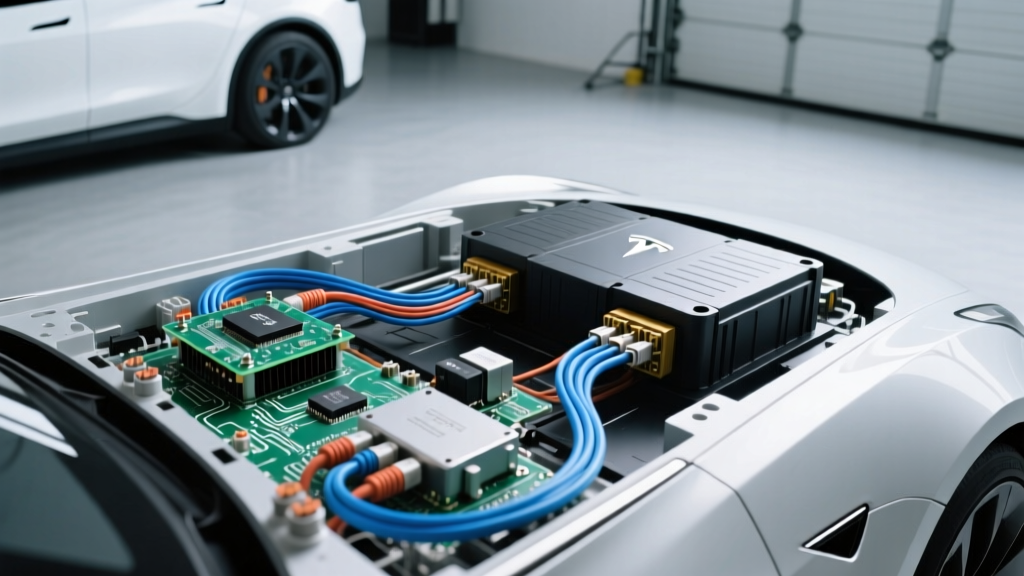
Instead of running individual signal wires from every sensor to a central ECU, Tesla uses an automotive Ethernet backbone connecting zonal body controllers. Each zone (front, rear, left, right) handles local loads — lights, window motors, cameras — and communicates over a shared high-speed data bus. This reduces total wire count and simplifies diagnostics, but it also means a single zone controller failure can affect multiple systems simultaneously.
High-Voltage Wiring: Battery to Inverter to Motors
The high-voltage (HV) system runs at approximately 350-400V nominal (Model 3/Y) or up to ~400V (Model S/X). Orange-sheathed HV cables connect the battery pack to the drive unit inverter(s), the DC-DC converter, and the charge port. These cables are heavily shielded and routed through protected channels to prevent collision damage. Any HV wiring repair requires Tesla-certified high-voltage technician certification — independent shops cannot legally or safely service these components without proper training and lockout/tagout procedures.
2026 Tesla Lineup: Range, Charging, and Efficiency Specs
Here's how the current Tesla models stack up on the metrics that matter most. All figures reflect 2026 model-year EPA data and manufacturer specifications.
| Spec | Model 3 Long Range AWD | Model Y Long Range AWD | Model S Dual Motor | Model X Dual Motor |
|---|---|---|---|---|
| EPA Range | 363 mi | 337 mi | 402 mi | 348 mi |
| Battery (usable) | ~79 kWh (NMC) | ~79 kWh (NMC) | ~100 kWh (NMC) | ~100 kWh (NMC) |
| RWD Std Range Battery | ~60 kWh (LFP) | ~60 kWh (LFP) | N/A | N/A |
| Peak DC Fast Charge | 250 kW | 250 kW | 250 kW | 250 kW |
| 10-80% DCFC Time | ~25 min | ~25 min | ~30 min | ~31 min |
| Level 2 (11.5 kW) | ~44 mi/hr | ~41 mi/hr | ~34 mi/hr | ~32 mi/hr |
| 0-60 mph | 4.2 sec | 4.8 sec | 3.1 sec | 3.8 sec |
| Horsepower | 346 hp | 384 hp | 670 hp | 670 hp |
| MPGe (combined) | 134 MPGe | 122 MPGe | 120 MPGe | 109 MPGe |
| kWh/100 mi | 25 kWh | 28 kWh | 28 kWh | 31 kWh |
| Base MSRP | $47,240 | $48,240 | $79,990 | $84,990 |
Source: fueleconomy.gov, Tesla.com. Specs reflect 2026 model year. Standard Range RWD trims use LFP chemistry; Long Range and Performance trims use NMC.
Real-World Range vs. EPA Sticker
EPA estimates are a starting point, not a guarantee. In our experience and aggregated owner data:
- Highway driving (75+ mph): Expect 10-15% less than EPA. A Model 3 LR rated at 363 mi typically delivers 300-320 mi on a flat interstate at 75 mph.
- Cold weather (below 32°F): Range drops 20-30% depending on cabin heating demand. A 363-mi Model 3 may deliver 250-290 mi in 20°F conditions without preconditioning.
- City/regenerative driving: Often matches or slightly exceeds EPA thanks to regen braking recapturing energy.
- Preconditioning: Warming the battery before DC fast charging or departure restores range and charge speed — always use Scheduled Departure in cold months.
Charging Speed and Home Electrical Requirements
Tesla's charging performance depends on both the car's onboard architecture and the wiring on your end — the home panel, the circuit, and the connector.
| Level | Power | Miles Added/Hour | Typical Use Case | Home Wiring Needed |
|---|---|---|---|---|
| Level 1 (120V) | ~1.4 kW | 3-5 mi/hr | Overnight trickle, emergencies | Standard 15A/20A outlet (NEMA 5-15) |
| Level 2 (240V, 32A) | 7.7 kW | 25-30 mi/hr | Daily home charging (Wall Connector on 40A circuit) | NEMA 14-50 or hardwired; 40A breaker, 6 AWG wire |
| Level 2 (240V, 48A) | 11.5 kW | 34-44 mi/hr | Fastest home charging | 60A breaker, 4 AWG wire, hardwired Wall Connector |
| DC Fast Charge | Up to 250 kW | ~1,000+ mi/hr (peak) | Road trips, Superchargers | N/A (public infrastructure) |
Home Charging Wiring: What Your Electrician Needs to Know
The Tesla Wall Connector is hardwired and supports up to 48A continuous draw (11.5 kW). This requires:
- A dedicated 60A breaker in your main panel
- 4 AWG copper wire (or 2 AWG aluminum) run from panel to the Wall Connector location
- A panel with at least 60A of spare capacity — many older homes with 100A service will need a panel upgrade to 200A, which costs $1,500-$3,000 depending on your utility and jurisdiction
- A permit and inspection in most municipalities
Cost breakdown for a typical Tesla Wall Connector installation:
- Wall Connector unit: $475
- Electrician labor + wire + conduit: $800-$2,500 (depends on run length and wall penetrations)
- Panel upgrade (if needed): $1,500-$3,000
- Permit: $50-$200
- Total: $1,325-$6,175
Always consult a licensed electrician for final specifications. The National Electrical Code (NEC) requires that continuous loads (like EV charging) not exceed 80% of the breaker rating — hence a 48A charger needs a 60A circuit.
DC Fast Charging: The Charge Curve Reality
Tesla's 250 kW peak rate applies only at low states of charge (typically 10-30% SoC) and with a preconditioned battery. The charge curve tapers significantly:
- 10-30% SoC: Peak ~250 kW (V3 Supercharger) or ~170 kW (V2)
- 30-60% SoC: Sustains ~150-180 kW
- 60-80% SoC: Tapers to ~80-100 kW
- 80-100% SoC: Drops to ~30-50 kW — this is why Tesla recommends charging to 80% on road trips
The 10-80% time of ~25 minutes (Model 3/Y) assumes a V3 Supercharger and proper battery preconditioning. Without preconditioning (e.g., navigating to a non-Supercharger destination), peak rates may be limited to 100-150 kW even at low SoC.
Tax Credit Eligibility and Ownership Cost
Federal EV tax credit rules under IRS §30D have specific requirements that affect which Tesla models and trims qualify. As of 2026:
| Model / Trim | Base MSRP | §30D Credit Eligibility | Effective Price (if eligible) |
|---|---|---|---|
| Model 3 RWD (LFP) | $38,990 | Eligibility depends on battery sourcing — LFP cells sourced from CATL (China) may NOT meet critical mineral requirements | $31,490-$38,990 |
| Model 3 Long Range AWD | $47,240 | Under $55,000 MSRP cap for sedans; NMC battery sourcing may qualify for partial ($3,750) or full ($7,500) credit | $39,740-$47,240 |
| Model Y Long Range AWD | $48,240 | Under $80,000 MSRP cap for SUVs; US-assembled with partial domestic sourcing | $40,740-$48,240 |
| Model S Dual Motor | $79,990 | Under $80,000 MSRP cap for sedans — borderline; verify current-year eligibility | $72,490-$79,990 |
| Model X Dual Motor | $84,990 | Under $80,000 MSRP cap for SUVs — check trim and options | $77,490-$84,990 |
§30D Eligibility Checklist
- Buyer income caps: AGI ≤ $150,000 (single), $225,000 (head of household), $300,000 (joint)
- MSRP caps: $55,000 for sedans (Model 3, S), $80,000 for SUVs/trucks (Model Y, X)
- Battery sourcing: Critical minerals and battery components must meet escalating domestic/free-trade-partner thresholds — these tighten annually
- Point-of-sale transfer: You can transfer the credit to the dealer at purchase for an immediate price reduction (effective 2024+)
- Verification: Always check IRS.gov §30D guidance and Tesla's checkout page for current eligibility before purchasing
Note: Battery-sourcing rules change annually. A trim that qualifies in January may lose eligibility if supply chains shift. Consult a tax professional for your specific situation.
Warranty, Reliability, and Wiring-Related Service Issues
Battery and Drive Unit Warranty
- Model 3/Y (Standard Range, LFP): 8 years / 100,000 miles, whichever comes first, with minimum 70% capacity retention
- Model 3/Y (Long Range/Performance, NMC): 8 years / 120,000 miles, minimum 70% retention
- Model S/X: 8 years / 150,000 miles, minimum 70% retention
Outside the battery, Tesla's basic vehicle limited warranty covers 4 years / 50,000 miles.
Common Wiring and Electrical Faults
Based on NHTSA complaint data and owner forums, the most frequent wiring-adjacent issues across Tesla models include:
- 12V/Li-ion auxiliary battery failures (pre-48V models): The low-voltage battery powers computers, lights, and door handles. Failure can brick the car even with a full HV battery. Tesla has moved to lithium-iron-phosphate 12V packs and now 48V systems to reduce this risk.
- Charge port wiring harness wear: Repeated plugging/unplugging can stress the wiring harness behind the charge port door. Symptoms include intermittent charge failures or "charge port latch" errors. Repair typically requires harness replacement ($300-$600 at a service center).
- Camera and sensor wiring: The Ethernet-based camera system is robust, but water ingress at connector points (particularly the front bumper camera on pre-2024 models) has caused intermittent Autopilot faults. Tesla addressed this with improved sealing in the Highland/Model 3 refresh.
- Heat pump wiring (Model Y, refreshed Model 3): The octovalve heat pump system uses complex refrigerant and electrical routing. Early Model Y units had occasional wiring harness issues near the heat pump assembly, causing reduced cabin heating efficiency.
Driver Assistance: Autopilot, FSD, and Electrical System Demands
Tesla's driver-assistance systems place significant demands on the vehicle's wiring and power distribution. The camera suite (8 cameras on current models), the HW4 computer, and the neural network processing all draw continuous power and require high-bandwidth data connections.
SAE Automation Level: Level 2
Autopilot and Full Self-Driving (Supervised) are SAE Level 2 systems. The driver must remain fully engaged, hands on or near the wheel, and eyes on the road at all times. These are not self-driving systems. Only Level 4 services like Waymo operate without a human driver in geofenced areas.
The electrical architecture must support real-time processing of ~1.2 megabytes per second of camera data. Tesla's HW4 computer draws approximately 70-100W continuously — a non-trivial load that factors into the vehicle's overall energy consumption and thermal management design.
What Autopilot/FSD Does NOT Do
- Does not drive autonomously without supervision
- Does not reliably detect stationary objects at highway speed (documented NHTSA incidents)
- Does not replace attentive driving — NHTSA requires crash reporting for Level 2+ systems
- FSD (Supervised) costs $8,000 or $99/month as of 2026 — weigh whether your commute justifies the cost
Interior, Cargo, and Practical Ownership
Space and Comfort
| Dimension | Model 3 | Model Y | Model S | Model X |
|---|---|---|---|---|
| Front Legroom | 42.7 in | 41.8 in | 42.7 in | 41.2 in |
| Rear Legroom | 35.2 in | 36.8 in | 35.4 in | 35.5 in |
| Cargo (rear seats up) | 23 cu ft | 30 cu ft | 26 cu ft | 42 cu ft |
| Cargo (rear seats folded) | 60 cu ft | 72 cu ft | 64 cu ft | 88 cu ft |
| Frunk | 3.1 cu ft | 4.1 cu ft | 3.1 cu ft | 6.6 cu ft |
Standout Tech
- 15.4" center touchscreen (Model 3/Y refresh), 17" (Model S/X) with tilt
- Over-the-air updates that add features post-purchase
- Supercharger network: 60,000+ global connectors; NACS standard now adopted by Ford, GM, Rivian, and others
- Tesla app: remote preconditioning, charge monitoring, Sentry Mode alerts
- Heat pump standard on all 2026 models — improves cold-weather range by 10-15% vs. resistive heating
Notable Drawbacks
- No Apple CarPlay or Android Auto — Tesla's native UI only
- Minimalist interior lacks physical buttons for climate, mirrors, and glovebox (all screen-controlled)
- Service center wait times remain longer than legacy brands in many metro areas
- Insurance premiums run 15-30% higher than comparable gas sedans/SUVs due to repair cost data
Who Should Buy a Tesla — and Who Shouldn't
Pros
- Best-in-class charging network (Supercharger reliability ~99.5% uptime)
- Industry-leading efficiency (kWh/100mi) translates to lower electricity cost per mile
- Over-the-air updates continuously improve the vehicle
- Strong resale value relative to most EVs
- 48V architecture reduces wiring complexity and weight (newer models)
Cons
- Tax credit eligibility uncertain due to battery sourcing rules
- Service center capacity strained in growing markets
- No CarPlay — a dealbreaker for some buyers
- Panel upgrade may be required for optimal home charging
- Insurance costs above segment average
Decision Framework
- Choose Model 3 if: You commute solo or as a couple, want maximum efficiency (134 MPGe), and can charge at home. The Long Range AWD at $47,240 offers the best value in the lineup.
- Choose Model Y if: You need cargo space for a family, prioritize SUV ride height, and want access to the $80,000 MSRP cap for tax credit eligibility.
- Choose Model S if: You want 400+ mi range and performance, can absorb the $80K price, and value sedan comfort over practicality.
- Choose Model X if: You need three rows and falcon-wing doors are appealing — but know the Hyundai Ioniq 9 and Kia EV9 offer more third-row space at lower prices.
- Look elsewhere if: You need Apple CarPlay, prefer a traditional dealer experience, or live in a charging desert without reliable DCFC access.
Frequently Asked Questions
What is the real-world range of a Tesla Model 3 Long Range?
EPA-rated at 363 miles, expect 300-320 miles on the highway at 75 mph in moderate temperatures. In cold weather (below 32°F), plan for 250-290 miles depending on cabin heating use and whether you precondition the battery.
How fast does a Tesla charge at home and on the road?
On a home Level 2 Wall Connector at 48A (11.5 kW), a Model 3 Long Range gains ~44 miles of range per hour — a full overnight charge from 20% to 80% takes about 5 hours. On a V3 Supercharger (250 kW DCFC), 10-80% takes approximately 25 minutes with a preconditioned battery.
How much does a Tesla cost after tax credits?
It depends on the trim, your income, and current battery-sourcing rules. A Model 3 Long Range AWD at $47,240 MSRP could drop to $39,740 with the full $7,500 §30D credit — but only if you meet income caps (≤$150K single / $300K joint), the vehicle meets sourcing requirements, and MSRP stays under $55K for sedans. Verify on IRS.gov before purchasing.
Does Tesla qualify for the federal EV tax credit?
Some trims do, but eligibility is not guaranteed. The Model Y Long Range AWD is most likely to qualify (under the $80K SUV cap, US-assembled). The Model 3 RWD with LFP batteries faces uncertainty due to Chinese-sourced critical minerals. Always check Tesla's checkout page and IRS guidance for the current month's eligibility.
Is Tesla worth buying vs. competitors like Hyundai Ioniq 5 or Ford Mustang Mach-E?
Tesla wins on charging network reliability, efficiency (kWh/100mi), and software. Competitors like the Ioniq 5 offer 800V architecture with faster peak charging (~350 kW on 800V chargers), Apple CarPlay, and more physical controls. If Supercharger access and OTA updates matter most, Tesla leads. If you value dealership service and CarPlay, consider Hyundai or Ford.
What are the biggest wiring-related issues to watch for?
On pre-2024 models, watch for 12V auxiliary battery failures (now largely resolved with lithium packs and 48V systems), charge port harness wear, and camera connector water ingress. All are repairable but require Tesla service center visits. The 48V architecture in newer models significantly reduces low-voltage wiring complexity and failure points.
Do I need to upgrade my electrical panel for a Tesla?
Maybe. If your home has a 100A panel and you want a 48A (11.5 kW) Wall Connector on a 60A circuit, you'll likely need a 200A upgrade ($1,500-$3,000). Homes with existing 200A service usually have sufficient capacity. Have a licensed electrician perform a load calculation before committing to equipment.