The Tesla WiFi Hotspot: What You Actually Get
When you buy a Tesla, you're not just buying a car — you're buying a rolling computer. One of the most frequently asked questions from new and prospective owners is about the Tesla WiFi hotspot capability. Unlike traditional automakers that offer built-in cellular hotspots for passengers, Tesla's approach to connectivity is fundamentally different, and understanding it is critical before you buy.
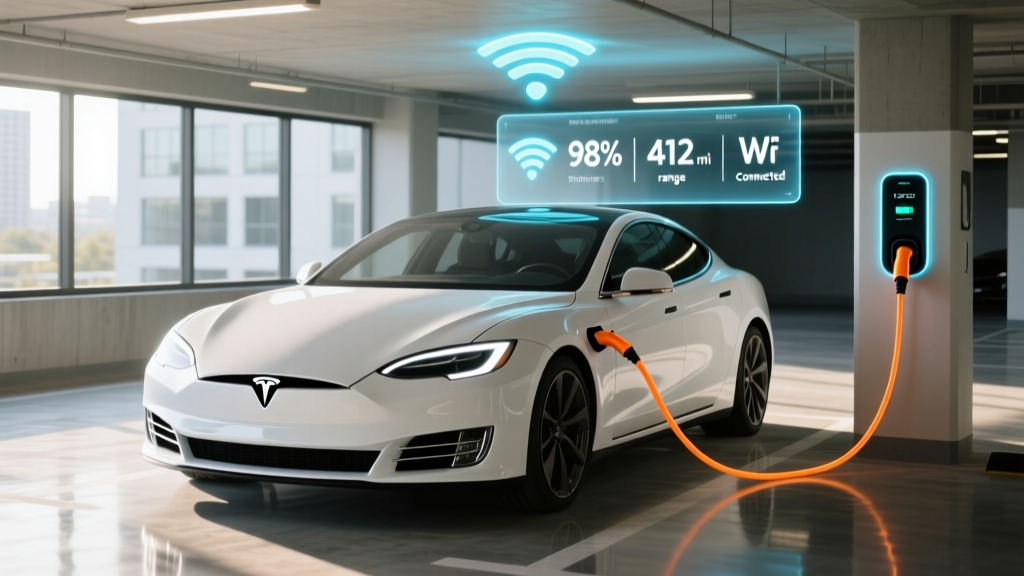
Tesla vehicles come with two connectivity tiers: Standard Connectivity (included free) and Premium Connectivity ($9.99/month or $99/year). Neither tier turns your Tesla into a passenger WiFi hotspot the way a Chevrolet or Ford might. Instead, Tesla's system is designed to keep the car itself connected — streaming music, pulling live traffic data, enabling satellite maps, and supporting over-the-air (OTA) updates. If you want passenger WiFi, you'll need to use your phone's personal hotspot or a dedicated mobile hotspot device.
This distinction matters because many buyers search for "Tesla WiFi hotspot" expecting to connect laptops and tablets on a road trip. You can't — at least not natively. What Tesla does offer is a robust infotainment ecosystem that leverages its built-in LTE/5G connection for the vehicle's own services. Let's break down the full ownership picture, from connectivity to range, charging, pricing, and whether a Tesla still makes sense in 2026's increasingly competitive EV market.
Range, Battery, and Real-World Efficiency
For this review, we'll focus on the highest-volume Tesla: the 2026 Model Y Long Range AWD, which remains the best-selling EV in the United States and the model most buyers cross-shop.
| Spec | Value |
|---|---|
| EPA Estimated Range | 320 miles |
| Battery Capacity (usable) | ~75 kWh (NMC chemistry) |
| Drivetrain | Dual-Motor AWD |
| Horsepower | 384 hp |
| 0-60 mph | 4.8 seconds |
| MPGe (combined) | 122 MPGe |
| Efficiency | 28 kWh/100 mi |
| Cargo Volume (rear seats up / folded) | 30.2 / 72.1 cu ft |
| Rear Legroom | 38.7 in |
| Battery Warranty | 8 years / 120,000 miles |
| Base MSRP | $47,990 |
Real-World Range Reality Check
The EPA rates the 2026 Model Y Long Range at 320 miles. In real-world highway driving at 70-75 mph in moderate temperatures (60-75°F), expect approximately 275-295 miles before needing to charge. In cold weather (below 32°F), range drops to roughly 230-260 miles due to battery chemistry limitations and cabin heating demands. Tesla's heat pump helps mitigate this compared to resistive heating systems, but the loss is still significant. City driving with heavy regenerative braking can sometimes exceed the EPA estimate, reaching 330+ miles in stop-and-go conditions.
The Model Y Long Range uses NMC (nickel manganese cobalt) battery chemistry, which offers higher energy density than LFP (lithium iron phosphate) but requires more careful charging habits. Tesla recommends charging NMC batteries to 80% for daily use and only going to 100% when you need the full range for a trip. The base Model Y RWD, by contrast, uses LFP chemistry and can be charged to 100% regularly without accelerated degradation — a trade-off worth understanding.
Charging Speed: DC Fast Charging and Home Level 2
Charging speed is where Tesla still holds a tangible advantage, thanks to the Supercharger network and the vehicle's thermal management system that preconditions the battery before you arrive.
| Charging Level | Power / Rate | Speed | Notes |
|---|---|---|---|
| Level 1 (120V household) | ~1.4 kW | ~3-4 miles/hour | Emergency/trickle only |
| Level 2 (240V home, 48A) | 11.5 kW | ~37 miles/hour | Full charge in ~8 hours |
| DC Fast Charge (Supercharger V4) | Peak 250 kW | 10-80% in ~22 min | Preconditioning required for peak speed |
| DC Fast Charge (CCS adapter, non-Tesla) | Up to 250 kW | Varies by station | CCS adapter included with new vehicles |
A critical nuance: Tesla's advertised peak of 250 kW is just that — a peak. The actual charging curve tapers significantly above 60% state of charge (SoC). From 10-50%, you'll see sustained rates of 150-230 kW depending on battery temperature. From 50-80%, the rate drops to roughly 80-120 kW. This is why the 10-80% time of ~22 minutes is a more useful metric than peak kW. Always use the vehicle's built-in navigation to route to a Supercharger — this triggers battery preconditioning, warming the pack to optimal temperature for faster charging. Skip preconditioning and your peak rate may be limited to 100-150 kW, especially in cold weather.
For home charging, Tesla's Wall Connector ($475) on a 60-amp circuit delivers up to 11.5 kW (48 amps continuous), adding roughly 37 miles of range per hour. Most owners charge overnight and wake up to a full battery every morning. Installation costs vary widely — expect $500-$2,000 for a straightforward install near your electrical panel, but costs can exceed $3,000 if a panel upgrade to 200 amps is needed. Always get a quote from a licensed electrician before committing.
Pricing, Trim Levels, and Federal Tax Credit Eligibility
| Trim | Base MSRP | Est. Federal Credit (§30D) | Effective Price |
|---|---|---|---|
| Model Y RWD (LFP) | $42,990 | Up to $7,500 (if eligible) | ~$35,490 |
| Model Y Long Range AWD | $47,990 | Up to $7,500 (if eligible) | ~$40,490 |
| Model Y Performance | $52,490 | Up to $7,500 (if eligible) | ~$44,990 |
The §30D federal tax credit is not automatic. To qualify for the full $7,500, you must meet several requirements simultaneously:
- Income caps: Modified AGI must not exceed $150,000 (single), $225,000 (head of household), or $300,000 (joint filers).
- MSRP cap: The vehicle's MSRP (including options but excluding destination) must not exceed $80,000 for SUVs. All Model Y trims clear this.
- Battery sourcing: A percentage of critical minerals and battery components must be sourced from the US or free-trade-agreement countries. These thresholds tighten annually. Verify current-year compliance on IRS.gov's qualified vehicle list, as eligibility can change mid-year.
- Point-of-sale transfer: Since 2024, you can transfer the credit to the dealer at purchase, effectively reducing your out-of-pocket cost at delivery rather than waiting for a tax refund.
Always confirm eligibility with a tax professional before relying on the credit in your purchase decision. Rules and sourcing requirements have shifted multiple times since the Inflation Reduction Act took effect.
Performance, Interior, and Technology
The Model Y Long Range AWD hits 60 mph in 4.8 seconds — quick for a family crossover but not sports-car territory. The Performance trim drops that to 3.5 seconds with 456 hp, though at a $4,500 premium and a slight range penalty. Dual-motor AWD provides confident traction in rain and snow, and Tesla's traction control system is among the most responsive in the EV segment.
Inside, the minimalist cabin is polarizing. There are no physical buttons — everything routes through the 15.4-inch center touchscreen. The 2025 refresh (carried into 2026) added ventilated front seats, ambient lighting, a rear-seat touchscreen, and power-folding second-row seats. Build quality has improved noticeably from the 2020-2023 era, though panel gaps still occasionally vary unit to unit.
Connectivity and the WiFi Question
Back to the core question: the Tesla WiFi hotspot situation. Tesla's built-in cellular connection powers the car's own services — navigation with live traffic, streaming Spotify/Apple Music/Tidal, OTA software updates, Sentry Mode clips sent to your phone, and satellite-view maps (Premium Connectivity). You can connect the car to your home WiFi for faster OTA downloads when parked, but the car does not broadcast a WiFi network for passenger devices.
For road-trip laptop connectivity, your options are:
- Use your smartphone's personal hotspot (most practical)
- Carry a dedicated mobile hotspot device (e.g., Netgear Nighthawk M6)
- Wait for Tesla to potentially add hotspot functionality in a future OTA update (unannounced)
The infotainment system itself is excellent — arguably the best in the EV market. Netflix, YouTube, and Disney+ stream on the center screen while parked. The gaming library includes Cyberpunk 2077 and Stardew Valley. And Tesla's navigation with Supercharger routing remains the gold standard for EV trip planning, automatically calculating charging stops, preconditioning the battery, and estimating arrival SoC.
Driver Assistance: Autopilot and FSD
SAE Level 2 — Driver Assistance, NOT Self-Driving. Tesla's Autopilot (included) and Full Self-Driving Supervised ($8,000 or $99/month) are Level 2 systems per SAE classification. You must keep your hands on the wheel (or demonstrate attention via the cabin camera) and remain fully responsible for driving at all times. FSD Supervised can navigate highway on-ramps, change lanes, and handle some city streets, but it makes errors and requires constant supervision. Only Level 4 services like Waymo operate without a human driver in defined areas.
Pros, Cons, and Competitive Position
Pros
- Supercharger network — still the most reliable DC fast-charging network in North America
- Best-in-class infotainment and OTA update cadence
- Strong efficiency (28 kWh/100 mi) translates to lower charging costs
- Practical cargo space (72.1 cu ft with seats folded) for a compact SUV
- Continual improvement via software — features added after purchase
Cons
- No native WiFi hotspot for passenger devices
- Ride quality is firm; road noise noticeable at highway speeds
- Minimalist interior lacks physical controls — not for everyone
- FSD ($8,000) remains Level 2 despite the name — expensive for what it delivers
- Insurance costs tend to be higher than segment average
How It Compares
The Model Y faces serious competition in 2026. The Hyundai Ioniq 5 offers comparable range (310 mi), 800V charging (10-80% in ~18 min), and a more comfortable ride, but relies on third-party charging networks. The Ford Mustang Mach-E provides a more traditional interior and strong handling, though its charging speed lags. The Kia EV6 shares the Ioniq 5's platform with a sportier design. None match Tesla's Supercharger advantage or software ecosystem, but all offer native WiFi hotspots for passengers — something Tesla still doesn't.
Who Should Buy the 2026 Tesla Model Y?
The Model Y is best for tech-forward commuters and small families who have reliable home charging access and value the Supercharger network for road trips. If you frequently drive long distances and want the most seamless charging experience available, Tesla's ecosystem remains unmatched. If passenger WiFi hotspot capability is a dealbreaker for your family's road-trip workflow, you'll need to supplement with a phone hotspot or consider a competitor.
Does the Tesla Model Y have a built-in WiFi hotspot for passengers?
No. Tesla's built-in cellular connection is used for the vehicle's own services (navigation, streaming, OTA updates). It does not create a WiFi network for passenger devices like laptops or tablets. Use your phone's personal hotspot or a dedicated mobile hotspot device instead.
What does Tesla Premium Connectivity include?
Premium Connectivity ($9.99/month or $99/year) adds live traffic visualization, satellite-view maps, music streaming via the car's cellular connection, video streaming (Netflix, YouTube) while parked, Caraoke, and internet browsing. Standard Connectivity includes basic navigation and OTA updates but routes streaming through your phone's Bluetooth connection.
How much does it cost to charge a Tesla Model Y at home?
At the US average electricity rate of ~$0.16/kWh, a full charge of the Model Y's ~75 kWh battery costs roughly $12. That translates to about $0.045 per mile — roughly one-third the per-mile fuel cost of a comparable gas-powered SUV at $3.50/gallon. Actual costs vary significantly by state and utility rate plan.
Does the 2026 Tesla Model Y qualify for the $7,500 federal tax credit?
It can, but eligibility depends on your income (below $150K single / $300K joint), the vehicle's battery sourcing compliance for the current year, and MSRP (all Model Y trims are under the $80K SUV cap). Check the IRS qualified vehicles list for real-time eligibility, as sourcing requirements change periodically.
What is the real-world range of the Model Y Long Range?
The EPA rates it at 320 miles. Real-world highway driving in moderate weather yields roughly 275-295 miles. Cold weather (below freezing) reduces this to approximately 230-260 miles. City driving with regenerative braking can exceed the EPA estimate.