If you've ever sat in a parked Tesla and wondered whether you can stream Netflix on the center display or use the car as a mobile hotspot for your laptop, the short answer is yes — but with important caveats about which connectivity tier you're paying for and how the system actually works. This guide breaks down exactly how Tesla's Wi-Fi and cellular connectivity functions in 2026, then transitions into a full profile of the current Tesla Model 3 to help you evaluate the vehicle as a whole.
Does Tesla Have Wi-Fi? The Complete Connectivity Breakdown
Every Tesla vehicle comes with a built-in cellular modem (LTE/5G depending on model year and hardware revision) and a Wi-Fi radio. But "having Wi-Fi" in a Tesla means several different things, and understanding the distinction matters for your monthly budget and daily use.
Tesla's Two Connectivity Tiers
Standard Connectivity (included free): This gives you basic navigation, traffic-based routing, and the ability to connect the car to your home Wi-Fi network or a mobile hotspot for over-the-air (OTA) software updates and media streaming. The car does not broadcast its own Wi-Fi hotspot to your devices under the free tier.
Premium Connectivity ($9.99/month or $99/year as of 2026): This unlocks satellite-view maps, live traffic visualization, video streaming (Netflix, YouTube, Disney+, etc.) on the center display while parked, Caraoke, and internet browsing — all using Tesla's built-in cellular connection. However, even with Premium Connectivity, Tesla does not offer a native Wi-Fi hotspot feature that shares the car's cellular data with your phone or laptop the way a dedicated mobile hotspot device does.
Can You Use Tesla as a Wi-Fi Hotspot?
No — not natively. Tesla's cellular modem is dedicated to the car's own systems. You cannot toggle a "mobile hotspot" setting to beam internet to your phone or laptop. If you need internet for a laptop while on the road, you'll need to either:
- Use your phone's personal hotspot
- Carry a dedicated mobile hotspot device (e.g., Verizon Inseego, T-Mobile Hotspot)
- Connect the Tesla to your phone's hotspot so the car's browser and streaming apps work, then use your phone's hotspot for other devices simultaneously (most modern smartphones support this)
Connecting Tesla to Your Home Wi-Fi
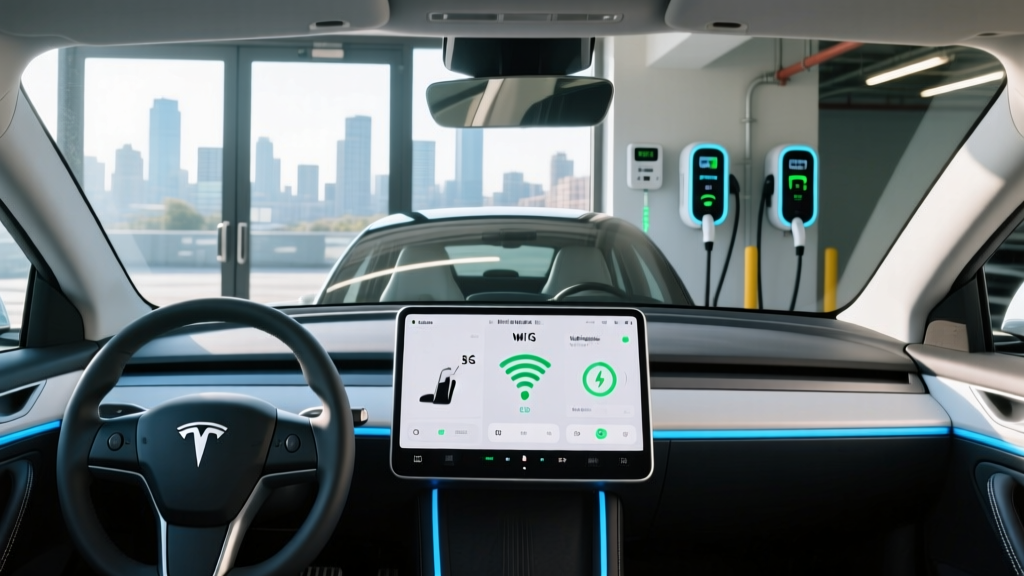
Tesla strongly recommends connecting your car to your home Wi-Fi network for OTA software updates, which can be several gigabytes in size. Without Wi-Fi, large updates download over the cellular connection, which is slow and may be deprioritized. To connect: tap the Wi-Fi icon in the top status bar of your Tesla's touchscreen, select your home network, and enter the password. The car will automatically reconnect when in range.
2026 Tesla Model 3: Real-World Range, Charging & Full Specs
With connectivity explained, let's examine the vehicle itself. The current-generation Tesla Model 3 (the "Highland" refresh introduced for the 2024 model year and carried into 2026 with minor software and trim updates) remains one of the most efficient and best-selling electric sedans in the U.S. market. Here's the data buyers need.
| Spec | RWD (Base) | Long Range AWD | Performance AWD |
|---|---|---|---|
| EPA Range | 341 mi | 363 mi | 315 mi |
| Battery (usable) | ~57.5 kWh (LFP) | ~75 kWh (NMC) | ~75 kWh (NMC) |
| Max DC Fast Charge | 170 kW | 250 kW | 250 kW |
| 10–80% DC Time | ~28 min | ~25 min | ~25 min |
| Level 2 Home Charge | 11.5 kW (~44 mi/hr) | 11.5 kW (~44 mi/hr) | 11.5 kW (~44 mi/hr) |
| 0–60 mph | 5.8 sec | 4.2 sec | 2.9 sec |
| Horsepower | 271 hp | 346 hp | 510 hp |
| Drivetrain | RWD (single motor) | AWD (dual motor) | AWD (dual motor) |
| MPGe (combined) | 132 MPGe | 125 MPGe | 110 MPGe |
| Efficiency | 25 kWh/100 mi | 27 kWh/100 mi | 30 kWh/100 mi |
| Base MSRP | $38,990 | $44,990 | $52,990 |
Source: EPA fueleconomy.gov, Tesla.com official specs. Prices exclude destination fee.
Real-World Range: What the EPA Sticker Doesn't Tell You
EPA sticker: 363 miles
Real-world highway (70–75 mph, 70°F): ~290–310 miles
Real-world mixed city/highway (moderate climate): ~320–340 miles
Cold weather (20°F, highway, heater on): ~220–260 miles
Hot weather (100°F+, A/C max): ~300–330 miles
The Model 3 Long Range's 363-mile EPA figure is among the best in its class, but EPA testing uses a specific drive cycle that doesn't fully capture sustained highway driving at 75+ mph or extreme temperatures. In our experience and consistent third-party testing, expect about 15–20% range reduction on highway-heavy road trips and 25–35% loss in freezing weather. The LFP battery in the RWD model handles 100% daily charges well (Tesla recommends charging LFP to 100% regularly), which partially offsets its lower total capacity. NMC-equipped Long Range and Performance models should be charged to 80% for daily use and 100% only before long trips.
Charging Speed: DC Fast Charging and Home Level 2
| Charging Level | Power | Miles Added per Hour | Notes |
|---|---|---|---|
| Level 1 (120V household) | ~1.4 kW | ~3–5 mi/hr | Emergency/trickle only; full charge takes days |
| Level 2 (240V home, 48A) | 11.5 kW | ~44 mi/hr | Overnight full charge in ~7–8 hours |
| DC Fast (Tesla Supercharger V3) | Up to 250 kW peak | ~1,000+ mi/hr (peak) | 10–80% in ~25 min; tapers significantly above 80% |
| DC Fast (CCS adapter, non-Tesla) | Up to 250 kW | Varies by station | Tesla includes NACS port; CCS adapter available |
Charging curve reality check: The 250 kW peak rate on Long Range and Performance models is sustained only between roughly 10–30% state of charge. By 50% SoC, the rate drops to ~150 kW, and by 80% it falls to ~60 kW. Charging from 80–100% on DC fast charge is painfully slow — plan your road-trip stops to charge to 80% and move on. The RWD model's LFP battery caps at ~170 kW peak, making its 10–80% time about 28 minutes.
For home charging, Tesla's Wall Connector ($420) on a 60-amp circuit delivers the full 11.5 kW (48 amps continuous), adding roughly 44 miles of range per hour. A typical overnight session from 20–80% takes about 5 hours. Installation costs vary widely — expect $500–$2,000 depending on whether your electrical panel needs an upgrade. Always have a licensed electrician assess your panel capacity before installation.
Pricing, Tax Credits & Total Cost
| Trim | MSRP | Est. Federal Credit (§30D) | Effective Price |
|---|---|---|---|
| RWD | $38,990 | Up to $7,500* | ~$31,490* |
| Long Range AWD | $44,990 | Up to $7,500* | ~$37,490* |
| Performance AWD | $52,990 | Up to $7,500* | ~$45,490* |
*Federal tax credit eligibility is NOT guaranteed. Under IRS §30D rules, you must meet ALL of the following:
- MSRP cap: Sedans must be ≤ $55,000 (all Model 3 trims qualify)
- Buyer income cap: AGI ≤ $150,000 (single) / $225,000 (head of household) / $300,000 (joint)
- Battery sourcing: Critical minerals and battery components must meet phased-in domestic/free-trade sourcing thresholds — Tesla's supply chain has largely adapted, but verify at point of sale
- Point-of-sale transfer: As of 2024+, you can transfer the credit to the dealer at purchase for an immediate price reduction, or claim it on your tax return
- Tax liability: The credit is non-refundable — you must owe at least $7,500 in federal tax to benefit fully (unless using point-of-sale transfer)
Consult a tax professional and verify current eligibility at irs.gov before purchasing.
Interior, Cargo, Tech & Driver Assistance
The refreshed Model 3 interior is a meaningful step up from pre-2024 models. Tesla added ventilated front seats, ambient lighting, rear-seat ventilation, improved sound insulation, and a rear touchscreen for climate and media control. The minimalist cabin eliminates nearly all physical buttons — even the turn signals are now capacitive buttons on the steering wheel (a polarizing design choice that some owners love and others find frustrating during roundabouts).
Cargo space: 23 cu ft total (19.8 cu ft trunk + 3.1 cu ft frunk). That's competitive with the Hyundai Ioniq 6 (12.3 cu ft trunk, smaller) but trails the Polestar 2 (14.4 cu ft + 1.4 frunk). Rear legroom measures 35.3 inches — adequate for adults on moderate-length trips but tighter than a midsize sedan like the Hyundai Ioniq 5.
Infotainment: The 15.4-inch center touchscreen runs Tesla's proprietary OS with no Apple CarPlay or Android Auto. Instead, Tesla offers native Spotify, Apple Music, Tidal, and podcast apps, plus the full web browser and video streaming mentioned earlier. Navigation is Tesla's own with real-time traffic and Supercharger routing.
Driver assistance: Every Model 3 includes Tesla's Basic Autopilot (lane centering, adaptive cruise control, emergency braking). Enhanced Autopilot ($6,000) adds automatic lane changes, auto-park, and Navigate on Autopilot. Full Self-Driving (Supervised) at $8,000 or $99/month adds traffic light/stop sign recognition and city-street autosteer.
Despite the "Full Self-Driving" name, Tesla's FSD (Supervised) is classified as SAE Level 2 driver assistance. The driver must remain fully engaged, hands on or near the wheel, and eyes on the road at all times. The system does not handle all driving scenarios and can make errors. Only SAE Level 4 services like Waymo operate without a human driver — and those are limited to specific geofenced areas.
Warranty & Long-Term Battery Outlook
Tesla's warranty structure for the 2026 Model 3:
- Basic vehicle: 4 years / 50,000 miles
- Battery & drive unit (RWD): 8 years / 100,000 miles
- Battery & drive unit (Long Range/Performance): 8 years / 120,000 miles
- Battery degradation threshold: Tesla warrants that the battery will retain at least 70% of original capacity during the warranty period
The LFP battery in the RWD model has a longer cycle life than NMC chemistry — research shows LFP cells can endure 3,000+ full charge cycles with minimal degradation, compared to roughly 1,500–2,000 for NMC. In practical terms, this means the RWD's smaller battery may outlast the Long Range's in terms of calendar life and cycle count, though it starts with fewer miles of range. Real-world degradation data from fleet operators suggests Tesla batteries lose roughly 5–10% capacity in the first 50,000 miles, then degrade more slowly afterward.
Pros, Cons & Who Should Buy the Model 3
- Class-leading efficiency (25 kWh/100 mi on RWD)
- Access to Tesla Supercharger network — the most reliable DC fast-charging network in the U.S.
- Strong OTA update cadence adds features post-purchase
- LFP battery option allows daily 100% charging without degradation anxiety
- Best-in-class infotainment and app ecosystem
- Low maintenance costs (no oil, minimal brake wear from regen)
- No Apple CarPlay / Android Auto — dealbreaker for some
- Capacitive turn signals and no physical stalks take adjustment
- No native Wi-Fi hotspot for external devices
- Rear seat space is tighter than crossover competitors
- Premium Connectivity is a recurring subscription cost
- Insurance costs tend to be higher than average for the segment
Best for: Tech-forward commuters and small households who prioritize efficiency, charging infrastructure access, and software experience. The RWD trim at ~$31,490 after the federal credit is one of the best value propositions in the EV market. The Long Range AWD suits road-trippers and those in cold climates who need the extra range buffer and all-wheel-drive traction. The Performance trim is for driving enthusiasts who want sports-car acceleration in a practical sedan.
Consider instead if: You need maximum rear-seat space (look at the Model Y or Ioniq 5), you refuse to live without CarPlay (Hyundai Ioniq 6, BMW i4), or you want a native Wi-Fi hotspot for passengers (some GM and Ford EVs offer this via OnStar/Connected Services).
Frequently Asked Questions
Does Tesla have built-in Wi-Fi that I can use with my phone or laptop?
No. Tesla's cellular modem powers the car's own apps, navigation, and streaming — but it does not broadcast a Wi-Fi hotspot for your personal devices. You'll need your phone's hotspot or a dedicated mobile hotspot device for external internet access.
What is the real-world range of the 2026 Tesla Model 3?
The EPA rates the Long Range AWD at 363 miles, but expect ~290–310 miles on sustained highway driving and ~220–260 miles in freezing weather. The RWD model's 341-mile EPA rating translates to roughly 270–290 miles highway in moderate conditions.
How fast does the Model 3 charge at home and on the road?
At home on a 240V Level 2 charger (48A), the Model 3 charges at 11.5 kW, adding ~44 miles per hour — a full overnight charge. On a Tesla V3 Supercharger, Long Range and Performance models peak at 250 kW and reach 10–80% in about 25 minutes, though the charge rate tapers significantly above 80%.
Does the 2026 Tesla Model 3 qualify for the $7,500 federal EV tax credit?
All three trims fall under the $55,000 MSRP sedan cap, making them potentially eligible. However, you must also meet IRS income limits (≤ $150K single / $300K joint), and the vehicle's battery must satisfy critical-mineral and component sourcing requirements. Verify eligibility at irs.gov and with your tax professional before purchase.
Is the Model 3 worth buying over the Hyundai Ioniq 6 or BMW i4?
The Model 3 wins on charging infrastructure (Supercharger access), efficiency, and software. The Ioniq 6 offers more rear-seat headroom and a conventional turn-signal stalk. The BMW i4 provides a more traditional luxury interior and Apple CarPlay. If Supercharger reliability and over-the-air updates are top priorities, the Model 3 remains the segment benchmark.
Do I need Premium Connectivity to use Tesla's navigation?
No. Standard (free) Connectivity includes full navigation with traffic-based routing. Premium Connectivity adds satellite-view maps, live traffic visualization on the map, and the ability to stream video and browse the internet over the car's cellular connection rather than requiring Wi-Fi.
How much does it cost to charge a Model 3 at home vs. Supercharging?
At the U.S. average residential electricity rate of ~$0.17/kWh (2026), charging a Long Range Model 3 from 10–80% at home costs roughly $8.80. Supercharger pricing varies by location and time of day but averages $0.30–$0.40/kWh, making the same charge $15–$21. Home charging saves most owners $600–$1,000 annually compared to exclusive Supercharger use.