Why EV Owners Search for "Tesla Water" Answers
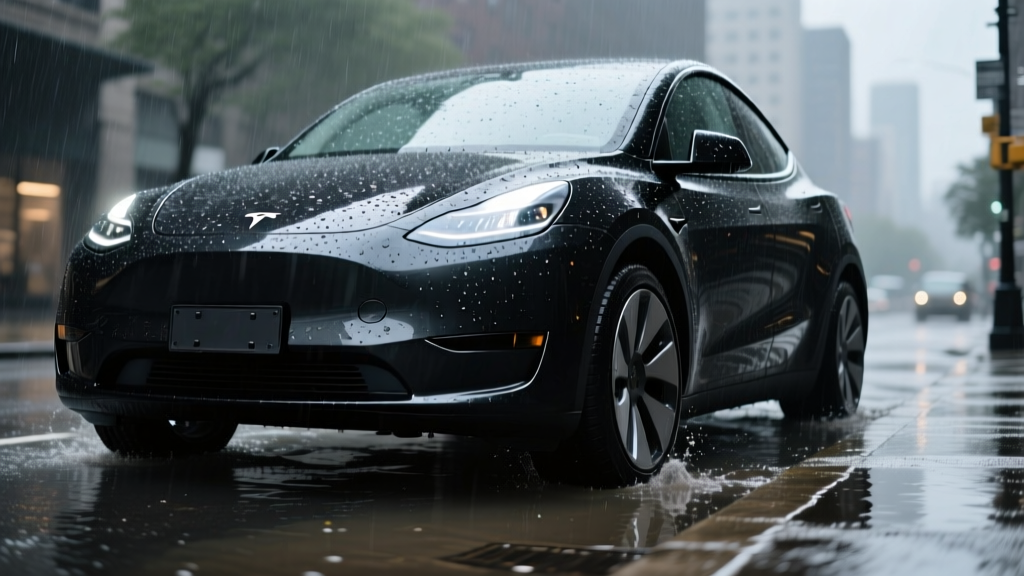
Type "tesla water" into any search bar and you will find a tangle of forum threads, YouTube clips of flooded sedans, and anxious owners wondering whether their $45,000 battery pack can survive a rainstorm. The concern is legitimate. An EV's traction battery stores 60-82 kWh of energy at 350-400 volts, and water intrusion into high-voltage components is a serious safety and financial risk. But the reality of Tesla's water engineering is more nuanced than either the fear-mongering or the "drive it through a river" bravado suggests.
This guide covers what Tesla's water protection actually means for Model Y owners in 2026, how EV battery sealing works, what happens when water damage does occur, and how Tesla's coverage compares to the competition. We will also run through the Model Y's core specs so you have the full ownership picture in one place.
Tesla's Water Protection: IP67, Wading Depth, and Real Limits
Tesla's high-voltage battery pack and drive unit enclosures carry an IP67 rating. Breaking that down: the "6" means complete protection against dust ingress, and the "7" means the enclosure can withstand submersion in up to 1 meter (roughly 39 inches) of water for 30 minutes without harmful water entry. This rating applies to the sealed battery casing and drive unit housings, not the entire vehicle.
Tesla does not publish an official wading depth for the Model Y. For reference, the now-discontinued Model S had a stated wading depth of approximately 11.8 inches (300 mm) in owner documentation. The Model Y, with its higher ride height (roughly 7.9 inches of ground clearance for the Long Range AWD), can physically clear more water than a Model 3, but the practical safe wading limit remains conservative.
While the battery pack is IP67-sealed, the cabin air intake, 12V/16V auxiliary battery, power electronics, and interior are NOT waterproof. Driving through standing water above the lower door sill (roughly 6-8 inches on Model Y) risks flooding the cabin, damaging interior electronics, and voiding warranty coverage. Tesla's warranty explicitly excludes water damage from flooding or submersion events.
What "Tesla Water" Actually Means in Practice
Here is how different water exposure scenarios play out with a Model Y:
| Scenario | Risk Level | Notes |
|---|---|---|
| Heavy rain / car wash | None | Vehicle is fully weather-sealed for normal precipitation and touchless/brush washes |
| Puddles (under 4 inches) | Low | Tires and splash guards handle this; battery well above this level |
| Flooded street (6-10 inches) | Moderate-High | Cabin floor and low-voltage electronics at risk; avoid if possible |
| Deep flooding (above door sill) | Severe | Interior damage, potential HV system fault, likely total loss by insurance |
| Saltwater submersion | Catastrophic | Corrosive; even brief exposure can cause long-term electrical degradation |
2026 Tesla Model Y: Core EV Specs at a Glance
Whether you are evaluating water-related risks or just shopping for a compact electric SUV, these are the numbers that matter for the current-generation Model Y (refreshed "Juniper" platform, 2025-2026 model years):
| Spec | Long Range AWD | Performance |
|---|---|---|
| EPA Range | 320 miles | 294 miles |
| Battery (usable) | ~75 kWh, NMC | ~75 kWh, NMC |
| Drivetrain | Dual-motor AWD | Dual-motor AWD |
| Horsepower | 384 hp | 510 hp |
| 0-60 mph | 4.8 sec | 3.5 sec |
| Max DC Charge Rate | 250 kW (peak) | 250 kW (peak) |
| 10-80% DC Fast Charge | ~25 min | ~25 min |
| Level 2 Charge Rate | 11.5 kW (~44 mi/hr) | 11.5 kW (~44 mi/hr) |
| MPGe (combined) | 111 MPGe | 102 MPGe |
| Efficiency | 30 kWh/100mi | 33 kWh/100mi |
| Cargo (rear seats up) | 30.2 cu ft | 30.2 cu ft |
| Cargo (rear seats folded) | 72.1 cu ft | 72.1 cu ft |
| Rear Legroom | 40.5 in | 40.5 in |
| Towing Capacity | 3,500 lbs | 3,500 lbs |
| Base MSRP | $44,990 | $48,990 |
Source: EPA fueleconomy.gov, Tesla.com. Figures reflect 2025-2026 Long Range and Performance trims.
The Long Range AWD's EPA sticker reads 320 miles, but real-world results vary significantly. Expect approximately 265-285 miles on sustained highway driving at 70-75 mph. In cold weather (below 32°F), range drops 20-30%, meaning a winter highway trip may deliver 220-250 miles before you need to plug in. City driving with regenerative braking recovers energy and can approach or slightly exceed the EPA figure in mild conditions. Always plan road trips around 250 miles of usable range to keep a safety margin.
Charging the Model Y: Speeds, Connectors, and Cold-Weather Behavior
The Model Y uses the NACS (North American Charging Standard) connector natively — Tesla designed it. This means direct access to the Tesla Supercharger network, which remains the most reliable public DC fast-charging infrastructure in the US, with over 25,000 stalls nationally as of early 2026.
| Charging Level | Power / Rate | Speed | Typical Use Case |
|---|---|---|---|
| Level 1 (120V household) | ~1.4 kW | ~3-5 mi/hr | Emergency / overnight trickle |
| Level 2 (240V home, 48A) | 11.5 kW | ~44 mi/hr | Daily home charging (~8-9 hrs for full) |
| DC Fast Charge (Supercharger V3) | 250 kW peak | 10-80% in ~25 min | Road trips, rapid top-ups |
| DC Fast Charge (non-Tesla CCS adapter) | Up to 150-250 kW | Varies by network | EA, EVgo, ChargePoint with NACS adapter |
The Charging Curve Reality
Tesla's 250 kW peak rate applies only in the low state-of-charge window (roughly 10-30% SoC) with a preconditioned battery. As the battery fills, charge speed tapers — by 60% SoC you are likely pulling 100-130 kW, and above 80% it drops to under 50 kW. This is why Tesla (and every EV maker) quotes 10-80% times rather than 0-100%. Charging from 80-100% at a Supercharger can add another 20-30 minutes and is rarely worth the time on a road trip.
Cold-weather charging note: In sub-freezing temperatures, always navigate to a Supercharger using the car's built-in navigation. This triggers battery preconditioning, warming the pack to accept faster charge rates. Without preconditioning, a cold Model Y battery may accept only 50-80 kW at a 250 kW stall, nearly doubling your 10-80% time.
Pricing, Trims, and Federal Tax Credit Eligibility
The 2026 Model Y lineup is straightforward: Long Range AWD and Performance. Both qualify for the full $7,500 federal EV tax credit under IRS §30D rules, provided you meet the buyer requirements. Tesla also offers a point-of-sale transfer option, letting you apply the credit as a purchase-price reduction at delivery rather than waiting for tax filing.
| Long Range AWD | Performance | |
|---|---|---|
| Base MSRP | $44,990 | $48,990 |
| Destination Fee | $1,390 | $1,390 |
| Typical As-Tested (w/ common options) | $47,500-$50,000 | $52,000-$55,000 |
| Federal Tax Credit (§30D) | $7,500 | $7,500 |
| Effective Price After Credit | ~$38,880 | ~$42,880 |
- MSRP Cap: SUVs/pickups must be under $80,000 — both Model Y trims qualify easily
- Buyer Income Cap: AGI ≤ $150,000 (single), $225,000 (head of household), $300,000 (joint)
- Battery Sourcing: Battery components must meet escalating domestic-content and critical-mineral thresholds — Tesla's US-built packs currently satisfy these requirements
- Final Assembly: Must be assembled in North America — Model Y is built in Fremont, CA and Austin, TX
- Point-of-Sale Transfer: Available — apply the $7,500 at purchase rather than on your tax return
Rules are subject to change. Verify current eligibility at irs.gov and consult a tax professional for your specific situation.
Warranty Coverage: Battery, Drive Unit, and the Water Damage Exclusion
Tesla's warranty structure for the Model Y is competitive with the EV segment:
- Basic Vehicle Limited Warranty: 4 years / 50,000 miles, whichever comes first
- Battery & Drive Unit Warranty: 8 years / 120,000 miles (Long Range & Performance) with minimum 70% capacity retention
- What the battery warranty covers: Defects in materials/workmanship and excessive degradation below the 70% State of Health threshold
The water damage exclusion is critical: Tesla's warranty explicitly does not cover damage caused by flooding, submersion, or driving through water beyond reasonable limits. If your Model Y sustains water damage to the battery pack or drive unit from a flood event, that repair falls to your comprehensive auto insurance — not Tesla. Given that a Model Y battery replacement costs between $12,000 and $16,000 out of warranty, this is a material financial risk for owners in flood-prone areas.
If your vehicle does encounter deep water, Tesla service recommends not attempting to drive or charge the vehicle and contacting roadside assistance immediately. High-voltage isolation faults will typically trigger warning messages on the touchscreen and may disable the vehicle.
Tech, Driver Assistance, and Interior Notes
The refreshed Model Y (Juniper generation) carries forward Tesla's minimalist interior approach with meaningful upgrades over the pre-2025 models:
- Infotainment: 15.4-inch center touchscreen, rear 8-inch screen for passengers, integrated streaming, navigation, and vehicle controls
- Autopilot (standard): SAE Level 2 driver assistance — adaptive cruise, lane centering, automatic emergency braking, blind-spot monitoring. Requires active driver supervision at all times; this is not self-driving.
- Full Self-Driving Supervised (optional, ~$8,000): Adds automated lane changes, Navigate on Autopilot, traffic light/stop sign recognition, and Autopark. Still SAE Level 2 — your hands stay on the wheel and your eyes stay on the road.
- Ambient lighting, ventilated front seats, and acoustic glass improve cabin refinement over prior generations
Tesla's Autopilot and FSD (Supervised) are SAE Level 2 systems. The driver is legally and operationally responsible for the vehicle at all times. These systems do not handle construction zones, unmapped roads, severe weather, or stationary obstacles reliably. NHTSA continues to investigate Autopilot-related incidents. Never treat any Level 2 system as a substitute for attentive driving.
Notable Drawbacks
- No physical instrument cluster — all information routes through the center screen
- No Apple CarPlay or Android Auto integration
- Ride quality on 20-inch wheels can be firm over broken pavement
- Panel gap consistency has improved but still draws criticism versus legacy luxury brands
- Insurance premiums run 15-25% higher than comparable ICE SUVs in most states
Who the Model Y Suits Best
✓ Choose the Model Y If:
- You want Supercharger network access for stress-free road trips
- You need 30+ cu ft of cargo space with an EV powertrain
- Home Level 2 charging is available to you
- You value over-the-air updates and integrated tech
- You live in a region with moderate winters (or can precondition)
✗ Look Elsewhere If:
- You regularly face deep-flood conditions (consider an ICE or hybrid for those scenarios)
- You prefer physical buttons, a traditional gauge cluster, or CarPlay
- You need more than 3,500 lbs of towing capacity
- You want a longer battery warranty (Hyundai/Kia offer 10yr/100,000mi)
- Three-row seating is a must (look at the Model X or Kia EV9)
Model Y vs. Key Competitors: Water Protection & Overall Value
| Spec | Tesla Model Y LR AWD | Ford Mustang Mach-E ER AWD | Hyundai Ioniq 5 Long Range AWD |
|---|---|---|---|
| EPA Range | 320 mi | 305 mi | 290 mi |
| Battery | ~75 kWh NMC | 91 kWh NMC | 77.4 kWh NMC |
| Max DC Charge | 250 kW | 150 kW | 240 kW |
| 10-80% Time | ~25 min | ~38 min | ~18 min |
| Ground Clearance | 7.9 in | 5.7 in | 6.1 in |
| Base MSRP | $44,990 | $48,995 | $49,850 |
| Battery Warranty | 8yr/120,000mi | 8yr/100,000mi | 10yr/100,000mi |
| Charging Network | Native NACS/Supercharger | NACS (adapter or native) | NACS (adapter or native) |
The Model Y's 7.9 inches of ground clearance gives it a practical edge in shallow-water scenarios versus the Mach-E and Ioniq 5, both of which sit lower. However, none of these vehicles are designed for water fording — and all exclude flood damage from their powertrain warranties. If water exposure is a genuine concern in your area, comprehensive insurance with low deductibles is the real safety net.
Frequently Asked Questions
Can a Tesla drive through flooded streets?
Teslas can handle shallow puddles and wet roads without issue, but driving through standing water above the lower door sill (roughly 6-8 inches on Model Y) risks interior flooding and electrical damage. Tesla's warranty does not cover water damage from flooding. If a flooded road is avoidable, avoid it.
Does rain or a car wash damage a Tesla?
No. Teslas are fully sealed against rain, snow, and car washes like any modern vehicle. The IP67 battery rating and standard automotive weather sealing handle normal precipitation without concern. Touchless and soft-touch car washes are fine; Tesla recommends avoiding high-pressure washers directly on charge port seals.
What happens if a Tesla battery gets water damaged?
If water intrudes into the high-voltage battery enclosure beyond its IP67 rating (deep submersion, flood events, or seal damage from impact), the vehicle will typically trigger an isolation fault and disable the drive system. The battery may need full replacement at $12,000-$16,000 out of pocket. This damage falls under comprehensive auto insurance, not Tesla's warranty.
Is the Tesla Model Y waterproof underneath?
The battery pack and drive units are sealed to IP67 (submersible to 1 meter for 30 minutes), but the vehicle's underbody also houses cooling lines, wiring harnesses, and the 16V auxiliary battery that are not rated for submersion. The underbody is splash-proof, not flood-proof.
Does the Model Y qualify for the $7,500 federal tax credit in 2026?
Yes, both Model Y trims currently qualify for the full $7,500 credit under IRS §30D, provided the buyer meets income caps ($150K single / $300K joint) and the vehicle meets battery sourcing requirements — which Tesla's US-manufactured packs currently satisfy. The credit can be applied at point of sale. Always verify at irs.gov before purchasing, as rules evolve.
How does the Model Y's water protection compare to a gas car?
Modern ICE vehicles also face severe damage from flood-level water — engine hydrolock, transmission contamination, and interior mold are common. EVs have fewer fluid-filled systems vulnerable to contamination, but the high-voltage battery replacement cost is steep. Neither powertrain type is designed for flood operation. For both, comprehensive insurance is the primary financial protection.