If you're researching a Tesla warranty used vehicle purchase in 2026, you're not alone. Pre-owned Teslas dominate the used EV market, offering access to the Supercharger network, over-the-air updates, and strong performance at a fraction of new-car pricing. But Tesla's warranty structure for second-hand buyers has nuances that can make or break your ownership experience.
This guide covers exactly what transfers, what doesn't, and how to evaluate a used Tesla's battery health, charging capability, and real-world range before signing the paperwork.
Tesla's Warranty Structure: What Covers a Used EV?
Tesla's warranty is fully transferable to subsequent owners, which is a significant advantage over some legacy automakers that limit coverage to the original purchaser. Here's the breakdown by model:
| Component | Model 3 / Model Y | Model S / Model X |
|---|---|---|
| Basic Vehicle Limited Warranty | 4 years / 50,000 miles | 4 years / 50,000 miles |
| Battery & Drive Unit Warranty | 8 years / 100,000 miles (RWD) 8 years / 120,000 miles (AWD) | 8 years / 150,000 miles |
| Battery Capacity Retention Threshold | 70% minimum | 70% minimum |
Key insight: The 8-year battery and drive unit warranty is the real value proposition. If you're buying a 2022 Model 3 Long Range with 35,000 miles, you still have roughly 5 years and 85,000 miles of battery coverage remaining. That's substantial protection against a $12,000–$18,000 battery replacement.
Real-World Range: EPA vs. What You'll Actually Get
2024–2025 Model 3 Long Range AWD: EPA 341 miles
Expected highway (70 mph): ~270–290 miles
Cold weather (below 32°F): ~220–250 miles (30–35% loss)
City driving with regen: ~310–330 miles
Tesla's EPA estimates are generally optimistic compared to real-world highway driving, where aerodynamic drag and sustained speeds reduce efficiency. The Model 3 Long Range's 341-mile EPA rating drops to roughly 270–290 miles at 70 mph on the interstate. In freezing temperatures, expect 30–35% range loss unless you precondition the battery.
The Model Y Long Range AWD (EPA 310 miles) follows a similar pattern: ~250 miles highway, ~210 miles in deep cold. For the Standard Range RWD variants (EPA 272 miles for Model 3), plan for 220–240 miles in mixed real-world use.
Battery Chemistry: LFP vs. NMC in Used Teslas
Tesla introduced lithium iron phosphate (LFP) batteries in Standard Range Model 3 and Model Y vehicles starting in late 2021. Long Range and Performance variants use nickel manganese cobalt (NMC) chemistry. This matters for used buyers:
| Factor | LFP (Standard Range) | NMC (Long Range/Performance) |
|---|---|---|
| Energy Density | Lower (shorter range) | Higher (longer range) |
| Cycle Life | 2,000+ cycles | 1,000–1,500 cycles |
| Recommended Charge Limit | 100% daily OK | 80% daily, 100% for trips |
| Cold-Weather Performance | Slower charging in cold | Better cold-weather range |
| Degradation Profile | Slower long-term degradation | Faster initial drop, then stabilizes |
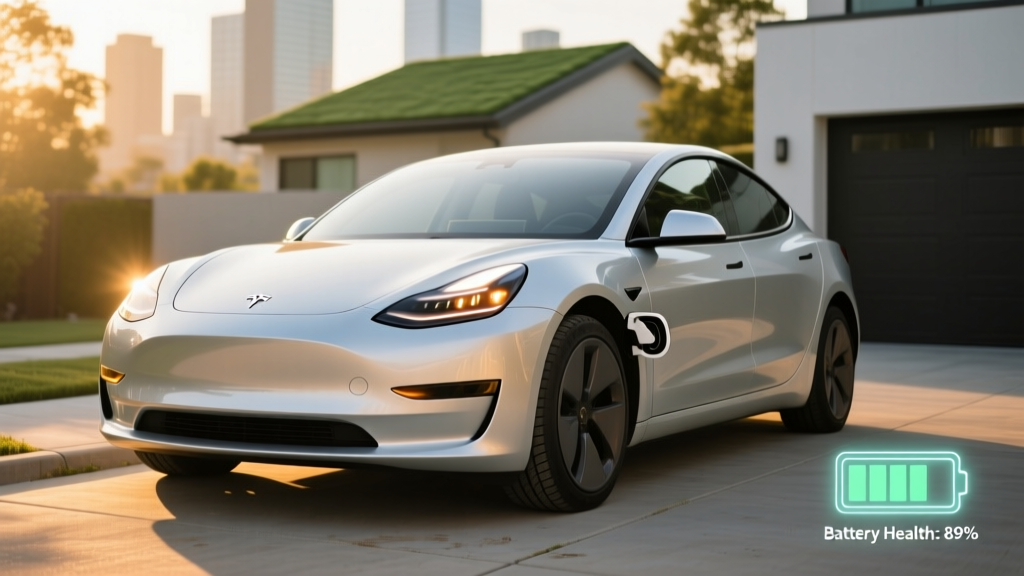
Used buyer takeaway: A 2022 Model 3 RWD with LFP chemistry may show less degradation than a 2020 Model 3 Long Range with NMC, even at similar mileage. Check the battery health screen (Settings > Service > Battery Health) or request a third-party diagnostic.
Charging Speed: What Used Teslas Can Actually Do
| Model/Year | Peak DC Fast Charge | 10–80% Time | Home Level 2 (48A) |
|---|---|---|---|
| 2021–2023 Model 3 Long Range | 250 kW (V3 Supercharger) | ~28–30 minutes | 44 miles/hr (11.5 kW) |
| 2024–2025 Model 3 Highland | 250 kW | ~25–27 minutes | 44 miles/hr (11.5 kW) |
| 2020–2023 Model Y Long Range | 250 kW | ~27–29 minutes | 44 miles/hr (11.5 kW) |
| 2024–2025 Model Y Juniper | 250 kW | ~24–26 minutes | 44 miles/hr (11.5 kW) |
Older 2018–2020 Model 3 vehicles max out at 150–170 kW on V2 Superchargers unless retrofitted, adding 5–10 minutes to a 10–80% session. All current Model 3 and Model Y variants support V3 Superchargers at 250 kW peak, though sustained rates taper above 60% state of charge.
At home, a 48-amp Level 2 charger (like the Tesla Wall Connector) delivers ~44 miles of range per hour, fully replenishing a Model 3 Long Range overnight. Budget $500–$1,200 for professional installation depending on panel capacity and run length.
Pricing & Tax Credits: What a Used Tesla Actually Costs
Used Tesla prices have dropped significantly since 2022. Here's what you'll find in early 2026:
| Model | Model Year | Typical Price Range | Federal Used EV Credit (§25E) |
|---|---|---|---|
| Model 3 Standard Range | 2021–2022 | $18,000–$23,000 | $4,000 (if eligible) |
| Model 3 Long Range | 2021–2023 | $22,000–$28,000 | $4,000 (if eligible) |
| Model Y Long Range | 2022–2023 | $26,000–$32,000 | $4,000 (if eligible) |
| Model S Long Range | 2021–2022 | $45,000–$55,000 | Not eligible (over $25k cap) |
The §25E Used EV Credit: This federal incentive provides up to $4,000 (30% of sale price, capped at $4,000) for qualifying used EVs. Requirements include:
- Vehicle must be at least 2 model years old
- Sale price must be $25,000 or less
- Buyer income limits: $75,000 (single), $112,500 (head of household), $150,000 (joint)
- Must purchase from a licensed dealer (private sales don't qualify)
- Credit can be claimed once per vehicle VIN over its lifetime
Source: IRS §25E Used Clean Vehicle Credit
Performance & Efficiency: Numbers That Matter
| Model | 0–60 mph | Horsepower | Drivetrain | MPGe (Combined) | kWh/100mi |
|---|---|---|---|---|---|
| Model 3 RWD (2022–2023) | 5.8 sec | 283 hp | Rear-Wheel Drive | 132 MPGe | 25 kWh |
| Model 3 Long Range (2022–2023) | 4.2 sec | 346 hp | Dual-Motor AWD | 131 MPGe | 26 kWh |
| Model Y Long Range (2023) | 4.8 sec | 384 hp | Dual-Motor AWD | 122 MPGe | 28 kWh |
| Model Y Performance (2023) | 3.5 sec | 456 hp | Dual-Motor AWD | 117 MPGe | 30 kWh |
Efficiency data from fueleconomy.gov. Tesla's dual-motor AWD system provides excellent traction in snow and rain, with minimal efficiency penalty compared to RWD variants.
Cargo, Space & Daily Usability
The Model 3 offers 23 cubic feet of trunk space (including the frunk), while the Model Y provides 76 cubic feet with rear seats folded—rivaling midsize SUVs. Rear legroom is 35.2 inches in the Model 3 and 40.5 inches in the Model Y, making the crossover significantly more family-friendly.
Both vehicles feature Tesla's minimalist interior with a 15.4-inch touchscreen (15-inch in pre-2024 models), wireless phone charging, and access to the Supercharger network. The 2024+ "Highland" and "Juniper" refreshes added ventilated seats, ambient lighting, and rear-seat touchscreens.
Who Should Buy a Used Tesla?
- Commuters: 250+ mile range covers most round trips with home charging
- Tech enthusiasts: OTA updates, Autopilot, and Supercharger access
- Budget-conscious EV buyers: $18k–$28k after tax credit is competitive with new gas cars
- You need 3-row seating (look at Rivian R1S or used Model X)
- You tow frequently (Model Y maxes at 3,500 lbs; competitors offer more)
- You prefer physical buttons and traditional controls
Pros & Cons of Buying a Used Tesla
- Fully transferable 8-year battery warranty
- Access to 50,000+ Supercharger stalls nationwide
- Strong software support and OTA updates
- Low maintenance costs (no oil changes, minimal brake wear)
- Excellent efficiency and range per kWh
- Insurance premiums 20–40% higher than gas equivalents
- Repair costs high out of warranty (body panels, sensors)
- Limited service center availability in rural areas
- Minimalist interior not for everyone
- Autopilot/FSD is Level 2 only—driver must remain engaged
FAQ: Tesla Warranty Used EV Questions
Does Tesla's warranty transfer to second owners?
Yes. Both the 4-year/50,000-mile basic warranty and the 8-year battery/drive unit warranty transfer automatically to subsequent owners. No registration or fee required.
How do I check battery health on a used Tesla?
Navigate to Settings > Service > Battery Health. This shows estimated range at 100% charge and a degradation percentage. You can also request a battery health report from Tesla Service or use third-party tools like Teslamate or Tessie.
What happens if the battery degrades below 70%?
If your battery's usable capacity drops below 70% within the 8-year/100,000–150,000-mile warranty period, Tesla will repair or replace it at no cost. Most 2020–2023 vehicles show 5–12% degradation at 50,000 miles, well above the threshold.
Can I get the $4,000 used EV tax credit on a Tesla?
Yes, if the vehicle is at least 2 model years old, priced at $25,000 or less, purchased from a licensed dealer, and your income falls under IRS limits. A 2022 Model 3 RWD at $22,000 qualifies; a 2022 Model Y at $28,000 does not.
Is Autopilot included on used Teslas?
Basic Autopilot (Traffic-Aware Cruise Control and Autosteer) is standard on all Teslas. Enhanced Autopilot and Full Self-Driving (FSD) capability may or may not transfer depending on whether the original owner purchased it outright or was subscribed. Verify the software menu before purchase.
How much does it cost to charge a used Tesla at home?
At the U.S. average electricity rate of $0.16/kWh, fully charging a Model 3 Long Range (82 kWh battery) costs ~$13, providing ~300 miles of range. That's roughly 4.3 cents per mile, compared to 12–15 cents per mile for a 30-MPG gas car at $3.50/gallon.