Quick Verdict: Tesla's Warranty Is Solid but Not Class-Leading
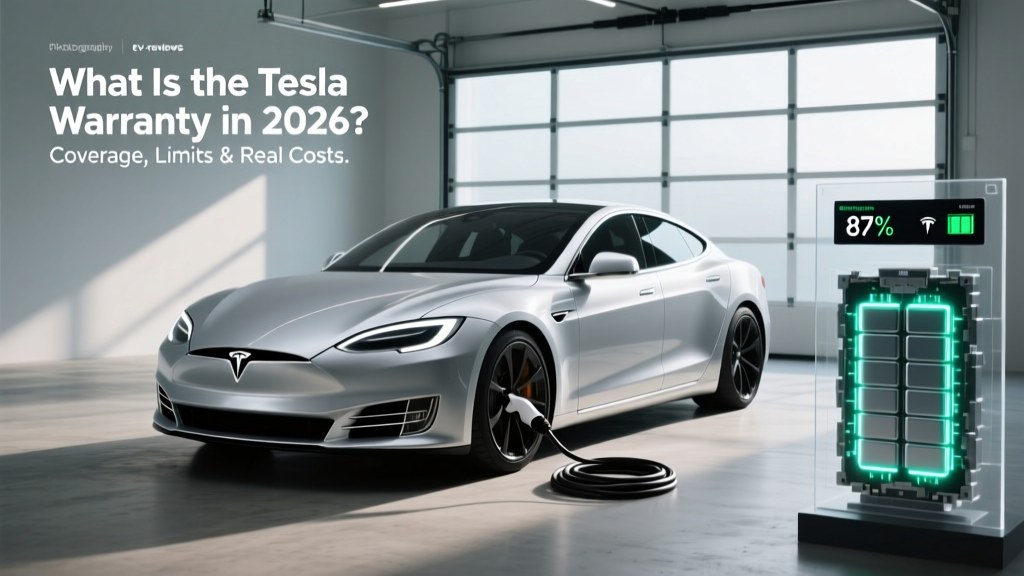
When shoppers ask what is the Tesla warranty, the short answer is a tiered system: 4 years/50,000 miles of bumper-to-bumper coverage, plus 8 years of battery and drive unit protection that varies by model (100,000 to 150,000 miles). For 2026 models, Tesla's warranty structure remains competitive but trails Hyundai's 10-year/100,000-mile powertrain coverage and matches most mainstream EV rivals. The real story is in the details — capacity retention thresholds, transferability, and what Tesla actually excludes.
This guide dissects every layer of Tesla's warranty across the Model 3, Model Y, Model S, Model X, and Cybertruck, pairs it with current range, charging, and pricing data, and helps you decide if the coverage is enough for your ownership plan.
Tesla Warranty Coverage by Model: The Full Breakdown
Tesla segments its warranty into three buckets: the basic vehicle limited warranty, the battery limited warranty, and the drive unit limited warranty. Here is exactly what each 2026 model receives.
| Model | Basic Vehicle | Battery & Drive Unit | Capacity Retention Threshold |
|---|---|---|---|
| Model 3 RWD | 4 yr / 50,000 mi | 8 yr / 100,000 mi | 70% minimum |
| Model 3 Long Range / Performance | 4 yr / 50,000 mi | 8 yr / 120,000 mi | 70% minimum |
| Model Y (all trims) | 4 yr / 50,000 mi | 8 yr / 120,000 mi | 70% minimum |
| Model S / Model X | 4 yr / 50,000 mi | 8 yr / 150,000 mi | 70% minimum |
| Cybertruck (all trims) | 4 yr / 50,000 mi | 8 yr / 120,000 mi | 70% minimum |
The 70% capacity retention threshold means Tesla will repair or replace the battery only if it degrades below 70% of its original capacity within the warranty period. This is the industry-standard threshold — Hyundai, Ford, and GM use the same number. If your 82 kWh Model 3 Long Range battery drops to 56 kWh usable capacity at 95,000 miles, Tesla covers it. At 72 kWh, you're on your own.
Battery Chemistry Matters: LFP vs NMC Degradation
Understanding what is the Tesla warranty also requires understanding what's inside the pack, because chemistry drives real-world degradation and your likelihood of ever filing a claim.
| Attribute | LFP (Lithium Iron Phosphate) | NMC (Nickel Manganese Cobalt) |
|---|---|---|
| Models using it | Model 3 RWD, Model Y RWD | Model 3 LR/Perf, Model Y LR/Perf, Model S/X, Cybertruck |
| Usable capacity | ~57 kWh (Model 3 RWD) | ~75–82 kWh (varies by model) |
| Energy density | Lower (heavier pack for same kWh) | Higher (more range per kg) |
| Cycle life | 3,000+ cycles to 80% SoH | 1,500–2,000 cycles to 80% SoH |
| Cold-weather performance | Moderate range loss (~30–40%) | Better cold retention (~20–30% loss) |
| Recommended charging | 100% daily OK | 80% daily; 100% for trips only |
| Typical 5-yr degradation | ~5–8% | ~7–12% |
The practical upshot: LFP-equipped Model 3 RWD and Model Y RWD owners are statistically less likely to ever approach the 70% warranty threshold. Real-world fleet data shows LFP packs retaining 92–95% capacity at 100,000 miles. NMC packs in Long Range and Performance variants hold up well but degrade slightly faster, particularly if frequently charged to 100% or DC fast-charged in extreme heat without preconditioning.
Model 3 Long Range AWD: EPA 341 miles. Expect ~290–310 miles on highway trips at 70 mph, and ~230–260 miles in sub-30°F winter driving. The heat pump helps, but cold still saps 20–30% of range.
Model Y Long Range AWD: EPA 320 miles. Real-world highway: ~270–290 miles. Cold weather: ~220–250 miles.
Model 3 RWD (LFP): EPA 272 miles. Highway: ~230–245 miles. Cold weather: ~175–200 miles (LFP suffers more in freezing temps).
What the Tesla Warranty Does NOT Cover
Tesla's warranty exclusions are where owners get surprised. The following are explicitly not covered under any Tesla warranty tier:
- Cosmetic battery swelling that doesn't affect capacity or function
- Range loss from normal degradation above the 70% threshold — a battery at 71% capacity at 119,000 miles on a Model Y is not a warranty claim
- Damage from aftermarket modifications, including suspension lifts, non-Tesla charging adapters used improperly, or third-party firmware tweaks
- Tire wear, brake pads, and wiper blades — standard wear items
- 12V auxiliary battery — covered only for 4 years/50,000 miles under the basic warranty, not the 8-year battery warranty (this is the small lithium-ion 12V battery that powers accessories)
- Paint and body — the basic 4-year warranty covers defects, but Tesla's paint quality complaints are well-documented; file claims early and document everything
- Charging equipment damage from power surges — Tesla recommends a dedicated circuit with proper surge protection
Tesla's warranty is transferable to subsequent owners, which supports resale value. However, the warranty clock starts from the original in-service date, not the date of resale. If you buy a 3-year-old Model Y with 45,000 miles, you inherit 1 year/5,000 miles of basic warranty and 5 years/75,000 miles of battery coverage. Always pull the vehicle's warranty status in the Tesla app before buying used.
Current Tesla Pricing, Range & Tax Credit Eligibility
Warranty value matters most in context of what you're paying. Here's the 2026 lineup with current pricing and federal tax credit status under IRS §30D rules.
| Model / Trim | Base MSRP | §30D Credit Eligible? | Est. Net Price |
|---|---|---|---|
| Model 3 RWD | $38,990 | Yes — up to $7,500 (point-of-sale) | ~$31,490 |
| Model 3 Long Range AWD | $45,490 | Yes — up to $7,500 | ~$37,990 |
| Model 3 Performance | $52,990 | Yes — up to $7,500 | ~$45,490 |
| Model Y Long Range AWD | $44,990 | Yes — up to $7,500 | ~$37,490 |
| Model Y Performance | $49,990 | Yes — up to $7,500 | ~$42,490 |
| Model S Long Range | $79,990 | No — exceeds $55,000 sedan MSRP cap | $79,990 |
| Model X Long Range | $84,990 | No — exceeds $80,000 SUV MSRP cap | $84,990 |
| Cybertruck AWD | $79,990 | No — exceeds $80,000 truck MSRP cap | $79,990 |
- Buyer income cap: $150,000 single / $225,000 head of household / $300,000 joint filers (modified AGI)
- Vehicle MSRP cap: $55,000 for sedans (Model 3), $80,000 for SUVs/trucks/vans (Model Y)
- Battery critical minerals and component sourcing must meet annual thresholds — Tesla's North American sourcing currently qualifies
- Credit is now available as a point-of-sale transfer to the dealer, reducing your purchase price directly
- Verify current eligibility at fueleconomy.gov before purchasing — rules update annually
Charging Speed, Efficiency & Performance Specs
A warranty protects your investment; these specs determine whether the investment fits your daily life.
| Spec | Model 3 LR AWD | Model Y LR AWD | Model S LR |
|---|---|---|---|
| EPA Range | 341 mi | 320 mi | 402 mi |
| Battery (usable) | ~79 kWh, NMC | ~79 kWh, NMC | ~100 kWh, NMC |
| Efficiency | 132 MPGe / 25 kWh/100mi | 122 MPGe / 28 kWh/100mi | 124 MPGe / 27 kWh/100mi |
| Peak DC Fast Charge | 250 kW | 250 kW | 250 kW |
| 10–80% DCFC Time | ~25 min | ~27 min | ~35 min |
| Level 2 Home Charging | 11.5 kW (~44 mi/hr) | 11.5 kW (~40 mi/hr) | 11.5 kW (~41 mi/hr) |
| 0–60 mph | 4.2 sec | 4.8 sec | 3.1 sec |
| Horsepower | 346 hp | 384 hp | 670 hp |
| Drivetrain | Dual-motor AWD | Dual-motor AWD | Dual-motor AWD |
| Cargo (rear + frunk) | 23 cu ft + 3.1 cu ft | 76 cu ft (seats folded) + 4.1 cu ft | 28 cu ft + 3.1 cu ft |
| Rear Legroom | 35.3 in | 41.6 in | 35.4 in |
Charging curve reality: Tesla's 250 kW peak rate applies only between roughly 10–30% state of charge. The curve tapers significantly: by 50% SoC you're typically at ~150 kW, and above 80% the rate drops below 50 kW. That 25-minute 10–80% figure assumes battery preconditioning is active (the car automatically initiates this when you navigate to a Supercharger). Without preconditioning, add 5–10 minutes in cold weather.
Home charging note: At 11.5 kW on a 48-amp Level 2 circuit, a Model 3 Long Range recovers from 20% to 80% in about 5.5 hours — ideal for overnight charging. Installation of a NEMA 14-50 outlet or Tesla Wall Connector typically runs $800–$2,000 depending on panel proximity and local electrical codes. Always get a quote from a licensed electrician; older homes may need a panel upgrade ($1,500–$3,000 additional).
Tesla vs. Competitors: How the Warranty Stacks Up
Understanding what is the Tesla warranty means comparing it against the alternatives you're cross-shopping.
| Brand / Model | Basic Warranty | Battery Warranty | Retention Threshold |
|---|---|---|---|
| Tesla Model Y LR | 4 yr / 50,000 mi | 8 yr / 120,000 mi | 70% |
| Hyundai Ioniq 5 | 5 yr / 60,000 mi | 10 yr / 100,000 mi | 70% |
| Ford Mustang Mach-E | 3 yr / 36,000 mi | 8 yr / 100,000 mi | 70% |
| Chevrolet Equinox EV | 3 yr / 36,000 mi | 8 yr / 100,000 mi | 60% (better for buyer) |
| BMW iX | 4 yr / 50,000 mi | 8 yr / 100,000 mi | 70% |
| Rivian R1S | 5 yr / 60,000 mi | 8 yr / 175,000 mi | 70% |
Key takeaways: Hyundai and Rivian lead on basic warranty length. Rivian's 175,000-mile battery warranty is the most generous in the segment. Chevrolet's 60% threshold is technically more buyer-friendly than Tesla's 70%, meaning Chevy will replace a battery that a Tesla owner would have to live with. Tesla's 120,000-mile battery coverage on Model Y and Model 3 LR is above-average but not best-in-class.
Where Tesla compensates is in the Supercharger network's reliability (over 99% uptime historically) and the fact that Tesla service centers handle everything in-house — no third-party dealer network friction. Hyundai's superior warranty means little if your local dealer has a 3-week service backlog.
Out-of-Warranty Battery Replacement: The Real Cost
If your Tesla battery fails outside the warranty window, the financial exposure is significant. Based on current Tesla service center estimates and third-party EV repair data:
- Model 3 (57 kWh LFP): $12,000–$16,000 for a full pack replacement
- Model 3/Y Long Range (79 kWh NMC): $14,000–$20,000
- Model S/X (100 kWh NMC): $18,000–$25,000
- Cybertruck (123 kWh): $20,000–$28,000 (limited data; estimate based on pack size)
These figures include the battery pack and labor but can vary by region and service center. Tesla has increasingly offered remanufactured packs at 20–30% below new-pack pricing, which can reduce out-of-pocket costs substantially. Third-party EV battery repair shops are also emerging — some can replace individual modules rather than the full pack for $3,000–$7,000, though this voids any remaining Tesla warranty.
The statistical likelihood of needing a full replacement remains low. Tesla's own impact report data shows Model S/X batteries retaining approximately 88% capacity at 150,000 miles, and Model 3/Y packs showing similar trajectories. The vast majority of Tesla owners will sell or trade the vehicle before the battery degrades below the 70% threshold.
Standout Tech & Notable Drawbacks
- Supercharger network: 6,000+ U.S. stations with NACS connector; best public charging reliability in the industry
- Over-the-air updates continuously add features (recent: improved regen profiles, UI refinements, battery management tweaks)
- Autopilot standard; FSD (Supervised) available at $8,000 or $99/mo — still SAE Level 2, requires active driver supervision
- Class-leading efficiency: Model 3 LR achieves 132 MPGe combined, among the best in the segment
- Minimalist interior maximizes cabin space; Model Y offers 76 cu ft cargo with seats folded
- Strong resale value supported by transferable warranty
- No Apple CarPlay or Android Auto — Tesla's native infotainment is capable but closed-ecosystem
- Panel gap quality and paint remain inconsistent; inspect carefully at delivery
- Service center wait times can stretch 2–4 weeks in some metro areas
- FSD (Supervised) is not autonomous driving — it is a Level 2 system requiring hands-on-wheel attention per NHTSA guidelines
- Model 3 rear legroom (35.3 in) is tight for tall passengers vs. Model Y (41.6 in) or Ioniq 5 (39.4 in)
- Model S/X/Cybertruck do not qualify for the §30D federal tax credit due to MSRP caps
Tesla's Autopilot (standard) and Full Self-Driving Supervised ($8,000 add-on) are both SAE Level 2 driver-assistance systems. They can steer, accelerate, and brake under certain conditions, but the driver must remain fully engaged, monitor the road, and be prepared to take over instantly. This is not Level 4 autonomous driving. No Tesla vehicle can drive itself without a supervising human. Confusing these levels is a safety risk — treat every Tesla driver-assist feature as a sophisticated cruise control, not a chauffeur.
Who Should Buy a Tesla (and Who Shouldn't)
- You want the most reliable public charging network for road trips — Supercharger density and uptime are unmatched
- You value OTA updates that improve the car over time
- You want strong resale value backed by a transferable 8-year battery warranty
- You're buying a Model 3 or Model Y that qualifies for the full $7,500 §30D credit, bringing effective pricing below $32,000–$38,000
- You're a daily commuter covering 30–80 miles round-trip with home Level 2 charging
- You want the longest possible factory warranty — Hyundai (10-year battery) or Rivian (175,000-mile battery) cover more
- You need Apple CarPlay/Android Auto integration
- You're buying a Model S, Model X, or Cybertruck and expected the $7,500 tax credit (none qualify due to MSRP caps)
- You live in a rural area far from a Tesla Service Center and cannot tolerate mobile-ranger-only service
- You need maximum rear-seat space for adults — the Model Y is fine, but the Model 3 is tight; consider the Ioniq 5 or EV6
Frequently Asked Questions
What is the Tesla warranty on the battery specifically?
Tesla covers the high-voltage battery for 8 years with mileage limits that vary by model: 100,000 miles for Model 3 RWD, 120,000 miles for Model 3 Long Range/Performance and all Model Y trims, and 150,000 miles for Model S and Model X. The battery must drop below 70% of original capacity for the warranty to apply.
Is Tesla's warranty transferable to a second owner?
Yes. All remaining warranty coverage transfers automatically when you buy or sell a Tesla. The warranty clock does not reset — it continues from the original in-service date and odometer reading. Always verify remaining coverage in the Tesla app using the VIN before purchasing a used Tesla.
Does modifying my Tesla void the warranty?
It can. Tesla's warranty terms state that aftermarket modifications to the powertrain, battery, or electrical system may void coverage on affected components. Cosmetic modifications (wraps, wheels, interior accessories) generally do not affect warranty. If you plan to modify, document the car's stock condition and understand that any drivetrain-related failure after modification will likely be denied.
How much does a Tesla battery replacement cost out of warranty?
Between $12,000 and $28,000 depending on the model, with Model 3 RWD at the low end and Cybertruck/Model S at the high end. Tesla increasingly offers remanufactured packs at a discount. Third-party module-level repair is emerging as a lower-cost alternative at $3,000–$7,000 but voids remaining Tesla warranty.
Does the Tesla warranty cover Autopilot or FSD hardware failures?
The Autopilot computer and cameras are covered under the basic 4-year/50,000-mile vehicle warranty. They are not covered under the 8-year battery and drive unit warranty. If your FSD computer fails at 55,000 miles, you'll be paying out of pocket unless you purchased an extended service agreement.
Is it worth buying an extended warranty for a Tesla?
Tesla offers an Extended Service Agreement on Model S and Model X (up to 4 additional years/50,000 miles). Model 3 and Model Y are not currently eligible for Tesla's own extension. Third-party extended warranties exist but read the fine print carefully — many exclude EV-specific components. For most Model 3/Y buyers, the standard warranty plus the statistical unlikelihood of major battery failure makes extended coverage unnecessary.
What is the real-world range vs. EPA for Tesla models?
Expect 10–15% less than the EPA sticker on highway trips at sustained speeds above 70 mph, and 20–35% less in sub-freezing temperatures. A Model 3 Long Range rated at 341 miles EPA will deliver roughly 290–310 miles on a summer road trip and 230–260 miles in January in the Midwest. LFP models (Model 3 RWD) lose proportionally more range in extreme cold due to the chemistry's lower cold-temperature performance.
Final Word: Tesla's Warranty in Context
The answer to "what is the Tesla warranty" is a competent, industry-standard package that protects against catastrophic battery failure while leaving normal degradation to the owner. The 70% threshold is fair and aligned with competitors. The 8-year duration is adequate, though Hyundai's 10-year and Rivian's 175,000-mile terms are more generous. Where Tesla wins is in the ecosystem: Supercharger reliability, OTA improvements, and strong resale value reduce total cost of ownership in ways that warranty length alone does not capture.
If you're buying a Model 3 or Model Y with the §30D credit and plan to own for 5–7 years with home charging, Tesla's warranty is more than sufficient. If you're planning a 10-year, 150,000-mile ownership cycle, consider whether the warranty expiration timeline aligns with your exit plan — and whether a Hyundai Ioniq 5 or Rivian R1S might offer better long-term peace of mind on paper.