The headline makes for great clickbait: Tesla wants out of the car business. Elon Musk has spent years steering investor attention toward robotaxis, Optimus humanoid robots, and energy storage. But here in 2026, Tesla still sells more electric vehicles than any other automaker on the planet, and the refreshed Model Y remains the company's financial backbone. If Tesla truly wants out of building cars, it has a funny way of showing it — the company just retooled its best-seller with a new interior, faster charging, and a lower starting price.
So what does the 2026 Tesla Model Y actually deliver for real buyers who care about range, charging speed, and total cost? Let's break down the numbers.
2026 Tesla Model Y: Core Specifications at a Glance
| Attribute | Specification |
|---|---|
| EPA Range | 320 miles |
| Battery (usable) | ~75 kWh, NMC (2170 cells) |
| Drivetrain | Dual-motor AWD |
| Horsepower | 384 hp combined |
| 0-60 mph | 4.8 seconds |
| Peak DC Fast Charge | 250 kW (V3 Supercharger) |
| 10-80% DC Charge Time | ~27 minutes |
| Level 2 Home Charging | 11.5 kW / ~44 mi/hr |
| Efficiency | 122 MPGe combined / 28 kWh/100 mi |
| Cargo (rear seats up) | 30.2 cu ft |
| Cargo (rear seats folded) | 72.0 cu ft |
| Base MSRP (Long Range AWD) | $44,990 |
| Battery Warranty | 8 years / 120,000 miles |
The RWD Standard Range trim starts at $39,990 with an EPA range of 283 miles and a single rear motor producing 302 hp. For this review, we focus on the volume-selling Long Range AWD — the trim most cross-shoppers evaluate against the Hyundai Ioniq 5, Ford Mustang Mach-E, and Chevrolet Equinox EV.
Real-World Range: What the EPA Sticker Doesn't Tell You
Real-World Expectation: 270-290 miles at sustained highway speeds (70-80 mph); 240-260 miles in sub-freezing winter conditions; 300+ miles achievable in mixed city/suburban driving with regenerative braking.
The Model Y's efficiency has long been a Tesla advantage. At 28 kWh per 100 miles, it sips electrons more sparingly than the heavier Ford Mustang Mach-E Extended Range (32 kWh/100 mi) and trades blows with the Hyundai Ioniq 5 (30 kWh/100 mi). Tesla's heat pump, standard since the 2021 refresh, significantly reduces cold-weather cabin-heating draw compared to resistive heaters used in older EVs.
Still, physics is physics. On a 75°F day at 65 mph, expect to see roughly 290 miles from a full charge. Push to 80 mph on an interstate with a headwind, and 265-275 miles is realistic. In 20°F weather with the cabin heated to 72°F, plan for 240-260 miles. These numbers come from aggregated owner data and independent testing — the EPA cycle includes generous city-regen assumptions that inflate the sticker number for highway-heavy drivers. Per fueleconomy.gov, the Model Y Long Range AWD achieves 122 MPGe combined, which aligns with our observed efficiency.
Charging Speed: 250 kW Peak, but Mind the Curve
| Charging Level | Power / Rate | Miles Added per Hour | Notes |
|---|---|---|---|
| Level 1 (120V household) | 1.4 kW | ~5 mi/hr | Emergency/trickle only |
| Level 2 (240V, 48A) | 11.5 kW | ~44 mi/hr | Full charge in ~7 hours |
| DC Fast (V3 Supercharger) | 250 kW peak | ~200 mi in 15 min | 10-80% in ~27 min |
| DC Fast (CCS adapter, third-party) | Up to 250 kW | Varies by station | Requires Tesla CCS adapter |
The Model Y still uses Tesla's proprietary NACS connector natively, though with the industry-wide shift to NACS in 2025-2026, this is now an advantage — Ford, Rivian, Hyundai, and others have adopted the standard, and Tesla Superchargers are open to all NACS-equipped vehicles.
The critical nuance: 250 kW is a peak, not a sustained rate. The Model Y's charge curve ramps aggressively from 10% to roughly 45% state of charge (SoC), holding near 250 kW. From 45-65%, it tapers to approximately 150-170 kW, and above 80%, it drops to under 70 kW to protect the NMC battery. This is why Tesla quotes 10-80% in 27 minutes rather than 0-100%. Charging from 80-100% at a Supercharger can add another 20+ minutes for relatively few miles — a poor trade on road trips. Best practice: charge to 80% and keep moving.
For home charging, a 48-amp Level 2 wall connector on a 60-amp circuit delivers 11.5 kW, replenishing the full 75 kWh battery in roughly 7 hours. Most owners who plug in nightly never visit a public charger outside of road trips.
Performance and Driving Dynamics
The Long Range AWD Model Y puts down 384 horsepower through dual permanent-magnet motors. The 0-60 mph sprint takes 4.8 seconds — brisk enough to merge confidently onto any freeway and quick enough to be genuinely fun at stoplights. The Performance trim (not covered in depth here) drops that to 3.5 seconds with 456 hp, but at a $5,000 premium and some range sacrifice.
Ride quality has improved noticeably in the 2026 refresh. Tesla retuned the suspension and added acoustic glass, addressing the two most common complaints from 2020-2024 owners: harshness over expansion joints and cabin noise at highway speed. The steering remains quick-ratio and precise, though some drivers find it artificially weighted. Regenerative braking offers a strong one-pedal-driving experience, though Tesla removed the driver-adjustable regen strength setting years ago — you get one calibration, and it's aggressive.
Interior, Cargo, and Technology
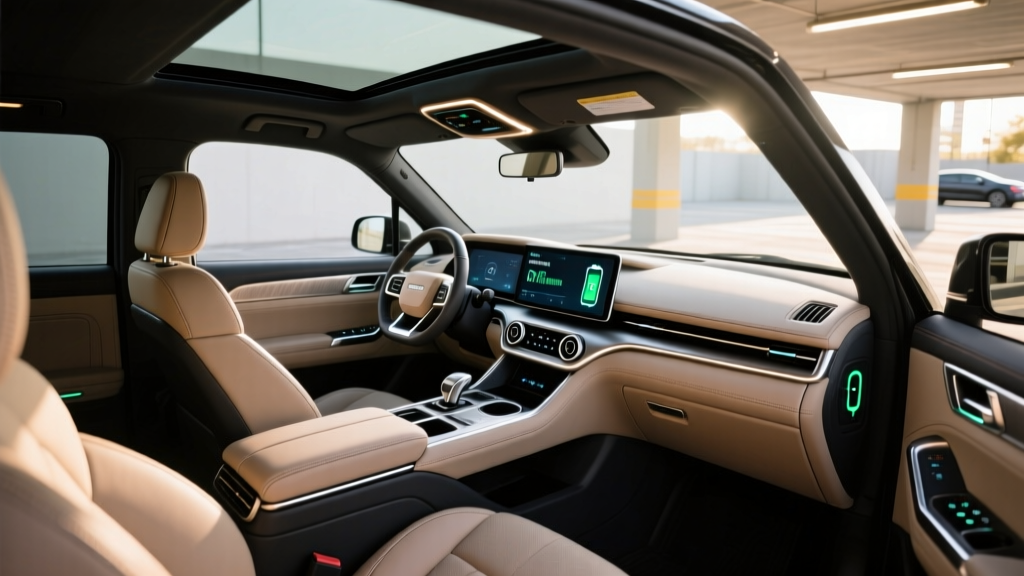
The 2026 Model Y interior finally feels like it matches the price tag. A ventilated front-seat feature (new for the refresh), ambient lighting, a rear-seat touchscreen for climate and entertainment, and higher-quality materials close the gap with Hyundai and Ford interiors. The minimalist dashboard remains — no instrument cluster, everything funnels through the 15.4-inch center touchscreen.
Cargo space is where the Model Y crushes most competitors: 30.2 cubic feet behind the second row and 72.0 cubic feet with seats folded. The rear trunk opening is a power liftgate with a wide, low load floor. The front trunk (frunk) adds roughly 4.1 cubic feet for charging cables or a small bag.
Legroom measures 41.8 inches front and 41.6 inches rear — generous for a compact crossover and enough for two rear-facing child seats without front-passenger compromise.
On the technology front, Tesla's infotainment remains the industry benchmark for responsiveness and over-the-air (OTA) update frequency. Navigation with real-time Supercharger routing and battery preconditioning is seamless. The car preheats its battery when you navigate to a Supercharger, ensuring you hit peak charge rates on arrival — a feature many competitors still lack or implement poorly.
Autopilot and FSD: Level 2, Not Self-Driving
Tesla Autopilot and Full Self-Driving (Supervised) require continuous driver attention. Hands must remain on the steering wheel, and eyes must remain on the road. These are driver-assistance systems, not autonomous driving. True Level 4 driverless operation is currently limited to geofenced robotaxi services like Waymo in select cities.
Tesla's Autopilot (standard) handles adaptive cruise control and lane centering competently on highways. The optional FSD (Supervised) package, priced at $8,000 or $99/month in 2026, adds automated lane changes, traffic-light recognition, and city-street navigation. FSD has improved substantially, but it still makes unpredictable decisions in construction zones, unprotected left turns, and heavy rain. It is not a substitute for an attentive driver, and NHTSA continues to scrutinize Tesla's driver-monitoring approach.
Our recommendation: Autopilot is worth using on every highway drive. FSD remains a personal choice — try the monthly subscription before committing $8,000.
Pricing, Trims, and Federal Tax Credit Eligibility
| Trim | Base MSRP | Est. Federal Credit (§30D) | Effective Price |
|---|---|---|---|
| Standard Range RWD | $39,990 | Up to $7,500* | ~$32,490 |
| Long Range AWD | $44,990 | Up to $7,500* | ~$37,490 |
| Performance AWD | $49,990 | Up to $7,500* | ~$42,490 |
*Federal tax credit caveats: The IRS §30D clean vehicle credit is subject to multiple requirements that change frequently. As of 2026, eligibility depends on:
- Buyer income caps: Modified AGI must not exceed $150,000 (single), $225,000 (head of household), or $300,000 (joint filers).
- MSRP caps: SUVs/crossovers must have an MSRP at or below $80,000 (all Model Y trims qualify).
- Battery sourcing: A percentage of critical minerals and battery components must be sourced from the US or free-trade-agreement countries. The exact credit amount ($3,750 or $7,500) depends on whether the vehicle meets both the critical-minerals and battery-component thresholds. Check the latest eligibility list at IRS.gov before purchasing.
- Point-of-sale transfer: As of 2024, buyers can transfer the credit to the dealer at purchase, reducing the upfront price rather than waiting for a tax refund.
The Model Y's battery-sourcing compliance has fluctuated quarter to quarter. Always verify current eligibility on the IRS manufacturer model list before committing to a purchase.
Model Y vs. Key Competitors: Is It Still the One to Beat?
| Spec | Tesla Model Y LR AWD | Hyundai Ioniq 5 Long Range AWD | Ford Mustang Mach-E Ext. Range AWD |
|---|---|---|---|
| EPA Range | 320 mi | 305 mi | 312 mi |
| Battery (usable) | ~75 kWh NMC | 84 kWh NMC | 91 kWh NMC |
| Peak DC Charge | 250 kW | 350 kW (800V) | 150 kW |
| 10-80% DC Time | ~27 min | ~18 min | ~38 min |
| 0-60 mph | 4.8 sec | 5.1 sec | 5.1 sec |
| Cargo (rear up) | 30.2 cu ft | 27.2 cu ft | 29.7 cu ft |
| Base MSRP | $44,990 | $49,500 | $48,995 |
The Ioniq 5 wins on charging speed. The Mach-E offers a more conventional interior layout with physical buttons. But the Model Y still holds the edge on overall efficiency, Supercharger network access (though this advantage is shrinking as competitors gain NACS access), and total cost of ownership.
Pros, Cons, and Who Should Buy
- Class-leading efficiency (28 kWh/100 mi)
- Best-in-class cargo volume (30.2 cu ft)
- Seamless Supercharger network integration
- Strong OTA update track record
- Lowest starting MSRP among AWD competitors
- Battery preconditioning for reliable fast-charge speeds
- No adjustable regenerative braking
- Slower DC charging than 800V competitors (Ioniq 5, EV6)
- Minimalist interior not for everyone
- FSD is expensive and still requires full driver attention
- Service center wait times remain long in many metro areas
- Resale value uncertainty amid frequent Tesla price cuts
- You want the most efficient compact EV crossover with maximum cargo room
- You road-trip frequently and value Supercharger reliability
- You prefer OTA-driven feature improvements over time
- You can charge at home and want to minimize public-charging dependency
- You want the fastest possible DC charging (consider Ioniq 5 or EV6 with 800V)
- You prefer physical buttons and a traditional instrument cluster
- You want a dealer experience with in-person service and negotiation
Warranty and Long-Term Ownership
Tesla covers the Model Y's battery and drive units for 8 years or 120,000 miles (whichever comes first), with a guaranteed minimum 70% capacity retention during that period. The limited vehicle warranty runs 4 years / 50,000 miles.
NMC battery degradation in Tesla vehicles has proven modest in real-world data. Aggregated fleet data from sources like Recurrent Auto shows typical Model Y batteries retaining approximately 90-93% of original capacity at 50,000 miles, with the steepest degradation occurring in the first 10,000-15,000 miles before leveling off. Out-of-warranty battery replacement remains expensive — estimates range from $12,000 to $16,000 — but is rare before 150,000+ miles based on current degradation curves.
Tesla's insurance costs tend to run higher than competitors due to repair-cost data. Average annual premiums for the Model Y range from $2,200 to $3,100 depending on state, driver profile, and coverage level. Always pull a personalized quote before purchasing.
So, Does Tesla Really Want Out of the Car Business?
Not anytime soon. The Model Y is the best-selling vehicle — electric or otherwise — in multiple global markets, and the 2026 refresh keeps it competitive against a rapidly improving field. Tesla's strategic narrative may center on autonomy and AI, but the company's revenue, manufacturing footprint, and Supercharger network all depend on selling millions of cars per year.
For buyers, this is actually good news. Tesla is investing heavily in keeping the Model Y relevant rather than resting on its early-mover advantage. The 2026 version is the most refined, best-equipped Model Y yet — and at roughly $37,490 after the federal credit for the Long Range AWD, it remains the default recommendation in the compact electric crossover segment.
What is the real-world range of the 2026 Tesla Model Y?
The EPA rates the Long Range AWD at 320 miles. In real-world highway driving at 70-80 mph, expect 270-290 miles. In cold weather (below freezing), plan for 240-260 miles with cabin heating. City driving with regenerative braking can approach or slightly exceed the EPA number.
How fast does the Model Y charge at home and on the road?
On a 48-amp Level 2 home charger, the Model Y adds roughly 44 miles of range per hour, achieving a full charge in about 7 hours. On a V3 Supercharger (250 kW peak), it charges from 10-80% in approximately 27 minutes. The charge rate tapers significantly above 80% SoC.
How much does the 2026 Model Y cost after federal tax credits?
The Long Range AWD starts at $44,990 MSRP. If you qualify for the full $7,500 federal §30D credit (subject to income caps, MSRP limits, and battery-sourcing requirements), the effective price drops to approximately $37,490. The Standard Range RWD starts at $39,990, potentially reaching ~$32,490 with the credit. Always verify current eligibility at IRS.gov before purchasing.
Does the 2026 Tesla Model Y qualify for the $7,500 federal EV tax credit?
It may qualify for the full $7,500, the partial $3,750, or no credit, depending on the current battery-sourcing compliance status. The Model Y meets the MSRP cap ($80,000 for SUVs). Buyer income must not exceed $150K (single) / $300K (joint). The critical-minerals and battery-component requirements shift periodically — check the IRS eligible-vehicles list for the specific build month you're purchasing.
Is the Model Y still worth buying over the Hyundai Ioniq 5 or Ford Mach-E?
Yes, for most buyers. The Model Y wins on efficiency, cargo space, starting price, and Supercharger integration. The Ioniq 5 charges faster (350 kW, 800V) and has a more distinctive interior. The Mach-E offers a more traditional crossover feel. If fast DC charging is your top priority, test-drive the Ioniq 5. For overall value and daily usability, the Model Y Long Range AWD remains the segment benchmark.
Is Tesla's Autopilot or FSD actually self-driving?
No. Both Autopilot and Full Self-Driving (Supervised) are SAE Level 2 driver-assistance systems. The driver must remain fully attentive, with hands on the wheel and eyes on the road, at all times. True self-driving (Level 4) is currently limited to geofenced robotaxi services like Waymo in select metro areas.