If you own a Tesla—or any NACS-equipped EV—home charging is the single biggest ownership advantage. But the cost of a Tesla Wall Connector extends well beyond the $420 sticker price on Tesla's website. Electrical panel capacity, wire gauge, conduit runs, and permit fees all shape what you'll actually pay to wake up to a full battery every morning.
This guide breaks down every cost layer of the Tesla Wall Connector (Gen 3) in 2026, from the hardware itself to a full professional installation, and shows you how to budget accurately before calling an electrician.
Tesla Wall Connector Hardware: What You Get for $420
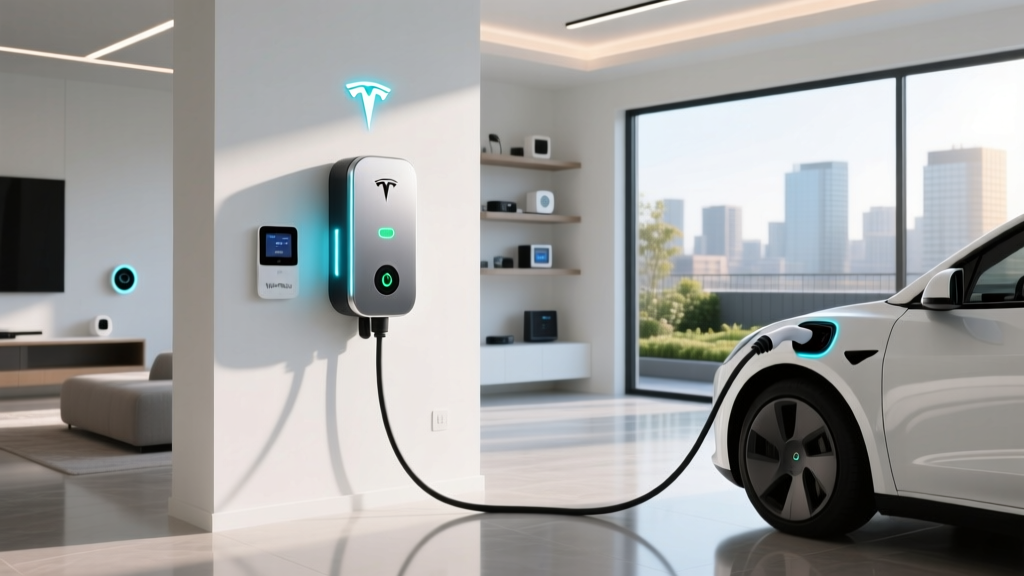
The Tesla Wall Connector (Generation 3) retails for $420 directly from Tesla's online store. Here's what that buys you:
- Max output: 11.5 kW (48 amps continuous on a 60A circuit)
- Connector: NACS (native Tesla plug—no adapter needed for Tesla vehicles)
- Cable length: 24-foot integrated cable
- Wi-Fi enabled: Receives over-the-air firmware updates
- Load sharing: Up to 6 Wall Connectors can share a single circuit
- Access control: Restrict charging to specific vehicles via the Tesla app
- Weather rating: Indoor or outdoor installation (NEMA 3R rated)
For non-Tesla EVs with NACS ports (increasingly common as Ford, GM, Rivian, and others adopt the standard), the Wall Connector works natively. CCS vehicles will need a NACS-to-CCS adapter, which Tesla sells separately for around $250.
Compared to third-party Level 2 chargers like the ChargePoint Home Flex (~$550) or the Emporia Vue (~$400), the Wall Connector is competitively priced and purpose-built for Tesla's ecosystem. The trade-off: it lacks a J1772 connector option out of the box, so if you have a mixed-EV household with legacy CCS/J1772 vehicles, you'll need an adapter or a second charger.
Total Cost of Tesla Wall Connector Installation: The Full Breakdown
The hardware is the easy part. Installation costs vary dramatically based on your home's electrical infrastructure. Here's a realistic cost table based on 2026 electrician rates and national averages:
| Cost Component | Simple Install | Moderate Install | Complex Install |
|---|---|---|---|
| Wall Connector unit | $420 | $420 | $420 |
| Electrician labor (2-8 hrs @ $85-$150/hr) | $170-$300 | $400-$750 | $800-$1,200 |
| 60A breaker + wiring (6 AWG copper, 50 ft) | $150-$250 | $300-$500 | $500-$800 |
| Conduit and mounting hardware | $50-$100 | $100-$250 | $250-$500 |
| Permit fees | $50-$100 | $100-$200 | $150-$300 |
| Electrical panel upgrade (if needed) | $0 | $0 | $1,500-$3,000 |
| Total estimated cost | $840-$1,170 | $1,320-$2,120 | $3,620-$6,220 |
What Defines Each Install Tier?
Simple install: Your panel has spare capacity (at least 60A headroom), and the charger mounts on a wall within 10-20 feet of the panel. The electrician runs a short conduit, installs the breaker, and connects the unit. Total time: 2-3 hours.
Moderate install: The charger is 30-60 feet from the panel, requiring a longer wire run through walls, attic, or crawlspace. The panel has capacity but the route is more involved. Total time: 4-6 hours.
Complex install: Your 100A or 150A panel doesn't have room for a 60A circuit, requiring a panel upgrade to 200A. This is the single biggest cost driver and can add $1,500-$3,000+ to the project. Older homes (pre-1990s) frequently hit this barrier.
The Panel-Upgrade Gotcha
Before budgeting, check your panel's amperage rating (printed on the main breaker). A 200A panel typically has enough headroom for a 60A EV circuit alongside existing loads. A 100A panel almost certainly does not. An electrician will perform a load calculation per NEC Article 220 to determine if your panel can handle the addition. If it can't, you're looking at a service upgrade—budget accordingly.
Charging Speed: What 11.5 kW Actually Means for Your Daily Routine
The Wall Connector delivers up to 11.5 kW (48A) on a 240V/60A circuit. That translates to roughly 30-44 miles of range per hour of charging, depending on your vehicle's efficiency. Here's how that maps to common Tesla models:
| Vehicle | Onboard Charger Limit | Effective kW | Miles of Range/Hour | 0-100% Time (approx.) |
|---|---|---|---|---|
| Model 3 RWD | 11.5 kW (48A) | 11.5 kW | ~44 mi/hr | ~6 hours |
| Model 3 Long Range AWD | 11.5 kW (48A) | 11.5 kW | ~41 mi/hr | ~8 hours |
| Model Y Long Range | 11.5 kW (48A) | 11.5 kW | ~37 mi/hr | ~9 hours |
| Model S / X | 11.5 kW (48A) | 11.5 kW | ~34 mi/hr | ~10 hours |
| Cybertruck AWD | 11.5 kW (48A) | 11.5 kW | ~30 mi/hr | ~13 hours |
Key insight: Every current Tesla model accepts the Wall Connector's full 11.5 kW, so you're not leaving speed on the table. The 48A onboard charger is standard across the fleet. An overnight charge (8-10 hours) will fully replenish any Tesla from near-empty.
If you install on a smaller circuit (say, a 40A breaker / 32A continuous), the Wall Connector can be software-configured to match—yielding about 7.7 kW and roughly 25-30 miles per hour. This is a practical option if your panel can't spare a full 60A.
Tesla Wall Connector vs. Competitors: Is It Worth the Cost?
At $420 for the unit, the Wall Connector is among the most affordable premium Level 2 chargers. But how does it compare when you factor in the full ecosystem?
| Feature | Tesla Wall Connector | ChargePoint Home Flex | Emporia Vue Smart Charger |
|---|---|---|---|
| Unit price | $420 | $550 | $400 |
| Max output | 11.5 kW (48A) | 12 kW (50A) | 11.5 kW (48A) |
| Connector | NACS | NACS or J1772 | J1772 (NACS adapter avail.) |
| Cable length | 24 ft | 23 ft | 24 ft |
| Wi-Fi / App | Yes (Tesla app) | Yes (ChargePoint app) | Yes (Emporia app) |
| Load sharing | Up to 6 units | No | No |
| Energy monitoring | Basic | Basic | Detailed (whole-home) |
| Scheduled charging | Yes (via vehicle) | Yes | Yes |
Choose the Tesla Wall Connector if: You drive a Tesla or NACS-equipped vehicle, want the cleanest integration with the Tesla app and vehicle scheduling, and value load-sharing for multi-charger garages.
Choose the ChargePoint Home Flex if: You have a mixed fleet with J1772 vehicles and want the flexibility of either connector type without adapters, or want a slightly higher 50A/12 kW output for future-proofing.
Choose the Emporia Vue if: You want detailed whole-home energy monitoring alongside EV charging, or you're budget-conscious and can use a NACS adapter for your Tesla.
Utility Rebates and the Federal Tax Credit: Can You Offset the Cost?
The good news: the cost of a Tesla Wall Connector and its installation may be partially offset by incentives.
Federal Alternative Fuel Infrastructure Tax Credit (§30C)
The IRS §30C credit covers 30% of the cost of home EV charging equipment and installation, up to a maximum of $1,000. This applies to both the Wall Connector hardware and the electrician's labor, wiring, and permit fees. Key caveats:
- The property must be your primary residence.
- The equipment must be placed in service during the tax year.
- The credit is non-refundable—it reduces your tax liability to zero but won't generate a refund beyond that.
- Eligibility is subject to census-tract requirements under the Inflation Reduction Act; consult a tax professional and the IRS website for current rules.
Example: If your total Wall Connector + install cost is $2,000, the §30C credit would be $600 (30%). If your total is $3,334 or more, you'd hit the $1,000 cap.
Utility and Local Rebates
Many utilities offer rebates for Level 2 charger installations—typically $200-$500, sometimes more if you agree to off-peak charging schedules. Check with your local utility; programs vary by jurisdiction and change frequently. Some municipalities also offer additional incentives through clean-energy programs.
Installation Tips: What to Know Before You Call an Electrician
A few practical steps that can save you money and headaches:
- Get 2-3 quotes. Electrician rates and markups vary significantly. Ask for a detailed breakdown of labor, materials, and permits.
- Ask about a load calculation first. Before committing to a 60A circuit, have the electrician verify your panel can handle it. A 40A circuit (32A continuous, 7.7 kW) is often sufficient and may avoid a panel upgrade.
- Consider future-proofing. If you're running new conduit anyway, ask the electrician to pull wire rated for 60A even if you start with a 40A breaker. Upgrading the breaker later is cheap; re-pulling wire is not.
- Mount height matters. Install the Wall Connector at roughly chest height (48-54 inches from the floor to the holster) for comfortable plug insertion without bending or reaching.
- Pull a permit. It's required by code in most jurisdictions, protects your homeowner's insurance, and ensures the work is inspected. Unpermitted electrical work can void insurance claims.
Is the Tesla Wall Connector Worth It? The Verdict
For Tesla owners and NACS-equipped EV drivers, the Wall Connector is the default recommendation for good reason: it's purpose-built, reliable, and integrates seamlessly with the Tesla ecosystem. The $420 hardware cost is competitive, and the 11.5 kW output matches every current Tesla's onboard charger limit.
Pros
- Competitive $420 price for premium 11.5 kW hardware
- Native NACS—no adapter needed for Tesla vehicles
- Load sharing supports up to 6 units on one circuit
- Over-the-air updates and Tesla app integration
- 24-foot cable reaches most garage parking positions
- Eligible for §30C federal tax credit (up to $1,000)
Cons
- No native J1772 option—requires adapter for non-NACS EVs
- 60A circuit may require panel upgrade in older homes ($1,500-$3,000+)
- Energy monitoring is basic compared to Emporia Vue
- Requires Wi-Fi for firmware updates and some features
- Tesla ecosystem lock-in limits portability if you switch brands
Frequently Asked Questions
Can I install the Tesla Wall Connector myself?
Tesla's documentation states that installation should be performed by a licensed electrician. A 240V/60A circuit involves working inside your electrical panel—a mistake can cause fire, injury, or code violations that void insurance. DIY is strongly discouraged unless you are a qualified electrician.
Will a 40A circuit work instead of 60A?
Yes. The Wall Connector can be configured via its setup wizard to any circuit rating from 15A to 60A. On a 40A breaker (32A continuous), you'll get 7.7 kW and roughly 25-30 miles of range per hour—enough to fully charge a Model 3 overnight. This can avoid a costly panel upgrade.
Does the Wall Connector work with non-Tesla EVs?
Yes, if the vehicle has a NACS charge port (Ford F-150 Lightning, GM Ultium vehicles, Rivian, and others as of 2025-2026). For CCS-equipped vehicles, you'll need a NACS-to-CCS adapter.
How long does installation take?
A simple install near the panel takes 2-3 hours. Moderate runs (30-60 ft) take 4-6 hours. Panel upgrades add a full day. Most installations are completed in a single visit.
What's the cheapest way to charge a Tesla at home?
The included Tesla Mobile Connector with a NEMA 14-50 adapter provides up to 9.6 kW (40A) on a 50A circuit—about 15% slower than the Wall Connector but roughly $200 cheaper in hardware. However, the Mobile Connector is not designed for permanent wall mounting and daily use; the Wall Connector's hardwired connection is more reliable and code-compliant for a dedicated charging station.