Quick Verdict: Tesla Wins the Sprint, But the Race Is Nuanced
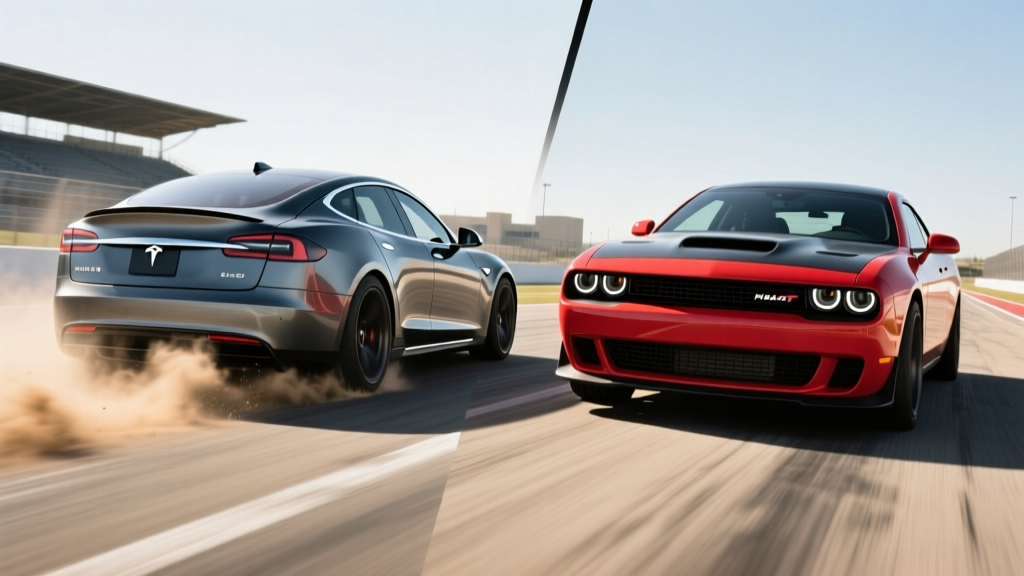
If you're asking is a Tesla faster than a Hellcat, the short answer in 2026 is yes — but only in specific scenarios and specific trims. The Tesla Model S Plaid hits 0-60 mph in 1.99 seconds (with rollout subtracted), while the all-electric 2026 Dodge Charger Daytona Scat Pack manages 3.3 seconds. Even the older supercharged 6.2L V8 Hellcat (discontinued after 2023) posted 3.4-3.6 second runs. Straight-line acceleration off the line is where Tesla's dual- and tri-motor instant torque dominates. But top-end roll-on performance, quarter-mile trap speeds, and track stamina tell a more complicated story that every buyer should understand before spending six figures.
This comparison pits the flagship electric performance sedan against Dodge's electric muscle successor — with historical context from the ICE Hellcat era — so you can see exactly where each wins and where the physics diverge.
Side-by-Side Performance Specs: Model S Plaid vs Charger Daytona vs Hellcat
| Spec | 2026 Tesla Model S Plaid | 2026 Dodge Charger Daytona Scat Pack | 2023 Dodge Challenger SRT Hellcat (ICE, final year) |
|---|---|---|---|
| 0-60 mph | 1.99 sec (w/ rollout) | 3.3 sec | 3.4 sec (Redeye: 3.4) |
| Quarter-mile | 9.23 sec @ 155 mph | 11.5 sec @ 121 mph | 10.96 sec @ 125 mph |
| Horsepower | 1,020 hp (tri-motor) | 670 hp (dual-motor AWD) | 717 hp (supercharged V8) |
| Torque (lb-ft) | 1,050 | 627 | 656 |
| Drivetrain | AWD (tri-motor) | AWD (dual-motor) | RWD |
| Top Speed | 200 mph | 134 mph (electronically limited) | 199 mph |
| Curb Weight | 4,766 lbs | 5,844 lbs | |
| Powertrain | BEV (tri-motor) | BEV (dual-motor) | 6.2L supercharged V8 |
Sources: Tesla spec sheet, Stellantis/Dodge press, MotorTrend instrumented testing archives.
The weight column matters: the Charger Daytona carries over 1,000 lbs more than the Model S Plaid, which blunts its acceleration advantage despite having substantial horsepower. The ICE Hellcat weighed around 4,450 lbs — lighter than both EVs — and its RWD layout meant traction-limited launches that the AWD EVs simply don't experience.
Where the Tesla Actually Wins: 0-60 Physics Explained
Electric motors deliver peak torque at 0 RPM. There's no turbo spool, no supercharger lag, no transmission shift interrupt. When you mat the throttle in a Model S Plaid, all 1,050 lb-ft is available in the first millisecond, distributed across three motors with torque vectoring that optimizes grip at each wheel.
The ICE Hellcat's supercharger eliminated most lag, but its 8-speed automatic still needed ~150-200 milliseconds per shift, and RWD traction on street tires limited real-world 0-60 runs to the 3.6-3.8 second range outside of prepared surfaces. The Charger Daytona, being AWD and electric, avoids the traction problem but can't overcome its 5,844-lb mass.
Real-world drag strip context: The Model S Plaid's 9.23-second quarter-mile at 155 mph is supercar territory (Bugatti, Koenigsegg). The Charger Daytona's 11.5-second pass is quick by any standard but closer to a modern C8 Corvette Z06 than a Hellcat Redeye. If your definition of "faster" is 0-60 or quarter-mile ET, Tesla wins decisively.
Where the Hellcat (and Daytona) Still Compete
Roll-on acceleration (45-70 mph): At higher speeds, horsepower-to-weight ratio matters more than torque-at-zero. The Hellcat's 717 hp in a 4,450-lb body gave it strong passing punch. The Model S Plaid still wins here (it has 1,020 hp), but the gap narrows.
Track stamina and heat management: This is the EV Achilles' heel. Sustained high-speed track use generates enormous battery and motor heat. Tesla has improved thermal management significantly with the Plaid's carbon-sleeved rotors and advanced cooling, but 3-4 hot laps will still trigger power derating. The ICE Hellcat could run all day at a track day with only brake-pad wear to manage.
Sound and drama: Subjective but real. The Hellcat's supercharger whine and V8 exhaust note create visceral feedback that EVs simulate (Dodge's "Fratzonic" exhaust system on the Daytona) but don't replicate. For buyers who value theater over telemetry, this matters.
Real-World Range Reality Check
Tesla Model S Plaid: EPA-estimated 396 miles (Long Range) / 359 miles (Plaid). Expect ~290-320 miles at sustained 75 mph highway speeds, and 20-30% reduction in sub-freezing temperatures due to cabin heating and battery chemistry.
Dodge Charger Daytona Scat Pack: EPA-estimated 274 miles (R/T) / 260 miles (Scat Pack). Expect ~200-220 miles highway, with similar cold-weather penalties.
2023 Hellcat (ICE baseline): EPA-rated 13 mpg city / 22 mpg highway / 16 combined. With an 18.5-gallon tank, real-world highway range was ~370 miles — but at $3.50/gal, that's $65 per fill vs ~$15 for a full home charge on the Plaid.
Battery, Charging, and Efficiency Deep Dive
| Metric | Model S Plaid | Charger Daytona Scat Pack |
|---|---|---|
| Battery capacity | ~100 kWh usable (NMC) | 100.6 kWh gross (NMC) |
| Chemistry | NMC (nickel manganese cobalt) | NMC |
| Max DC fast charge | 250 kW (V3 Supercharger) | ~175 kW peak |
| 10-80% DCFC time | ~27 minutes | ~32 minutes |
| Level 2 home rate | 11.5 kW (~44 mi/hr) | 11 kW (~38 mi/hr) |
| Connector | NACS (native Tesla) | CCS1 (adapter for Superchargers) |
| Efficiency (MPGe) | 116 MPGe combined | 93 MPGe combined |
| kWh/100 mi | 29 | 36 |
Efficiency data via fueleconomy.gov.
Charging-curve reality: Neither car sustains peak kW for the full session. The Model S Plaid peaks at 250 kW only between roughly 10-30% SoC, then tapers to ~150 kW by 60% and ~80 kW above 80%. The 27-minute 10-80% figure reflects this tapered curve, not a sustained 250 kW. Same applies to the Daytona, with an even more aggressive taper. Always precondition the battery (Tesla does this automatically when you navigate to a Supercharger) to hit peak rates.
Home charging economics: At the US average residential rate of ~$0.16/kWh, fully charging the Plaid's 100 kWh battery costs about $16, yielding ~320 real-world highway miles. That's roughly $0.05/mile — compared to the Hellcat's $0.22/mile at $3.50/gal and 16 mpg combined.
Pricing, Trims, and Federal Tax Credit Eligibility
| Trim | 2026 MSRP | §30D Credit Eligibility |
|---|---|---|
| Tesla Model S Long Range | $79,990 | No — exceeds $55,000 sedan MSRP cap |
| Tesla Model S Plaid | $94,990 | No — exceeds $55,000 sedan MSRP cap |
| Dodge Charger Daytona R/T | $61,590 | No — exceeds $55,000 sedan cap |
| Dodge Charger Daytona Scat Pack | $73,590 | No — exceeds $55,000 sedan cap |
Neither vehicle qualifies for the §30D federal EV tax credit. Per IRS rules, new EVs classified as sedans must have an MSRP at or below $55,000 to qualify (SUVs/trucks: $80,000). Both the Model S and Charger Daytona are classified as sedans and far exceed the cap. Additionally, buyer income caps apply ($150K single / $300K joint AGI) and critical-mineral/battery-sourcing requirements must be met.
Used market workaround: The §25E used-EV credit offers up to $4,000 (30% of sale price, capped) on EVs priced at $25,000 or less. Given current depreciation curves, a 2022-2023 Model S may approach this threshold by 2027-2028, but Daytona models are too new.
Interior, Cargo, Technology, and Daily Usability
Model S Plaid: 28 cu ft cargo (rear seats up), 17-inch cinematic touchscreen, yoke or round steering wheel, 5-seat capacity with ~42 inches front legroom. The minimalist interior is polarizing — no physical buttons, everything routed through the screen. Autopilot (Level 2 driver assist) is standard; FSD (Supervised) is a $8,000 option that still requires active driver engagement and is not autonomous driving.
Charger Daytona Scat Pack: Larger footprint, 4-seat configuration with a pass-through rear area. Dodge emphasizes muscle-car styling cues: physical "Fratzonic" exhaust button, performance pages on the Uconnect 5 infotainment (12.3-inch), and a more traditional cockpit layout. Cargo space is more limited due to the fastback design — roughly 16-18 cu ft usable. Level 2 ADAS features are available but less advanced than Tesla's hardware suite.
Warranty comparison: Tesla covers the battery and drive unit for 8 years/150,000 miles (whichever comes first) with a 70% minimum capacity retention guarantee. Dodge provides 8 years/100,000 miles on the battery pack. Both offer 4-year/50,000-mile basic vehicle coverage.
Model S Plaid — Pros
- Sub-2-second 0-60 — fastest production sedan ever tested
- 396-mile EPA range (Long Range); 359 (Plaid)
- Access to 6,000+ Tesla Supercharger network (NACS native)
- Over-the-air updates continuously add features
- Lowest cost per mile among performance cars
Model S Plaid — Cons
- $94,990+ MSRP, no federal tax credit
- Track stamina limited by thermal management
- Minimalist interior lacks physical controls
- Insurance premiums 25-40% above comparable ICE sedans
- Yoke steering controversial for daily use
Who Should Buy Which?
Choose the Tesla Model S Plaid if:
- You want the absolute fastest 0-60 production car available
- You prioritize efficiency (116 MPGe) and low per-mile cost
- You road-trip frequently and value Supercharger network access
- You want a daily-driver that happens to be supercar-quick
Choose the Dodge Charger Daytona Scat Pack if:
- You want muscle-car styling and sound (Fratzonic system)
- You prefer a traditional cockpit layout with physical controls
- Track-day stamina matters less than street presence
- You want Dodge's dealer network for service vs Tesla's mobile-ranger model
Choose a used ICE Hellcat (2015-2023) if:
- You want V8 sound without simulation
- You want to avoid EV charging logistics entirely
- Budget is $35,000-$55,000 (current used market)
- You accept 13-16 mpg and $0.22/mile fuel cost
Frequently Asked Questions
Is a Tesla faster than a Hellcat in every speed metric?
No. The Model S Plaid dominates 0-60 mph (1.99 vs 3.4 seconds) and quarter-mile ET (9.23 vs 10.96 seconds). However, the ICE Hellcat's lighter weight and lack of battery thermal limits give it an edge in sustained track use and roll-on scenarios above 100 mph where EV power tapering occurs.
Can the Dodge Charger Daytona beat a Tesla in a drag race?
In a 2026-spec comparison, no. The Daytona Scat Pack's 3.3-second 0-60 and 11.5-second quarter-mile are quick but can't match the Plaid's 1.99/9.23. Against a base Model S Long Range (3.1 sec 0-60), the Daytona is very close and could win with a better launch on prepared surface.
Why doesn't the Model S Plaid qualify for the EV tax credit?
The IRS §30D credit caps sedan MSRP at $55,000. At $94,990, the Plaid is nearly double the threshold. This is a legislative design choice to direct incentives toward more affordable EVs, not a reflection of the car's American content or battery sourcing.
How does cold weather affect range on these EVs?
Expect 20-30% range reduction at 20°F and below, primarily from cabin heating demand and increased battery internal resistance. The Model S Plaid's heat pump helps mitigate this vs older EVs, but physics dictates real losses. A 359-mile EPA Plaid might deliver 250-280 miles in winter highway driving.
What's the real cost to charge vs fueling a Hellcat?
At $0.16/kWh (US average residential), a full 100 kWh Model S charge costs ~$16 for ~320 real-world miles ($0.05/mi). A Hellcat at 16 mpg combined and $3.50/gal costs ~$0.22/mi — over 4x more per mile. Over 15,000 miles/year, that's $3,300 (Hellcat) vs $750 (Model S home-charged).
Is the Hellcat still available new in 2026?
No. Dodge discontinued the supercharged 6.2L HEMI Hellcat after the 2023 model year as part of Stellantis's electrification transition. The Charger Daytona is its electric spiritual successor. Used Hellcats (2015-2023) remain available on the secondary market, typically $35,000-$70,000 depending on variant and mileage.
Does Tesla Autopilot make the Model S self-driving?
No. Autopilot and FSD (Supervised) are SAE Level 2 driver-assistance systems. You must keep your hands on the wheel and eyes on the road at all times. True self-driving (Level 4) is currently only available in limited robotaxi services like Waymo in specific geofenced areas.