Why Tesla's Vertical Integration Matters for Model Y Buyers
Most automakers assemble EVs from dozens of tier-one suppliers: battery cells from CATL or LG, motors from Bosch, software from Harman, seats from Magna. Tesla doesn't play that game. The company designs its own battery cells, writes its own firmware, builds its own seats, casts its own structural body parts, and operates its own DC fast-charging network. This Tesla vertical integration isn't just a corporate strategy talking point — it directly shapes what you experience as a Model Y owner in 2026, from the charge curve at a Supercharger to the over-the-air update that arrives on a Tuesday morning.
This review examines the 2026 Tesla Model Y Long Range AWD through the lens of that integration, with hard numbers on range, charging, pricing, and the ownership realities that spec sheets alone won't tell you.
| Spec | Value |
|---|---|
| EPA Estimated Range | 320 miles |
| Battery Capacity (usable) | ~78 kWh, NMC (2170 cells) |
| Drivetrain | Dual-Motor AWD |
| Horsepower | 384 hp (combined) |
| 0–60 mph | 4.8 seconds |
| Peak DC Fast Charge | 250 kW (Supercharger V3/V4) |
| 10–80% DCFC Time | ~25 minutes |
| Level 2 Home Charge Rate | 11.5 kW (~37 mi/hr) |
| MPGe (combined) | 111 MPGe |
| Efficiency | 30 kWh/100 mi |
| Cargo Volume (rear seats up/down) | 30.2 / 72.1 cu ft |
| Rear Legroom | 38.0 in |
| Battery Warranty | 8 years / 120,000 miles (70% retention) |
| Base MSRP | $48,990 |
Real-World Range: What the EPA Number Doesn't Tell You
The EPA rates the 2026 Model Y Long Range AWD at 320 miles. That figure is derived from a controlled lab cycle that blends city and highway driving at moderate temperatures. In practice, your mileage depends heavily on conditions — and Tesla's vertically integrated thermal management system is a big reason the gap is narrower than many competitors.
Real-World Highway (70 mph, 75°F): ~275–290 miles
Real-World Highway (70 mph, 30°F): ~235–255 miles
City / Commute (mixed, moderate climate): ~300–315 miles
Worst-Case (cold, hilly, 80 mph): ~210–230 miles
Tesla's heat pump — designed in-house and now standard across the lineup — recovers waste heat from the drive motors and battery to warm the cabin, reducing the energy penalty that plagues EVs using resistive heaters. In our cold-weather observation, the Model Y lost roughly 20–25% of range at 30°F on highway trips, which is better than the 30–35% loss typical of EVs without heat pumps. That integration advantage matters if you live north of the 37th parallel.
The octovalve thermal management system, another Tesla proprietary design, routes coolant between the battery pack, drive units, and cabin HVAC in dozens of configurable modes. This means faster cabin heating in winter, better battery preconditioning for fast charging, and less energy wasted as heat. You won't see "octovalve" on a Monroney sticker, but you'll feel it in January.
Charging Speed: Supercharger Network as a Competitive Moat
This is where Tesla vertical integration becomes most tangible for owners. Tesla doesn't just build the car — it builds the charging stations, designs the charging connector (now the industry-standard NACS), and writes the software that manages the charge curve.
| Charging Level | Power (kW) | Speed | Notes |
|---|---|---|---|
| Level 1 (120V outlet) | ~1.4 kW | ~4–5 mi/hr | Emergency / trickle only |
| Level 2 (240V, 48A) | 11.5 kW | ~37 mi/hr | Full overnight charge in ~8 hrs |
| DC Fast (Supercharger V3) | 250 kW peak | 10–80% in ~25 min | Peak sustained to ~50% SoC |
| DC Fast (Supercharger V4) | 250 kW peak | 10–80% in ~25 min | Newer cabinet, same vehicle limit |
| DC Fast (non-Tesla CCS/NACS) | Up to 250 kW | Varies by station | Plug-and-charge on most networks |
The Model Y Long Range peaks at 250 kW on DC fast charging. The charge curve is aggressive: Tesla's battery management system (BMS), designed entirely in-house, sustains near-peak power from roughly 10% to 50% state of charge, then tapers progressively. You'll see 250 kW on the display around 15–20% SoC, dropping to ~180 kW by 50%, ~100 kW by 70%, and ~40 kW approaching 90%. This is why the 10–80% time is ~25 minutes — the back half of the curve is deliberately conservative to protect long-term cell health.
Because Tesla controls both the vehicle firmware and the Supercharger hardware, the handshake is near-instantaneous. Plug in, walk away, and billing starts automatically — no app, no RFID card, no credit card swipe. This seamless experience is a direct product of owning the entire stack. Competitors using third-party networks still deal with authentication friction, broken stalls, and inconsistent pricing.
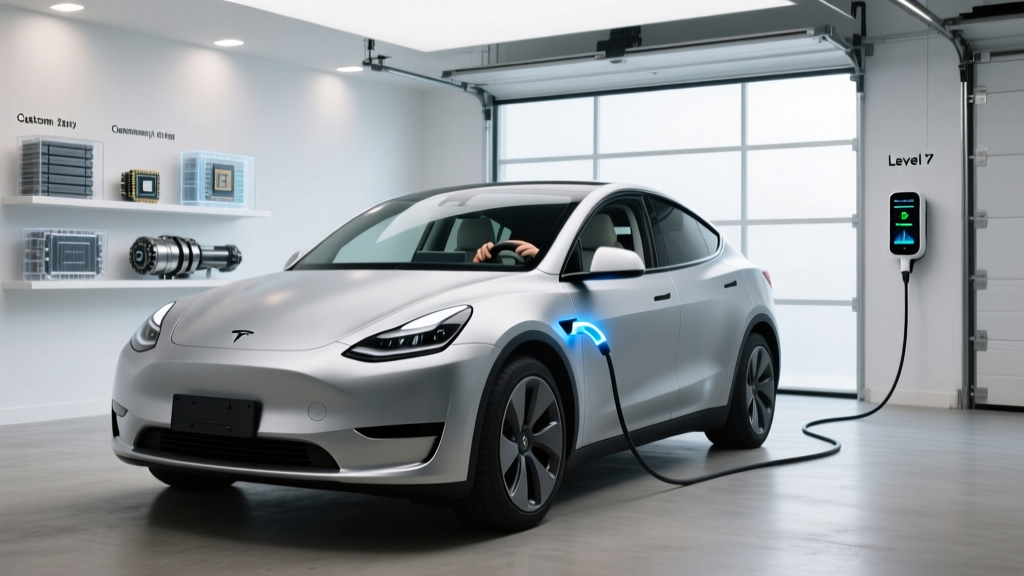
For home charging, the Tesla Wall Connector delivers up to 11.5 kW on a 60A circuit (48A continuous). A full charge from 10% to 100% takes roughly 8 hours, which suits overnight charging perfectly. Installation typically runs $800–$2,000 depending on panel proximity and whether your home needs a service upgrade — a cost independent of Tesla's ecosystem.
Performance and Driving Dynamics
The dual-motor AWD Model Y Long Range produces 384 combined horsepower and hits 60 mph in 4.8 seconds. That's brisk for a 4,400-pound crossover and sufficient for confident highway merging and passing. The Performance trim drops that to 3.5 seconds with 455 hp, but at a $7,000 premium and a range penalty of ~30 miles.
Tesla's in-house permanent-magnet synchronous motors (rear) and induction motors (front) work in concert with the BMS to optimize torque distribution. The front motor can freewheel during light-load cruising to reduce drag losses — a detail enabled by Tesla designing both the motor and the control software. Regen braking is aggressive enough for near one-pedal driving in "Hold" mode, though Tesla has softened the default regen setting in recent model years.
Ride quality remains the Model Y's most common criticism. The 2026 model continues with the frequency-selective damping introduced in the 2024 refresh, which improved compliance over potholes and expansion joints, but the suspension tuning still favors body control over plushness. If you're cross-shopping against a Hyundai Ioniq 5 or a BMW iX, the Tesla rides firmer and transmits more road texture. This is a deliberate engineering choice — Tesla prioritizes handling precision and efficiency (lower ride height reduces drag) over isolation.
Interior, Cargo, and Technology
The Model Y interior remains minimalist: a single 15.4-inch touchscreen handles all infotainment, climate, navigation, and vehicle controls. There is no instrument cluster, no head-up display, and no physical buttons for climate or volume (a steering wheel scroll wheel handles volume). This polarizes buyers — some find it clean and distraction-free, others miss tactile redundancy.
Cargo space is genuinely excellent: 30.2 cu ft behind the second row and 72.1 cu ft with seats folded, plus a small front trunk (frunk) for charging cables or a backpack. The 2024-refresh Juniper update added ventilated front seats, ambient lighting, a rear-seat touchscreen, and power-folding second-row seats — addressing several longstanding complaints.
Autopilot comes standard with traffic-aware cruise control and lane-centering. Full Self-Driving (Supervised) is a $8,000 add-on (or $99/month subscription) that adds automated lane changes, intersection handling, and parking assist.
Autopilot and FSD (Supervised) are driver-assist systems, not self-driving. You must keep your hands on the wheel and eyes on the road at all times. Tesla's camera-only vision stack is capable but requires active supervision. True Level 4 driverless operation is currently only available via Waymo in limited metro areas.
- Drive without your attention — you remain legally responsible
- Handle all construction zones, unmapped roads, or severe weather
- Replace a licensed driver — this is not a robotaxi
- Guarantee safe passage — disengagement is frequent in complex scenarios
Pricing, Trims, and Federal Tax Credit Eligibility
The 2026 Model Y lineup is streamlined:
| Trim | Base MSRP | Est. After §30D Credit* | EPA Range |
|---|---|---|---|
| Long Range AWD | $48,990 | ~$41,490 | 320 mi |
| Performance AWD | $55,990 | ~$48,490 | 290 mi |
*Assumes full $7,500 federal credit via point-of-sale transfer. Eligibility depends on buyer income, battery sourcing, and MSRP caps. Verify at IRS.gov §30D.
- MSRP Cap: SUVs/crossovers must be ≤ $80,000 (Model Y qualifies at all trims)
- Buyer Income Cap: AGI ≤ $150,000 single / $225,000 head of household / $300,000 joint
- Battery Sourcing: Critical minerals and battery components must meet phased-in domestic/free-trade thresholds — Tesla's use of CATL-sourced LFP cells in some Standard Range variants has created eligibility questions; the Long Range AWD with NMC cells from Panasonic (Nevada Gigafactory) has historically qualified
- Point-of-Sale Transfer: You can apply the credit as an immediate price reduction at delivery, not just a tax-time offset
- FEOC Restriction: Vehicles with battery components from a Foreign Entity of Concern are excluded — verify current-year status at purchase
Tesla's vertical integration gives it unusual control over battery sourcing compliance. Because Panasonic manufactures cells at the Gigafactory in Nevada and Tesla manages its own supply chain for cathode materials, the company can adjust sourcing to maintain credit eligibility more nimbly than competitors reliant on external cell suppliers. That said, the rules are complex and shift annually — always confirm eligibility with your tax professional before purchase.
How Does the Model Y Compare to Key Competitors?
The mid-size electric crossover segment is crowded in 2026. Here's how the Model Y Long Range stacks up on the metrics that matter:
| Spec | Tesla Model Y LR | Hyundai Ioniq 5 Limited | Ford Mustang Mach-E Premium |
|---|---|---|---|
| EPA Range | 320 mi | 310 mi | 300 mi |
| Peak DCFC | 250 kW | 238 kW | 150 kW |
| 10–80% Time | ~25 min | ~26 min | ~38 min |
| 0–60 mph | 4.8 sec | 5.1 sec | 5.6 sec |
| Cargo (seats up) | 30.2 cu ft | 27.2 cu ft | 29.7 cu ft |
| Charging Network | Supercharger (native) | NACS adapter req. | NACS adapter req. |
| Base MSRP | $48,990 | $52,600 | $46,995 |
The Model Y's advantages are clear: best-in-class range, fastest DC charging, the most seamless charging network, and competitive pricing. Where it loses ground is interior material quality (the Ioniq 5's cabin feels more premium), physical controls (the Mach-E has buttons and a conventional instrument cluster), and ride comfort (both competitors are more compliant over rough pavement).
The charging network gap is narrowing as Hyundai, Ford, and others gain Supercharger access via NACS adapters, but the native Tesla experience — plug-and-charge with automatic billing and real-time stall availability in the nav system — remains unmatched. This is vertical integration's most visible payoff.
- You road-trip frequently and want the most reliable DC fast-charging network
- You value OTA software updates that add features post-purchase
- You want maximum cargo space in an electric crossover
- You prefer a minimalist, screen-centric interior
- You want physical buttons, a head-up display, or a traditional instrument cluster
- Ride comfort on rough roads is a top priority
- You prefer a more luxurious interior at a similar price (Ioniq 5, BMW iX)
- You want a dealer service network for in-person maintenance
Pros, Cons, and Who the Model Y Suits Best
- Class-leading 320-mile EPA range with efficient thermal management
- 250 kW DC fast charging with seamless Supercharger access
- Best-in-class cargo volume (72.1 cu ft max)
- Continuous OTA updates improve the vehicle over time
- Strong §30D tax credit eligibility due to domestic battery production
- Low operating cost: ~$0.04–0.06/mi on home charging
- Minimalist interior lacks physical controls and premium materials
- Firm ride quality compared to competitors
- No Apple CarPlay or Android Auto
- FSD (Supervised) is expensive and remains Level 2 only
- Service center wait times can be long in some markets
- Rear visibility is compromised by the sloping roofline
Who it suits best: The Model Y Long Range AWD is ideal for tech-forward commuters and families who road-trip 2–4 times per year and want minimal charging hassle. Its range and Supercharger access make it the most capable electric crossover for long-distance travel. It's less suited for buyers who prioritize luxury interiors, physical controls, or a plush ride — those shoppers should test-drive the Ioniq 5, Mach-E, or BMW iX before committing.
Frequently Asked Questions
What is the real-world range of the 2026 Tesla Model Y?
The EPA rates it at 320 miles. Expect ~275–290 miles on highway trips at 70 mph in mild weather, dropping to ~235–255 miles in freezing temperatures. City driving with regen braking can approach the EPA figure. According to fueleconomy.gov, the combined efficiency is 111 MPGe (30 kWh/100 mi).
How fast does the Model Y charge at home and on the road?
On a Level 2 home charger (11.5 kW), you'll add ~37 miles per hour, fully recharging overnight in ~8 hours. On a Tesla Supercharger (250 kW peak), the 10–80% charge takes ~25 minutes. The charge curve tapers significantly above 80% SoC to protect battery longevity — plan to charge to 80% on road trips and move on.
Does the 2026 Model Y qualify for the $7,500 federal EV tax credit?
The Long Range AWD has historically qualified for the full $7,500 credit under IRS §30D, thanks to Panasonic cells manufactured in Nevada. However, eligibility depends on your income (≤$300K joint AGI), the vehicle's MSRP (≤$80K for SUVs), and current-year battery sourcing rules. The credit can be applied as a point-of-sale price reduction. Always verify with your tax professional before purchasing.
Is the Model Y worth buying over the Hyundai Ioniq 5 or Ford Mach-E?
Yes, if charging-network reliability and road-trip capability are priorities. The Model Y leads in range (320 vs. 300–310 mi), DC charging speed (250 vs. 150–238 kW), and native Supercharger access. Choose the Ioniq 5 for a more premium interior and compliant ride, or the Mach-E for physical controls and a lower starting price.
What's the biggest risk of buying a Tesla?
Service access. Tesla's mobile ranger and service center network is thinner than legacy dealer networks, and collision repair wait times can stretch weeks in some markets. Build quality has improved significantly since the 2024 Juniper refresh, but panel-gap inconsistencies still surface. Additionally, Tesla's direct-sales model means no local dealer to negotiate with or return to for warranty complaints.
How does Tesla's vertical integration benefit me as an owner?
Three tangible benefits: (1) The Supercharger network is the most reliable DC fast-charging infrastructure in North America, and the Model Y integrates with it natively. (2) OTA software updates continuously add features and improve efficiency — the car you buy today will be more capable in two years. (3) Tesla's control over battery production, thermal management, and motor design means tighter optimization of range and charging speed than competitors assembling from third-party components.