What Does Valet Mode Do on a Tesla?
Tesla Valet Mode is a driver-profile lock-down feature that restricts vehicle access and performance when you hand your keys—or your phone key—to someone else. Activated from the touchscreen or the Tesla app, it enforces a bundle of security and privacy constraints that protect both your property and your driving data.
Here is exactly what Valet Mode restricts on current (2025–2026) Tesla vehicles running recent software:
- Speed and acceleration cap: Maximum speed is limited to 70 mph, and acceleration is reduced to roughly 25% of normal output, preventing aggressive driving.
- Glovebox lockout: The glovebox remains locked and cannot be opened from the touchscreen or physical button.
- Frunk (front trunk) restriction: The frunk cannot be opened from the touchscreen. Rear trunk access remains available for luggage handling.
- HomeLink disabled: Garage-door and gate openers stored in HomeLink are inaccessible, protecting your home address.
- Personal data hidden: Navigation history, saved destinations (Home, Work), calendar sync, and recent phone-call logs are concealed from the driver display.
- Sentry Mode & Dashcam footage: Access to stored Sentry Mode and Dashcam clips on the touchscreen is blocked.
- Autopilot / FSD restrictions: Autosteer and Full Self-Driving (Supervised) features are disabled. Traffic-Aware Cruise Control remains available.
- Profile & settings lock: The valet cannot change driver profiles, adjust safety settings, or pair new phone keys.
- Wi-Fi and Bluetooth pairing: New network and device pairing is disabled.
SAE Automation Level Note: Valet Mode disables Autosteer and FSD (Supervised), which are SAE Level 2 driver-assist systems. These require an attentive driver at all times and are not "self-driving." Only Level 4 robotaxi services like Waymo operate without a human driver.
To activate Valet Mode, tap the driver-profile icon on the touchscreen, select Valet Mode, and set a 4-digit PIN. You can also activate it remotely via the Tesla app. Deactivation requires entering that same PIN—or using the app, which is useful if the valet has already parked the car and you want to restore full access before you reach it.
Unlike traditional "valet keys" from legacy automakers that only limit speed, Tesla's implementation leverages the car's software-defined architecture to lock down personal data, home access, and driver-assist features in one toggle. For EV owners who frequently use hotel valets, airport parking services, or car-wash attendants, it's a meaningful security layer that costs nothing and takes seconds to engage.
2026 Tesla Model 3: Full EV Review
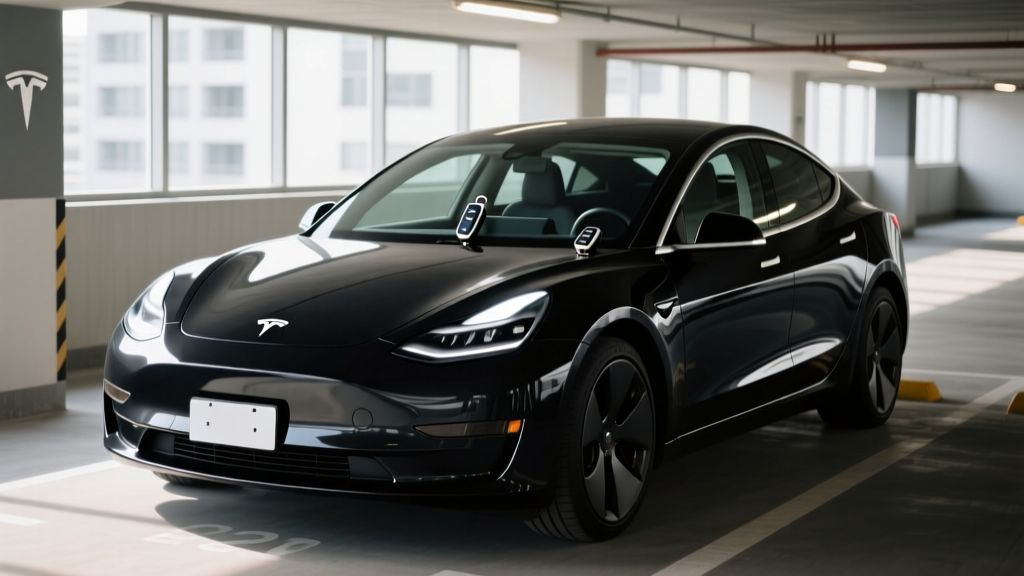
Valet Mode is available across Tesla's entire lineup, but the 2026 Tesla Model 3 remains the most popular entry point into the Tesla ecosystem. Following the significant "Highland" refresh that debuted for the 2024 model year, the current Model 3 continues with refined styling, improved cabin insulation, ventilated front seats, and ambient lighting. Here's the full breakdown.
| Spec | Long Range RWD | Long Range AWD | Performance |
|---|---|---|---|
| EPA Range | 363 mi | 341 mi | 315 mi |
| Battery (usable) | ~75 kWh (NMC) | ~75 kWh (NMC) | ~75 kWh (NMC) |
| Drivetrain | Rear-Wheel Drive | Dual-Motor AWD | Dual-Motor AWD |
| Horsepower | ~271 hp | ~346 hp | ~510 hp |
| 0–60 mph | 5.8 sec | 4.2 sec | 2.9 sec |
| Max DC Fast Charge | 170 kW | 250 kW | 250 kW |
| 10–80% DC Charge | ~28 min | ~25 min | ~25 min |
| Level 2 Home Charge | 11.5 kW (~44 mi/hr) | 11.5 kW (~44 mi/hr) | 11.5 kW (~44 mi/hr) |
| MPGe (combined) | 132 MPGe | 122 MPGe | 113 MPGe |
| Efficiency | 25 kWh/100 mi | 27 kWh/100 mi | 30 kWh/100 mi |
| Cargo Volume | 23 cu ft (trunk + frunk) | 23 cu ft | 23 cu ft |
| Base MSRP | $44,130 | $49,130 | $54,630 |
Source: EPA fueleconomy.gov, Tesla.com. Prices include destination fee. Specs reflect latest available data; confirm with Tesla at order time.
Real-World Range: What the EPA Sticker Doesn't Tell You
Real-World Range Reality Check: The Long Range RWD's EPA rating of 363 miles is one of the highest in its class, but real-world results vary significantly. Expect ~290–310 miles on a sustained 75-mph highway trip in moderate temperatures (60–75°F). In sub-freezing winter conditions (20–30°F), range can drop to ~230–260 miles due to cabin heating demands and reduced battery efficiency—even with the Model 3's heat pump. City driving with frequent regenerative braking can actually exceed the EPA combined figure, sometimes reaching 340–360 miles in stop-and-go traffic at moderate speeds.
The Model 3 Long Range uses an NMC (nickel manganese cobalt) lithium-ion pack. NMC chemistry offers high energy density, which is why this sedan achieves over 360 EPA miles from a ~75 kWh usable pack. The trade-off versus LFP (lithium iron phosphate)—used in the Standard Range variant—is that NMC prefers not to sit at 100% state of charge for extended periods. Tesla recommends daily charging to 80–90% for NMC packs and reserving 100% for road trips.
The Highland redesign brought meaningful efficiency gains. Improved aerodynamics (a lower drag coefficient), lighter wheels, and the standard heat pump all contribute to the Model 3's class-leading efficiency of 25 kWh per 100 miles on the Long Range RWD. That number matters when you're paying for electricity: at the national average residential rate of ~$0.16/kWh, driving 100 miles costs roughly $4.00—about one-third the cost of a comparable gas sedan at 30 MPG and $3.50/gallon.
Charging Speed: DC Fast, Level 2, and the Supercharger Advantage
| Charging Level | Power | Miles Added per Hour | Typical Use Case |
|---|---|---|---|
| Level 1 (120V) | ~1.4 kW | ~4–5 mi/hr | Emergency / overnight trickle |
| Level 2 (240V, 48A) | 11.5 kW | ~44 mi/hr | Home daily charging |
| DC Fast (V3 Supercharger) | Peak 250 kW | ~1,000+ mi/hr (peak) | Road trips |
The Model 3 Long Range AWD and Performance trims peak at 250 kW on a V3 Supercharger, reaching 10–80% in approximately 25 minutes. However, that peak rate is not sustained. The charge curve tapers significantly above 60% state of charge, and by 80%, you're pulling closer to 60–70 kW. This is normal lithium-ion behavior—charging speed slows to protect battery longevity.
On a home Level 2 charger (Tesla Wall Connector on a 60-amp circuit), the onboard charger accepts up to 11.5 kW, adding roughly 44 miles of range per hour. A full overnight charge from 20% to 80% takes about 4–5 hours, which covers virtually any daily commute.
The Model 3 uses the NACS (North American Charging Standard) connector natively. Tesla Superchargers are the most reliable DC fast-charging network in the US, with over 25,000 stalls nationwide. Non-Tesla chargers (Electrify America, EVgo, ChargePoint) are also accessible, as the NACS connector is now the industry standard adopted by most automakers for 2025+ models.
Preconditioning matters: When you navigate to a Supercharger using the built-in navigation, the Model 3 automatically warms the battery to its optimal charging temperature. Skipping preconditioning—by driving to a charger without using navigation—can slow your peak charge rate by 30–50%, especially in cold weather.
Pricing, Tax Credits, and Total Cost
| Trim | Base MSRP | §30D Credit | Effective Price |
|---|---|---|---|
| Long Range RWD | $44,130 | Up to $7,500* | ~$36,630 |
| Long Range AWD | $49,130 | Up to $7,500* | ~$41,630 |
| Performance | $54,630 | Up to $7,500* | ~$47,130 |
*Federal §30D credit eligibility depends on multiple factors. Verify current rules at IRS.gov.
- MSRP cap: Sedans must be priced at or below $55,000 to qualify. The Long Range RWD and AWD trims clear this bar; the Performance trim at $54,630 is right at the line—options can push it over.
- Buyer income cap: Modified adjusted gross income must not exceed $150,000 (single), $225,000 (head of household), or $300,000 (joint filing).
- Battery sourcing: The credit is split into two halves—$3,750 for critical-minerals sourcing and $3,750 for battery-component manufacturing. Sourcing requirements tighten annually. Tesla's North American battery supply chain has generally qualified Model 3 buyers for the full $7,500, but rules can shift. Confirm at purchase.
- Point-of-sale transfer: As of 2024, you can transfer the credit to the dealer at purchase, reducing your out-of-pocket cost immediately rather than waiting for a tax refund.
Interior, Tech, and Standout Features
The post-Highland Model 3 cabin is noticeably quieter than pre-2024 models, thanks to acoustic glass and improved sound deadening. The minimalist interior centers on a 15.4-inch touchscreen that handles everything from climate control to navigation. There are no physical stalks—turn signals live on the steering wheel, and gear selection is via the touchscreen or a roof-mounted button panel (a design choice that remains polarizing).
Key tech features include:
- Ventilated front seats (new for Highland generation)
- Ambient interior lighting with customizable color
- Rear-seat 8-inch touchscreen for climate and media control
- Tesla Premium Audio (17 speakers on Long Range/Performance)
- Standard Autopilot (Traffic-Aware Cruise Control + Autosteer)
- Optional FSD (Supervised) at $8,000 or $99/month
- Sentry Mode with live camera access via the app
- Over-the-air software updates that add features over time
Notable drawbacks:
- No physical turn-signal stalks—buttons on the wheel take adjustment
- Rear visibility is limited; the backup camera is essential
- No Apple CarPlay or Android Auto (Tesla's native system only)
- Rear-seat legroom (35.3 inches) is tighter than a Hyundai Ioniq 6 or BMW i4
- Panel-gap quality, while improved, still varies by production batch
Warranty Coverage
Tesla provides a 4-year/50,000-mile basic vehicle warranty and an 8-year/120,000-mile battery and drive unit warranty for the Long Range AWD and Performance trims. The Long Range RWD carries an 8-year/100,000-mile battery warranty. Tesla warrants that the battery will retain at least 70% of its original capacity during the warranty period. Real-world degradation data from Tesla's fleet suggests most Model 3 packs lose approximately 10–12% capacity over the first 100,000 miles, with the curve flattening significantly afterward.
Pros and Cons
✓ Pros
- Class-leading EPA range (363 mi on LR RWD)
- Supercharger network access—most reliable DC charging in the US
- Excellent efficiency (25 kWh/100 mi)
- Comprehensive Valet Mode with data & access lockout
- OTA updates continuously improve the car
- Strong resale value relative to non-Tesla EVs
✗ Cons
- No physical stalks for turn signals or wipers
- No Apple CarPlay / Android Auto
- FSD (Supervised) is expensive and still requires driver attention
- Rear seat is snug for tall passengers on long trips
- Insurance costs run 15–25% above comparable gas sedans
- Service center wait times can be long in some metro areas
Is the 2026 Model 3 Worth It vs. Competitors?
The Model 3's primary rivals include the Hyundai Ioniq 6 (EPA 361 mi, $39,650 base), BMW i4 eDrive40 (EPA 301 mi, $52,200 base), and Polestar 2 (EPA 320 mi, $49,900 base). The Ioniq 6 matches the Model 3 on range and undercuts it on price, but it charges on the CCS connector (with NACS adoption coming) and lacks the Supercharger ecosystem. The BMW i4 offers a more traditional luxury interior and physical controls but sacrifices range and charges slower. The Polestar 2 is well-built but has fallen behind on range and charging speed.
The Model 3 wins on the combination of range, charging infrastructure, software depth (including Valet Mode, Sentry Mode, and OTA updates), and efficiency. If you value a conventional cockpit layout, physical controls, or Android Auto, the Ioniq 6 or i4 may be a better fit. If you want the most integrated EV experience with the lowest running costs and best road-trip charging, the Model 3 remains the benchmark.
Who Should Buy the 2026 Tesla Model 3?
Best for: Daily commuters with home charging, tech-forward buyers who want a software-defined vehicle, road-trippers who value Supercharger reliability, and anyone who regularly uses valet services and wants robust vehicle security.
Look elsewhere if: You need generous rear-seat space for car seats or tall adults (consider Model Y or Ioniq 5), you refuse to give up Apple CarPlay, or you live in an area with limited Tesla Service Center access.
Frequently Asked Questions
Can a valet driver access my Tesla's glovebox or frunk?
No. Valet Mode locks the glovebox and disables frunk access from the touchscreen. Only the rear trunk remains accessible, which is useful for the valet to load luggage but prevents access to stored valuables up front.
Does Valet Mode limit how fast the valet can drive my Tesla?
Yes. Maximum speed is capped at 70 mph and acceleration is reduced to about 25% of normal. This prevents joyriding and reduces the risk of an accident while your car is in someone else's hands.
Can I activate Valet Mode remotely from my phone?
Yes. The Tesla app allows you to activate and deactivate Valet Mode remotely, which is useful if you forgot to set it before handing off your car, or if you want to unlock full access before the valet returns your vehicle.
Does the 2026 Model 3 qualify for the full $7,500 federal tax credit?
As of current IRS §30D rules, the Model 3 Long Range RWD and AWD trims (under the $55,000 sedan MSRP cap) have generally qualified for the full $7,500 credit, provided the buyer meets income requirements and battery-sourcing rules are satisfied. The Performance trim sits at the MSRP cap edge—adding options can disqualify it. Always verify eligibility at point of purchase, as sourcing rules tighten annually.
What is the real-world range of the Model 3 Long Range?
The EPA rates the Long Range RWD at 363 miles. In real-world highway driving at 75 mph, expect roughly 290–310 miles. In cold weather (below 30°F), that drops to approximately 230–260 miles. City driving with regenerative braking can approach or even slightly exceed the EPA combined estimate.
How fast does the Model 3 charge on a home charger?
On a Level 2 home charger (240V, 48-amp circuit with a Tesla Wall Connector), the Model 3 charges at up to 11.5 kW, adding approximately 44 miles of range per hour. A typical overnight session from 20% to 80% takes about 4–5 hours.
Is Tesla Autopilot self-driving?
No. Tesla Autopilot and FSD (Supervised) are SAE Level 2 driver-assist systems. They can steer, accelerate, and brake under certain conditions, but the driver must remain fully attentive, keep hands on the wheel, and be prepared to take over at any moment. They are not autonomous driving systems.