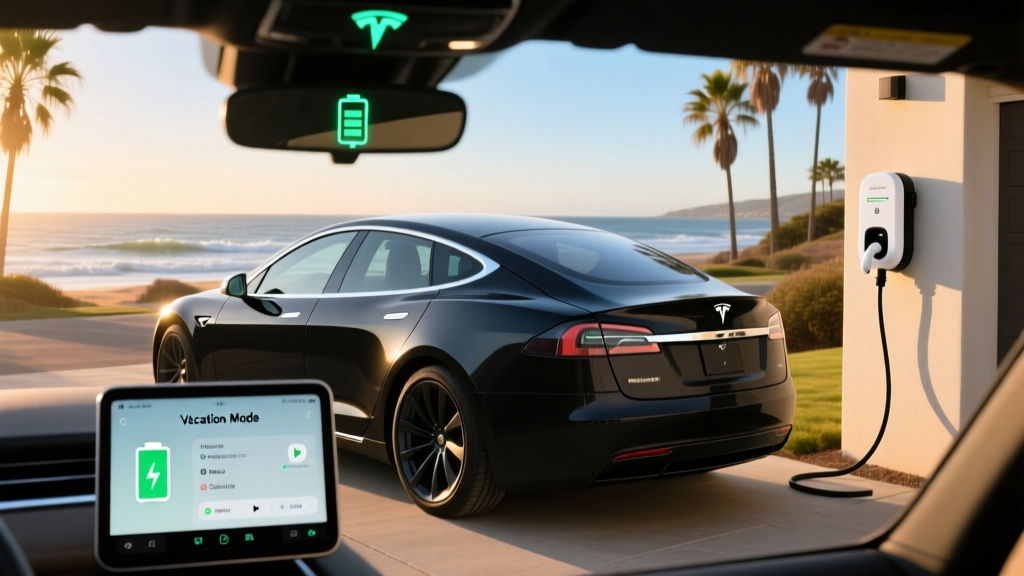
Search "Tesla Vacation Mode" and you'll find a surprising amount of confusion. Some owners think it's a camping feature, others assume it's a long-term parking setting, and a few conflate it with Tesla's actual climate features. In this guide, we clarify exactly what Vacation Mode does across the Tesla fleet, how it impacts your battery's state of charge over days or weeks away, and pair that with a complete ownership profile — EPA range, real-world efficiency, charging speeds, pricing, and 2026 federal tax-credit eligibility — so you know exactly what you're signing up for before you buy.
What Is Tesla Vacation Mode, Exactly?
Tesla does not currently offer a standalone feature officially branded "Vacation Mode" in its software menu. What owners and searchers typically mean is a combination of Tesla's existing power-management and security settings designed for extended parking:
- Sentry Mode management: Turning Sentry Mode off to prevent the cameras and onboard computer from drawing power continuously while parked.
- Cabin Overheat Protection: A feature that activates A/C or fan-only cooling if interior temperatures exceed 105°F, drawing battery power to protect the cabin and electronics.
- Energy usage settings: Disabling "Always Connected" and preconditioning schedules to minimize vampire drain.
- Scheduled Departure / Charging limits: Setting a charge limit (e.g., 50–80% for LFP or NMC batteries) appropriate for long-term storage.
Collectively, these settings function as a de facto "vacation mode." When configured correctly, a Tesla parked at the airport or in a garage for two to four weeks will lose roughly 1–3% of state of charge per day — significantly better than the 5–10% daily drain you'd see with Sentry Mode and Cabin Overheat Protection left active in hot climates.
Real-World Range vs. EPA Estimates Across the 2026 Tesla Lineup
Because "Vacation Mode" applies across Tesla's lineup, here's how range and efficiency break down by model. These figures reflect the latest EPA data available via fueleconomy.gov for current 2025/2026 model-year vehicles.
| Model / Trim | EPA Range (mi) | Battery (kWh usable) | Chemistry | MPGe (combined) | kWh/100 mi |
|---|---|---|---|---|---|
| Model 3 RWD | 272 | 57.5 | LFP | 132 | 25 |
| Model 3 Long Range AWD | 363 | 78.4 | NMC | 134 | 25 |
| Model Y Long Range AWD | 320 | 78.4 | NMC | 123 | 27 |
| Model S Long Range | 402 | 100 | NMC | 124 | 27 |
| Model X Long Range | 335 | 100 | NMC | 116 | 29 |
| Cybertruck AWD | 340 | 123 | NMC | 76 | 44 |
Charging Speeds: DC Fast Charging and Home Level 2
Whether you're topping up before a flight or returning to your car after a two-week trip, knowing your charge speeds matters. Tesla's Supercharger network uses the NACS connector natively; all current Tesla vehicles charge via NACS without an adapter.
| Model | Max DC Fast Charge (kW) | 10–80% Time (min) | Level 2 Home Rate (kW) | Level 2 Miles/Hour |
|---|---|---|---|---|
| Model 3 RWD (LFP) | 170 | ~25 | 11.5 | ~37 |
| Model 3 LR / Model Y LR | 250 | ~22 | 11.5 | ~44 |
| Model S / Model X | 250 | ~27 | 11.5 | ~36–41 |
| Cybertruck | 350 (V4 stalls) | ~18 | 11.5 | ~30 |
Charging curve reality: The peak kW number is just that — a peak. Teslas, like all EVs, taper charge speed as the battery fills. You'll see maximum power between roughly 10–40% state of charge. Above 80%, the rate drops sharply to protect battery longevity. On a road trip, plan your stops around the 10–80% window for the fastest sessions.
Vacation Mode tip: If leaving your Tesla for more than a week, set the charge limit to 50% for NMC batteries (Model 3 LR, Model Y, Model S/X) or 100% for LFP batteries (Model 3 RWD). Tesla officially recommends LFP batteries be charged to 100% at least weekly to maintain calibration. Plug in to a Level 2 charger if possible — even a standard 120V outlet (Level 1) provides ~3–4 miles of range per hour, enough to offset vampire drain indefinitely.
Performance and Drivetrain Specifications
| Model | Drivetrain | Horsepower | 0–60 mph (sec) | Towing Capacity (lb) |
|---|---|---|---|---|
| Model 3 RWD | Rear-Wheel Drive | 283 | 5.8 | — |
| Model 3 LR AWD | Dual-Motor AWD | 366 | 4.2 | — |
| Model Y LR AWD | Dual-Motor AWD | 384 | 4.8 | 3,500 |
| Model S LR | Dual-Motor AWD | 670 | 3.1 | — |
| Model X LR | Dual-Motor AWD | 670 | 3.8 | 5,000 |
| Cybertruck AWD | Dual-Motor AWD | 600 | 3.9 | 11,000 |
All Tesla models feature regenerative braking with one-pedal driving capability. The dual-motor AWD system provides independent torque vectoring front and rear, contributing to strong traction in rain and snow without a traditional mechanical center differential.
Pricing, Trims, and Federal Tax Credit Eligibility
Tesla's pricing has shifted considerably over the past two years. Below are base MSRPs for the 2025/2026 model year. As-tested prices typically add $1,000–$3,000 for color upgrades, FSD capability, or larger wheels.
| Model | Base MSRP | §30D Credit Eligible? | Est. After Credit |
|---|---|---|---|
| Model 3 RWD | $38,990 | Yes (up to $7,500) | ~$31,490 |
| Model 3 LR AWD | $45,240 | Yes (up to $7,500) | ~$37,740 |
| Model Y LR AWD | $44,990 | Yes (up to $7,500) | ~$37,490 |
| Model S LR | $79,990 | No (exceeds $55K sedan cap) | $79,990 |
| Model X LR | $84,990 | No (exceeds income limits for most) | $84,990 |
| Cybertruck AWD | $79,990 | No (exceeds $80K truck cap) | $79,990 |
- MSRP caps: Sedans ≤ $55,000; SUVs/trucks/vans ≤ $80,000
- Buyer income caps (MAGI): $150K single / $225K head of household / $300K joint
- Battery sourcing: Critical minerals and battery components must meet phased-in North American/content thresholds (increasing annually through 2030)
- Point-of-sale transfer: You can now transfer the credit to the dealer at purchase, reducing your out-of-pocket cost immediately
Interior, Cargo, and Technology
Tesla's minimalist interior centers on a single touchscreen — 15.4 inches in Model 3/Y, 17 inches in Model S/X, and an 18.5-inch front plus 9.4-inch rear setup in Cybertruck. Physical buttons are nearly absent; climate, mirrors, and glovebox are all screen-controlled.
| Model | Front Legroom (in) | Rear Legroom (in) | Cargo (cu ft, rear seats up) | Frunk (cu ft) |
|---|---|---|---|---|
| Model 3 | 42.7 | 35.2 | 23 | 3.1 |
| Model Y | 41.8 | 41.6 | 30 (76 folded) | 4.1 |
| Model S | 42.4 | 35.4 | 28 (74 folded) | 5.3 |
| Model X | 41.2 | 38.4 | 43 (88 folded) | 6.6 |
| Cybertruck | 41.5 | 41.0 | 34 (bed: 67) | 7.1 (front trunk) |
Standout tech: Tesla's infotainment remains best-in-class for responsiveness, integrated navigation with real-time Supercharger routing, over-the-air updates, and entertainment (Netflix, YouTube, gaming while parked). Autopilot is standard; Full Self-Driving (Supervised) is a $8,000 option or $99/month subscription.
Warranty, Battery Longevity, and Vacation-Mode Battery Care
Tesla's warranty structure covers the battery and drive unit generously:
- Model 3 RWD (LFP): 8 years / 100,000 miles, whichever comes first, with minimum 70% capacity retention
- Model 3 LR / Model Y LR: 8 years / 120,000 miles, 70% retention
- Model S / X: 8 years / 150,000 miles, 70% retention
- Cybertruck: 8 years / 120,000 miles, 70% retention
- Basic vehicle warranty: 4 years / 50,000 miles across all models
For vacation-mode parking specifically: Real-world data from Tesla fleet telemetry and independent studies shows that NMC batteries stored at 50% SoC in moderate temperatures (60–75°F) degrade less than 0.5% over a month. LFP batteries tolerate 100% storage better than NMC but still benefit from moderate temperatures. Avoid leaving any Tesla at 100% SoC in extreme heat for extended periods — that combination accelerates calendar degradation.
Pros and Cons of the Tesla Ecosystem
- Supercharger network — most reliable DC fast-charging ecosystem in North America
- Over-the-air updates continuously add features
- Class-leading efficiency (kWh/100 mi)
- Strong resale value relative to non-Tesla EVs
- LFP option on Model 3 RWD offers 100% daily charging without degradation concern
- Minimalist interior frustrates some buyers — no physical climate controls or instrument cluster
- FSD (Supervised) remains Level 2 despite its name — $8K for a feature that doesn't deliver autonomy
- Service center wait times can stretch weeks in underserved metro areas
- Model S/X no longer qualify for §30D credit due to MSRP caps
- No Apple CarPlay or Android Auto — Tesla's ecosystem is closed
Who Should Buy a Tesla — and Who Should Look Elsewhere?
Choose Tesla if: You value Supercharger access for road trips, want OTA feature updates, prefer best-in-class efficiency, and are comfortable with a screen-centric interface. Model 3 and Model Y with the §30D credit represent some of the best value-per-mile EVs on the market.
Look elsewhere if: You need physical buttons and a traditional instrument cluster (consider Hyundai Ioniq 5 or BMW i4), require a luxury sedan with premium materials (BMW i5, Mercedes EQE), need three-row seating (Kia EV9), or live in an area with limited Tesla Service infrastructure.
Frequently Asked Questions
What is the real-world range of a Tesla?
Real-world range typically falls 10–15% below the EPA estimate during highway driving and 20–30% below in freezing weather. A Model Y Long Range rated at 320 miles EPA delivers roughly 270–285 miles on a 70-mph highway trip in mild weather, and 220–250 miles in sub-freezing conditions with cabin heating active.
How fast does a Tesla charge at home and on the road?
On a Tesla Wall Connector (Level 2, 48A), expect 11.5 kW adding roughly 37–44 miles per hour depending on the model. A full overnight charge from 20% to 80% takes about 5–6 hours. On a V3 Supercharger (250 kW DC), Model 3 LR and Model Y reach 10–80% in roughly 22 minutes. Cybertruck on V4 stalls peaks at 350 kW for a ~18-minute 10–80% session.
How much does a Tesla cost after tax credits?
The Model 3 RWD starts at $38,990 and drops to approximately $31,490 after the full $7,500 §30D credit (if you meet income and sourcing requirements). The Model Y Long Range falls from $44,990 to roughly $37,490. Model S, Model X, and Cybertruck exceed MSRP caps and do not qualify for the federal credit.
Does Tesla qualify for the federal EV tax credit?
Model 3 and Model Y currently qualify for up to $7,500 under IRS §30D, provided the buyer meets income caps ($150K single / $300K joint) and the vehicle meets battery-sourcing requirements. The credit can be transferred at point of sale to reduce your purchase price directly. Always check fueleconomy.gov for the latest eligibility, as battery-component sourcing rules tighten annually.
How do I set up my Tesla for long-term parking (vacation mode)?
Disable Sentry Mode and Cabin Overheat Protection, turn off Scheduled Departure and preconditioning, set your charge limit to 50% (NMC) or 100% (LFP), and leave the car plugged into a Level 2 charger if possible. Expect 1–3% daily SoC loss with these settings. Avoid parking in direct sunlight in hot climates for multi-week absences.
Is Tesla worth buying vs. competitors?
For road-trippers who rely on DC fast charging, Tesla's Supercharger network remains a decisive advantage — though NACS adoption by Ford, GM, Rivian, and others is narrowing the gap via adapters. For value, the Model 3 RWD at ~$31,500 after credit is hard to beat on a $/mile-of-range basis. If interior quality, physical controls, or dealer service matter more to you, the Hyundai Ioniq 6, BMW i4, or Chevrolet Equinox EV are strong alternatives worth cross-shopping.