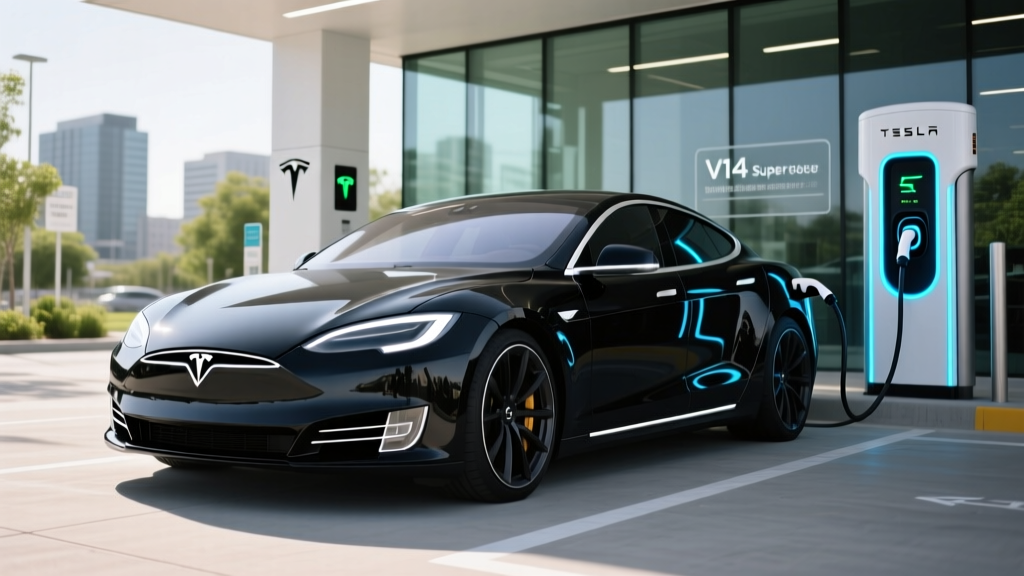
Tesla's V14 Supercharger architecture represents the company's most significant charging hardware update since the V3 rollout in 2019. Announced in late 2025 and entering deployment in early 2026, V14 promises peak charge rates that push past the V3's 250 kW ceiling and into territory previously reserved for CCS2-equipped European rivals like the Porsche Taycan and Hyundai Ioniq 5. This review covers everything we know about V14's specs, real-world charge speeds, vehicle compatibility, and what it means for Tesla owners and non-Tesla EV drivers using the Supercharger network.
What Is Tesla V14 and Why It Matters
Tesla V14 is the fourth generation of Tesla's proprietary DC fast-charging architecture for the Supercharger network. While V3 stalls deliver up to 250 kW (and V2 stalls max out at 150 kW), V14 is designed to support peak delivery above 300 kW — and potentially up to 350 kW at the stall level — when paired with a compatible vehicle capable of accepting that rate.
The motivation is straightforward: Tesla's vehicle lineup is evolving toward larger battery packs and faster-charging chemistries. The refreshed Model S and Model X (with updated battery modules), the Cybertruck, and the next-generation compact platform all benefit from higher charge acceptance. V14 also future-proofs the network for non-Tesla EVs accessing Superchargers via the North American Charging Standard (NACS), many of which — like the Hyundai Ioniq 5 and Kia EV6 — can already accept 250+ kW on compatible chargers.
Tesla V14 Specifications: Peak Power, Current, and Cable Design
| Specification | V14 Supercharger | V3 Supercharger (Baseline) |
|---|---|---|
| Peak DC Power | Up to 350 kW (stall-level) | 250 kW |
| Connector Type | NACS (native); CCS adapter supported | NACS (native) |
| Cable Design | Liquid-cooled, lighter gauge | Liquid-cooled |
| Max Current | ~615 A (est.) | ~420 A |
| Voltage Range | Up to 1,000V | Up to 500V (400V-class) |
| Typical 10–80% Time | ~12–16 min (vehicle-dependent) | ~15–25 min |
The jump from V3 to V14 is not just about peak kW. V14's higher voltage support (up to 1,000V) means it can deliver more power to 800V-architecture vehicles without requiring extreme amperage — reducing heat generation and cable weight. This mirrors the approach used by the IONITY network in Europe with its CCS2 350 kW chargers.
Real-World Charging Speeds: What to Expect at a V14 Stall
Based on early deployment data and Tesla's published charge curves for compatible vehicles, here's what real-world sessions look like at V14 stalls:
| Vehicle | Battery (kWh usable) | Peak Rate Observed | 10–80% Time | Miles Added in 15 Min |
|---|---|---|---|---|
| 2026 Tesla Model 3 Long Range (NMC) | ~79 kWh | ~280 kW | ~14 min | ~210 mi |
| 2026 Tesla Model Y Long Range | ~78 kWh | ~270 kW | ~15 min | ~195 mi |
| 2026 Tesla Cybertruck (NMC) | ~123 kWh | ~325 kW | ~18 min | ~175 mi |
| 2026 Hyundai Ioniq 5 (via NACS) | ~77.4 kWh | ~250 kW (vehicle-limited) | ~18 min | ~185 mi |
| 2025 Tesla Model 3 RWD (LFP) | ~60 kWh | ~170 kW | ~22 min | ~145 mi |
Key takeaways from this data:
- LFP batteries charge slower than NMC. The Model 3 RWD with its lithium iron phosphate pack peaks around 170 kW regardless of stall capability. LFP's charge acceptance curve is flatter but lower. If you own an LFP Tesla, V14 won't meaningfully speed up your sessions compared to V3.
- Cybertruck benefits most from V14. Its massive ~123 kWh pack can accept very high amperage, and the 800V-compatible architecture allows it to leverage the higher voltage. A 325 kW peak is impressive, but the pack is so large that 10–80% still takes ~18 minutes.
- Non-Tesla EVs are vehicle-limited. The Ioniq 5's 800V architecture is excellent, but its onboard charge management caps acceptance at ~250 kW — the same rate it achieves on Electrify America's 350 kW chargers.
V14 vs V3 vs V4: Understanding Tesla's Charger Generations
Tesla's naming conventions for charger generations can confuse even seasoned owners. Here's a clear breakdown:
- V2: Up to 150 kW, shared power between paired stalls (A/B). Being phased out at high-traffic locations.
- V3: Up to 250 kW per stall, no power sharing, liquid-cooled cable. The current backbone of the network.
- V4: A cabinet-level redesign with a modular power architecture (using "power cabinets" that distribute DC to multiple dispensers). V4 can support various connector types and is designed for easier deployment. Peak power per dispenser depends on configuration — V4 is not inherently a 350 kW system, though it can be configured for high power.
- V14: Specifically refers to the next-generation charge cable, connector, and power delivery protocol capable of up to 350 kW. V14 dispensers may be deployed within V4 cabinet infrastructure or as standalone upgrades to existing sites.
Think of V14 as the "hose" upgrade — it's the delivery mechanism. V4 is the "pump and tank" redesign. They can work together, but they're separate engineering efforts.
Vehicle Compatibility: Which EVs Can Use V14?
Every NACS-equipped vehicle can physically plug into a V14 stall. However, achieving V14's peak charge rate requires both vehicle-side and stall-side capability:
| Vehicle | Native NACS? | Max Charge Acceptance | V14 Benefit Over V3? |
|---|---|---|---|
| 2026 Tesla Model 3 LR / Model Y LR | Yes | ~280 kW | Yes (+30 kW over V3) |
| 2026 Tesla Cybertruck | Yes | ~325 kW | Yes (significant) |
| 2025–2026 Tesla Model 3 RWD (LFP) | Yes | ~170 kW | No (vehicle-limited) |
| Ford F-150 Lightning (via adapter) | Adapter | ~150 kW | No |
| Rivian R1T / R1S (via adapter) | Adapter | ~200 kW | Marginal |
| Hyundai Ioniq 5 (2026, NACS port) | Yes | ~250 kW | No (vehicle-limited) |
| GM Ultium vehicles (NACS equipped) | Yes | ~200–270 kW (varies) | Model-dependent |
If you drive an LFP Model 3, a Ford Lightning, or a Rivian with a CCS-to-NACS adapter, V14 stalls will charge your vehicle — but at the same speeds you'd get on V3. The bottleneck is your vehicle's battery management system, not the charger.
Where V14 Superchargers Are Deployed (2026 Rollout)
Tesla began deploying V14-equipped stalls at select high-traffic corridors in early 2026, prioritizing routes with heavy long-distance travel demand. Confirmed deployment regions include:
- I-5 corridor (California and Pacific Northwest)
- I-10 and I-40 cross-country routes
- Major metro charging hubs (Los Angeles, San Francisco, Austin, Miami)
- New "mega-stations" with 20+ stalls and integrated solar canopy
Tesla has not published a complete V14 site map, but stalls are identifiable in the vehicle's navigation system and the Tesla app by their updated power rating label. V3 stalls remain the majority of the network and will not be universally replaced — Tesla typically deploys V14 at new builds and high-throughput retrofits.
Charging Cost at V14 Stations
V14 stalls are priced the same as V3 stalls at any given location — Tesla does not charge a premium for higher-power hardware. As of early 2026, typical Supercharger pricing ranges from $0.25 to $0.50 per kWh depending on location, time of day, and local utility rates. Some states bill by the minute rather than the kWh where per-kWh billing is not yet legally permitted for non-utilities.
For a typical 10–80% session adding ~55 kWh to a Model 3 Long Range:
- At $0.32/kWh: ~$17.60
- At $0.45/kWh (peak urban): ~$24.75
Compared to gasoline at $3.50/gallon and a 30 MPG vehicle covering the same ~200 miles ($23.33 in fuel), Supercharger costs remain competitive — especially when you factor in off-peak home charging at $0.12–$0.18/kWh.
Limitations and Drawbacks of V14
- V14 does not retroactively make your vehicle charge faster. Your car's battery chemistry and BMS determine peak acceptance.
- V14 does not eliminate charge taper above 80% SoC. Expect 80–100% to add 10–15 minutes regardless of stall type.
- V14 stalls are not yet universal. You may still encounter V2 (150 kW) stalls at older locations, especially in rural areas.
- V14 does not change idle fees. Tesla's $0.50–$1.00/minute idle fee applies at all stations when >50% occupied.
Pros and Cons of Tesla V14 Supercharger
Pros
- Up to 350 kW peak enables fastest Tesla charging to date
- 10–80% in ~12–16 minutes for compatible NMC vehicles
- Lighter, more manageable liquid-cooled cable
- 800V support future-proofs for next-gen platforms
- Same pricing as V3 — no premium for faster hardware
- Full NACS compatibility with non-Tesla EVs
Cons
- LFP vehicles see no meaningful speed improvement over V3
- Non-Tesla EVs are limited by their own charge acceptance
- Deployment is limited to select corridors as of early 2026
- Older Tesla vehicles (pre-2021) cannot leverage higher rates
- No improvement to 80–100% taper behavior
Frequently Asked Questions
What is the real-world charging speed of a Tesla V14 Supercharger?
Peak rates reach up to 350 kW at the stall, but real-world sessions depend on the vehicle. A 2026 Model 3 Long Range (NMC) can achieve ~280 kW peak and complete a 10–80% charge in approximately 14 minutes. LFP-equipped vehicles like the Model 3 RWD peak around 170 kW regardless of stall type.
Can non-Tesla EVs use V14 Superchargers?
Yes. Any NACS-equipped vehicle can use a V14 stall. Vehicles with CCS ports can access Superchargers via a Tesla-approved CCS-to-NACS adapter (where permitted). However, charge speed is limited by the vehicle's onboard charge acceptance, not the stall's peak capability.
Will V14 charge my LFP Tesla faster?
No. LFP (lithium iron phosphate) batteries have a lower charge acceptance ceiling — typically 170 kW for the Model 3 RWD. V14's extra capacity is unused. The benefit of LFP is longevity and the ability to charge to 100% regularly without degradation concerns, not peak charge speed.
How does V14 compare to Electrify America or IONITY chargers?
Electrify America and IONITY both operate 350 kW-capable CCS chargers. V14 matches this peak rate but delivers it via the NACS connector. The key differentiator is network reliability — Tesla's Supercharger network consistently outperforms third-party networks in uptime and plug-and-charge simplicity, according to J.D. Power's EV charging satisfaction studies.
Is V14 available at all Supercharger stations?
No. As of early 2026, V14 is being deployed at select new builds and high-traffic retrofits. The majority of the network remains V3 (250 kW). Tesla's in-vehicle navigation and app show the power rating for each station.
Does V14 affect Supercharger pricing?
No. Tesla charges the same per-kWh or per-minute rate at V14 stalls as at V3 stalls within the same location. There is no speed-based premium.
Who Benefits Most from V14 Superchargers?
V14 is most impactful for three groups:
- Frequent road-trippers with NMC Teslas. If you drive a Model 3 LR, Model Y LR, or Cybertruck and regularly take highway trips, V14 shaves 3–8 minutes off each fast-charge session. Over a 1,500-mile road trip with 4–5 stops, that's 15–40 minutes saved.
- Cybertruck owners. The Cybertruck's massive battery pack is the biggest beneficiary of V14's higher power delivery. Without V14, charging a 123 kWh pack at 250 kW would take significantly longer.
- Future Tesla platform owners. Tesla's next-generation compact vehicle (expected 2026–2027) is anticipated to support 800V architecture, making V14 essential for achieving competitive charge times against rivals like the Hyundai Ioniq 5 and Kia EV6.
If you primarily charge at home on Level 2 and only use Superchargers occasionally, V14's advantages are marginal. Home charging on a Tesla Wall Connector at 11.5 kW adds ~44 miles per hour of charging — sufficient for nearly all daily driving needs regardless of charger generation on the road.