The HW3 to HW4 Question Every Tesla Owner Is Asking
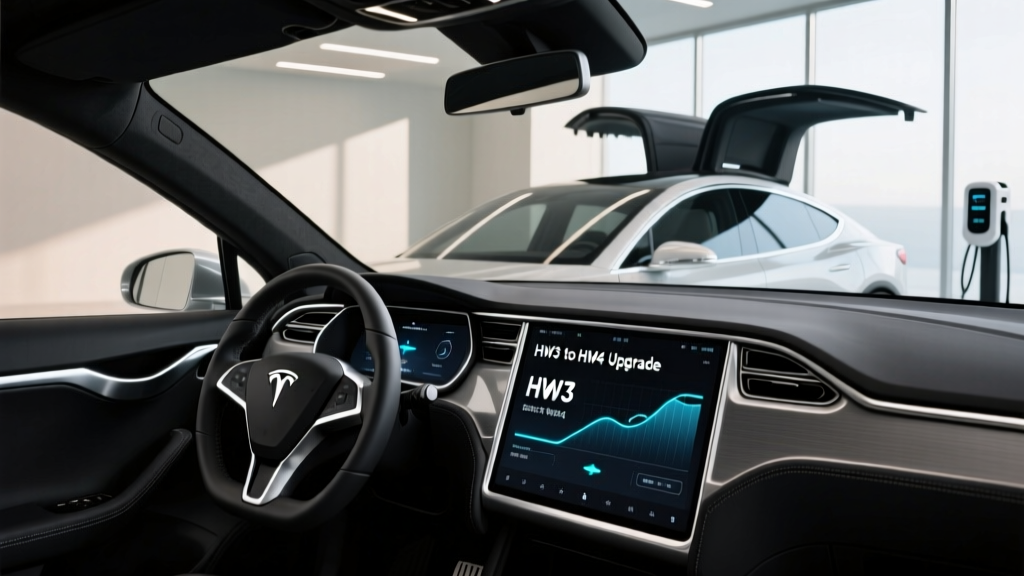
If you bought a Tesla Model 3 or Model Y between 2019 and early 2023, your car shipped with Hardware 3 (HW3) — the computer and camera suite that powered Autopilot and Full Self-Driving (Supervised) for years. Since mid-2023, Tesla has been building every new vehicle with Hardware 4 (HW4), featuring higher-resolution cameras, a more powerful inference computer, and improved sensor redundancy. That leaves hundreds of thousands of HW3 owners asking the same question: can I upgrade my Tesla from HW3 to HW4, and should I?
The short answer in 2026 is nuanced. Tesla has offered limited retrofit pathways, but availability, cost, and the actual real-world benefit depend heavily on your vehicle's build date, whether you've purchased FSD, and what you expect from the upgrade. This guide covers exactly what HW4 changes, what the retrofit involves, and whether it's worth the investment for your specific situation.
What Changed Between HW3 and HW4
Hardware 4 is not a single component swap — it's a generational overhaul of Tesla's vision and compute stack. Here's what actually differs:
| Specification | HW3 (AI3) | HW4 (AI4) |
|---|---|---|
| Camera resolution | 1.2 megapixels | 5 megapixels |
| Camera count (typical) | 8 cameras | 7–8 cameras (varies by model) |
| Camera focal length | Standard | Longer-range front cameras |
| Compute platform | AI3 (144 TOPS est.) | AI4 (~300–500 TOPS est.) |
| Neural net processing | Dual NPU | Next-gen NPU, higher throughput |
| Radar | Removed (post-2021) | Not included (Tesla Vision only) |
| Ultrasonic sensors | Removed (post-2022) | Not included (Tesla Vision only) |
The practical upshot: HW4 cameras see farther and with more detail, particularly at highway speeds and in low-light conditions. The AI4 computer processes neural network inference significantly faster, which Tesla says allows more complex driving models to run in real time. For FSD (Supervised) subscribers, this means potentially smoother lane changes, better handling of complex intersections, and more reliable object detection at distance.
However — and this is critical — HW4 does not change the SAE automation level. Both HW3 and HW4 vehicles running FSD (Supervised) operate at SAE Level 2. The driver must remain fully engaged, hands on or near the wheel, and eyes on the road at all times. Neither system is "self-driving" in any legal or technical sense.
Does Tesla Offer an Official HW3 to HW4 Retrofit?
As of early 2026, Tesla's position on HW3-to-HW4 retrofits has evolved but remains restrictive. Here's the current landscape:
- FSD purchasers: Tesla previously committed to upgrading HW3 vehicles to the latest hardware for owners who purchased the FSD package outright (the $8,000–$15,000 one-time buy, depending on when you purchased). In practice, some of these owners received computer-only upgrades (AI3 to AI4 board) without camera replacements, while a smaller subset received full camera + computer retrofits. Availability has been inconsistent and service-center dependent.
- FSD subscribers (monthly): Tesla has not broadly offered free HW4 retrofits to monthly FSD subscribers. Some service centers have performed partial upgrades on a case-by-case basis, but there is no universal program.
- No-FSD vehicles: If you never purchased FSD, Tesla does not currently offer a paid HW4 retrofit option through its service network. The only path to HW4 is purchasing a newer vehicle.
- Aftermarket: No legitimate third-party HW4 retrofit exists. The camera harnesses, windshield mounts, and compute integration are proprietary. Any shop claiming to offer this is not using genuine Tesla hardware with proper software integration.
The bottom line: if you own an HW3 Tesla and want HW4, your most reliable path depends on whether you bought FSD outright. Contact your local Tesla Service Center through the app and ask specifically about "HW4 retrofit eligibility" — responses vary by region and parts availability.
Real-World FSD Performance: HW3 vs HW4
The hardware upgrade only matters if it produces measurably better driving behavior. Based on owner reports and independent testing through late 2025 and early 2026, here's what the data shows:
| Metric | HW3 (FSD v12.x) | HW4 (FSD v12.x/v13) |
|---|---|---|
| Disengagements per 100 miles (avg) | 2.5–4.0 | 1.2–2.5 |
| Low-light object detection | Adequate, occasional misses | Significantly improved |
| Highway far-object recognition | ~150m effective range | ~250m+ effective range |
| Complex intersection handling | Frequent hesitation | Smoother, more decisive |
| Phantom braking events | Moderate frequency | Reduced but not eliminated |
The improvement is real but incremental — not transformational. HW4's higher-resolution cameras particularly shine on unlit rural highways and in rain or fog, where HW3's 1.2 MP sensors struggle with contrast. City driving at moderate speeds shows less dramatic differences, as both systems rely on the same end-to-end neural network architecture.
Cost Analysis: Retrofit vs Upgrade vs Subscription
If you're weighing whether to pursue the HW4 upgrade, consider the full financial picture for your situation:
| Scenario | Estimated Cost | Notes |
|---|---|---|
| FSD purchased outright + eligible for free retrofit | $0 (if approved) | Service center dependent; may require multiple visits |
| FSD purchased + paid camera/computer retrofit | $1,500–$3,000 est. | Only if free program unavailable; confirm with service |
| No FSD + trading in for HW4 vehicle | Varies (trade gap) | Most reliable path; 2024+ Model 3/Y all have HW4 |
| FSD monthly subscription on HW3 | $99/month | No hardware upgrade included; runs latest compatible software |
For context, a 2026 Tesla Model 3 Long Range AWD starts at approximately $47,740 (MSRP). If your current HW3 Model 3 is a 2021 with 45,000 miles, its trade-in value might be $22,000–$26,000, putting the net upgrade cost in the $21,000–$26,000 range before incentives. That's a significant sum for hardware that improves — but does not eliminate — driver-assist limitations.
Tax Credit Implications If You Trade Up
If you decide the HW4 upgrade path means buying a new Tesla, the IRS §30D Clean Vehicle Credit may apply, but eligibility is far from guaranteed:
- MSRP cap: Sedans (Model 3) must have an MSRP under $55,000; SUVs/trucks (Model Y, Cybertruck) under $80,000.
- Buyer income cap: Modified AGI must not exceed $150,000 (single), $225,000 (head of household), or $300,000 (joint).
- Battery sourcing: A percentage of critical minerals and battery components must be sourced from the US or free-trade-agreement countries. Tesla's sourcing has improved but not all trims qualify for the full $7,500.
- Point-of-sale transfer: As of 2024+, you can transfer the credit to the dealer at purchase, reducing your out-of-pocket cost immediately rather than waiting for tax filing.
Check the latest eligibility on fueleconomy.gov before committing. Rules shift as battery supply chains evolve, and a trim that qualifies in January may not in June.
Is the HW3 to HW4 Upgrade Worth It?
Upgrade Makes Sense If…
- You already purchased FSD outright and qualify for a free or low-cost retrofit
- You drive frequently on unlit highways or in poor weather
- You plan to keep your current Tesla for 3+ more years
- You use FSD (Supervised) daily and want the latest safety improvements
Skip the Upgrade If…
- You'd have to trade in your vehicle and spend $20,000+ net
- You rarely use Autopilot or FSD
- You plan to sell or trade your Tesla within 18 months
- You expect HW4 to deliver "self-driving" — it won't
For most HW3 owners who purchased FSD, the pragmatic move is to contact Tesla Service, request the retrofit, and accept whatever Tesla offers — whether that's a full camera + computer swap or just the AI4 board. The improvement is genuine, and if it's free or low-cost, there's little downside. For those without FSD, the math rarely justifies trading in solely for HW4 unless you were already planning a vehicle upgrade.
Frequently Asked Questions
Can any Tesla service center perform the HW3 to HW4 upgrade?
Not all service centers have the parts, training, or authorization to perform full HW4 retrofits. Larger metro-area centers are more likely to offer the service. Request it through the Tesla app and be prepared for potential wait times of several weeks to months depending on parts availability.
Does HW4 improve range or efficiency?
No. HW4 is purely a compute and sensor upgrade. It does not change the battery, motors, or thermal management. Your EPA-rated range and kWh/100mi efficiency remain identical after the retrofit.
Will HW3 continue to receive FSD software updates?
Yes, as of 2026 Tesla continues to ship FSD (Supervised) updates to HW3 vehicles. However, some advanced features may be HW4-exclusive over time as neural network models grow more compute-intensive. Tesla has not announced an HW3 end-of-support date.
Is it safe to buy a used Tesla with HW3 in 2026?
Absolutely — HW3 Teslas are safe, capable vehicles. Autopilot on HW3 remains a strong Level 2 system. Just understand that FSD performance will be modestly behind HW4 vehicles, and factor that into your purchase decision and price negotiation.
Does the HW4 retrofit affect my vehicle's warranty?
A Tesla-performed retrofit should not void your existing battery, drive unit, or vehicle warranty. Get the warranty implications in writing from the service center before authorizing the work. Third-party modifications will void relevant warranty coverage.