The Quick Answer: How Long Does a Tesla Update Take?
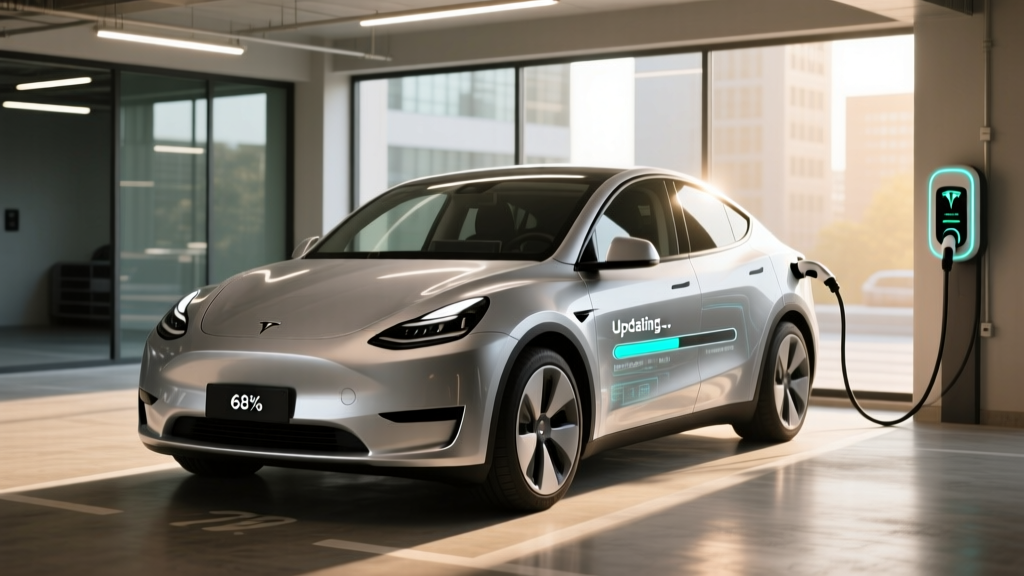
If you own a Tesla or are considering one, over-the-air (OTA) software updates are a core part of the ownership experience. In 2026, a typical Tesla OTA update takes between 25 and 45 minutes to install once the download is complete. Major version updates (like a full FSD Supervised branch change or a holiday release) can stretch to 60–90 minutes, while minor patches may finish in under 20 minutes.
The process has two distinct phases:
- Download phase: The update file (typically 1–4 GB) downloads over Wi-Fi in the background while you drive or while the car is parked. This can take 30 minutes to several hours depending on your network speed. Tesla strongly prefers Wi-Fi; cellular downloads are throttled and may take days for large packages.
- Installation phase: Once downloaded, the car must be parked, in Park, and not actively charging. The vehicle reboots its computers, flashes new firmware to multiple ECUs, and recalibrates systems. This is the 25–90 minute window where the car is unusable — the touchscreen stays black or shows a progress bar, and you cannot drive or charge.
2026 Tesla Model Y: Full Review & Specs
While Tesla's software update cadence is a major ownership differentiator, the hardware underneath matters just as much. The 2026 Tesla Model Y Long Range AWD remains Tesla's volume seller and one of the most capable electric crossovers on the market. Here's a complete breakdown.
| Spec | Value |
|---|---|
| EPA Range | 320 miles |
| Battery Capacity | ~75 kWh usable (NMC chemistry) |
| Max DC Fast Charge | 250 kW peak |
| 10–80% DC Charge Time | ~27 minutes |
| Level 2 Home Charging | 11.5 kW (44 mi/hr) |
| 0–60 mph | 4.8 seconds |
| Horsepower | 384 hp (dual motor) |
| Drivetrain | AWD (dual motor) |
| MPGe (combined) | 117 MPGe (29 kWh/100 mi) |
| Cargo Volume | 76.2 cu ft (rear seats folded), 30.2 cu ft behind 2nd row |
| Base MSRP | $44,990 |
| Battery Warranty | 8 years / 120,000 miles (min 70% retention) |
Real-World Range: What to Actually Expect
EPA sticker: 320 miles
Real-world highway (70 mph, moderate temps): ~265–285 miles
Cold weather (below 32°F, highway): ~220–250 miles
City / mixed commuting: ~290–310 miles
The EPA's 320-mile estimate for the Model Y Long Range assumes a mix of city and highway driving at moderate temperatures. In practice, highway driving at 70–80 mph consumes significantly more energy due to aerodynamic drag — expect a 10–15% reduction from the sticker. Cold weather compounds this: battery internal resistance increases, cabin heating draws power (the Model Y uses a heat pump, which helps but doesn't eliminate the penalty), and regenerative braking is limited until the battery warms up.
For a 300-mile road trip in summer conditions, you'll likely arrive with 30–50 miles of buffer. In winter, plan a charging stop at the 200-mile mark to stay comfortable. The Model Y's navigation system is generally accurate at predicting remaining charge at your destination when using the built-in route planner.
Charging Speed: DC Fast, Level 2, and the Charge Curve
| Level | Power (kW) | Miles Added per Hour | Notes |
|---|---|---|---|
| Level 1 (120V) | ~1.4 kW | ~3–4 mi/hr | Emergency only; 80+ hours for full charge |
| Level 2 (240V, 48A) | 11.5 kW | ~44 mi/hr | Full charge in ~7 hours; ideal home setup |
| DC Fast (V3 Supercharger) | 250 kW peak | ~1,000 mi/hr (at peak) | 10–80% in ~27 min; tapers sharply above 80% |
The Model Y's 250 kW peak DC fast-charge rate is achieved only under ideal conditions: battery preconditioned (the car does this automatically when navigating to a Supercharger), state of charge (SoC) below 20%, and ambient temperatures above 50°F. The charge curve is the critical detail most spec sheets omit — the car pulls peak power only between roughly 5% and 35% SoC, then steps down progressively. From 80% to 100%, charging slows to under 30 kW, which is why Tesla (and every experienced EV owner) recommends charging to 80% on road trips unless you absolutely need the last 20%.
At home on a Level 2 Wall Connector (48 amps / 11.5 kW), a full overnight charge adds roughly 44 miles of range per hour. Most owners who plug in nightly never visit a gas station or think about "filling up" — you simply wake up with a full battery every morning.
Performance, Efficiency, and Daily Practicality
The dual-motor AWD powertrain produces 384 hp and launches the Model Y to 60 mph in 4.8 seconds. That's quick enough to merge onto any highway with authority, though the Performance trim (3.5 seconds, ~$52,990) exists for enthusiasts. The single-motor RWD variant (~$39,990) trades AWD traction and 30+ miles of range for a lower entry price.
Efficiency is a Tesla strong suit. At 29 kWh per 100 miles (117 MPGe combined per fueleconomy.gov), the Model Y extracts more miles per kilowatt-hour than most competitors. This matters for your electricity bill: at the US average residential rate of ~$0.16/kWh, a full 75 kWh charge costs roughly $12 — versus $45–55 for a comparable gas crossover at 25 MPG and $3.50/gallon.
Interior space is generous for the segment. With 30.2 cubic feet behind the second row and 76.2 cubic feet with seats folded, the Model Y handles Costco runs and camping gear without issue. Rear legroom measures 41.6 inches — enough for adults on long trips. The front trunk (frunk) adds 4.1 cubic feet for charging cables or a small bag.
Pricing, Tax Credits, and Ownership Cost
| Trim | MSRP | Under §30D MSRP Cap? | Potential Credit |
|---|---|---|---|
| Long Range RWD | $39,990 | Yes ($80,000 cap for SUVs) | Up to $7,500* |
| Long Range AWD | $44,990 | Yes | Up to $7,500* |
| Performance AWD | $52,990 | Yes | Up to $7,500* |
*Federal EV tax credit eligibility under IRS §30D depends on multiple factors that change frequently:
- Buyer income caps: Modified AGI must not exceed $300,000 (joint), $225,000 (head of household), or $150,000 (individual).
- MSRP caps: Vans/SUVs/pickups must be under $80,000; sedans under $55,000. All Model Y trims qualify.
- Battery sourcing: The credit splits into two $3,750 halves — one for critical minerals sourcing, one for battery component manufacturing. Tesla's US-built battery packs have historically met both requirements, but supply chain shifts can alter eligibility month to month.
- Point-of-sale transfer: As of 2024+, you can transfer the credit to the dealer at purchase, reducing your out-of-pocket cost immediately rather than waiting for tax filing.
Always verify current eligibility on the IRS website or with a tax professional before relying on the credit in your purchase decision.
Tech, Driver Assistance, and the Software Experience
The Model Y's 15.4-inch touchscreen controls virtually every vehicle function — climate, mirrors, glovebox, and drive settings. The interface is responsive and well-organized, though the lack of physical buttons for turn signals (now on a stalk in 2026 models after Tesla reversed its earlier decision) and wipers can frustrate new owners during the learning curve.
Autopilot (included) provides adaptive cruise control and lane centering — a solid SAE Level 2 driver-assist system. Full Self-Driving (Supervised), available as an $8,000 option or $99/month subscription, adds automatic lane changes, traffic light recognition, and city street navigation. Despite the name, FSD Supervised remains Level 2: you must keep your hands on the wheel and eyes on the road at all times. It is not autonomous driving.
Back to software updates: Tesla pushes OTA improvements roughly every 2–4 weeks, ranging from UI tweaks and new games to meaningful efficiency gains and Autopilot refinements. This continuous improvement model is a genuine differentiator — your car can gain features after purchase that didn't exist when you bought it. However, it also means the interface changes periodically, which some owners find disorienting.
Pros, Cons, and Who Should Buy the Model Y
- Class-leading efficiency (29 kWh/100 mi)
- Supercharger network reliability
- Spacious cargo area (76.2 cu ft)
- Continuous OTA software improvements
- Strong resale value relative to EV segment
- Heat pump standard for cold-weather efficiency
- Minimalist interior lacks physical controls
- FSD is expensive and still requires full supervision
- Insurance premiums often 20–40% higher than comparable gas SUVs
- Ride quality is firm on broken pavement
- Service center wait times can be lengthy in some regions
- No Apple CarPlay / Android Auto
Who the Model Y suits best: Daily commuters with home charging access, small families needing cargo versatility, and road-trippers who value the Supercharger network's reliability. If you drive 30–60 miles daily and can install a Level 2 charger at home, the Model Y's operating cost advantage over gas crossovers is substantial — roughly $600–$800/year in fuel savings alone.
Consider alternatives if: You prioritize a plush, quiet ride (the Hyundai Ioniq 5 or BMW iX are more refined), need third-row seating, or want Apple CarPlay integration. The Ford Mustang Mach-E and Chevrolet Equinox EV offer competitive range at lower price points, though neither matches the Supercharger ecosystem.
Frequently Asked Questions
Can I drive my Tesla while a software update is downloading?
Yes. The download phase happens in the background over Wi-Fi (or slowly over cellular) while the car is fully operational. You only lose access during the installation phase, which begins after the download completes and you approve it (or it auto-schedules overnight).
What happens if the power goes out during a Tesla update?
Tesla's update system is designed with fail-safes. If power is lost during installation, the car will typically resume or roll back safely when power returns. However, it's best practice to ensure your car has at least 20% battery before starting an update, and avoid unplugging during installation.
Does the Model Y qualify for the full $7,500 federal tax credit in 2026?
All Model Y trims fall under the $80,000 SUV MSRP cap. Whether you receive the full $7,500 depends on your income (AGI limits apply), and Tesla's current battery sourcing compliance with §30D critical-mineral and component-manufacturing rules. Check the IRS clean vehicle credit page for the latest eligibility list before purchasing.
How does the Model Y's real-world range compare to the Hyundai Ioniq 5?
The 2026 Ioniq 5 Long Range AWD carries an EPA rating of ~305 miles. In real-world highway testing, both vehicles deliver roughly 260–280 miles in moderate temperatures. The Model Y holds a slight efficiency edge (29 vs. ~31 kWh/100 mi), but the Ioniq 5 charges faster at 350 kW-capable stations (10–80% in ~18 minutes vs. ~27 minutes for the Model Y).
Is the Tesla Supercharger network really better than other charging networks?
In reliability metrics, yes. Tesla's Supercharger network consistently reports 95%+ uptime at individual stalls, while third-party networks like Electrify America and EVgo have historically struggled with broken chargers and payment friction. The gap has narrowed as non-Tesla EVs gain Supercharger access via NACS adapters, but for Tesla owners, the seamless plug-and-charge experience remains a significant ownership advantage.