Tesla's decision to rebuild its infotainment stack on Epic Games' Unreal Engine has generated outsized attention since the transition began rolling out across 2025-2026 production vehicles. The "Tesla Unreal Engine" update isn't a new car — it's a ground-up software overhaul touching visualization, navigation rendering, and the instrument cluster experience. But for buyers evaluating a 2026 Model 3 or Model Y, the real question isn't what's on the screen. It's whether the underlying vehicle still delivers on range, charging speed, and value.
This review covers the current 2026 Tesla Model 3 Long Range AWD — the volume trim most buyers cross-shop — with notes on how the Unreal Engine interface changes the ownership experience and where it doesn't.
2026 Model 3 Long Range: Core Specs at a Glance
| Attribute | 2026 Model 3 Long Range AWD |
|---|---|
| EPA Range | 341 miles |
| Battery (usable) | ~79 kWh, NMC (Nickel Manganese Cobalt) |
| Efficiency | 132 MPGe combined / 25 kWh per 100 mi |
| Max DC Fast Charge | 250 kW peak (V3 Supercharger) |
| 10–80% DCFC Time | ~25 minutes (preconditioned) |
| Level 2 Home Charging | 11.5 kW / ~44 mi/hr (48A Wall Connector) |
| 0–60 mph | 4.2 seconds |
| Horsepower | ~346 hp (dual motor combined) |
| Drivetrain | Dual-motor AWD |
| Cargo Volume | 23 cu ft (rear trunk) + ~3 cu ft (frunk) |
| Rear Legroom | 35.2 inches |
| Battery Warranty | 8 years / 120,000 miles (min 70% retention) |
| Base MSRP | $47,740 (before destination) |
Real-World Range: What the EPA Number Doesn't Tell You
Real-World Highway (70 mph, 72°F): ~285–305 miles
Real-World Highway (32°F, no heat pump pre-conditioning): ~230–260 miles
City/Commuter (mixed stop-and-go, mild climate): ~320–340 miles
The Model 3 Long Range's 341-mile EPA figure remains competitive in 2026, but as with every EV, real-world results depend heavily on speed, temperature, and terrain. Tesla's heat pump — standard since the 2021 refresh — mitigates cold-weather losses better than most competitors, but highway driving at 75+ mph still cuts range by 10–15% versus the sticker. In sub-freezing conditions without active preconditioning, expect a 20–30% reduction.
According to fueleconomy.gov, the Model 3 LR achieves 132 MPGe combined, translating to roughly 25 kWh per 100 miles — among the most efficient AWD sedans in its class. That efficiency is the real reason the car goes as far as it does on a sub-80 kWh pack.
Charging Speed: DC Fast, Level 2, and the Supercharger Advantage
| Charging Method | Max Rate | Speed (approx.) | Notes |
|---|---|---|---|
| DC Fast (V3 Supercharger) | 250 kW peak | ~170 mi in 15 min | Peak rate holds to ~50% SoC, then tapers |
| DC Fast (CCS via adapter) | ~150–200 kW | Varies by station | Tesla CCS adapter included; third-party networks improving |
| Level 2 (Tesla Wall Connector, 48A) | 11.5 kW | ~44 mi/hr | Full charge in ~7–8 hours |
| Level 2 (Generic J1772 via adapter) | Up to 11.5 kW | ~30–44 mi/hr | Depends on station amperage |
| Level 1 (120V household) | ~1.4 kW | ~3–4 mi/hr | Emergency/trickle only |
The 250 kW peak rate on V3 Superchargers is genuinely useful, but peak ≠ sustained. The charge curve holds near 250 kW up to roughly 40–50% state of charge, then progressively tapers. A 10–80% session takes approximately 25 minutes when the battery is properly preconditioned (the car does this automatically when you navigate to a Supercharger). Without preconditioning — say, pulling into a charger cold — that same session can stretch to 35+ minutes.
Tesla's NACS connector is now the de facto North American standard, with Ford, GM, Rivian, and others adopting it through 2025–2026. The practical upshot: Supercharger network access, long Tesla's strongest ownership advantage, is no longer exclusive. But Tesla owners still benefit from the most seamless plug-and-charge experience on the network.
The Unreal Engine Infotainment Overhaul: Substance or Gimmick?
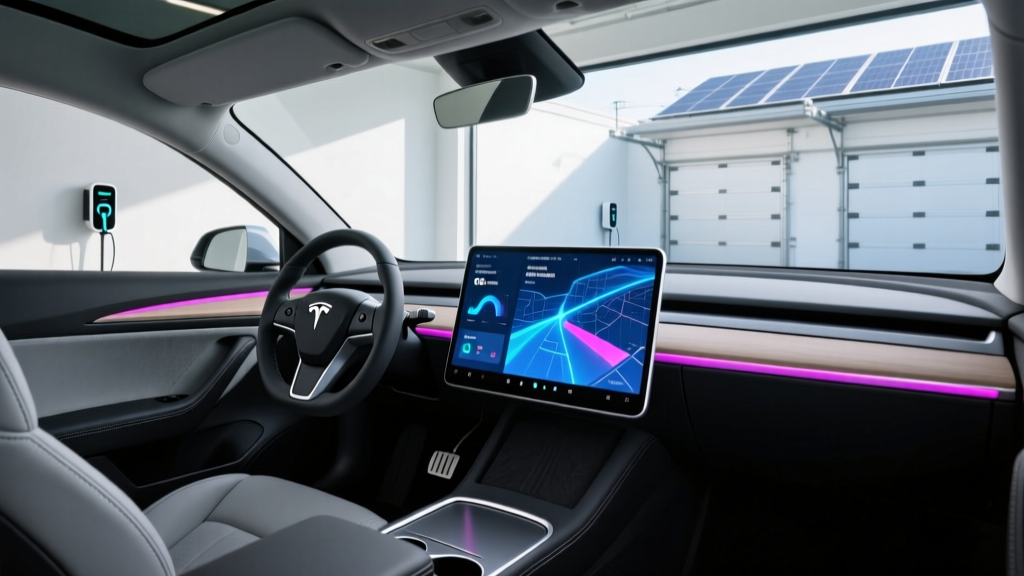
Starting with late-2024 production and expanding through the 2026 model year, Tesla began migrating its instrument cluster and visualization pipeline to Unreal Engine 5. The results are visually obvious: the 3D vehicle model on screen now renders with realistic lighting, reflections, and real-time environmental context. Turn signals, wipers, and door state animate fluidly. Navigation maps render with 3D terrain and building detail that rivals dedicated automotive nav systems.
But the functional improvements matter more than eye candy:
- Instrument cluster responsiveness: Speed, range, and Autopilot visualization update with minimal latency — a genuine improvement over the previous Chromium-based rendering pipeline.
- Navigation context: The Unreal-powered map shows lane markings, highway exits, and surrounding vehicles in a way that reduces cognitive load during Autopilot use.
- Energy app integration: Real-time consumption graphs now overlay directly on the route visualization, making range planning more intuitive.
The drawback? The transition has introduced occasional bugs — delayed widget rendering on cold boot, rare map freezes requiring a scroll-wheel reboot. Tesla's OTA update cadence (roughly every 2–4 weeks) has been addressing these, but early-adopter friction is real. The previous interface, while visually dated, was extremely stable.
Autopilot and FSD: Still Level 2, Still Requires Your Attention
Driver Requirement: Hands on wheel or eyes on road at all times. The system does NOT drive itself.
FSD (Supervised): Despite the name, Full Self-Driving remains a Level 2 driver-assist feature. Level 4 (true driverless) is only available in limited robotaxi services like Waymo.
Tesla's Autopilot comes standard and handles highway lane-keeping and adaptive cruise competently. FSD (Supervised), a $8,000 add-on or $99/month subscription in 2026, extends capability to city streets, traffic-light recognition, and autonomous turns. In practice, FSD handles 85–90% of suburban driving scenarios well, but still requires intervention for construction zones, unusual lane markings, and unprotected left turns in heavy traffic.
The Unreal Engine visualization enhances FSD's perceived reliability by showing you exactly what the car "sees" — detected vehicles, pedestrians, lane boundaries — rendered in real time. This transparency builds appropriate trust, but it should never replace active supervision.
Pricing, Trims, and Federal Tax Credit Eligibility
| Trim | Base MSRP | Destination | Total Before Credit | Est. After §30D Credit |
|---|---|---|---|---|
| Model 3 RWD | $38,990 | $1,390 | $40,380 | ~$32,880* |
| Model 3 Long Range AWD | $47,740 | $1,390 | $49,130 | ~$41,630* |
| Model 3 Performance | $54,990 | $1,390 | $56,380 | ~$48,880* |
*Credit estimates assume full $7,500 §30D eligibility. Actual credit depends on buyer income, battery sourcing, and MSRP caps. See IRS.gov §30D guidelines for current-year rules.
Key §30D eligibility points for 2026:
- MSRP cap: Sedans must be under $55,000. The Model 3 RWD and Long Range qualify; the Performance trim may exceed the cap depending on options.
- Income cap: Adjusted gross income must not exceed $150,000 (single) / $300,000 (joint) / $225,000 (head of household).
- Battery sourcing: Critical minerals and battery components must meet phased-in domestic/free-trade-agreement thresholds. Tesla's Nevada and Texas battery production has largely met these requirements for Model 3, but buyers should verify VIN eligibility at the point of sale.
- Point-of-sale transfer: As of 2024, the credit can be transferred to the dealer at purchase, reducing your out-of-pocket cost immediately rather than waiting for tax filing.
Who Should Buy the 2026 Model 3 Long Range?
- You have reliable home Level 2 charging and want minimal public-charging dependence
- Real-world range above 280 miles on highway road trips is a priority
- You value Supercharger network seamlessness and NACS-native access
- You want a tech-forward infotainment experience and accept early-adopter software friction
- You prefer physical controls, Apple CarPlay/Android Auto, or a traditional dealer service experience
- Rear-seat comfort and headroom are top priorities (Model 3's sloping roofline compromises taller passengers)
- You want a more conservative, proven infotainment platform
Pros and Cons: The Honest Summary
- Class-leading efficiency (25 kWh/100mi) translates to real range on a modest battery
- 250 kW Supercharger access with seamless plug-and-charge
- Unreal Engine UI is visually superior and functionally improved over prior Tesla software
- Strong OTA update cadence adds features post-purchase
- 8-yr/120,000-mi battery warranty with 70% retention floor
- Qualifies for full $7,500 federal credit (verify VIN + income)
- No Apple CarPlay or Android Auto — Tesla's ecosystem is walled-garden
- Rear seat headroom tight for passengers over 6'0"
- Unreal Engine transition has introduced occasional software bugs
- FSD (Supervised) remains Level 2 — not autonomous despite marketing
- Service center availability still inconsistent in rural markets
- Insurance premiums run 15–25% higher than comparable ICE sedans
Frequently Asked Questions
What is the real-world range of the 2026 Tesla Model 3 Long Range?
Expect 285–305 miles on the highway in mild weather, dropping to 230–260 miles in freezing conditions. City driving with regenerative braking can approach or match the 341-mile EPA sticker.
How fast does the Model 3 charge at home and on road trips?
On a Tesla Wall Connector (48A, Level 2), you'll add roughly 44 miles per hour — a full overnight charge in 7–8 hours. On a V3 Supercharger, 10–80% takes about 25 minutes with battery preconditioning.
Does the 2026 Model 3 qualify for the $7,500 federal EV tax credit?
The RWD and Long Range trims generally qualify, subject to buyer income caps ($150K single / $300K joint), MSRP caps ($55K for sedans), and battery-sourcing requirements. Verify your VIN's eligibility at the point of sale or via the IRS Clean Vehicle portal.
What does the Tesla Unreal Engine update actually change?
It replaces the previous Chromium-based rendering pipeline with Unreal Engine 5 for the instrument cluster, vehicle visualization, and navigation maps. The result is smoother animations, realistic 3D rendering, and better real-time FSD visualization — with some early-adopter bugs being resolved via OTA updates.
Is the Model 3 Long Range worth buying over the Hyundai Ioniq 6 or BMW i4?
The Model 3 wins on efficiency, Supercharger access, and software features. The Ioniq 6 offers comparable range with 800V charging (faster peak speeds on compatible chargers) and CarPlay support. The BMW i4 provides a more traditional luxury interior and dealer service network. Your priority — tech ecosystem vs. comfort vs. charging flexibility — should drive the decision.
How long will the Model 3 battery last?
Tesla warranties the battery for 8 years or 120,000 miles, whichever comes first, with a minimum 70% capacity retention guarantee. Real-world degradation data from fleet operators suggests NMC packs in the Model 3 lose roughly 8–12% capacity over the first 100,000 miles, with the curve flattening significantly after year 3.
The 2026 Model 3 Long Range remains one of the most efficient, capable, and well-supported electric sedans available. The Unreal Engine infotainment overhaul is a genuine differentiator for tech-oriented buyers, though it comes with the caveat of ongoing software maturation. If your charging situation is solid and your priorities align with Tesla's ecosystem approach, it's a compelling package — especially with the $7,500 federal credit bringing effective pricing well under $42,000 for the Long Range.