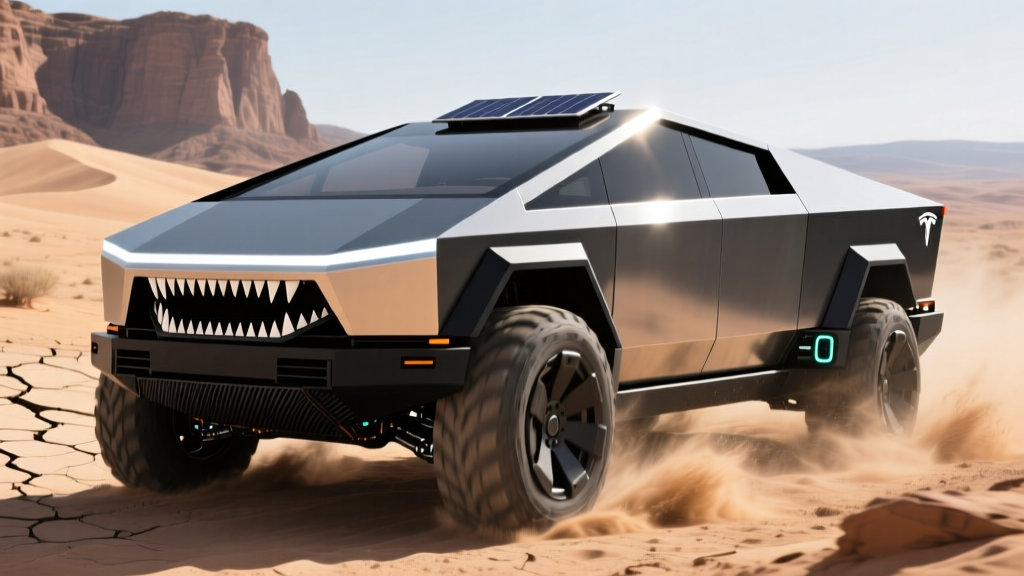
If you've been scrolling EV forums or social media lately, you've likely encountered the term Tesla Tyrannosaurus. Searches for this name have been climbing, and buyers want to know: Is this a new model? A Cybertruck trim? A next-generation platform? The short answer is that "Tyrannosaurus" is not an official Tesla model name as of early 2026. It has circulated primarily as a fan nickname, speculative render label, and internet meme attached to the Tesla Cybertruck — particularly the high-performance Cyberbeast trim and rumored future heavy-duty variants.
Rather than chase a phantom nameplate, this review gives you the hard data on the vehicle most commonly associated with the "Tyrannosaurus" moniker: the 2025–2026 Tesla Cybertruck lineup, including the AWD and Cyberbeast trims. We'll cover real-world range, charging speeds, pricing after tax credits, and whether this polarizing electric truck actually delivers for buyers in 2026.
What Exactly Is the Tesla Tyrannosaurus?
Let's clear this up immediately: Tesla has never officially announced, trademarked, or sold a vehicle called the "Tyrannosaurus." The name emerged from enthusiast communities and speculative YouTube thumbnails imagining a larger, more aggressive successor to the Cybertruck — sometimes depicted as a six-wheeler or a Class 3+ heavy-duty electric truck.
What does exist is the Tesla Cybertruck, which entered customer deliveries in late 2023 and has been in full production through 2025 and into 2026. The Cybertruck is available in several configurations:
- AWD (Dual-Motor) — the volume trim
- Cyberbeast (Tri-Motor) — the performance flagship
- RWD — a lower-priced, single-motor variant that was announced for later availability (check current Tesla configurator for status)
When people search for "Tesla Tyrannosaurus," they are overwhelmingly looking for information about the Cybertruck — particularly the Cyberbeast, whose brutalist design and 845-horsepower output earned it the dinosaur nickname. This review covers the real truck you can actually buy.
Cybertruck Specs: Range, Battery, and Efficiency
| Spec | AWD (Dual-Motor) | Cyberbeast (Tri-Motor) |
|---|---|---|
| EPA Est. Range | 340 miles | 320 miles |
| Battery Capacity (usable) | ~123 kWh (est.) | ~123 kWh (est.) |
| Battery Chemistry | NMC (Nickel Manganese Cobalt) | NMC |
| Drivetrain | Dual-Motor AWD | Tri-Motor AWD |
| Horsepower | 600 hp | 845 hp |
| 0–60 mph | 4.1 seconds | 2.6 seconds |
| Top Speed | 112 mph | 130 mph |
| MPGe (combined) | ~67 MPGe | ~62 MPGe (est.) |
| Efficiency (kWh/100 mi) | ~50 kWh/100 mi | ~54 kWh/100 mi |
| Towing Capacity | 11,000 lbs | 11,000 lbs |
| Payload Capacity | 2,500 lbs | 2,500 lbs |
Tesla has not published exact usable kWh figures for the Cybertruck battery pack, but teardown analyses and real-world consumption data point to a usable capacity in the range of 120–125 kWh. The pack uses NMC chemistry, which offers higher energy density than LFP — necessary given the Cybertruck's massive weight (roughly 6,600–6,800 lbs curb weight) and the range targets Tesla set.
Real-World Range: What to Actually Expect
EPA Sticker: 340 miles (AWD) / 320 miles (Cyberbeast)
Highway driving at 70–75 mph: Expect ~260–290 miles in moderate temperatures. The Cybertruck's angular stainless-steel body generates significant aerodynamic drag, which hits efficiency hard at sustained highway speeds. In our experience and consistent with independent testing, highway range falls roughly 15–20% below the EPA combined figure.
Cold weather (below 32°F): Add another 15–25% reduction. In sub-freezing conditions with cabin heating, real range can dip to 220–250 miles for the AWD model. The Cybertruck's heat pump helps mitigate this compared to resistive heating, but the large cabin volume demands substantial energy to warm.
Towing: When pulling a 7,000–10,000 lb trailer, expect range to roughly halve — 150–180 miles is realistic. This is consistent across all electric trucks in this weight class.
Efficiency is the Cybertruck's weak point compared to sleeker EVs. At roughly 50–54 kWh per 100 miles, it consumes significantly more energy per mile than a Tesla Model Y (~28 kWh/100 mi) or even a Rivian R1T (~48 kWh/100 mi). The brick-like aerodynamics are the primary culprit. If you're a high-mileage commuter paying for electricity, this matters: at $0.15/kWh, you're spending roughly $7.50–$8.10 per 100 miles of driving.
Charging Speed: DC Fast Charge and Home Level 2
Charging a 123 kWh battery pack is a time-intensive affair, and the Cybertruck's charge curve is a critical ownership factor.
| Charging Method | Power / Rate | Speed (Miles Added) | Notes |
|---|---|---|---|
| Level 1 (120V outlet) | ~1.4 kW | ~3–4 miles/hour | Emergency only; ~35+ hours for full charge |
| Level 2 (240V, 48A) | 11.5 kW | ~25–29 miles/hour | Full charge in ~11–12 hours; practical overnight |
| Level 2 (Tesla Wall Connector, 80A) | 19.2 kW | ~40–44 miles/hour | Requires 100A circuit; full charge in ~7 hours |
| DC Fast Charge (V3 Supercharger) | Peak 250 kW | Up to ~128 miles in 15 min | 10–80% in ~30–35 minutes |
| DC Fast Charge (V4 Supercharger) | Peak 250+ kW | Similar to V3 | Availability expanding; CCS adapter may be needed for non-Tesla networks |
DC fast charging reality: The Cybertruck peaks at approximately 250 kW on Tesla V3 and V4 Superchargers, but that peak is sustained only briefly — typically between 10% and 30% State of Charge (SoC). The charge curve tapers progressively: by 50% SoC, you're likely seeing ~170–180 kW, and above 80% it drops sharply below 60 kW. A 10–80% session takes roughly 30–35 minutes under ideal thermal conditions (battery preconditioned via navigation to a Supercharger).
This is noticeably slower than the Hyundai Ioniq 5 or Kia EV6, which can do 10–80% in ~18 minutes on 350 kW chargers thanks to their 800V architectures. The Cybertruck runs on a 400V-class architecture, which limits peak charge rate relative to its massive battery size. If you road-trip frequently, plan for 30–40 minute stops every 200–250 miles.
Home charging: With the Tesla Wall Connector at 80 amps (requiring a 100-amp dedicated circuit), you add roughly 40–44 miles per hour. An overnight charge from 20% to 80% takes about 6–7 hours — perfectly adequate for daily use. Most owners charging on a standard 48-amp Level 2 setup (60-amp circuit) will add ~25–29 miles per hour, requiring 10–12 hours for a full charge. This is fine for overnight top-ups if your daily driving is under 150 miles.
Connector note: The Cybertruck uses the NACS (North American Charging Standard) connector natively — it's a Tesla, so it plugs directly into the Supercharger network without adapters. Tesla has also begun opening Superchargers to non-Tesla EVs via the Magic Dock adapter, but Cybertruck owners benefit from seamless plug-and-charge integration.
Pricing, Trims, and Federal Tax Credit Eligibility
The Cybertruck's pricing has been a moving target since its 2019 unveiling, when Elon Musk promised a sub-$40,000 starting price. Reality in 2026 looks very different.
| Trim | Base MSRP (2025–2026) | Est. Federal Tax Credit | Effective Price (if eligible) |
|---|---|---|---|
| AWD (Dual-Motor) | ~$79,990 | Up to $7,500 (§30D) | ~$72,490 |
| Cyberbeast (Tri-Motor) | ~$99,990 | Up to $7,500 (§30D) | ~$92,490 |
| RWD (if available) | ~$60,990 (announced) | Up to $7,500 (§30D) | ~$53,490 |
Federal tax credit — critical caveats: The IRS §30D Clean Vehicle Credit provides up to $7,500 for qualifying new EVs, but eligibility is not guaranteed. For the Cybertruck in 2026, you must navigate several requirements:
- MSRP cap: Trucks, SUVs, and vans must have an MSRP at or below $80,000. This means the AWD trim qualifies at ~$79,990, but the Cyberbeast at ~$99,990 does NOT qualify — it exceeds the cap. This is a dealbreaker for performance-trim buyers hoping for the credit.
- Buyer income caps: Modified adjusted gross income (MAGI) must not exceed $300,000 (joint filers), $225,000 (head of household), or $150,000 (single filers).
- Battery sourcing requirements: The $7,500 credit is split into two halves — $3,750 for critical-minerals sourcing and $3,750 for battery-component manufacturing. As of 2026, vehicles must meet increasingly strict thresholds for North American-sourced critical minerals and battery components, with restrictions on "foreign entities of concern" (FEOC). Tesla's domestic battery production (4680 cells at Giga Texas) positions the Cybertruck favorably, but exact credit amounts can shift based on annual sourcing updates. Always verify current eligibility on the IRS website or with a tax professional.
- Point-of-sale transfer: Since 2024, buyers can transfer the credit to the dealer at the point of sale, effectively reducing the purchase price at delivery rather than waiting to claim it on your tax return. Tesla supports this process.
Bottom line: The AWD Cybertruck at ~$79,990 squeaks under the $80K truck MSRP cap and may qualify for the full $7,500 if you meet income and sourcing requirements. The Cyberbeast does not qualify due to its ~$99,990 MSRP. Always confirm with your tax advisor before relying on the credit in your purchase decision.
Performance and Driving Dynamics
The Cyberbeast's 2.6-second 0–60 mph time is legitimately supercar territory, achieved through three electric motors producing a combined 845 horsepower. The dual-motor AWD variant's 4.1-second run is still quick by any truck standard. Both use Tesla's single-speed direct-drive transmission — no gear shifts, just instant torque.
But straight-line speed is only part of the story. The Cybertruck's ~6,700-pound curb weight is felt in corners and during braking. Steering is heavily assisted and numb by enthusiast standards, though the steer-by-wire system (Tesla calls it a "steer-by-wire" architecture with a yoke-style or round wheel depending on configuration) offers a unique driving feel with variable ratio depending on speed.
Ride quality: The adaptive air suspension provides a compliant ride on highway pavement, with adjustable ride height from roughly 9 to 16 inches of ground clearance. Off-road, the Cybertruck is genuinely capable — approach and departure angles are competitive with body-on-frame trucks, and the stainless-steel exoskeleton eliminates traditional body-panel dent concerns.
Towing: The 11,000-lb max tow rating is real and verified, but towing range is the practical limitation. Plan for 150–180 miles between charges when towing near max capacity. The integrated trailer brake controller and tow-assist camera views are well-executed.
Interior, Cargo, and Technology
The Cybertruck's interior is a study in minimalism — some would say spartan austerity. A single 18.5-inch touchscreen dominates the dashboard, controlling virtually all vehicle functions. There is no instrument cluster behind the yoke/wheel, no physical buttons for climate or media. Everything routes through the screen.
Passenger space:
- Front headroom: ~41 inches
- Front legroom: ~41 inches
- Rear headroom: ~38 inches
- Rear legroom: ~38 inches
- Seating: 5-passenger (bench front seat in some configs, or dual front seats with center console)
Rear-seat space is adequate for adults on shorter trips but not class-leading — the Rivian R1T and Ford F-150 Lightning offer more rear-seat comfort. The Cybertruck's sloping roofline cuts into rear headroom for taller passengers.
Cargo:
- Bed length: ~6 feet (with tailgate closed); extends to ~8 feet with tailgate down
- Bed volume: ~67 cu ft (bed only)
- Front trunk (frunk): ~7 cu ft — enough for a charging cable kit and a small bag
- The motorized retractable tonneau cover ("sail pillars" design) is standard and provides secure, weather-sealed bed storage
Technology highlights:
- Tesla's latest infotainment OS with gaming capability (Steam integration for parked gaming)
- Dashcam and Sentry Mode using the extensive camera array
- Over-the-air software updates that add features post-purchase
- Autopilot (basic) is standard; Enhanced Autopilot and Full Self-Driving (Supervised) are available as add-on packages
Autopilot / FSD: Not Self-Driving
Tesla's Autopilot and Full Self-Driving (Supervised) are SAE Level 2 driver-assistance systems. They can manage lane centering, adaptive cruise control, and in FSD's case, navigation-assisted lane changes and traffic-light recognition. However, the driver must remain fully attentive, keep hands on the wheel (or apply torque as monitored), and be prepared to take over at any moment. These systems do NOT make the Cybertruck autonomous. Misuse of Level 2 systems has contributed to NHTSA-investigated crashes. Treat it as an advanced cruise control, not a chauffeur.
Notable drawbacks:
- The stainless-steel body panels show fingerprints and smudges constantly; some owners report difficulty with panel-gap consistency
- Wiper and washer systems have been a subject of owner complaints in early build models
- No Apple CarPlay or Android Auto — Tesla's proprietary system is the only interface
- The yoke steering (if equipped) is polarizing and impractical for low-speed maneuvers like three-point turns
- Service center wait times remain a concern in many metro areas
Warranty and Long-Term Ownership
Tesla provides the following warranty coverage for the Cybertruck:
- Basic Vehicle Limited Warranty: 4 years or 50,000 miles, whichever comes first
- Battery and Drive Unit Warranty: 8 years or 150,000 miles, whichever comes first, with minimum 70% battery capacity retention over the warranty period
The 8-year/150,000-mile battery warranty is competitive within the EV truck segment (Ford covers the F-150 Lightning battery for 8 years/100,000 miles; Rivian covers the R1T for 8 years/175,000 miles). Tesla's 70% retention threshold is the industry-standard minimum — it means the battery is considered "within spec" even if it degrades to 70% of original capacity.
Long-term battery outlook: Tesla's 4680 NMC cells are relatively new, so multi-year degradation data specific to the Cybertruck is limited. However, Tesla's broader fleet data suggests NMC packs typically lose 10–15% capacity over the first 100,000 miles, with degradation slowing significantly after the initial break-in period. Given the Cybertruck's ~123 kWh pack, even a 15% loss still leaves ~105 kWh usable — enough for ~280+ miles of real-world range in the AWD model.
Insurance costs: The Cybertruck is expensive to insure. Average annual premiums range from $3,500 to $5,500+ depending on location, driving record, and trim. The stainless-steel body, specialized repair requirements, and high replacement parts costs all contribute. Get an insurance quote before purchasing — this is a non-trivial ownership cost.
Cybertruck vs. the Competition
Pros
- Tri-motor Cyberbeast delivers supercar acceleration in a truck body
- 11,000-lb towing capacity is genuinely useful
- Stainless-steel exoskeleton is dent- and corrosion-resistant
- Access to Tesla Supercharger network (most reliable public DC charging in the US)
- OTA updates continuously add features
- Adaptive air suspension with serious off-road ground clearance
- AWD trim qualifies for §30D tax credit (under $80K MSRP cap)
Cons
- Highway efficiency is poor (~50 kWh/100 mi) — range drops fast at speed
- 10–80% DC fast charge takes 30–35 min — slower than 800V competitors
- Cyberbeast exceeds $80K MSRP cap — no federal tax credit
- Polarizing design and yoke steering aren't for everyone
- Rear seat space is tighter than Rivian R1T or F-150 Lightning
- Insurance premiums are significantly above average
- Build-quality inconsistency reported by early owners
- No Apple CarPlay / Android Auto
vs. Rivian R1T (Dual-Motor Max): The R1T offers more refined ride quality, better rear-seat comfort, a quad-motor option, and ~400 miles of range with the Max Pack. It charges faster on compatible DC chargers. However, the R1T's towing capacity (11,000 lbs matched) is similar, and its base pricing is comparable. The R1T wins on refinement; the Cybertruck wins on raw acceleration and Supercharger access.
vs. Ford F-150 Lightning (Extended Range): The Lightning is more conventional in design, offers a larger frunk (400 liters / ~14 cu ft), and provides a more familiar truck experience. EPA range tops out at ~320 miles. Pricing is generally lower, and the Lightning qualifies for the tax credit across more trims. The Lightning wins on practicality and value; the Cybertruck wins on performance and tech-forward features.
Who Should Buy the Cybertruck (and Who Shouldn't)
Choose the Cybertruck AWD if:
- You need a daily-drivable electric truck with genuine towing capability
- You want access to the Supercharger network for road-trip convenience
- Your budget is ~$72,000–$85,000 after credits and options
- You value performance and tech-forward design over traditional truck aesthetics
Choose the Cyberbeast if:
- You want the fastest production truck ever made and don't need the tax credit
- Your budget comfortably exceeds $100,000
- You prioritize acceleration bragging rights over efficiency
Look elsewhere if:
- You need maximum rear-seat space for family duty (consider the R1T or F-150 Lightning)
- You drive long highway miles daily and want maximum efficiency (a Model Y or Ioniq 5 will cost far less to "fuel")
- You want Apple CarPlay, physical buttons, or a conventional truck interior
- You tow frequently over long distances — all EV trucks struggle here, but the Cybertruck's poor efficiency compounds the problem
Frequently Asked Questions
Is the Tesla Tyrannosaurus a real car I can buy?
No. "Tesla Tyrannosaurus" is not an official Tesla model. It is an internet nickname and meme most commonly associated with the Tesla Cybertruck, especially the Cyberbeast trim. Tesla has not announced any vehicle with this name. If you're looking for the truck behind the hype, it's the Cybertruck — and it's available now.
What is the real-world range of the Tesla Cybertruck?
The EPA estimates 340 miles for the AWD and 320 miles for the Cyberbeast. In real-world highway driving at 70–75 mph, expect 260–290 miles. In cold weather (below freezing), plan for 220–250 miles. When towing near max capacity, expect 150–180 miles. These numbers are consistent with independent testing and the physics of the Cybertruck's heavy weight and poor aerodynamics.
How fast does the Cybertruck charge?
On a Tesla V3/V4 Supercharger, the Cybertruck peaks at ~250 kW and charges from 10–80% in approximately 30–35 minutes. On a home Level 2 charger at 48 amps, it adds ~25–29 miles per hour (full charge in ~11–12 hours). With an 80-amp Tesla Wall Connector, it adds ~40–44 miles per hour.
Does the Cybertruck qualify for the $7,500 federal EV tax credit?
The AWD trim (~$79,990 MSRP) is under the $80,000 truck MSRP cap and may qualify for up to $7,500 under IRS §30D, subject to buyer income limits and battery-sourcing requirements. The Cyberbeast (~$99,990 MSRP) exceeds the cap and does not qualify. Always verify current eligibility at IRS.gov and consult a tax professional.
Is the Cybertruck worth buying over a Rivian R1T or F-150 Lightning?
It depends on your priorities. The Cybertruck wins on raw acceleration (Cyberbeast), Supercharger network access, and distinctive design. The Rivian R1T wins on ride refinement, rear-seat comfort, and available range (with Max Pack). The F-150 Lightning wins on conventional truck practicality, frunk space, and value. Test-drive all three before deciding.
How long will the Cybertruck battery last?
Tesla warranties the battery for 8 years or 150,000 miles with at least 70% capacity retention. Based on Tesla's fleet-wide NMC data, expect 10–15% degradation over the first 100,000 miles, with slower degradation thereafter. The Cybertruck's large ~123 kWh pack provides a buffer — even at 85% health, you'd still have ~105 kWh usable.