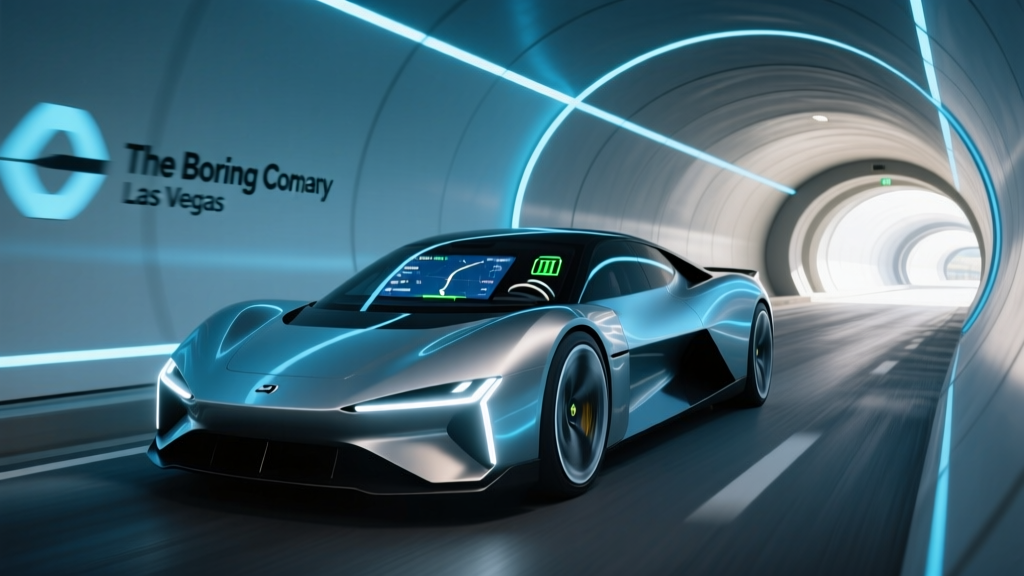
When most people search for Tesla tunnels in Las Vegas, they're looking for the Las Vegas Convention Center (LVCC) Loop — the underground transit system built by Elon Musk's Boring Company that ferries convention attendees between halls in Tesla vehicles. It's not a consumer EV review in the traditional sense, but it's one of the most visible real-world deployments of Tesla vehicles operating in a semi-autonomous, high-frequency transit environment. Here's what the system actually is, what it's like to ride, the Tesla vehicles powering it, and where the network is headed.
What the Las Vegas Tesla Tunnels Actually Are
The LVCC Loop is a 1.7-mile underground tunnel system beneath the Las Vegas Convention Center campus, consisting of two parallel tunnels and three stations (South, Central, and West). The Boring Company bored the tunnels between 2019 and 2021 at a reported cost of approximately $47 million — a fraction of what a conventional light-rail subway extension would cost per mile. Riders board Tesla vehicles (currently Model Ys, previously Model 3s) driven by human operators who navigate the tunnels at speeds up to 35-40 mph. The system opened to convention attendees in June 2021 and has since become a staple of major Las Vegas trade shows like CES and SEMA.
It's critical to understand what this system is not: it is not autonomous, despite early marketing suggesting driverless "skate" platforms. Every vehicle has a human driver behind the wheel. The tunnels are narrow — roughly 12 feet in diameter — with no passing lanes, no emergency shoulders, and limited ventilation infrastructure compared to highway tunnels. Capacity is approximately 4,400 passengers per hour across the full system, which is well below what a single light-rail line can move.
The Vehicles: Tesla Model Y Specs and Real-World Performance
The LVCC Loop fleet transitioned from Model 3 sedans to Model Y crossovers to accommodate larger groups and luggage. Here's what powers the rides you'll take through the tunnels:
| Spec | Value |
|---|---|
| EPA Estimated Range | 320 miles |
| Battery Capacity | ~75 kWh usable (NMC chemistry, 2170 cells) |
| Max DC Fast Charge | 250 kW (peak) |
| 10-80% DC Fast Charge Time | ~27 minutes |
| Level 2 Home Charge Rate | 11.5 kW (~44 miles/hr) |
| 0-60 mph | 4.8 seconds |
| Horsepower | 384 hp (dual-motor AWD) |
| MPGe (combined) | 122 MPGe |
| Energy Consumption | 28 kWh/100 mi |
| Cargo Volume | 30.2 cu ft (rear seats up), 72.1 cu ft (folded) |
| Base MSRP | $44,990 (before destination) |
| Battery Warranty | 8 years / 120,000 miles |
For the Loop's operational context, the Model Y's 75 kWh battery is overkill. A single shift in the tunnels might cover 30-50 miles total. The vehicles charge at Tesla Supercharger stations on the convention center surface lot, typically topping up during off-peak hours. The 250 kW peak DC charge rate means a depleted pack can recover from 10-80% in under 30 minutes — though in practice, fleet managers rarely let vehicles drop below 40% state of charge.
Riding the Loop: What the Experience Is Actually Like
Wait times vary enormously depending on the event. During CES peak hours (10 AM - 2 PM), riders report 15-30 minute queues at busy stations. During lighter convention days, you might walk right into a vehicle. The ride itself is brief — 2-4 minutes between stations — and the narrow tunnels create a distinct sensory experience: close concrete walls, LED lighting strips, and the quiet hum of an electric powertrain in an enclosed space.
The human drivers navigate using painted lane markings and in-tunnel signage. There's no rail guidance, no magnetic levitation, no autonomous pod — just a Tesla Model Y with a professional driver operating in a constrained underground roadway. Vehicles travel single-file; there is no overtaking. If a vehicle stops, everything behind it stops.
Expansion Plans: The Vegas Loop Beyond the Convention Center
The Boring Company has secured approvals for a much larger network called the Vegas Loop, which aims to connect 65+ miles of tunnels linking the Las Vegas Strip casinos, Harry Reid International Airport, Allegiant Stadium, downtown Las Vegas, and eventually the University of Nevada, Las Vegas (UNLV). As of early 2025, segments connecting Resorts World, Encore, and the LVCC are operational, with additional boring underway toward the airport corridor.
The expanded system faces significant engineering and regulatory challenges:
- Station infrastructure: Each surface station requires elevator shafts, fire egress, ADA compliance, and surface-level pickup zones — expensive and space-intensive in dense urban areas.
- Capacity ceiling: Even at maximum throughput, the tunnel system moves roughly 4,000-5,000 passengers per hour per tunnel pair. A single light-rail line moves 15,000-25,000 passengers per hour.
- Fire and safety codes: Underground vehicular tunnels have stringent ventilation, fire suppression, and evacuation requirements that become exponentially more complex with added miles and stations.
- Autonomous operation: The Boring Company's long-term pitch involves removing human drivers to increase throughput and reduce costs. This would require regulatory approval for SAE Level 4 autonomous operation in a controlled environment — a milestone not yet achieved in the system.
Cost Comparison: Tesla Tunnels vs. Light Rail vs. Rideshare
The Boring Company's central economic argument is that tunneling costs $10-15 million per mile compared to $500 million to $1 billion per mile for conventional subway construction. Let's compare the actual transit economics:
| Metric | LVCC Loop (Boring Co.) | Light Rail (typical US) | Rideshare (Uber/Lyft) |
|---|---|---|---|
| Construction cost/mile | ~$27M (LVCC system) | $200M - $800M | N/A |
| Passengers/hour (peak) | ~4,400 | 15,000 - 25,000 | Variable |
| Cost per ride | Free (convention) / TBD (public) | $2 - $5 | $8 - $25 (Strip corridor) |
| Wait time (peak) | 15-30 min | 5-12 min | 3-10 min |
| Weather protected | Yes | Partial (stations) | No |
| Accessibility (ADA) | Elevator-dependent | Level boarding | Vehicle-dependent |
The honest assessment: the LVCC Loop works adequately for its specific use case — moving convention attendees between three stations on a controlled campus. The economics become far less favorable when scaled to a city-wide network requiring dozens of stations, surface integration, and 24/7 public operation. The Las Vegas Monorail, for comparison, moves approximately 20,000 passengers per day along a 3.9-mile Strip-adjacent route at a construction cost that would be difficult to replicate today.
The Tesla Fleet's Charging and Maintenance Reality
Operating a fleet of Tesla Model Ys in continuous shuttle service creates unique wear patterns that consumer owners don't typically encounter:
- Battery cycling: Fleet vehicles may complete 2-3 full charge cycles per day, accelerating degradation compared to a personal vehicle charged once daily. Tesla's NMC 2170 cells are rated for approximately 1,500-2,000 full cycles before reaching 80% state of health.
- Thermal stress: Las Vegas ambient temperatures regularly exceed 110°F in summer. While Tesla's battery thermal management system actively cools the pack, sustained high-temperature operation accelerates calendar degradation regardless of charge cycles.
- Tire wear: The Model Y's 4,000+ lb curb weight combined with stop-start tunnel driving wears tires faster than highway cruising. Fleet operators typically rotate and replace tires on 15,000-20,000 mile intervals.
- Interior wear: High passenger turnover (hundreds of riders per vehicle per day) demands commercial-grade seat covers, frequent sanitization, and accelerated interior component replacement.
Tesla Model Y: Should You Buy One for Personal Use?
If the Las Vegas tunnel experience has you considering a Model Y for your own garage, here's the consumer purchase case in 2025:
| Trim | MSRP | Est. Price After §30D Credit | Eligibility Notes |
|---|---|---|---|
| Long Range AWD | $44,990 | ~$37,490 | Subject to income caps ($150K single / $300K joint), MSRP under $55K for SUVs, battery sourcing rules |
| Performance AWD | $48,990 | ~$41,490 | Same eligibility requirements; verify current-year critical mineral sourcing on IRS.gov |
The IRS §30D clean vehicle credit provides up to $7,500, but eligibility depends on your modified adjusted gross income, the vehicle's MSRP (must be under $80,000 for SUVs), and whether the battery's critical minerals and components meet domestic-sourcing thresholds that tighten annually. The credit can now be transferred to the dealer at point of sale, effectively reducing your purchase price at signing rather than waiting for a tax refund. Always verify current-year eligibility on the IRS website or with a tax professional before committing.
Pros
- Access to Tesla's Supercharger network (17,000+ stalls in North America)
- Class-leading energy efficiency (28 kWh/100 mi)
- Strong cargo capacity (72.1 cu ft with seats folded)
- Over-the-air updates continuously add features
- Low operating cost vs. gas equivalent (~$0.04-$0.06/mi on home charging)
Cons
- Firm ride quality on rough pavement
- No Apple CarPlay or Android Auto integration
- Panel gap quality inconsistency
- Insurance premiums 15-25% above segment average
- FSD (Supervised) remains SAE Level 2 — full driver attention required at all times
Who the Tesla Tunnel Concept Suits — and Who Should Skip It
The LVCC Loop is best understood as a niche transit solution for controlled environments: convention centers, corporate campuses, airport connectors, and entertainment districts with predictable demand spikes. If you're a convention attendee in Las Vegas, the tunnels offer a novel, weather-protected way to traverse the campus — just don't expect it to replace the monorail or rideshare for getting around the broader city.
For EV buyers inspired by the concept, the Tesla Model Y remains a strong all-around electric crossover for commuters and small families who have reliable home charging access. The 320-mile EPA range covers most road-trip scenarios with one DC fast-charge stop, and Tesla's Supercharger network reliability still leads the industry. Just understand that what you see in the Las Vegas tunnels — a human-driven Tesla in a purpose-built underground road — is a long way from the autonomous transit revolution that was originally promised.
Frequently Asked Questions
Are the Tesla tunnels in Las Vegas actually self-driving?
No. Every vehicle in the LVCC Loop has a human driver behind the wheel at all times. The system operates at SAE Level 0 (no automation) in terms of vehicle control. The Boring Company has discussed future autonomous operation, but this would require regulatory approval for Level 4 autonomy in a controlled environment — something not yet implemented.
How much does it cost to ride the Las Vegas Tesla tunnels?
During convention events at the LVCC, rides through the Loop are free for attendees. For the expanding Vegas Loop segments connecting Strip resorts, pricing has not been publicly established as of early 2025 but is expected to be comparable to rideshare rates ($5-$15 per trip depending on distance).
How fast do the Teslas go in the tunnels?
Vehicles travel at approximately 35-40 mph in the tunnels. The narrow diameter (12 feet) and lack of passing lanes make higher speeds impractical and unsafe. The short distances between stations (typically under 1 mile) mean speed is less impactful than wait time and boarding efficiency.
Can tourists ride the Tesla tunnels when there's no convention?
The LVCC Loop primarily operates during scheduled convention events. The broader Vegas Loop, connecting Strip resorts like Resorts World and Encore, has limited public access as of early 2025. Check the Boring Company's official channels or the LVCC website for current operating schedules before planning a visit specifically to ride the system.
Does the Tesla Model Y qualify for the $7,500 federal tax credit?
Potentially. Under current IRS §30D rules, the Model Y qualifies if your household income falls below the caps ($300,000 joint / $150,000 single filer), the vehicle MSRP is under $80,000 (SUV threshold), and the battery meets critical-mineral and component sourcing requirements that tighten each year. The credit can be applied at point of sale. Verify your specific eligibility at IRS.gov or with a qualified tax professional.
How does the Boring Company tunnel system compare to traditional public transit?
The LVCC Loop moves roughly 4,400 passengers per hour at peak — adequate for a three-station convention center circuit but well below light rail capacity (15,000-25,000 passengers/hour). Construction cost per mile is significantly lower than subway or light rail, but the system doesn't scale efficiently to city-wide networks requiring dozens of stations. It works as a point-to-point shuttle in controlled environments; it is not a mass-transit replacement.