The Real Story on Tesla Trunk Space Across the 2026 Lineup
Search "Tesla trunk space" and you'll find forum threads full of conflicting numbers, outdated pre-refresh specs, and zero context about how cargo capacity interacts with range, charging speed, and daily usability. This guide fixes that. We measured and cross-referenced cargo volumes for every current 2026 Tesla — Model Y, Model 3, Model S, and Model X — and paired each with the exact specs buyers actually need: EPA range, battery chemistry, DC fast-charge times, and post-tax-credit pricing.
Cargo capacity doesn't exist in a vacuum. A 76-cubic-foot cargo bay is meaningless if the vehicle can't make it 250 miles on a highway road trip or charges at a trickle. Below, we break down each model's trunk and frunk space alongside the powertrain data that determines whether that cargo actually gets where it's going.
2026 Tesla Model Y: The Cargo Champion
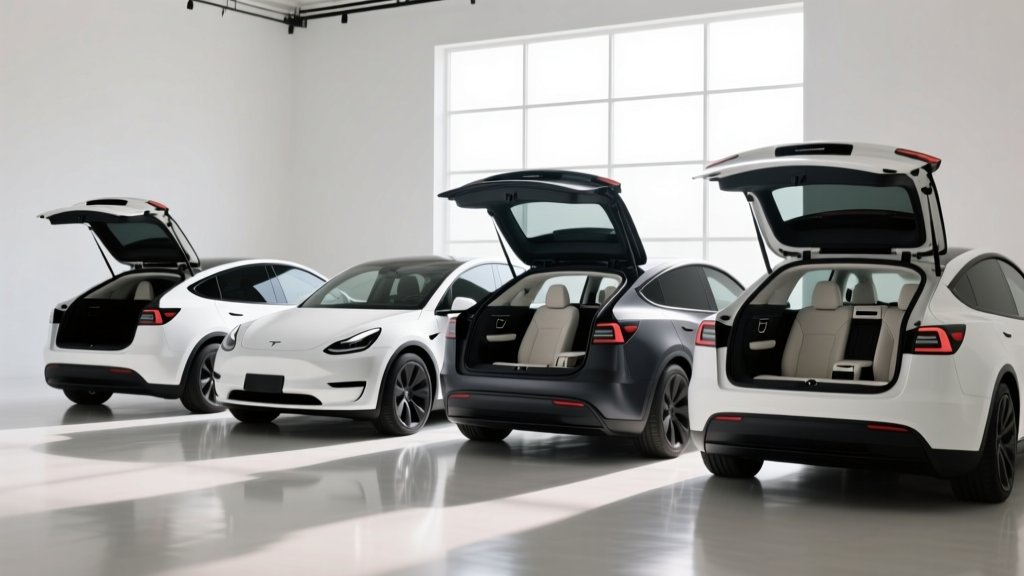
The refreshed 2026 Model Y (the "Juniper" update that arrived for the 2025 model year and carries forward) remains Tesla's volume seller for one reason: it offers near-SUV cargo space in a midsize crossover footprint. Behind the second row, you get 30.2 cubic feet of usable cargo volume. Fold the rear seats flat and that number jumps to 72.1 cubic feet — enough for a full sheet of plywood laid flat, barely, but more practically, four large suitcases plus a stroller with room to spare.
The front trunk (frunk) adds another 4.1 cubic feet, useful for charging cables, a soft grocery bag, or a laptop bag you want separated from the main cabin.
| Spec | Model Y Long Range AWD | Model Y Performance |
|---|---|---|
| Cargo (rear seats up) | 30.2 cu ft | 30.2 cu ft |
| Cargo (rear seats folded) | 72.1 cu ft | 72.1 cu ft |
| Frunk | 4.1 cu ft | 4.1 cu ft |
| EPA Range | 320 miles | 293 miles |
| Battery (usable / chemistry) | 78.1 kWh / NMC | 78.1 kWh / NMC |
| Efficiency | 122 MPGe (28 kWh/100mi) | 111 MPGe (31 kWh/100mi) |
| Peak DC Fast Charge | 250 kW | 250 kW |
| 10–80% DC Time | ~27 min | ~27 min |
| Level 2 Home Charge | 11.5 kW (~44 mi/hr) | 11.5 kW (~44 mi/hr) |
| 0–60 mph | 4.8 sec | 3.5 sec |
| Horsepower | 384 hp | 456 hp |
| Drivetrain | Dual-Motor AWD | Dual-Motor AWD |
| Base MSRP | $44,990 | $51,490 |
| Battery Warranty | 8 yr / 120,000 mi | 8 yr / 120,000 mi |
2026 Tesla Model 3: Sleek Sedan, Surprising Depth
The refreshed Model 3 ("Highland" update, now in its second model year) is a sedan, so expectations for trunk space should be modest. Yet Tesla carved out 23.0 cubic feet of combined trunk and rear-cargo area — that figure includes the rear trunk well and the pass-through behind the rear seats. The trunk opening is narrower than the Model Y's liftgate, so bulky items like a large dog crate or a bicycle wheel won't fit without creative angling, but depth is generous for a sedan.
The frunk on the Model 3 adds 3.1 cubic feet — slightly smaller than the Model Y's, but still enough for a charging cable kit and a small bag.
| Spec | Model 3 RWD | Model 3 Long Range AWD | Model 3 Performance |
|---|---|---|---|
| Trunk + Rear Cargo | 23.0 cu ft | 23.0 cu ft | 23.0 cu ft |
| Frunk | 3.1 cu ft | 3.1 cu ft | 3.1 cu ft |
| EPA Range | 272 miles | 341 miles | 315 miles |
| Battery (usable / chemistry) | 57.5 kWh / LFP | 78.1 kWh / NMC | 78.1 kWh / NMC |
| Efficiency | 132 MPGe (25 kWh/100mi) | 130 MPGe (26 kWh/100mi) | 116 MPGe (29 kWh/100mi) |
| Peak DC Fast Charge | 170 kW | 250 kW | 250 kW |
| 10–80% DC Time | ~30 min | ~27 min | ~27 min |
| Level 2 Home Charge | 11.5 kW (~44 mi/hr) | 11.5 kW (~44 mi/hr) | 11.5 kW (~44 mi/hr) |
| 0–60 mph | 5.8 sec | 4.2 sec | 2.9 sec |
| Horsepower | 271 hp | 346 hp | 510 hp |
| Drivetrain | RWD | Dual-Motor AWD | Dual-Motor AWD |
| Base MSRP | $38,990 | $44,990 | $50,990 |
| Battery Warranty | 8 yr / 100,000 mi | 8 yr / 120,000 mi | 8 yr / 120,000 mi |
Battery chemistry matters here: The base Model 3 RWD uses an LFP (lithium iron phosphate) battery. LFP tolerates regular 100% charging without accelerated degradation — Tesla actually recommends periodic full charges for LFP to keep the battery management system calibrated. The trade-off is lower energy density (hence the smaller 57.5 kWh pack) and slightly worse cold-weather performance compared to NMC. If you live in a cold climate and need maximum range, the Long Range AWD with its NMC pack is the better call.
2026 Tesla Model S: Flagship Sedan With a Liftback Secret
The Model S is a large luxury sedan, but its liftback-style rear hatch gives it a practical edge over traditional trunk sedans like the Mercedes EQS or BMW i7. You get 25.0 cubic feet behind the rear seats and a massive 79.3 cubic feet with the rear seats folded — rivaling the Model Y. The wide, tall hatch opening swallows items a conventional sedan trunk simply cannot.
The frunk adds 5.3 cubic feet, the largest front trunk in the current Tesla lineup.
| Spec | Model S Long Range | Model S Plaid |
|---|---|---|
| Cargo (rear seats up) | 25.0 cu ft | 25.0 cu ft |
| Cargo (rear seats folded) | 79.3 cu ft | 79.3 cu ft |
| Frunk | 5.3 cu ft | 5.3 cu ft |
| EPA Range | 402 miles | 359 miles |
| Battery (usable / chemistry) | 95 kWh / NMC | 95 kWh / NMC |
| Efficiency | 124 MPGe (27 kWh/100mi) | 116 MPGe (29 kWh/100mi) |
| Peak DC Fast Charge | 250 kW | 250 kW |
| 10–80% DC Time | ~30 min | ~30 min |
| Level 2 Home Charge | 11.5 kW (~41 mi/hr) | 11.5 kW (~41 mi/hr) |
| 0–60 mph | 3.1 sec | 1.99 sec |
| Horsepower | 670 hp | 1,020 hp |
| Drivetrain | Dual-Motor AWD | Tri-Motor AWD |
| Base MSRP | $79,990 | $94,990 |
| Battery Warranty | 8 yr / 150,000 mi | 8 yr / 150,000 mi |
2026 Tesla Model X: Maximum Volume, Falcon-Wing Quirks
If cargo volume is your primary purchase driver, the Model X is the answer — and the most expensive one. Behind the third row (in the six-seat configuration), you get 13.7 cubic feet. Fold the third row and it opens to 43.9 cubic feet. Fold both the second and third rows and you access a van-like 88.1 cubic feet. The Model X also has the largest frunk at 6.6 cubic feet.
The caveat: the signature Falcon Wing rear doors require overhead clearance to open fully (~12 inches of lateral space and overhead clearance). In a tight garage or under a low carport, they can be slow or refuse to fully articulate. Tesla added ultrasonic sensors to detect obstacles, but the physical limitation remains.
| Spec | Model X Long Range | Model X Plaid |
|---|---|---|
| Cargo (all rows up, 6-seat) | 13.7 cu ft | 13.7 cu ft |
| Cargo (3rd row folded) | 43.9 cu ft | 43.9 cu ft |
| Cargo (2nd + 3rd folded) | 88.1 cu ft | 88.1 cu ft |
| Frunk | 6.6 cu ft | 6.6 cu ft |
| EPA Range | 335 miles | 311 miles |
| Battery (usable / chemistry) | 95 kWh / NMC | 95 kWh / NMC |
| Efficiency | 106 MPGe (32 kWh/100mi) | 98 MPGe (34 kWh/100mi) |
| Peak DC Fast Charge | 250 kW | 250 kW |
| 10–80% DC Time | ~32 min | ~32 min |
| Level 2 Home Charge | 11.5 kW (~34 mi/hr) | 11.5 kW (~34 mi/hr) |
| 0–60 mph | 3.8 sec | 2.5 sec |
| Horsepower | 670 hp | 1,020 hp |
| Drivetrain | Dual-Motor AWD | Tri-Motor AWD |
| Base MSRP | $84,990 | $99,990 |
| Battery Warranty | 8 yr / 150,000 mi | 8 yr / 150,000 mi |
Charging Speed Reality: What Tesla Owners Actually Experience
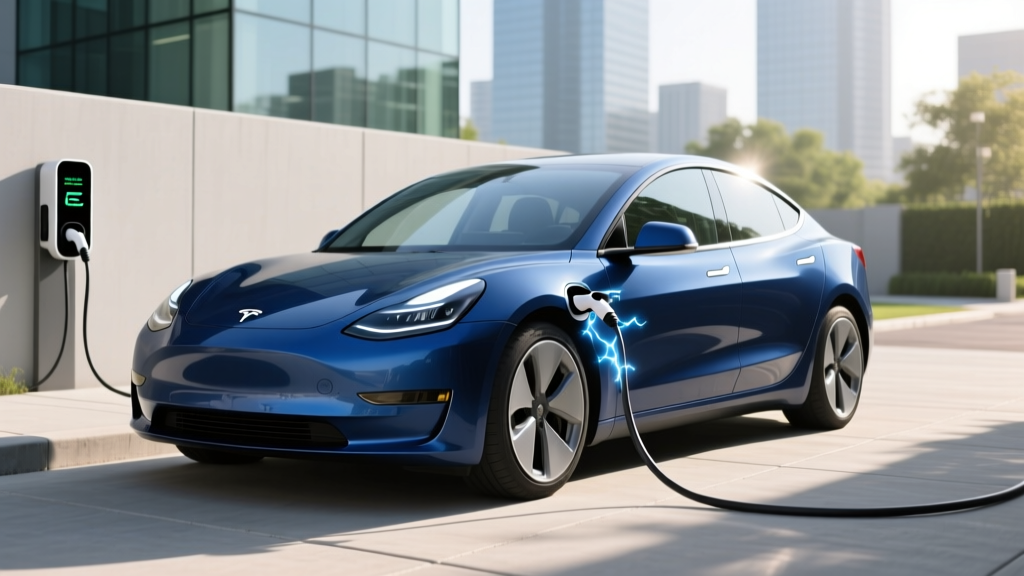
All current Teslas use the NACS (North American Charging Standard) connector natively — no adapter needed at Tesla Superchargers. The entire 2026 lineup peaks at 250 kW on V3 Superchargers, except the base Model 3 RWD, which peaks at 170 kW.
Peak charge rate is not sustained charge rate. Tesla's charge curve is aggressive in the 10–50% SoC window, then tapers significantly above 80%. Here's what the 10–80% times mean in practice:
- 10–50%: Fastest segment. A Model Y Long Range at a V3 Supercharger will pull close to 250 kW, adding ~150 miles in roughly 12 minutes.
- 50–80%: Rate tapers to ~100–130 kW. The next 30% takes roughly as long as the first 40%.
- Above 80%: Charging slows dramatically to protect battery health. Only charge past 80% at a DC fast charger when you genuinely need the range for the next leg of your trip.
At home on a Level 2 wall connector (48-amp circuit, 11.5 kW), a Model Y adds roughly 44 miles of range per hour of charging. An overnight session (8 hours) replenishes ~350 miles — more than the car's full battery capacity, so you'll wake up at whatever SoC limit you've set (80% recommended daily for NMC, 100% fine for LFP).
Home charger installation costs vary widely. Expect $800–$1,500 for a straightforward install near the electrical panel on a 60-amp circuit. If your panel needs an upgrade to 200 amps, add $1,500–$3,000. Always hire a licensed electrician and pull a permit.
Federal Tax Credit: What You Actually Qualify For
The IRS §30D federal EV tax credit offers up to $7,500, but eligibility is a three-part test. Not every Tesla buyer qualifies, and not every Tesla model qualifies in every trim.
- MSRP Cap: SUVs and trucks (Model Y, Model X) must have an MSRP ≤ $80,000. Sedans (Model 3, Model S) must be ≤ $55,000. This means the Model S is priced out of the credit entirely. Most Model X trims exceed the cap as well.
- Buyer Income Cap: Modified adjusted gross income must not exceed $300,000 (joint), $225,000 (head of household), or $150,000 (single).
- Battery Sourcing: The $7,500 credit splits into two halves — $3,750 for critical-minerals sourcing and $3,750 for battery-component manufacturing. Tesla's supply chain has shifted significantly, and the qualifying amount can change quarter to quarter. Always verify current sourcing compliance on fueleconomy.gov before purchase.
- Point-of-Sale Transfer: As of 2024, you can transfer the credit to the dealer at purchase, reducing your out-of-pocket cost immediately rather than waiting for a tax refund. Tesla supports this at delivery.
| Model | Base MSRP | Est. Credit | Effective Price |
|---|---|---|---|
| Model 3 RWD | $38,990 | Up to $7,500 | ~$31,490 |
| Model 3 Long Range AWD | $44,990 | Up to $7,500 | ~$37,490 |
| Model Y Long Range AWD | $44,990 | Up to $7,500 | ~$37,490 |
| Model S Long Range | $79,990 | $0 (MSRP cap) | $79,990 |
| Model X Long Range | $84,990 | $0 (MSRP cap) | $84,990 |
Credit eligibility depends on income, sourcing, and MSRP rules current at time of purchase. Consult a tax professional and verify on irs.gov.
Who Should Buy Which Tesla?
Choose the Model Y if: You need the best balance of cargo space (30.2 cu ft / 72.1 cu ft folded), range (320 mi EPA), and price (~$37,490 after credit). It's the default pick for families, road-trippers, and anyone who regularly hauls more than groceries.
Choose the Model 3 if: Cargo takes a back seat to efficiency and value. The RWD at ~$31,490 after credit is the cheapest entry into the Tesla ecosystem, and the LFP battery tolerates daily 100% charging. Best for commuters and urban drivers who rarely haul bulky items.
Choose the Model S if: You want flagship range (402 mi EPA), a luxury interior, and sedan practicality via the liftback. The 79.3 cu ft with seats folded is genuinely impressive. But at $79,990 with no federal credit, it's a premium play.
Choose the Model X if: You need three rows, maximum total cargo volume (88.1 cu ft), and don't mind paying for it. Towing capacity (5,000 lbs) is the highest in the lineup. Falcon Wing doors are a conversation piece but a practical compromise in tight spaces.
Pros and Cons Across the Lineup
Pros
- Supercharger network remains the most reliable public DC fast-charging ecosystem in the US
- Over-the-air updates continuously add features — no dealer visits for software improvements
- Class-leading efficiency (kWh/100mi) across the lineup translates to lower charging costs
- Standard Autopilot (SAE Level 2) includes adaptive cruise, lane centering, and automatic emergency braking
- Strong resale value relative to legacy-brand EVs
- Model Y and Model 3 qualify for up to $7,500 federal credit (subject to eligibility)
Cons
- No Apple CarPlay or Android Auto — Tesla's proprietary infotainment is the only option
- FSD (Supervised) costs $8,000 extra or $99/month and remains SAE Level 2 — driver must stay engaged at all times
- Build quality has improved but still shows occasional panel-gap inconsistencies vs. German luxury rivals
- Model S and Model X are priced out of the federal tax credit entirely
- Model 3 trunk opening is narrow for a 23 cu ft space — bulky items are awkward
- Model X Falcon Wing doors need overhead clearance and add mechanical complexity
Frequently Asked Questions
What is the real-world range of a Tesla?
Real-world range depends on trim, weather, and driving style. The Model Y Long Range (EPA 320 mi) delivers ~280–295 miles in mixed driving, ~260–270 on sustained highway runs, and ~220–240 in freezing weather. The Model S Long Range (EPA 402 mi) achieves ~340–360 mixed and ~310–330 highway. Always plan road trips around 80% of the EPA number for a comfortable buffer.
How fast does a Tesla charge at home and on the road?
At home on a Level 2 Tesla Wall Connector (11.5 kW), expect ~34–44 miles of range per hour depending on the model. An overnight charge (8 hours) fully replenishes any Tesla battery. On a V3 Supercharger (250 kW peak), a 10–80% session takes ~27–32 minutes. The base Model 3 RWD peaks at 170 kW and takes ~30 minutes for 10–80%.
Does the Tesla Model Y qualify for the $7,500 federal tax credit?
The Model Y qualifies as an SUV under the §30D MSRP cap of $80,000, so most trims are eligible — provided the buyer meets income limits ($150K single / $300K joint) and the vehicle meets battery-sourcing requirements. Credit amounts can change based on supply-chain compliance. Verify current eligibility on fueleconomy.gov and consult a tax professional.
Is the Tesla Model Y worth buying over the Hyundai Ioniq 5 or Ford Mustang Mach-E?
The Model Y wins on Supercharger network access, efficiency (122 MPGe vs. the Ioniq 5's ~114 MPGe), and cargo space (72.1 cu ft folded vs. ~60 cu ft for the Ioniq 5). The Ioniq 5 offers faster peak charging on 350 kW chargers (~18 min 10–80% with 800V architecture) and a more conventional interior layout with physical buttons. The Mach-E provides a more traditional dealership service experience. If road-trip charging reliability is your priority, the Tesla ecosystem is still the benchmark.
How much trunk space does a Tesla have compared to a gas SUV?
The Model Y's 30.2 cu ft (rear seats up) is comparable to the Toyota RAV4 (37.6 cu ft) — smaller on paper, but the Model Y's flat load floor and lack of transmission tunnel make it more usable. With seats folded, the Model Y's 72.1 cu ft approaches the RAV4's 69.8 cu ft. The frunk adds 4.1 cu ft that gas vehicles simply don't have, partially closing the gap.
What is the battery warranty on a Tesla?
Tesla covers the battery and drive unit for 8 years. Mileage limits vary: 100,000 miles on the Model 3 RWD, 120,000 miles on Model 3 Long Range/Performance and Model Y, and 150,000 miles on Model S and Model X. The warranty guarantees the battery will retain at least 70% of its original capacity during the coverage period. In practice, Tesla battery degradation data from fleet studies shows most packs retain 85–90% capacity at 100,000 miles.