Quick Verdict: Tron Mode Is a UI Flex, Not a Performance Unlock
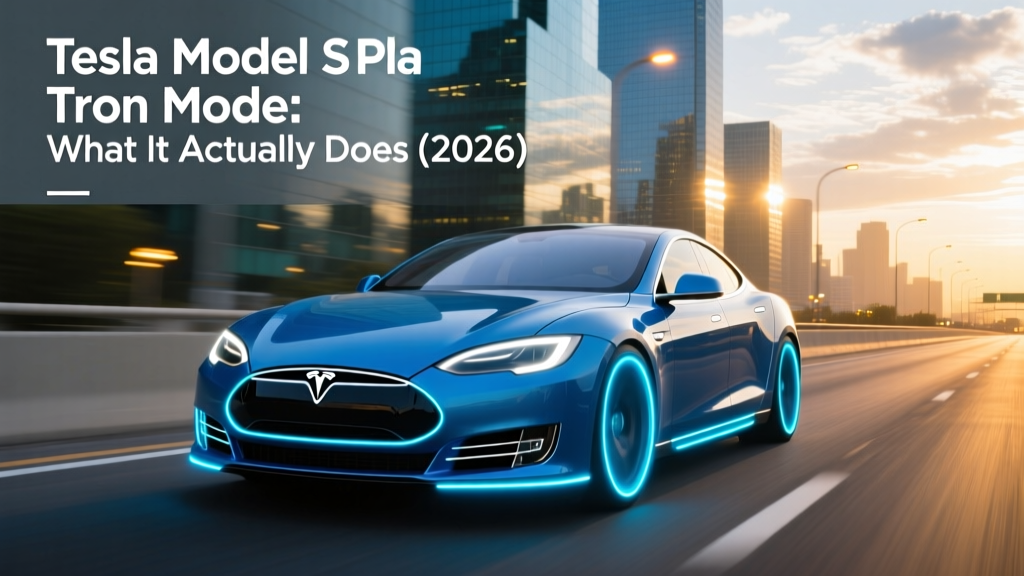
If you've searched for Tesla Tron Mode, you've probably seen screenshots of a neon-blue, grid-heavy instrument cluster that looks ripped from the 1982 (or 2010) sci-fi film. Here's the short answer: Tron Mode is an Easter-egg visual theme available on the Model S Plaid's instrument cluster. It does not increase horsepower, alter torque vectoring, change suspension damping, or unlock any hidden performance. It's a cosmetic skin — fun for a weekend, rarely left on past the first week of ownership.
What is real is the car underneath it. The 2026 Tesla Model S Plaid remains one of the quickest production sedans on the planet, and the decision to buy one should rest on its 1,020-hp tri-motor powertrain, 402-mile EPA range, and 320-kW DC fast-charging capability — not a dashboard theme. Let's break the actual machine down.
What Is Tesla Tron Mode, Exactly?
Tron Mode is a hidden display theme that owners can activate via a specific tap sequence on the instrument cluster (typically a long-press on the battery icon or a code entered in the software menu — the exact gesture has varied across OTA updates). Once enabled, the driver display switches to a blue-and-black grid aesthetic with glowing cyan lines, reminiscent of the "Grid" from the Tron franchise.
Functionally, the information displayed is identical to the standard cluster: speed, state of charge (SoC), navigation, Autopilot visualization, and energy consumption. No telemetry is added, no drive-mode parameters change. Think of it as Tesla's equivalent of a video game skin.
Not a performance mode. Tron Mode does not affect acceleration, top speed, suspension, or thermal management. If you want maximum performance, engage Plaid Mode (which does precondition the powertrain and adjust chassis settings). Tron Mode is purely visual.
Range, Battery, and Real-World Efficiency
The 2026 Model S Plaid uses a ~100 kWh (usable) battery pack with NMC (nickel-manganese-cobalt) chemistry — chosen for its high energy density, which is necessary to push 1,020 hp while preserving range. EPA-rated efficiency is 120 MPGe combined, or roughly 31 kWh per 100 miles.
| Spec | Value |
|---|---|
| Battery (usable) | ~100 kWh, NMC |
| EPA range | 402 mi (Long Range); 396 mi (Plaid) |
| MPGe (combined) | 120 MPGe / 31 kWh/100 mi |
| Drivetrain | Tri-motor AWD (Plaid); Dual-motor AWD (Long Range) |
| Horsepower | 1,020 hp (Plaid); 670 hp (Long Range) |
| 0-60 mph | 1.99 sec (Plaid w/ rollout); ~3.1 sec (Long Range) |
| Top speed | 200 mph (Plaid, w/ track package) |
EPA 396 mi (Plaid) — what to expect in the real world: On a 70-mph highway loop in mild weather, expect ~330-350 miles before needing to charge. In winter conditions (sub-30°F), that drops to roughly 260-290 miles due to cabin heating and increased battery resistance. City driving with heavy regen can actually exceed the EPA number, sometimes reaching 380+ miles. Source: fueleconomy.gov.
Charging: DC Fast, Level 2, and the Curve Reality
The Model S Plaid supports up to 320 kW peak on Tesla's V4 Superchargers, though sustained rates depend on SoC and battery temperature. Preconditioning (initiated automatically when you navigate to a Supercharger) is critical — skip it and peak rates may be halved.
| Level | Power | Rate / Time |
|---|---|---|
| Level 1 (120V) | ~1.4 kW | ~3-4 mi/hr |
| Level 2 (240V, 48A) | 11.5 kW | ~34 mi/hr |
| DC Fast (V4 Supercharger) | Up to 320 kW peak | 10-80% in ~25 min; taper above 80% |
| DC Fast (CCS adapter, EA) | Up to ~150 kW | 10-80% in ~40 min (varies by station) |
A note on the charge curve: the Plaid will hold ~250 kW from roughly 10-45% SoC, then taper progressively. By 80%, you're down to ~60-80 kW. For road trips, plan stops around 15-20 minutes each and leave at 70-75% SoC — charging past 80% at a DC fast station is rarely time-efficient.
At home, a Tesla Wall Connector on a 60A circuit (48A continuous) delivers 11.5 kW, adding roughly 34 miles per hour of charging. Most owners plug in overnight and wake up full. Installation runs $800-$2,000 depending on panel proximity and whether a 200A service upgrade is needed.
Interior, Cargo, and Daily Practicality
The refreshed Model S interior is minimalist but functional. The 17-inch landscape touchscreen handles everything from climate to media to vehicle settings, while the yoke (standard on Plaid, round wheel optional) takes a week of muscle-memory adjustment. Build quality on 2025-2026 models has improved meaningfully over the 2021-2022 launch cars — panel gaps are tighter, and the ventilated front seats are a welcome addition.
- Front legroom: 42.7 in
- Rear legroom: 35.4 in (tight for tall adults on long trips)
- Cargo (rear trunk): 28 cu ft
- Frunk: ~3.1 cu ft (smaller than Model 3/Y due to HVAC hardware)
- Rear seats folded: ~58 cu ft total
For a performance sedan, practicality is strong. Two adults plus luggage for a week fits easily. Three adults in the rear is a squeeze on anything beyond a 30-minute trip.
Pricing, Trims, and Federal Tax Credit Eligibility
| Trim | Base MSRP | Federal §30D Credit | Effective Price |
|---|---|---|---|
| Model S Long Range | $72,990 | Currently ineligible (MSRP cap + sourcing) | $72,990 |
| Model S Plaid | $87,990 | Currently ineligible | $87,990 |
The tax credit reality: As of 2026, the Model S does not qualify for the $7,500 federal EV tax credit under IRS §30D. The sedan MSRP cap is $55,000, and both trims exceed it. Additionally, buyer income caps ($150k single / $300k joint) and battery critical-mineral sourcing requirements further restrict eligibility for most luxury EVs. Always verify current rules at irs.gov before purchasing, as these regulations continue to evolve.
State incentives may still apply — California, Colorado, and several others offer rebates that aren't MSRP-capped, but amounts vary by jurisdiction. Consult your state's energy office.
Autopilot, FSD, and Smart Driving Features
SAE Level 2 — driver supervision required. Tesla Autopilot and Full Self-Driving (Supervised) are Level 2 driver-assistance systems. You must keep your hands on the wheel (or apply torque) and eyes on the road at all times. This is not Level 4 autonomy; the car does not drive itself.
Standard Autopilot includes Traffic-Aware Cruise Control and Autosteer (lane centering on marked roads). The optional FSD (Supervised) package, currently priced at $8,000 upfront or $99/month, adds automatic lane changes, navigation-on-autopilot, traffic-light/stop-sign recognition, and enhanced city-street driving. Real-world FSD performance in 2026 is competent on highways but still requires intervention in construction zones, complex intersections, and adverse weather.
For a true hands-off experience, you'd need a Level 4 robotaxi service like Waymo — available only in select cities. The Model S remains a driver's car with strong assistance, not a chauffeur replacement.
Warranty, Ownership Costs, and Who Should Buy
Tesla's warranty on the Model S is competitive for the segment:
- Basic vehicle: 4 years / 50,000 miles
- Battery & drive units: 8 years / 150,000 miles (minimum 70% capacity retention)
NMC batteries in the Plaid have shown roughly 8-12% degradation over 100,000 miles in fleet data, meaning most owners will remain well within the warranty threshold. Replacement cost, if out of warranty, is estimated at $15,000-$22,000 — a figure worth considering for high-mileage used purchases.
Who the Model S Plaid is for: Buyers who want supercar acceleration in a four-door daily driver, plan to road-trip on the Supercharger network, and don't need third-row seating. It's less practical than the Model X for families and less affordable than the Model 3 Performance, but nothing else in the EV sedan segment matches its combination of 1,020 hp and 396 miles of range.
Who should look elsewhere: Budget-conscious buyers (the Model 3 Highland Performance delivers 0-60 in ~3.0 sec for $52,990), families needing three rows (Model X or Rivian R1S), and anyone counting on the federal tax credit to make the math work.
Pros
- 1.99-sec 0-60 — quickest production sedan
- 396-mi EPA range despite 1,020 hp
- 320-kW peak DC charging on V4 Superchargers
- Supercharger network reliability (17,000+ US stalls)
- Over-the-air updates continuously add features
Cons
- $87,990+ MSRP; no federal tax credit eligibility
- Rear seat tight for tall adults
- FSD (Supervised) still requires active supervision
- Yoke steering polarizing; round wheel is a no-cost option
- NMC battery degrades faster than LFP in high-heat climates
Tesla Tron Mode FAQ
How do I activate Tron Mode on my Model S Plaid?
The activation gesture has changed across software versions. On most 2025-2026 firmware builds, a long-press on the battery icon on the instrument cluster (not the main touchscreen) for ~5 seconds triggers it. Some builds require a code entered via the software menu. It can be toggled off the same way.
Does Tron Mode drain the battery faster?
Negligibly. The instrument cluster is a low-power display; the added GPU load of the Tron skin is on the order of watts, not kilowatts. You will not see measurable range loss.
Is Tron Mode available on the Model 3 or Model Y?
No. Tron Mode is exclusive to the Model S (and has been reported on some Model X builds). The Model 3/Y instrument cluster hardware is different and does not support it.
Does the Model S Plaid qualify for the $7,500 federal tax credit?
No. Under current IRS §30D rules, the sedan MSRP cap is $55,000. The Plaid starts at $87,990, making it ineligible regardless of buyer income or battery sourcing. Verify current rules at irs.gov.
What's the real-world range of the Model S Plaid on a road trip?
Expect 330-350 miles at 70 mph in mild weather; 260-290 miles in sub-30°F winter conditions. City driving with regen can exceed 380 miles.
How fast does the Plaid charge at a Supercharger?
Up to 320 kW peak on V4 Superchargers, with a 10-80% charge taking approximately 25 minutes when properly preconditioned. Sustained rate averages ~220 kW through the mid-SoC range.