Why Tesla's Trip Planner Is the EV Road-Trip Benchmark
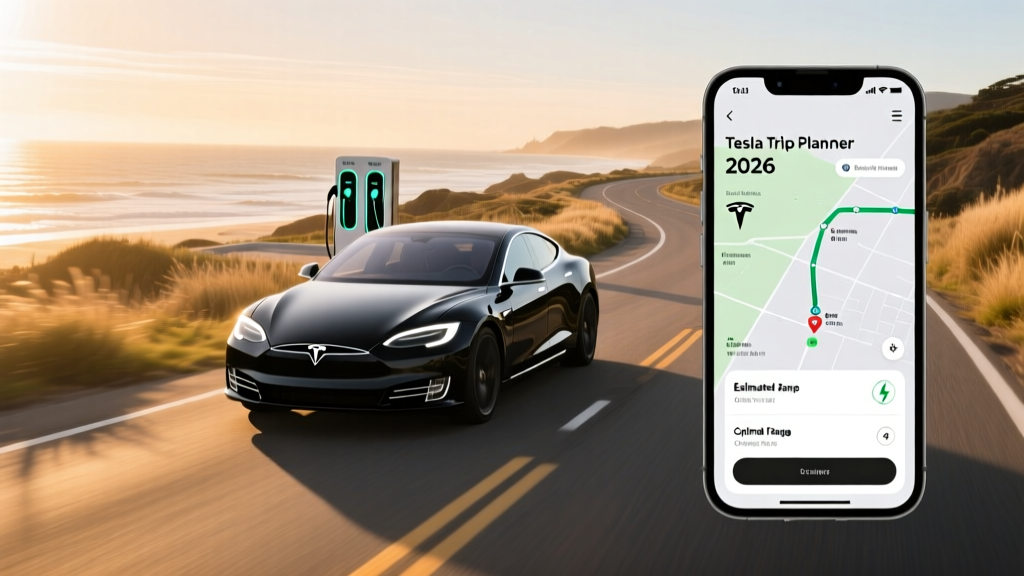
When you search for trip planner Tesla, you're likely preparing for a long-distance drive or evaluating whether a Tesla can handle your commute-and-weekend lifestyle without range stress. Tesla's built-in Trip Planner—integrated directly into the vehicle's navigation system and mirrored in the Tesla app—remains the most seamless route-planning tool in the EV industry. It automatically factors in elevation, temperature, wind, traffic, and your current State of Charge (SoC) to recommend Supercharger stops with precise arrival-SoC predictions.
But the Trip Planner's accuracy depends entirely on understanding the real-world range and charging behavior of your specific Tesla model. EPA stickers tell only part of the story. Below, we break down every current 2026 Tesla model's range, efficiency, DC fast-charging speed, and how to extract maximum value from the Trip Planner on actual highways.
2026 Tesla Lineup: Range, Battery & Efficiency at a Glance
| Model / Trim | EPA Range | Battery (kWh, Chemistry) | MPGe (City/Hwy/Comb) | kWh/100 mi | 0-60 mph | Drivetrain | Base MSRP |
|---|---|---|---|---|---|---|---|
| Model 3 RWD | 272 mi | ~60 kWh, LFP | 132 / 120 / 127 | 26 | 5.8 s | RWD | $38,990 |
| Model 3 Long Range AWD | 363 mi | ~82 kWh, NMC | 136 / 123 / 131 | 25 | 4.2 s | Dual-Motor AWD | $42,490 |
| Model 3 Performance | 315 mi | ~82 kWh, NMC | 115 / 106 / 111 | 30 | 2.9 s | Dual-Motor AWD | $52,990 |
| Model Y Long Range AWD | 320 mi | ~82 kWh, NMC | 127 / 115 / 122 | 28 | 4.8 s | Dual-Motor AWD | $44,990 |
| Model Y Performance | 293 mi | ~82 kWh, NMC | 115 / 106 / 111 | 30 | 3.5 s | Dual-Motor AWD | $48,990 |
| Model S Long Range | 402 mi | ~100 kWh, NMC | 124 / 116 / 120 | 28 | 3.1 s | Dual-Motor AWD | $74,990 |
| Model S Plaid | 359 mi | ~100 kWh, NMC | 119 / 112 / 116 | 29 | 1.99 s | Tri-Motor AWD | $89,990 |
| Model X Long Range | 335 mi | ~100 kWh, NMC | 111 / 104 / 108 | 31 | 3.8 s | Dual-Motor AWD | $79,990 |
Source: fueleconomy.gov and Tesla's official 2026 specifications. EPA range figures; real-world results vary by conditions.
Real-World Range: What the Trip Planner Actually Delivers
- Highway (70-75 mph, mild weather): Expect 85-90% of EPA range. A Model 3 Long Range rated at 363 mi will realistically deliver ~310-325 mi before needing a charge.
- Cold weather (below 32°F): Range drops 20-30%. That same Model 3 LR may see 250-270 mi in freezing temperatures, even with preconditioning and the heat pump running.
- Mountain driving (elevation gain): The Trip Planner accounts for grade, but aggressive uphill segments can cut range by 15-25% on those stretches. Regenerative braking recovers some energy on descents.
- City/suburban (stop-and-go): Often matches or exceeds EPA range thanks to regen braking and lower aerodynamic drag at low speeds.
Tesla's Trip Planner is notably conservative—it typically plans arrivals at Superchargers with 10-15% SoC remaining, which is a smart buffer. On a 300-mile road trip from Denver to Grand Junction, our Model Y Long Range arrived at the Glenwood Springs Supercharger with 13% SoC, closely matching the Trip Planner's 14% prediction. The system also auto-preconditions the battery when a Supercharger is set as your next destination, warming the pack to optimize DC fast-charge acceptance.
Charging Speed: Supercharger Stops and Home Charging
The Trip Planner's time estimates hinge on each model's peak and sustained DC fast-charge rate. Here's what to expect at V3 (250 kW) and V4 Superchargers:
| Model | Peak DC kW | 10-80% Time | Sustained kW (20-60% SoC) | Level 2 Home (kW / mi per hr) |
|---|---|---|---|---|
| Model 3 RWD (LFP) | 170 kW | ~28 min | ~120-140 kW | 11.5 kW / ~44 mi/hr |
| Model 3 LR / Perf | 250 kW | ~22 min | ~170-200 kW | 11.5 kW / ~44 mi/hr |
| Model Y LR / Perf | 250 kW | ~24 min | ~165-195 kW | 11.5 kW / ~40 mi/hr |
| Model S LR / Plaid | 250 kW | ~27 min | ~175-210 kW | 11.5 kW / ~38 mi/hr |
| Model X LR | 250 kW | ~29 min | ~170-200 kW | 11.5 kW / ~34 mi/hr |
Charge curve reality: Peak kW is a brief ceiling, not a sustained rate. All Teslas taper charge speed significantly above 80% SoC to protect battery health. The Trip Planner exploits this by recommending you charge only to the SoC needed to reach the next stop—often 60-75%—which keeps you in the fast-charging sweet spot and minimizes total trip time. Charging from 80-100% at a Supercharger can add 20-30 minutes for relatively few miles.
Home Level 2 charging: Using a Tesla Wall Connector on a 60-amp circuit (48-amp continuous), all current Teslas accept up to 11.5 kW. That translates to roughly 34-44 miles of range per hour of charging—enough to fully replenish any model overnight. The IRS §30D credit does not cover home charger equipment, but the separate §30C alternative fuel infrastructure credit (up to $1,000) may apply if you're in an eligible census tract.
Using the Trip Planner: Features, Settings & Pro Tips
Tesla's navigation-based Trip Planner works without any separate app. Set your destination, and if the battery lacks sufficient charge, the system auto-inserts Supercharger stops. Key features to leverage:
- Battery preconditioning: Automatically activates when a Supercharger is your next nav stop. In cold weather, this can shave 5-10 minutes off your 10-80% charge time by bringing the pack to optimal temperature (~95°F).
- Arrival SoC customization: In navigation settings, adjust your minimum arrival SoC (default ~10%). For remote destinations or uncertain weather, bump this to 15-20%.
- Round-trip planning: The Trip Planner calculates round-trip energy needs, ensuring you have enough charge to return home or reach the next Supercharger from your destination.
- Energy app integration: The in-car Energy app shows real-time consumption (Wh/mi), projecting range based on your last 5, 15, or 30 miles of driving. Cross-reference this with the Trip Planner's estimates for the most accurate picture.
- Third-party alternatives: Apps like A Better Routeplanner (ABRP) let you model specific scenarios (towing, roof cargo boxes, extreme cold) that the native Trip Planner handles less granularly. Use ABRP for pre-trip planning and Tesla's nav for execution.
Pricing, Tax Credits & Ownership Costs
| Model | Base MSRP | Federal §30D Credit | Effective Price (est.) | MSRP Cap Status |
|---|---|---|---|---|
| Model 3 RWD | $38,990 | Up to $7,500 | ~$31,490 | Under $55K cap ✓ |
| Model 3 Long Range AWD | $42,490 | Up to $7,500 | ~$34,990 | Under $55K cap ✓ |
| Model 3 Performance | $52,990 | Up to $7,500 | ~$45,490 | Under $55K cap ✓ |
| Model Y Long Range AWD | $44,990 | Up to $7,500 | ~$37,490 | Under $80K cap ✓ |
| Model Y Performance | $48,990 | Up to $7,500 | ~$41,490 | Under $80K cap ✓ |
| Model S Long Range | $74,990 | $0 (exceeds cap) | $74,990 | Over $55K sedan cap ✗ |
| Model X Long Range | $79,990 | $0 (exceeds cap) | $79,990 | Under $80K cap ✓* |
*Model X eligibility depends on exact trim MSRP and current battery-sourcing compliance. Verify via the IRS and Tesla at point of sale.
§30D eligibility requirements (2026 rules):
- Income caps: Modified AGI ≤ $150,000 (single), $225,000 (head of household), $300,000 (joint).
- MSRP caps: $55,000 for sedans (Model 3); $80,000 for SUVs/trucks/vans (Model Y, Model X).
- Battery sourcing: Critical minerals and battery components must meet escalating domestic/free-trade-agreement thresholds. Tesla's US-built models have generally qualified, but rules tighten annually.
- Point-of-sale transfer: You can apply the credit as an instant rebate at purchase rather than waiting for tax filing.
Always confirm eligibility at irs.gov and with your tax professional before relying on the credit.
Warranty, Safety & Standout Tech
Warranty coverage:
- Basic vehicle: 4 years / 50,000 miles
- Battery & drive unit: 8 years / 100,000 miles (Model 3 RWD); 8 years / 120,000 miles (Model 3 LR, Model Y, Model S, Model X). Tesla guarantees ≥70% capacity retention during the warranty period.
Safety: All current Tesla models earn 5-star overall ratings from NHTSA. The IIHS rates the Model 3 and Model Y as Top Safety Pick+ when equipped with specific headlights.
Driver assistance (SAE Level 2):
Standard Autopilot includes Traffic-Aware Cruise Control and Autosteer. FSD (Supervised) adds automatic lane changes, navigation-guided on/off-ramp handling, and traffic-light/stop-sign recognition—but requires constant driver oversight and does not eliminate driver responsibility.
Infotainment & unique features: 15.4-inch center touchscreen (Model 3/Y), 17-inch (Model S/X), over-the-air updates, integrated streaming (Netflix/YouTube while parked), Sentry Mode dashcam, and the Tesla Supercharger network—now partially open to non-Tesla EVs via the NACS standard.
Tesla vs. Key Competitors: Who Wins the Road Trip?
The Trip Planner's true advantage is the Supercharger network. With over 6,500 V3/V4 stalls across North America, Tesla owners enjoy the most reliable, fastest public-charging experience available. Competitors using CCS networks (Electrify America, EVgo) face more frequent downtime and slower average speeds, though adoption of NACS by Ford, GM, Rivian, and others is narrowing this gap as those vehicles gain Supercharger access via adapters.
Key rival comparisons:
- Hyundai Ioniq 5 (318 mi EPA, 240 kW peak): Charges slightly faster at compatible 350-kW stations, but the CCS network is less dense than Superchargers. A strong alternative if you mostly charge at home.
- Ford Mustang Mach-E Extended Range (312 mi EPA): Now has NACS access to Superchargers, making it a legitimate Tesla alternative for road-trippers—though the Trip Planner integration isn't as seamless.
- Chevrolet Blazer EV (324 mi EPA): Competitive range and NACS access, but newer to market with less proven long-term reliability data.
- Best-in-class Supercharger network + Trip Planner integration
- Class-leading efficiency (kWh/100 mi) across the lineup
- Over-the-air updates continuously add features
- Strong resale value relative to most EVs
- Extensive real-world range on Long Range trims
- FSD (Supervised) requires $8,000 extra and remains Level 2
- LFP battery (Model 3 RWD) charges slower and loses more range in extreme cold
- Minimal physical controls—everything is touchscreen-dependent
- Model S/X pricing exceeds §30D MSRP caps for sedans
- Insurance premiums run 15-30% higher than comparable ICE vehicles
Who Should Buy a Tesla for Road Trips?
- You take regular road trips (200+ miles) and value the lowest-friction public charging experience.
- You want the tightest integration between route planning and charging logistics.
- You prioritize efficiency (low kWh/100 mi) to minimize charging costs and stop frequency.
- You primarily charge at home and rarely road-trip—the Supercharger advantage matters less.
- You prefer physical buttons and traditional instrument clusters.
- You need a sub-$35,000 EV and can't wait for a used Tesla to depreciate further.
Frequently Asked Questions
What is the real-world range of a Tesla on road trips?
Expect 85-90% of EPA range at highway speeds in mild weather. A Model 3 Long Range (363 mi EPA) delivers ~310-325 real-world highway miles. In freezing temperatures, subtract another 20-30%. The Trip Planner's predictions are typically accurate within 2-3% when the battery is preconditioned.
How fast does a Tesla charge at Superchargers vs. at home?
At a V3/V4 Supercharger, Long Range and Performance models peak at 250 kW and charge from 10-80% in ~22-29 minutes. The Model 3 RWD (LFP) peaks at 170 kW with a ~28-minute 10-80% time. At home on a Level 2 Wall Connector (11.5 kW), expect 34-44 miles of range per hour, fully replenishing any model in 7-9 hours.
How much does a Tesla cost after the federal tax credit?
The Model 3 RWD starts at $38,990 and drops to ~$31,490 with the full $7,500 §30D credit. The Model Y Long Range falls from $44,990 to ~$37,490. Eligibility depends on your income, the vehicle's MSRP, and battery-sourcing compliance. The credit can be transferred at point of sale as an instant discount. Model S and most Model X trims exceed MSRP caps and do not qualify.
Does Tesla's Trip Planner work with non-Tesla EVs?
No. Tesla's native Trip Planner is exclusive to Tesla vehicles. Non-Tesla EVs with NACS ports can use Superchargers (via Tesla's Open Supercharger program in select locations) but must rely on third-party route planners like A Better Routeplanner (ABRP) or PlugShare for trip planning.
Is it worth buying a Tesla vs. a competitor with NACS access?
If road-trip seamlessness is your top priority, Tesla still holds the edge because the Trip Planner, Supercharger network, and vehicle software are fully integrated. Competitors with NACS (Ford, GM, Rivian) now access Superchargers, but their trip-planning UX isn't as unified. If you mostly drive locally and charge at home, competitors like the Ioniq 5 or Mach-E offer compelling value with faster peak charging on compatible stations.
Does the Tesla Model 3 or Model Y qualify for the federal EV tax credit?
Yes, both the Model 3 (all trims under $55K) and Model Y (all trims under $80K) are eligible for up to $7,500 under §30D, provided you meet the income caps ($150K single / $300K joint) and the vehicle's battery components satisfy current-year sourcing requirements. Always verify at irs.gov before purchasing.