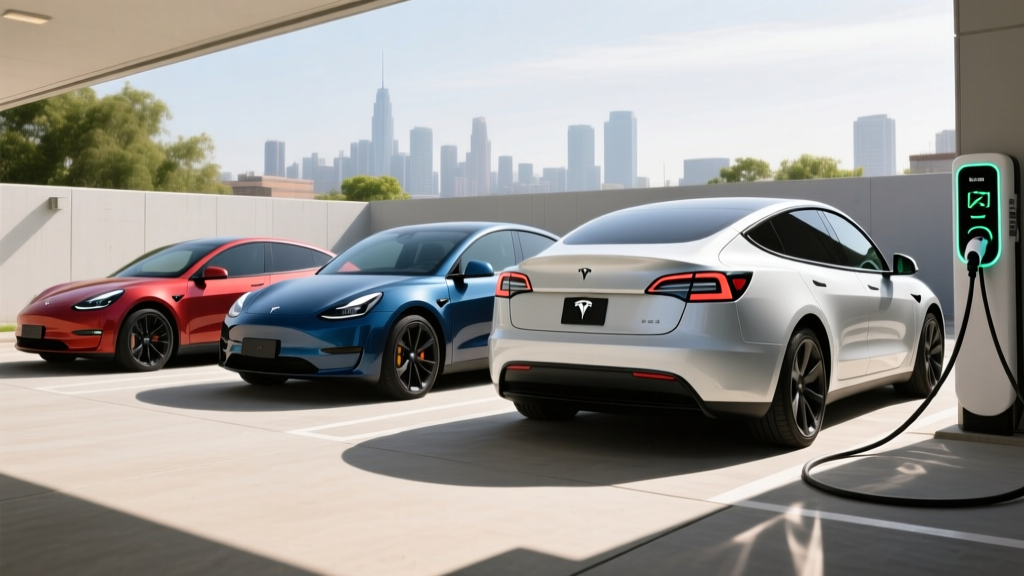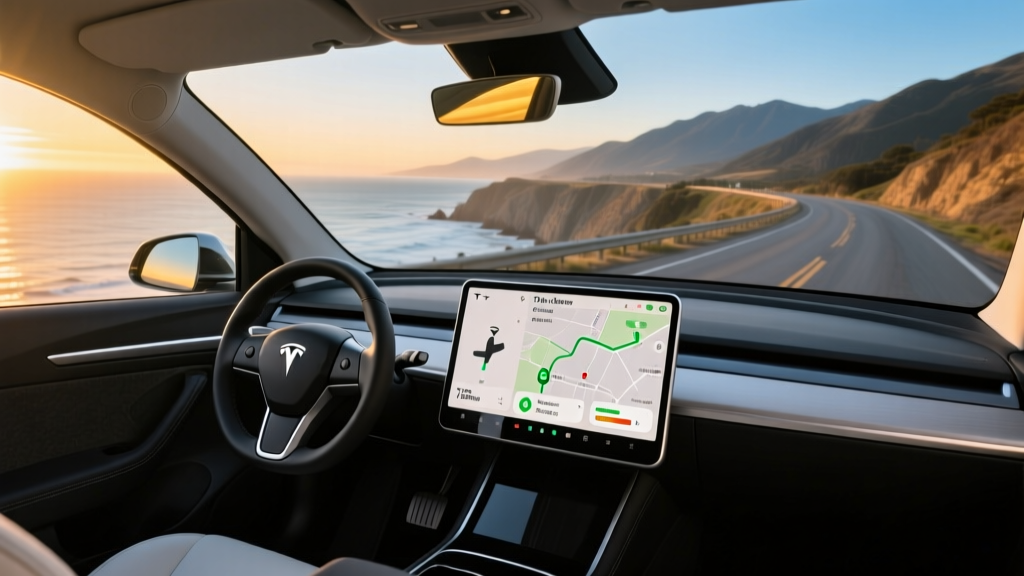
If you own or are considering a Tesla, you have likely encountered the term Tesla drive planner — a catch-all phrase that covers Tesla's built-in Trip Planner, the navigation system's automatic Supercharger routing, and third-party tools like A Better Routeplanner (ABRP). These tools are not just conveniences; they are essential to extracting maximum range, minimizing charge time, and eliminating guesswork on longer drives. This review uses the 2026 Tesla Model Y Long Range AWD as our reference vehicle to show exactly how drive planning works in practice — and what real-world range and charging numbers you should expect.
2026 Tesla Model Y Long Range: Core EV Specifications
| Spec | Value |
|---|---|
| EPA Range | 320 miles |
| Battery (usable) | ~75 kWh, NMC chemistry |
| Drivetrain | Dual-motor AWD |
| Horsepower | 384 hp |
| 0–60 mph | 4.8 seconds |
| Peak DC Fast Charge | 250 kW |
| 10–80% DC Time | ~25 minutes |
| Level 2 Home Charge | 11.5 kW (~44 mi/hr) |
| EPA Efficiency | 122 MPGe / 28 kWh/100 mi |
| Cargo (rear seats up) | 30.2 cu ft |
| Cargo (rear seats folded) | 72.1 cu ft |
| Rear Legroom | 39.4 in |
| Battery Warranty | 8 yr / 120,000 mi |
| Base MSRP | $44,990 |
Sources: fueleconomy.gov, Tesla Model Y specs.
Real-World Range: What the EPA Number Doesn't Tell You
EPA Sticker: 320 miles
Highway (70–75 mph, moderate temps): ~270–290 miles
City / mixed driving: ~300–315 miles
Cold weather (below 32°F): ~220–260 miles (20–30% reduction)
Towing (light trailer, ~1,500 lb): ~190–220 miles
The EPA combined cycle blends city and highway driving at moderate temperatures. On a pure highway road trip at 75 mph, aerodynamic drag pushes consumption higher — expect roughly 10–15% less range than the sticker. In freezing temperatures, the battery's internal resistance rises and cabin heating draws significant energy, even with the Model Y's heat pump. A Tesla drive planner accounts for these variables, which is precisely why relying on the trip computer alone is insufficient for long trips.
Third-party tools like A Better Routeplanner (ABRP) let you input ambient temperature, elevation changes, wind, payload weight, and driving speed to generate a far more accurate range prediction than the in-car system shows before departure. Tesla's built-in Trip Planner, by contrast, uses real-time consumption data once you begin driving and dynamically adjusts Supercharger arrival estimates — making it excellent mid-trip but less useful for pre-trip planning at home.
How Tesla's Trip Planner Works (and Where Third-Party Tools Excel)
Tesla's onboard navigation functions as an integrated drive planner with several key behaviors:
- Automatic Supercharger routing: Enter a destination beyond your current range, and the system plots Supercharger stops, displays estimated arrival state of charge (SoC), and shows minutes needed at each stop.
- Battery preconditioning: When a Supercharger is set as your next navigation stop, the car preheats or precools the battery to optimize charge speed on arrival — essential for hitting peak 250 kW rates.
- Dynamic energy prediction: The trip energy graph shows elevation, speed, and temperature impacts, updating arrival SoC in real time.
- Charger availability: The system displays real-time stall counts and pricing at Supercharger stations along your route.
Where the built-in system falls short is pre-trip scenario planning. You cannot easily model "what if I drive 80 mph instead of 70?" or "what if it's 20°F outside?" before leaving. ABRP fills this gap: you set your vehicle model, battery degradation percentage, weather, speed, and HVAC use, and it generates a full itinerary with charge stops, times, and costs. Many experienced Tesla owners use ABRP for pre-trip planning and Tesla's onboard system for real-time execution.
Charging Speed: DC Fast Charging and Home Level 2
| Charging Level | Power (kW) | Miles Added per Hour | Notes |
|---|---|---|---|
| Level 1 (120V outlet) | ~1.4 kW | ~3–4 mi/hr | Emergency/trickle only |
| Level 2 (240V, 48A) | 11.5 kW | ~44 mi/hr | Full charge in ~7 hours |
| DC Fast (V3 Supercharger) | Peak 250 kW | ~1,000+ mi/hr at peak | 10–80% in ~25 min |
| DC Fast (V4 Supercharger) | Peak 250 kW* | Similar to V3 for Model Y | *Model Y limited to 250 kW |
A critical concept: kW (kilowatts) is the rate of charging — like water pressure. kWh (kilowatt-hours) is the battery capacity — like tank size. The Model Y's ~75 kWh battery charging at a peak 250 kW will not sustain that rate. The charge curve tapers significantly above 50–60% SoC, which is why 10–80% takes ~25 minutes while 80–100% can take an additional 25–30 minutes. A good drive planner models this taper so you don't overstay at a Supercharger.
For home charging, a Level 2 wall connector on a 60A circuit (48A continuous) delivers 11.5 kW — enough to fully replenish the Model Y overnight. Installation typically costs $800–$2,000 depending on panel proximity and local permit requirements. If your home has a 200A panel with spare capacity, the install is straightforward; older 100A panels may require a $1,500–$3,000 upgrade.
Pricing, Trims, and Federal Tax Credit Eligibility
| Trim | MSRP | Est. After §30D Credit |
|---|---|---|
| Long Range AWD | $44,990 | ~$37,490* |
| Performance AWD | $48,990 | ~$41,490* |
*Eligibility for the up-to-$7,500 federal tax credit under IRS §30D depends on multiple factors that change frequently:
- MSRP cap: SUVs must be ≤ $80,000 (Model Y qualifies)
- Buyer income cap: Modified AGI ≤ $300,000 (joint) / $150,000 (single)
- Battery sourcing: Critical minerals and battery components must meet escalating domestic/free-trade-partner thresholds — these tighten annually through 2029
- Point-of-sale transfer: As of 2024+, you can transfer the credit to the dealer at purchase, reducing your out-of-pocket cost immediately rather than waiting for tax filing
Because battery-sourcing rules shift yearly and depend on Tesla's supply chain at time of manufacture, always verify current eligibility on the IRS Clean Vehicle credit page or with your tax professional before assuming the full $7,500.
Autopilot, FSD, and Driver-Assist Technology
Tesla Autopilot and Full Self-Driving (Supervised) require continuous driver attention and hands-on-wheel supervision. The driver is legally and operationally responsible at all times. This is not autonomous driving.
The Model Y comes standard with Basic Autopilot (Traffic-Aware Cruise Control and Autosteer). The FSD (Supervised) package, currently an $8,000 add-on or $99/month subscription, adds Navigate on Autopilot (automatic highway interchanges), autosteer on city streets, traffic light/stop sign recognition, and Smart Summon. While impressive in capability, FSD remains a Level 2 system — meaning it can make errors, disengage without warning, and requires you to monitor the road continuously.
For drive planning specifically, Navigate on Autopilot integrates with the Trip Planner: the car suggests lane changes and off-ramps based on your routed Supercharger stops. This integration is genuinely useful on long highway drives but does not eliminate the need for vigilance.
Who the Model Y (and Its Trip Planner) Suits Best
- Families needing 72 cu ft cargo and 39+ in rear legroom
- Road-trippers who value Supercharger network reliability
- Tech-forward commuters who want integrated route planning
- Daily drivers with home Level 2 charging access
- You need true Level 4 autonomy (not available in any consumer vehicle)
- You tow heavy loads regularly (>3,500 lb) — range drops sharply
- You lack home charging access and rely solely on public infrastructure
- You prefer physical buttons and traditional infotainment layouts
The Model Y's combination of 320-mile EPA range, 250 kW DC fast charging, and Tesla's vertically integrated Supercharger network (now open to NACS-equipped non-Tesla EVs) makes it one of the most practical EVs for multi-state road trips. The drive planner ecosystem — built-in plus third-party — is a genuine competitive advantage that reduces trip anxiety measurably.
Pros, Cons, and Key Competitors
- 320-mile EPA range covers most daily needs without charging
- 250 kW V3/V4 Supercharger network is the most reliable in the US
- Integrated trip planner with battery preconditioning
- 72.1 cu ft cargo with seats folded — SUV-leading
- Over-the-air updates continuously add features
- Heat pump standard — better cold-weather efficiency
- Touchscreen-only controls frustrate some drivers
- FSD (Supervised) is expensive and still Level 2
- DC charge rate capped at 250 kW — Hyundai Ioniq 5 peaks at 350 kW
- Ride quality is firm on rough pavement
- No Apple CarPlay / Android Auto support
- Insurance premiums above segment average
Versus competitors: The Hyundai Ioniq 5 (310 mi, 350 kW charging) and Ford Mustang Mach-E Extended Range (312 mi) offer comparable range with faster DC charging or lower pricing. However, neither matches Tesla's Supercharger network density or the integrated drive-planner experience. If public charging reliability is your top priority, the Tesla ecosystem remains the benchmark.
Frequently Asked Questions
What is a Tesla drive planner and how do I use it?
A Tesla drive planner refers to the vehicle's built-in Trip Planner (part of the navigation system) that automatically routes you through Superchargers on long trips, estimates arrival SoC, and preconditioning the battery for optimal charging. You activate it simply by entering a destination beyond your current range. Third-party planners like A Better Routeplanner (ABRP) offer more granular pre-trip modeling with weather, speed, and elevation inputs.
What is the real-world range of the 2026 Model Y Long Range?
The EPA rates it at 320 miles combined. In real-world highway driving at 70–75 mph in moderate temperatures, expect 270–290 miles. In freezing weather, range can drop to 220–260 miles due to battery resistance and cabin heating demands.
How fast does the Model Y charge at a Supercharger?
It peaks at 250 kW on V3 and V4 Superchargers, achieving a 10–80% charge in approximately 25 minutes. Charging slows substantially above 80% — plan to leave at 80% to minimize total trip time.
Does the 2026 Tesla Model Y qualify for the $7,500 federal tax credit?
It may, depending on current IRS §30D battery-sourcing requirements, your income (≤$300K joint / ≤$150K single), and the vehicle's MSRP (must be ≤$80K for SUVs — the Model Y qualifies). Sourcing rules tighten annually; verify on irs.gov before purchase.
Is the Model Y worth buying over the Ioniq 5 or Mach-E?
If Supercharger network access, integrated trip planning, and cargo space are your priorities, yes. If you want faster DC charging (350 kW on Ioniq 5) or prefer physical controls and CarPlay, the competitors are compelling alternatives. Total cost of ownership is similar once charging and incentives are factored in.
Can I use third-party route planners with my Tesla?
Yes. A Better Routeplanner (ABRP) is the most popular third-party tool and supports all Tesla models. You manually enter your plan, then execute it using Tesla's onboard navigation. The two tools complement each other — ABRP for pre-trip modeling, Tesla's system for real-time execution.