If you've searched for "Tesla transmission" you're likely wondering whether these electric vehicles use a multi-speed gearbox like a conventional car. The short answer: Tesla vehicles do not have a traditional multi-speed transmission. Instead, every Tesla uses a single-speed reduction gear that connects the electric motor to the drive wheels. It's a fundamentally different approach to power delivery — and understanding it matters for anyone evaluating a Tesla's real-world performance, efficiency, and long-term ownership costs.
This guide breaks down exactly how Tesla's drivetrain works, why the company ditched the multi-gear concept years ago, and what it means for range, acceleration, and maintenance. We'll also cover the full specs for the current 2025–2026 Tesla lineup so you can see how this single-gear design performs on paper and on the road.
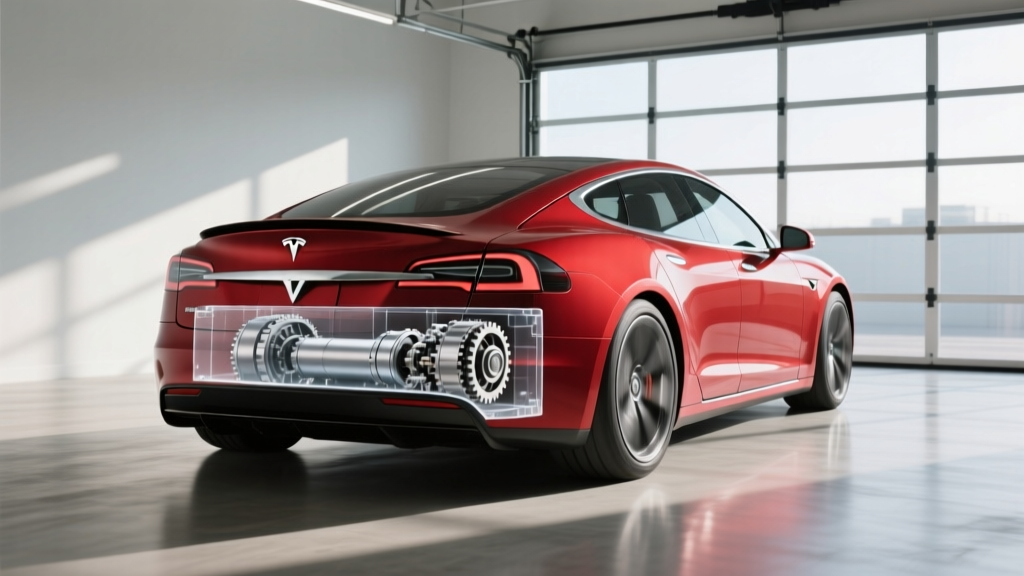
How Tesla's Single-Speed Reduction Gear Works
Internal combustion engines produce usable torque only within a narrow RPM band — typically between 1,500 and 5,500 RPM. A multi-speed transmission (6-, 8-, or 10-speed automatic) exists to keep the engine in that sweet spot as vehicle speed changes.
Electric motors don't have this limitation. A Tesla drive unit generates maximum torque from 0 RPM and maintains a broad, flat power band up to roughly 18,000–20,000 RPM. That means a single fixed gear ratio is enough to take the car from a standstill to its top speed without ever shifting.
Tesla's reduction gear typically uses a ratio around 9:1 (the exact figure varies by model and drive unit). The motor spins roughly nine times for every one rotation of the wheels. This single-ratio design is sometimes called a "1-speed transmission," but it has no clutch, no torque converter, no shift solenoids, and no gear hunting. It's a fixed-ratio reduction gearbox — closer in concept to a bicycle's single cog than to an automatic transmission.
What This Means for Driving Feel and Performance
The single-speed design gives Teslas their signature driving character:
- Instant throttle response: No shift delay, no torque-converter spool-up. Press the pedal and torque arrives in milliseconds.
- Linear acceleration: The pull is continuous and smooth from 0 to highway speed. There's no "shift shock" or power interruption.
- Regenerative braking integration: The same motor that drives the wheels reverses role to slow the car, feeding energy back into the battery. No transmission downshifts are needed for engine braking.
- Quieter cabin: Without gear changes, the only mechanical sound at speed is a faint whine from the reduction gear and motor — far less noise than any ICE drivetrain.
The tradeoff? A single gear ratio is always a compromise between low-end acceleration and high-speed efficiency. Tesla manages this by selecting a ratio that favors the 0–80 mph range where most driving occurs, while still allowing top speeds of 125–163 mph depending on the model. At very high speeds (above 100 mph), an EV with a single-speed gear will consume more energy per mile than a hypothetical multi-speed EV would — but since almost no one drives at those speeds regularly, the compromise is practical.
Current Tesla Lineup: Full Drivetrain & Specs
Here's how the single-speed drivetrain pairs with each Tesla model's motor configuration, battery, and EPA-rated range for the 2025–2026 model year.
| Spec | Model 3 Long Range AWD | Model Y Long Range AWD | Model S Plaid | Model X Long Range |
|---|---|---|---|---|
| Drivetrain | Dual-motor AWD | Dual-motor AWD | Tri-motor AWD | Dual-motor AWD |
| Transmission | Single-speed reduction | Single-speed reduction | Single-speed reduction (×3) | Single-speed reduction |
| Horsepower | ~346 hp | ~384 hp | 1,020 hp | ~670 hp |
| 0–60 mph | 4.2 sec | 4.8 sec | 1.99 sec | 3.8 sec |
| Battery (usable) | ~75 kWh, NMC | ~75 kWh, NMC | ~95 kWh, NMC | ~95 kWh, NMC |
| EPA Range | 363 mi | 320 mi | 359 mi | 335 mi |
| MPGe (combined) | 132 MPGe | 122 MPGe | 120 MPGe | 109 MPGe |
| Base MSRP | $42,380 | $44,380 | $89,990 | $79,990 |
| Battery Warranty | 8 yr / 120,000 mi | 8 yr / 120,000 mi | 8 yr / 150,000 mi | 8 yr / 150,000 mi |
Sources: fueleconomy.gov, Tesla.com specs. Specs reflect 2025–2026 model-year data; always verify at time of purchase.
Real-World Range: What the EPA Sticker Doesn't Tell You
EPA estimates assume a mix of city and highway driving at moderate temperatures. In practice:
• Highway-only at 75 mph: Expect ~10–15% less than EPA (e.g., Model 3 LR ≈ 305–325 mi)
• Cold weather (below 32°F): Range drops 20–30% due to battery resistance and cabin heating (Model 3 LR ≈ 250–290 mi)
• City driving with regen: Often exceeds EPA by 5–10% thanks to regenerative braking recapturing energy
Tesla's heat pump (standard on all current models) significantly reduces cold-weather HVAC losses compared to older resistive heaters.
Tesla's trip planner in the navigation system adjusts range estimates in real time based on elevation, speed, temperature, and wind. On long road trips, this tends to be more accurate than the dashboard's rated-range display. For daily commuting, the rated range is a reliable guide — but plan fast-charging stops using the car's built-in navigation, which will precondition the battery for optimal charge speed.
Charging Speed: DC Fast, Level 2, and Level 1
The single-speed drivetrain has no bearing on charging, but Tesla's Supercharger network and onboard charger specs are central to ownership. Here's what to expect across the lineup:
| Charging Level | Power | Speed (approx.) | Notes |
|---|---|---|---|
| Level 1 (120V) | ~1.4 kW | 3–5 mi/hr | Emergency/trickle only; overnight adds ~40 mi |
| Level 2 (240V home) | 7.7–11.5 kW | 30–44 mi/hr | Full charge in 7–10 hrs; Wall Connector recommended |
| DC Fast (V3 Supercharger) | Up to 250 kW | 10–80% in ~25–30 min | Peak rate tapers above 50% SoC; preconditioning critical |
| DC Fast (V4 Supercharger) | Up to 325 kW | 10–80% in ~20–25 min | Available at select new stations; compatible with current Teslas |
Charging-curve reality: Tesla's peak 250 kW rate on V3 Superchargers only holds between roughly 10% and 35% State of Charge. Above 50%, the rate tapers significantly — by 80% you're typically at 50–70 kW. This is why Tesla's navigation preconditions the battery (heats it to optimal temperature) before you arrive at a Supercharger. Skipping preconditioning can add 10–15 minutes to your session, especially in cold weather.
All current Teslas use the NACS (North American Charging Standard) connector natively — the same plug used at every Tesla Supercharger. With adapters, Teslas can also charge at CCS stations, though at reduced speeds depending on the adapter.
Pricing, Trims, and Federal Tax Credit Eligibility
| Model / Trim | Base MSRP | §30D Credit Eligible? | Est. After Credit |
|---|---|---|---|
| Model 3 RWD | $38,990 | Yes (if sourcing rules met) | ~$31,490 |
| Model 3 Long Range AWD | $42,380 | Yes (if sourcing rules met) | ~$34,880 |
| Model 3 Performance | $52,990 | Yes (under $55K sedan cap) | ~$45,490 |
| Model Y Long Range AWD | $44,380 | Yes (under $80K SUV cap) | ~$36,880 |
| Model Y Performance | $48,380 | Yes (under $80K SUV cap) | ~$40,880 |
| Model S | $79,990 | No (exceeds sedan MSRP cap) | $79,990 |
| Model X | $79,990 | No (exceeds SUV MSRP cap) | $79,990 |
IRS §30D tax credit rules (2025–2026): The federal EV credit of up to $7,500 is subject to multiple requirements that change annually. Key constraints include:
- MSRP caps: Sedans (Model 3) must be ≤ $55,000; SUVs/trucks (Model Y, Cybertruck) must be ≤ $80,000
- Buyer income caps: AGI ≤ $150K single / $225K head of household / $300K joint
- Battery sourcing: Critical minerals and battery components must meet increasing domestic/free-trade sourcing thresholds — these tighten each year and can disqualify otherwise eligible vehicles mid-year
- Point-of-sale transfer: Eligible buyers can apply the credit as an instant dealer discount rather than waiting for tax filing
Always verify current eligibility on IRS.gov before purchasing — battery sourcing rules have disqualified and re-qualified specific Tesla configurations multiple times since 2023. Consult a tax professional for your specific situation.
Maintenance Advantage: No Transmission Fluid, No Gears to Wear
One of the most underappreciated benefits of Tesla's single-speed design is the near-elimination of drivetrain maintenance. A conventional automatic transmission contains hundreds of moving parts — planetary gear sets, clutch packs, valve bodies, torque converters — and requires periodic fluid changes ($150–$400 each) and eventual rebuilds or replacements ($3,000–$7,000).
Tesla's reduction gear contains a handful of helical gears bathed in a small amount of lubricant that Tesla considers lifetime-fill under normal use. There is no transmission fluid service interval in Tesla's maintenance schedule. The drive unit itself (motor + reduction gear) is covered under Tesla's battery and drive unit warranty:
- Model 3 / Model Y: 8 years or 120,000 miles (whichever comes first)
- Model S / Model X: 8 years or 150,000 miles
- Coverage threshold: Battery retains ≥ 70% capacity during the warranty period
While drive unit failures are rare, they are not unheard of. Replacement of a complete drive unit runs $5,000–$8,000 out of warranty — a figure worth knowing if you plan to keep a Tesla well past the 120K-mile mark. That said, the simplicity of the single-speed gear means there are far fewer failure points than in any multi-speed automatic or dual-clutch transmission.
Cargo, Interior Space, and Practicality
The absence of a bulky transmission tunnel running through the car's floor is a direct packaging benefit of the single-speed EV drivetrain. Here's how space breaks down:
- Model 3: 23 cu ft trunk + 3.1 cu ft frunk; 42.3" front legroom, 35.2" rear
- Model Y: 30 cu ft cargo (rear seats up) / 72 cu ft (folded) + 4.1 cu ft frunk; 41.8" front legroom, 40.5" rear
- Model S: 28 cu ft cargo (rear seats up, hatchback) + 3.1 cu ft frunk; 42.4" front, 35.4" rear
- Model X: 44 cu ft cargo (behind 2nd row, 5-seat) + 6.6 cu ft frunk; 41.2" front, 38.4" second row
The flat floor and available front trunk (frunk) are direct results of packaging electric motors at the axles rather than running a driveshaft and transmission through the vehicle center. For families, the Model Y's cargo volume rivals midsize SUVs like the Toyota RAV4 — with the added benefit of a low, flat load floor.
Who Should Buy a Tesla (and Who Shouldn't)
- You want the lowest-maintenance drivetrain on the market (no transmission service, no oil changes, minimal brake wear from regen)
- Supercharger network access is a priority — it remains the most reliable DC fast-charging ecosystem in the U.S.
- You value over-the-air updates that improve the car after purchase
- You want strong acceleration without the complexity of a multi-gear system
- You need a true body-on-frame truck with heavy towing capacity (Rivian R1T or F-150 Lightning may fit better)
- You prefer physical buttons and traditional instrument clusters over Tesla's minimalist screen-only interface
- You want a dealership service experience — Tesla's mobile-ranger and service-center model can mean longer wait times in some markets
- Current §30D sourcing rules disqualify your desired trim and budget is tight
Pros and Cons at a Glance
- No transmission maintenance — ever
- Instant torque, seamless acceleration
- Supercharger network reliability
- Class-leading efficiency (MPGe)
- Strong OTA update track record
- Heat pump standard on all models
- Screen-only controls frustrate some drivers
- No Apple CarPlay / Android Auto
- Service wait times in high-growth markets
- Model S/X priced out of federal credit
- Regen braking not adjustable on newer builds
- Cold-weather range loss still significant
Frequently Asked Questions
Does a Tesla have a transmission?
Tesla vehicles use a single-speed reduction gear, not a multi-speed transmission. It has one fixed gear ratio (approximately 9:1) and never shifts. The electric motor's wide RPM range makes multiple gears unnecessary.
Does Tesla ever need transmission fluid?
Tesla's reduction gear uses a small amount of lubricant that is considered lifetime-fill. There is no scheduled transmission fluid service in Tesla's maintenance guidelines. This is a significant cost savings over conventional vehicles.
Why did the original Tesla Roadster have a 2-speed transmission?
The 2008 Roadster prototype used a two-speed gearbox to balance strong launch acceleration with a usable top speed, given the limitations of early electric motors. The unit proved fragile under high torque loads and was replaced with a single-speed unit before production. Motor technology has since advanced enough that multi-speed gearboxes are unnecessary.
How does Tesla's single gear affect highway efficiency?
At sustained highway speeds above 75 mph, a single-speed EV consumes slightly more energy than a theoretical multi-speed EV would. However, Tesla compensates with excellent aerodynamics (Model S drag coefficient of 0.208) and motor efficiency. Real-world highway efficiency for the Model 3 LR is roughly 27–29 kWh/100 mi, which remains among the best in the EV segment.
Can I tow with a Tesla?
Yes. The Model Y is rated for 3,500 lbs of towing, the Model X for 5,000 lbs. The single-speed gear handles towing without the shift-hunting or overheating issues that can plague conventional transmissions under load. However, towing reduces range by 30–50% depending on trailer weight and speed.
How long does a Tesla drive unit last?
Tesla's drive units (motor + reduction gear) are designed to last the life of the vehicle. Tesla has stated a target of a "million-mile" drivetrain. Real-world data from high-mileage Teslas (200,000+ miles) shows that drive unit replacements are uncommon, though not unheard of. The 8-year/120,000-mile (or 150,000-mile) warranty provides substantial coverage.
Does the single-speed design limit top speed?
Yes, compared to what a multi-speed gearbox could theoretically achieve. The Model 3 Performance tops out at 163 mph, the Model S Plaid at 200 mph (with track package). For context, these figures exceed legal speed limits everywhere in the U.S. and are more than adequate for any real-world driving scenario.
Always verify specs, pricing, and tax credit eligibility directly with Tesla.com and IRS.gov before purchasing. Rules and configurations change frequently.