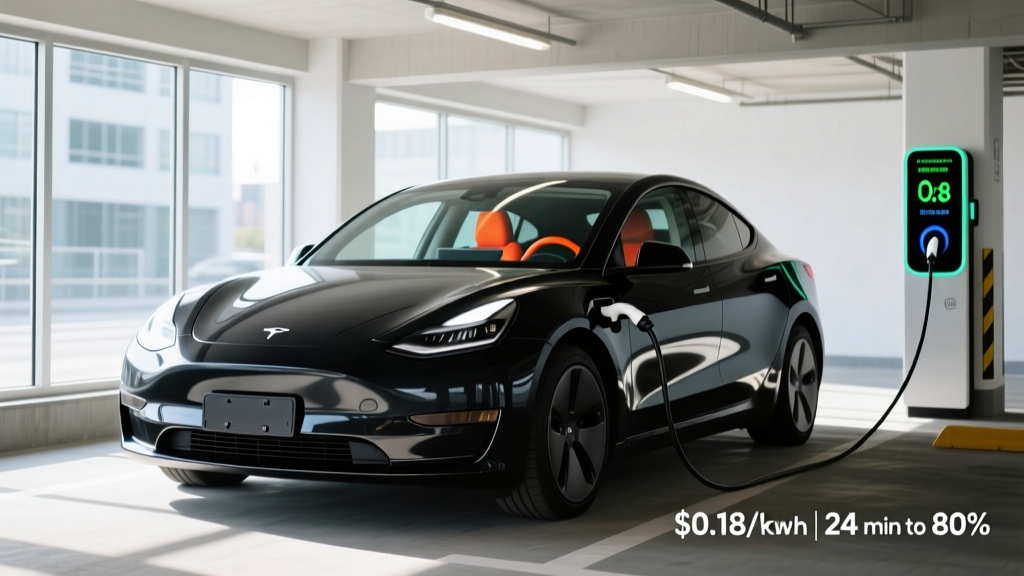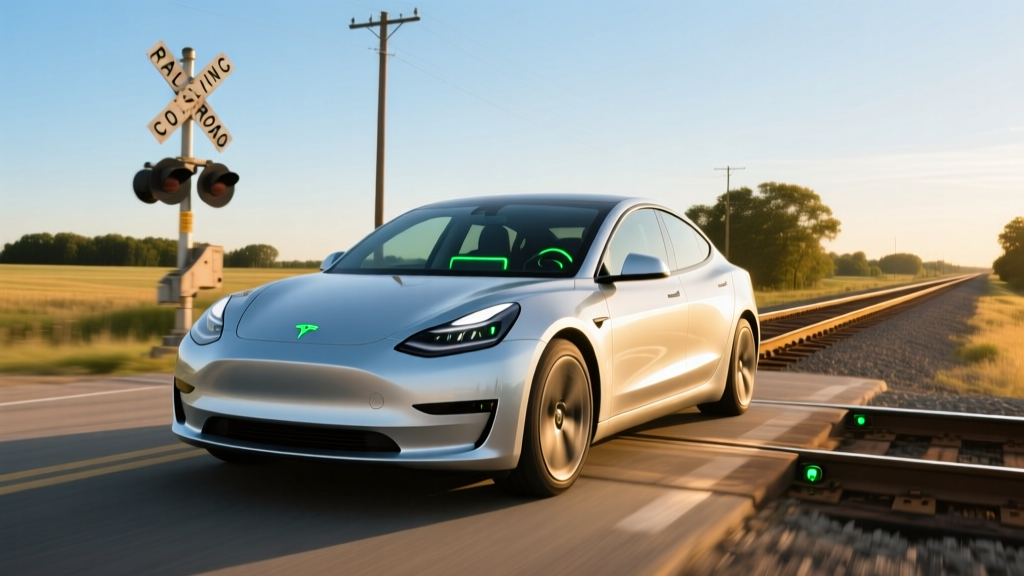
If you've searched Tesla train tracks lately, you've probably seen the viral dashcam clips: a Tesla Model Y or Model 3 approaching a railroad crossing with Autopilot engaged, sometimes failing to slow for the gates, or—in the worst cases—colliding with crossing infrastructure or a train. These incidents aren't unique to Tesla, but they highlight a critical gap in consumer understanding of SAE Level 2 driver-assistance systems and how EVs handle some of the most unforgiving road scenarios.
This article unpacks what's actually happening when Teslas encounter train tracks, how Autopilot and FSD (Supervised) behave at railroad crossings, the real-world EV range implications of detours around rail corridors, and—because you're still shopping—the full 2026 Model Y spec profile so you can evaluate the vehicle on its merits, not just its headlines.
SAE Level 2 ≠ Self-Driving
Every Tesla sold today, even with FSD (Supervised) enabled, operates at SAE Level 2. That means the human driver is legally and physically responsible for steering, braking, and monitoring the environment at all times. Only fully driverless robotaxis like Waymo operate at Level 4. No consumer Tesla is autonomous. If you take your hands off the wheel at a railroad crossing, you are driving unsafely regardless of what the software is doing.
Why Teslas and Train Tracks Keep Making Headlines
Railroad crossing incidents involving Teslas cluster around three failure modes, and none of them are unique to electric vehicles:
- Autopilot not recognizing lowered gates or flashing signals. Vision-only systems (Tesla removed radar and ultrasonic sensors starting in 2022-2023) rely on camera interpretation of crossing arms, lights, and pavement markings. A partially lowered gate at an oblique angle, a sun-blinded camera, or faded crossbucks can fail to trigger deceleration.
- Driver over-reliance. NHTSA crash investigations repeatedly cite "automation complacency"—drivers who treat Level 2 assist as Level 4 autonomy and look away from the road, especially on familiar commuter routes with rail crossings.
- Regenerative braking behavior. In "Hold" regen mode, lifting off the accelerator slows the Tesla aggressively—but not always predictably on steel rail surfaces, which have far less friction than asphalt. This matters when a driver lifts off expecting one-pedal stopping and the car glides further than anticipated across the tracks.
Tesla's owner manuals explicitly state that Autopilot and FSD (Supervised) may not detect railroad crossing gates, and that drivers must take over at all crossings. The NHTSA's ongoing investigation into Tesla Autopilot has documented dozens of crashes at emergency scenes and controlled intersections, and rail crossings share the same sensor-recognition challenges.
2026 Tesla Model Y: The EV Most Likely at Those Crossings
The Model Y remains Tesla's volume seller and the vehicle in most of the viral rail-crossing footage, simply because it's the best-selling EV in the United States. Here's the 2026 spec profile buyers actually need.
| Spec | Value |
|---|---|
| EPA Estimated Range | 320 miles |
| Real-World Highway (70 mph) | ~265-280 miles |
| Real-World Cold (30°F) | ~230-255 miles |
| Battery Capacity (usable) | ~75 kWh (NMC) |
| Battery Chemistry | NMC (Long Range/AWD); LFP (RWD base) |
| Max DC Fast Charge | 250 kW peak (V3 Supercharger) |
| 10-80% DC Fast Charge | ~25-27 minutes |
| Level 2 Home Charge (11.5 kW) | ~44 miles/hour |
| 0-60 mph | 4.8 seconds (Long Range AWD) |
| Horsepower | 384 hp (dual-motor AWD) |
| MPGe (combined) | 117 MPGe |
| Efficiency | 28 kWh/100 mi |
| Cargo Volume (rear seats up) | 30.2 cu ft |
| Cargo Volume (rear seats folded) | 72.0 cu ft |
| Rear Legroom | 41.6 inches |
| Towing Capacity | 3,500 lbs |
| Battery/Powertrain Warranty | 8 years / 120,000 miles |
| Base MSRP (Long Range AWD) | $48,990 |
| As-Tested (FSD, Pearl White, 20" wheels) | ~$59,000 |
Real-World Range Reality Check
The EPA sticker says 320 miles for the 2026 Model Y Long Range AWD. Plan for 265-280 miles on sustained highway driving at 70+ mph, and 230-255 miles in sub-freezing weather without preconditioning. If your commute includes a rail crossing detour adding 15-20 miles round trip, budget accordingly—the detour matters more in January than July.
Charging Speed: What Detours Around Rail Crossings Actually Cost You
One under-discussed element of the "Tesla train tracks" concern: if a rail crossing is blocked (by a stalled freight train, which happens more than you'd think), EV drivers must detour—sometimes 20-40 miles out of the way in rural areas. That's where charging speed becomes a safety issue, not just a convenience one.
| Charging Level | Power (kW) | Miles Added per Hour | Typical Use Case |
|---|---|---|---|
| Level 1 (120V household) | 1.4 kW | ~4-5 miles/hr | Emergency / overnight trickle |
| Level 2 (240V, 48A home) | 11.5 kW | ~44 miles/hr | Daily home charging |
| DC Fast (V3 Supercharger) | 250 kW peak | ~175 miles in 15 min (10-50%) | Road trips, detours |
| DC Fast (V4 Supercharger) | Up to 325 kW | ~200 miles in 15 min | Newer corridor stations |
The Model Y's charge curve is aggressive early (peaking at 250 kW from ~10-30% SoC on V3 Superchargers) but tapers significantly above 60%, and especially above 80%. That 10-80% time of ~25-27 minutes assumes battery preconditioning is active (navigating to a Supercharger in the Tesla nav triggers this automatically). Plug into a cold battery at a non-Tesla DC fast charger via the NACS-to-adapter, and expect 30-35 minutes for the same window.
For the blocked-crossing detour scenario: a 30-mile detour at highway speeds consumes roughly 9-11 kWh. On a V3 Supercharger, that's recoverable in about 4-5 minutes of stopped charging time, assuming you're below 70% SoC.
Pricing, Tax Credits, and the Real Cost to Buy
The 2026 Tesla Model Y Long Range AWD starts at $48,990 before destination fees. The base RWD model (with LFP battery chemistry and lower range) starts around $44,990. Adding FSD (Supervised) is an $8,000 option at purchase, or $99/month as a subscription as of early 2026.
| Trim | MSRP | Federal §30D Credit | Effective Price (if eligible) |
|---|---|---|---|
| RWD (LFP battery) | $44,990 | Up to $7,500 (if sourcing reqs met) | ~$37,490 |
| Long Range AWD (NMC) | $48,990 | Up to $7,500 (if sourcing reqs met) | ~$41,490 |
| Performance AWD | $53,990 | Up to $7,500 (if sourcing reqs met) | ~$46,490 |
Eligibility is not automatic. Under IRS §30D rules current for 2026, the $7,500 credit requires the vehicle's MSRP to fall under the $55,000 SUV cap (all Model Y trims qualify), the buyer's AGI to be under $150,000 (single) or $300,000 (joint), AND the battery to meet critical-mineral and battery-component sourcing thresholds that tighten annually. Tesla's North American battery sourcing has generally qualified recent Model Y builds for the full credit, but always verify on IRS.gov before purchase, as the rules shift and the point-of-sale transfer option requires dealer paperwork at delivery.
Autopilot, FSD, and Railroad Crossings: What the Software Actually Does
Tesla's Autopilot (standard) and FSD (Supervised) handle railroad crossings differently than traffic lights or stop signs, and the distinction matters for safety.
- Autopilot (Traffic-Aware Cruise + Autosteer): Will maintain speed and lane position through a crossing but does not reliably detect gates, flashing lights, or crossbuck signage as stop/yield triggers. The driver must brake manually.
- FSD (Supervised): Tesla's vision system attempts to identify crossing infrastructure and may decelerate for clearly visible lowered gates. However, Tesla's own owner's manual warns that FSD may not recognize all crossing signals, and the driver must be prepared to take over immediately.
- Navigation routing: Tesla's nav does not actively avoid railroad crossings the way it avoids toll roads. If your route includes an at-grade crossing, the car will take you through it without special warning beyond standard map display.
⚠️ Critical Safety Limitation
No Tesla software feature—Autopilot, FSD (Supervised), or Emergency Braking—is certified to reliably stop the vehicle at all railroad crossings under all lighting, weather, and gate-position conditions. Treat every crossing as a manual-driving scenario. The NHTSA and FRA (Federal Railroad Administration) both recommend coming to a complete stop at crossings when visibility is limited, regardless of vehicle automation level.
Pros and Cons: The Honest Ownership Picture
Pros
- Supercharger network remains the most reliable DC fast-charging ecosystem in North America, with 6,000+ U.S. stations—critical for detour recovery
- Class-leading efficiency: 28 kWh/100 mi beats most competitors (Ford Mustang Mach-E: ~33 kWh/100 mi)
- Over-the-air updates continuously improve FSD behavior, including incremental crossing-recognition improvements
- 72 cu ft cargo volume (seats folded) is SUV-competitive for family hauling
- 8-year/120,000-mile battery warranty with 70% capacity retention guarantee
- NACS connector is now the industry standard; access to growing non-Tesla fast-charging networks
Cons
- Vision-only sensor suite (no lidar, no radar) has documented blind spots at rail crossings and emergency scenes
- Regenerative braking on steel rail surfaces is less predictable than on asphalt—lift-off deceleration can feel inconsistent
- No physical instrument cluster; all information routes through the center screen, increasing glance-time away from crossings
- FSD (Supervised) is $8,000 extra and still requires full driver attention—questionable value vs. subscription
- Build quality variability (panel gaps, paint) remains a common owner complaint vs. legacy automakers
- Insurance premiums run 15-25% higher than comparable gas SUVs in most U.S. states
Who the 2026 Model Y Suits Best
Buy it if: You want the lowest-friction EV ownership experience in the U.S.—best charging network, strong efficiency, OTA updates, and cargo space that handles a family of four with strollers and groceries. The 320-mile EPA range (265-280 real-world highway) covers most commutes and regional road trips without charge-stop anxiety.
Look elsewhere if: Your daily route includes multiple uncontrolled railroad crossings, rural unpaved roads, or scenarios where sensor reliability in adverse weather is paramount. The Hyundai Ioniq 5 and Ford Mustang Mach-E retain radar sensors that supplement cameras, offering redundancy at crossings and in fog/snow. If you prioritize build consistency, the BMW iX or Genesis Electrified GV70 deliver at higher price points.
Frequently Asked Questions
Does Tesla Autopilot automatically stop at railroad crossings?
No. Autopilot (standard) and FSD (Supervised) are not guaranteed to detect railroad crossing gates, flashing signals, or pavement markings. Tesla's owner manual explicitly states the driver must take over at all rail crossings. Treat every crossing as a manual-driving scenario.
What's the real-world range of the 2026 Model Y?
The EPA estimates 320 miles for the Long Range AWD. Expect 265-280 miles on sustained highway driving at 70 mph, and 230-255 miles in sub-freezing temperatures. Preconditioning the battery (automatic when navigating to a Supercharger) recovers some cold-weather loss.
How fast does the Model Y charge at home and on the road?
On a 240V Level 2 home charger (11.5 kW), you'll add ~44 miles per hour—enough to fully recharge overnight. On a V3 Supercharger (250 kW peak), 10-80% takes ~25-27 minutes with battery preconditioning. V4 Superchargers can shave 3-5 minutes off that time.
Does the 2026 Model Y qualify for the $7,500 federal EV tax credit?
It can, but eligibility depends on your income (under $150K single / $300K joint AGI), the vehicle's battery sourcing meeting 2026 critical-mineral and component thresholds, and MSRP staying under the $55,000 SUV cap (all Model Y trims qualify). Verify current eligibility on IRS.gov before purchase. Point-of-sale transfer is available at delivery.
Is the Model Y worth buying vs. the Hyundai Ioniq 5 or Ford Mach-E?
The Model Y wins on charging-network access (Superchargers), efficiency (28 kWh/100 mi vs. ~33 for competitors), and cargo volume. The Ioniq 5 and Mach-E win on sensor redundancy (both retain radar), interior material quality, and available hands-free driving features on mapped highways (BlueCruise on Mach-E). Test-drive all three; the decision often comes down to which driver-assist philosophy and charging ecosystem you trust more.
What should I do if my Tesla gets stuck on train tracks?
Exit the vehicle immediately and move far away from the tracks. Call 911 and the emergency number posted on the crossing sign (every U.S. crossing has a unique DOT number and emergency contact). Do not attempt to push the vehicle or re-enter it. Tesla's 12V battery failure has occasionally disabled door handles and drive systems—know your manual door-release location before you need it.
The "Tesla train tracks" conversation is ultimately a conversation about automation expectations vs. reality. The 2026 Model Y is an excellent, efficient, practical EV—but it is not autonomous, and no software update changes the physics of a 4,000-pound vehicle approaching a train. Drive the car; don't let the car drive you through a crossing.