Tesla's Traffic Light and Stop Sign Control has evolved from a cautious beta feature into a core component of Full Self-Driving (Supervised). For 2026 Model 3 and Model Y buyers, understanding how this feature actually performs at intersections — and what the vehicles deliver in range, charging, and value — is essential before committing to a purchase and the $8,000 FSD package.
This review breaks down Tesla's traffic light recognition capability within the broader context of owning a 2026 Model 3 or Model Y, covering the exact specs, real-world efficiency, charging realities, and federal tax credit eligibility that matter to buyers.
What Tesla Traffic Light Recognition Actually Does
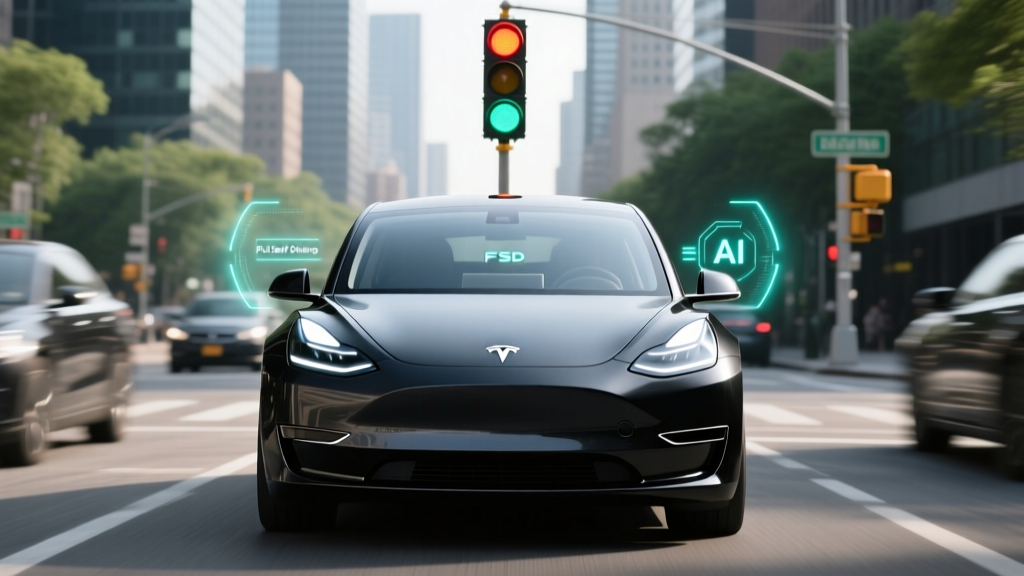
Traffic Light and Stop Sign Control is a feature within Tesla's FSD (Supervised) software stack. When enabled, the vehicle's vision system identifies traffic lights and stop signs, then automatically adjusts speed to stop at red lights and stop signs, and proceeds through green lights — all under active driver supervision.
Tesla FSD (Supervised), including traffic light recognition, is a Level 2 driver-assistance system per SAE J3016. The driver must remain fully attentive, keep hands on the wheel, and be prepared to intervene at any moment. This is not autonomous driving. Tesla's own documentation and NHTSA guidance require continuous driver engagement.
The system uses Tesla's pure-vision approach — no lidar or radar in current-production vehicles — relying on eight surround cameras and the HW4 (AI4) computer to classify signal states (red, yellow, green, turn arrows) and determine right-of-way. In practice, the feature handles standard four-way intersections competently but can hesitate at complex multi-lane junctions, temporary construction signals, or when a traffic light is mounted at an unusual angle.
Where Traffic Light Recognition Excels
- Standard suburban intersections: Reliable detection and smooth deceleration at clearly visible, well-maintained signals.
- Stop sign compliance: Consistent full-stop behavior at marked and unmarked stop signs, including four-way stops with proper yielding logic.
- Fresh green lights: The system proceeds through green signals without unnecessary hesitation in most scenarios.
Known Limitations
- Protected vs. permissive turns: The system sometimes struggles to distinguish a green arrow from a solid green when deciding whether to turn across traffic.
- Stale yellow timing: Occasional hard braking when a light transitions to yellow earlier than the system's prediction model expects.
- Obstructed signals: Large trucks, tree canopy, or sun glare can delay recognition, requiring driver takeover.
- Construction zones: Temporary traffic signals and flaggers are not reliably handled — driver must assume control.
2026 Model 3 and Model Y: Specs at a Glance
Traffic light recognition is available on any Tesla equipped with FSD (Supervised), but most buyers are choosing between the refreshed Model 3 (Highland platform) and the Model Y (Juniper refresh). Here are the exact specifications for the most popular trims.
| Spec | Model 3 Long Range AWD | Model Y Long Range AWD |
|---|---|---|
| EPA Range | 341 miles | 320 miles |
| Battery (usable) | ~75 kWh, NMC | ~75 kWh, NMC |
| Efficiency | 132 MPGe / 25 kWh/100mi | 123 MPGe / 27 kWh/100mi |
| Peak DC Fast Charge | 250 kW | 250 kW |
| 10–80% DC Time | ~25 min | ~27 min |
| Level 2 Home Charge | 11.5 kW (~44 mi/hr) | 11.5 kW (~40 mi/hr) |
| 0–60 mph | 4.2 seconds | 4.8 seconds |
| Horsepower | ~346 hp (dual motor) | ~384 hp (dual motor) |
| Drivetrain | AWD (dual motor) | AWD (dual motor) |
| Cargo Volume | 23 cu ft (trunk) + 3 cu ft (frunk) | 30 cu ft (rear) + 4 cu ft (frunk) |
| Rear Legroom | 35.3 inches | 41.6 inches |
| Battery Warranty | 8 yr / 120,000 mi | 8 yr / 120,000 mi |
| Base MSRP | $47,740 | $48,630 |
Source: fueleconomy.gov and Tesla spec sheets. MSRP excludes destination fee.
Real-World Range: What to Actually Expect
Model Y Long Range AWD: EPA 320 miles. Expect ~265–290 miles highway. Cold-weather range drops to ~215–245 miles under the same conditions.
Tesla's NMC battery chemistry delivers strong energy density but is more sensitive to cold-weather range loss than LFP packs. The heat pump (standard on both models) mitigates some cabin-heating energy draw, but the physics of lithium-ion internal resistance at low temperatures still costs 15–25% of rated range in sustained sub-freezing driving.
For commuters doing 40–60 miles daily with home charging, neither model's real-world range presents a concern. For road trips, Tesla's navigation system factors in elevation, temperature, and speed to provide accurate arrival SoC estimates — one of the strongest route-planning implementations in the EV market.
Charging Speed: DC Fast and Home Level 2
| Level | Power (kW) | Miles Added per Hour | Notes |
|---|---|---|---|
| Level 1 (120V) | ~1.4 kW | ~5 mi/hr | Emergency/trickle only |
| Level 2 (240V, 48A) | 11.5 kW | 40–44 mi/hr | Full overnight charge in ~7–8 hrs |
| DC Fast (V3 Supercharger) | 250 kW peak | ~1,000 mi/hr (peak) | 10–80% in ~25 min; tapers sharply above 80% |
| DC Fast (V4 Supercharger) | 250 kW (vehicle-limited) | ~1,000 mi/hr (peak) | V4 posts support higher kW, but Model 3/Y peak at 250 kW |
The charge curve matters more than peak kW. Tesla's 250 kW peak holds only between roughly 10–30% SoC. From 30–60%, expect ~150–180 kW sustained. From 60–80%, the rate drops to ~80–100 kW. Above 80%, charging slows dramatically to protect battery health — a full 80–100% top-off can add another 20+ minutes.
For home charging, a Tesla Wall Connector on a 60A circuit delivers the full 11.5 kW (48A continuous). A typical installation with a 200A panel runs $500–$1,500 depending on run length and conduit requirements. Homes with older 100A panels may need a $1,500–$3,000 service upgrade — factor this into your purchase budget.
Tesla's NACS connector is now the industry standard adopted by Ford, GM, Rivian, and others, meaning Model 3/Y owners have access to the largest and most reliable DC fast-charging network in North America: over 6,000 Supercharger stations and 60,000+ stalls.
Pricing, Trims, and Federal Tax Credit Eligibility
| Trim | MSRP | + FSD Package | After Max §30D Credit |
|---|---|---|---|
| Model 3 RWD | $38,990 | $46,990 | $31,490* |
| Model 3 Long Range AWD | $47,740 | $55,740 | $40,240* |
| Model 3 Performance | $54,630 | N/A (incl.) | $47,130* |
| Model Y Long Range AWD | $48,630 | $56,630 | $41,130* |
| Model Y Performance | $53,130 | N/A (incl.) | $45,630* |
*Assumes full $7,500 §30D credit eligibility. Actual credit depends on buyer income, battery sourcing, and MSRP caps. Point-of-sale transfer available at participating dealers.
- MSRP Cap: Sedans (Model 3) must be ≤$55,000; SUVs/trucks/vans (Model Y) ≤$80,000. All current trims qualify on MSRP alone.
- Buyer Income Cap (MAGI): $150,000 single / $225,000 head of household / $300,000 joint filers. Exceed these and the credit phases to $0.
- Battery Sourcing: The $7,500 credit splits into $3,750 for critical-mineral sourcing and $3,750 for battery-component manufacturing. Tesla's shifting supply chain means eligibility can vary by production batch — verify the specific VIN's qualification at IRS.gov's qualified vehicle list.
- Point-of-Sale Transfer: Since 2024, you can transfer the credit to the dealer at purchase, reducing your out-of-pocket cost immediately rather than waiting for tax filing. Tesla supports this at checkout.
The FSD (Supervised) package adds $8,000 to the purchase price (or $99/month subscription). If your primary interest is traffic light recognition and intersection automation, this is a significant investment for a feature that remains Level 2 and requires constant supervision. Many buyers find the included Basic Autopilot — which handles lane centering and adaptive cruise on highways — sufficient for daily driving.
Tech, Interior, and the FSD Experience
Both the Model 3 Highland and Model Y Juniper share Tesla's minimalist interior architecture: a single 15.4-inch center touchscreen controls virtually all vehicle functions, with no traditional instrument cluster. The Model 3 refresh added ventilated front seats, ambient lighting, a rear passenger touchscreen, and significantly improved cabin insulation over the pre-2024 generation.
The infotainment system remains class-leading in responsiveness, with native Netflix/YouTube streaming (while parked), a strong navigation system with real-time Supercharger availability, and over-the-air updates that continuously add features. Tesla's app integration — preconditioning, charging status, Sentry Mode clips, and Summon — is the most comprehensive in the industry.
For traffic light recognition specifically, the FSD visualization display renders detected signals, stop signs, crosswalks, and lane markings on the center screen in real time. This visualization builds confidence in what the system "sees," but it can also create a false sense of security. The system occasionally renders a signal incorrectly (e.g., showing green when the light has turned yellow) — reinforcing why driver attention is non-negotiable.
Notable Drawbacks
- No instrument cluster: Speed and navigation info live on the center screen, requiring eye movement away from the road.
- Turn signal stalks removed (Model 3 Highland): Turn signals are now steering-wheel-mounted buttons, which frustrates some drivers during roundabouts and lane changes.
- Phantom braking: Both models have documented instances of unexpected deceleration on highways with Autopilot engaged — a known issue Tesla has addressed through software updates but not fully eliminated.
- Insurance costs: Tesla insurance premiums run 15–30% higher than comparable EVs from Hyundai or Ford, partly due to repair costs for sensor/camera damage.
Who Should Buy — and Who Should Look Elsewhere
- You commute in suburban areas with well-marked intersections and want reduced stop-and-go fatigue
- You have reliable home charging access (Level 2 installation feasible)
- You value the Supercharger network for road trips and travel frequently
- You're comfortable with a screen-centric interface and OTA-driven vehicle evolution
- You meet §30D income caps and your VIN qualifies for the full $7,500 credit
- You want a traditional instrument cluster and physical controls
- You need proven Level 2 highway systems without the $8,000 FSD premium (BlueCruise, Hyundai HDA2)
- Insurance costs in your state make Tesla ownership disproportionately expensive
- You prefer dealer-service infrastructure over Tesla's mobile-ranger/service-center model
Pros and Cons at a Glance
- Best-in-class DC charging network (Supercharger access)
- Strong EPA range (341/320 mi) with accurate route planning
- Traffic light recognition handles standard intersections well
- OTA updates continuously improve features
- Excellent efficiency (25–27 kWh/100mi)
- Spacious Model Y cargo area (30+ cu ft)
- Point-of-sale tax credit transfer reduces upfront cost
- FSD costs $8,000 extra and remains Level 2 (not autonomous)
- Traffic light recognition falters at complex/construction intersections
- No instrument cluster; turn signal buttons on Model 3
- Higher insurance premiums than competitors
- Cold-weather range loss of 15–25% (NMC chemistry)
- Phantom braking events still reported on Autopilot
- 250 kW peak DC charge rate trails Hyundai/Kia's 350 kW capability
Frequently Asked Questions
Does Tesla traffic light recognition work without FSD?
No. Traffic Light and Stop Sign Control requires the FSD (Supervised) package, which costs $8,000 as a one-time purchase or $99/month as a subscription. Basic Autopilot, which is included with every Tesla, does not include intersection signal recognition — it handles highway lane centering and adaptive cruise only.
What is the real-world range of the 2026 Model 3 Long Range?
The EPA rates it at 341 miles. In real-world highway driving at 70–75 mph, expect 280–305 miles. In sustained freezing temperatures, plan for 230–260 miles. Preconditioning the battery while plugged in (using scheduled departure) recovers some cold-weather efficiency.
How fast does a Tesla Model Y charge at home?
On a Level 2 Tesla Wall Connector (240V, 48A, 11.5 kW), the Model Y Long Range adds approximately 40 miles of range per hour, reaching a full charge from 10% in about 7–8 hours. This is sufficient for any daily commute when charging overnight.
Does the 2026 Model 3 or Model Y qualify for the $7,500 federal tax credit?
Both models are on the IRS qualified vehicles list, but your personal eligibility depends on modified adjusted gross income (≤$150K single, ≤$300K joint), and the specific VIN's battery-component and critical-mineral sourcing. The credit can be transferred at point of sale to reduce your purchase price immediately. Consult a tax professional for your specific situation.
Is FSD traffic light recognition worth the $8,000 cost?
For drivers who commute through many signalized intersections daily and want reduced cognitive load, the feature adds genuine convenience. However, it remains a Level 2 assist — you must supervise every intersection. If your primary driving is highway commuting, Basic Autopilot (included free) covers lane centering and cruise control, saving $8,000. The FSD subscription ($99/month) is a lower-risk way to test the feature before committing to a purchase.
How does Tesla's traffic light recognition compare to competitors?
Ford's BlueCruise (hands-free highway driving) does not handle traffic lights. GM's Super Cruise similarly focuses on highway use. Hyundai/Kia's Highway Driving Assist 2 includes intersection turning assist in limited scenarios but is not as broadly deployed as Tesla's system. Tesla currently offers the most widely available traffic light recognition feature, though its reliability at complex intersections remains imperfect.
Sources: fueleconomy.gov (EPA range and efficiency), IRS.gov (§30D qualified vehicle list), Tesla.com official specifications. All pricing and specs reflect 2026 model year as published. Tax credit eligibility subject to change — verify at purchase.