What Is Tesla Tow Mode and How Does It Work?
Tesla Tow Mode is a software setting available on the Cybertruck, Model X, and Model Y (when equipped with the factory tow package) that adjusts the vehicle's behavior for trailer hauling. When engaged, it modifies throttle response, suspension height (on air-suspension models), trailer sway mitigation, and—critically—regenerative braking behavior. On the Cybertruck and Model X, Tow Mode also activates an integrated trailer brake controller if one is equipped, and adjusts the rearview camera to show a trailer-hitch view.
The feature is not a separate hardware package; it is a software toggle found under Controls > Driving on the vehicle's touchscreen. However, it only appears on vehicles that have the factory-installed tow hitch and wiring harness. Aftermarket hitches will not activate Tow Mode, and the vehicle will not recognize trailer lighting or brake signals without the OEM 7-pin connector.
Which Tesla Models Support Tow Mode?
As of the 2025–2026 model year, three Tesla vehicles offer Tow Mode with a factory tow package:
- Cybertruck (AWD and Cyberbeast): 11,000 lb max towing capacity. Standard integrated trailer brake controller. Tow Mode adjusts air suspension ride height and activates trailer light check.
- Model X (Long Range and Plaid): 5,000 lb max towing capacity (with 20" wheels; drops to 3,500 lb with 22" wheels). Tow Mode includes trailer sway control and rear camera hitch view.
- Model Y (Long Range AWD, with tow package): 3,500 lb max towing capacity. Tow Mode added via OTA update for vehicles with the factory hitch; adjusts regen and stability control.
The Model 3 and Model S do not currently offer a factory tow package in the US market, and Tow Mode is unavailable on these vehicles.
Towing Range Impact: The Numbers That Matter
The single most important question for EV towers is how much range you lose when hauling a trailer. The answer is substantial—and it varies by trailer weight, aerodynamics, terrain, and speed.
Here is a breakdown of observed efficiency and range impact across Tesla models when towing:
| Model | EPA Range (unloaded) | Trailer Weight | Observed Efficiency | Est. Towing Range |
|---|---|---|---|---|
| Cybertruck AWD | 340 mi | 7,000 lb enclosed | ~650–800 Wh/mi | 120–180 mi |
| Model X Long Range | 335 mi | 4,000 lb boat | ~550–700 Wh/mi | 150–200 mi |
| Model Y LR AWD | 310 mi | 2,500 lb utility | ~420–520 Wh/mi | 180–210 mi |
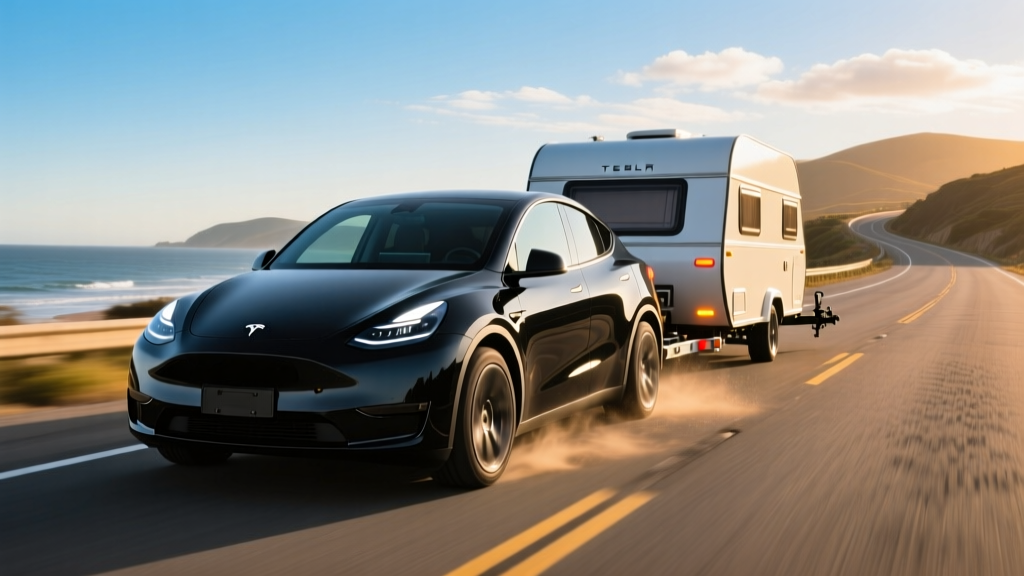
| Model Y LR AWD | 310 mi | 3,500 lb camper | ~550–650 Wh/mi | 140–175 mi |
For context, an unloaded Model Y Long Range averages roughly 270–290 Wh/mi in mixed driving per EPA data on fueleconomy.gov. Towing roughly doubles—or in the Cybertruck's case, nearly triples—energy consumption per mile.
Battery, Charging, and How Tow Mode Affects Charging Stops
Understanding the battery specs helps explain why towing range drops so dramatically:
| Model | Battery (usable, est.) | Chemistry | Max DC Charge | 10–80% Time | Level 2 Rate |
|---|---|---|---|---|---|
| Cybertruck AWD | ~123 kWh | NMC | 250 kW (V3 SC) | ~28 min | 11.5 kW (~37 mi/hr) |
| Model X LR | ~95 kWh | NMC | 250 kW (V3 SC) | ~25 min | 11.5 kW (~34 mi/hr) |
| Model Y LR AWD | ~75 kWh | NMC | 250 kW (V3 SC) | ~22 min | 11.5 kW (~44 mi/hr) |
When towing, you will charge more often. A Cybertruck towing 7,000 lb may need a Supercharger stop every 100–130 miles. However, DC fast charging speed is unaffected by Tow Mode—the battery accepts the same peak kW whether or not a trailer is attached. What does change is the state of charge you need to reach before continuing. Because range is compressed, many towers charge to 90% or higher at each stop, which means longer dwell times since the charge curve tapers sharply above 80%.
Charging curve reality: At a V3 Supercharger (250 kW peak), the Cybertruck sustains roughly 200+ kW only between 10–40% SoC. From 40–65%, it drops to ~130–150 kW. Above 80%, it falls below 50 kW. If you are towing and need to charge from 15% to 90%, expect 45–55 minutes at the charger—not the 28-minute 10–80% figure quoted for normal driving.
Performance and Drivetrain Specs While Towing
| Model | 0–60 mph (unloaded) | Horsepower | Drivetrain | Max Tow Rating |
|---|---|---|---|---|
| Cybertruck AWD | 3.9 sec | 600 hp | Dual-motor AWD | 11,000 lb |
| Cybertruck Cyberbeast | 2.6 sec | 845 hp | Tri-motor AWD | 11,000 lb |
| Model X LR | 3.8 sec | 670 hp | Dual-motor AWD | 5,000 lb |
| Model Y LR AWD | 4.8 sec | 384 hp | Dual-motor AWD | 3,500 lb |
Tow Mode softens throttle response to prevent abrupt torque application that could destabilize a trailer. In the Cybertruck, it also lowers the air suspension by roughly 0.5 inches at highway speed to reduce drag and improve stability. On the Model X, the adaptive air suspension similarly adjusts damping firmness.
Acceleration while towing is predictably slower. A Model Y with a 3,500 lb trailer will see 0–60 times stretch to roughly 8–9 seconds. The Cybertruck, with its massive torque output, still manages 0–60 in approximately 6–7 seconds with a heavy trailer—competitive with a Ford F-150 PowerBoost hybrid under similar load.
Pricing, Tax Credit Eligibility, and Total Cost
| Model & Trim | Base MSRP | Tow Package Add-On | §30D Credit Eligible? | Est. Net Price |
|---|---|---|---|---|
| Cybertruck AWD | $79,990 | Included | No (MSRP cap exceeded) | $79,990 |
| Model X Long Range | $79,990 | $1,200 | No (MSRP cap exceeded) | $81,190 |
| Model Y LR AWD | $47,990 | $1,000 | Yes (if income & sourcing met) | ~$41,490 |
- MSRP cap: SUVs/pickups must be ≤$80,000; sedans ≤$55,000. The Cybertruck and Model X exceed the cap; the Model Y qualifies.
- Income cap: Modified AGI ≤$300,000 (joint), ≤$225,000 (HOH), ≤$150,000 (single).
- Battery sourcing: Critical minerals and battery components must meet escalating domestic-sourcing thresholds. Verify current-year compliance on irs.gov before purchase.
- Point-of-sale transfer: Eligible buyers can apply the credit as a down-payment reduction at the dealer, rather than waiting for a tax refund.
Consult a tax professional. Credit rules are subject to change and depend on your individual tax situation.
Warranty Coverage
Tesla's warranty covers the battery and drive unit for 8 years, but mileage limits differ by model:
- Cybertruck: 8 years / 120,000 miles (battery & drive unit), with a minimum 70% capacity retention threshold.
- Model X: 8 years / 150,000 miles (battery & drive unit), 70% retention.
- Model Y: 8 years / 120,000 miles (Long Range AWD), 70% retention.
Towing does not void the battery warranty, but sustained high-load operation (frequent max-capacity towing in hot climates) may accelerate degradation. Tesla's thermal management system actively cools the battery during high-discharge events, which mitigates—but does not eliminate—this risk.
Pros and Cons of Towing with a Tesla
- Instant torque provides confident merging and hill climbing under load
- Trailer sway mitigation is responsive and effective
- No fuel cost markup—electricity per mile is still cheaper than gas, even at 700 Wh/mi
- Cybertruck's 11,000 lb rating is class-competitive
- Integrated trailer brake controller (Cybertruck, Model X) eliminates aftermarket installs
- Over-the-air updates continue to improve Tow Mode features
- 40–65% range reduction makes long-distance towing impractical without frequent stops
- Supercharger stalls are not designed for trailer parking—many require unhitching or awkward maneuvering
- Charge times stretch to 45–55 min when towing (need to charge past 80%)
- No diesel-range equivalent: a 300-mile tow trip requires 2–3 stops
- Model Y's 3,500 lb limit is below many competing SUVs
- Autopilot/FSD not recommended while towing—driver must manage all steering/braking
Who Should (and Shouldn't) Tow with a Tesla?
Tesla towing makes sense if: You tow short distances (under 100 miles one-way) to a boat ramp, campsite, or dump station where you can charge at your destination overnight on Level 2. The Cybertruck is a legitimate light-duty work truck for job-site hauling where daily routes are predictable and depot charging is available.
Look elsewhere if: You regularly tow 300+ miles on rural routes with sparse charging infrastructure, or you need to tow in extreme cold where range loss compounds. For cross-country trailer hauling, a heavy-duty diesel pickup or a PHEV like the Ford F-150 PowerBoost still offers more practical range between fuel stops.
Frequently Asked Questions
Does Tow Mode increase regenerative braking?
No. Tow Mode actually reduces regenerative braking aggressiveness to prevent the trailer from pushing the tow vehicle during deceleration. Strong regen with a heavy trailer can cause instability, especially on downhill grades. Tesla recommends using the friction brakes more actively when towing and ensuring the trailer brake controller is properly calibrated.
Can I use a Supercharger with a trailer attached?
Physically, yes—but it is often impractical. Most Supercharger stalls are pull-through only at select truck-friendly locations (Tesla has been expanding these). At standard stalls, you will need to unhitch or perform a multi-point turn. Plan charging stops using the Tesla app's trip planner, which accounts for trailer load when estimating arrival SoC.
Does towing void my Tesla battery warranty?
No, as long as you stay within the vehicle's rated tow capacity and use the factory hitch and wiring. However, if Tesla's diagnostic logs show repeated extreme-discharge events (e.g., sustained towing at max capacity in high ambient temperatures), they may flag this as "abuse" in a warranty dispute. Keep your loads within 80% of the rated capacity for routine use.
How does the Cybertruck's towing compare to a Ford F-150 Lightning?
The Cybertruck (11,000 lb rating) and F-150 Lightning (10,000 lb with Max Tow) are closely matched on paper. In real-world testing, both trucks see similar range compression—roughly 50–60% loss at highway speeds with a 7,000 lb trailer. The Lightning's larger battery (131 kWh extended range) provides slightly more towing range (approximately 140–200 miles vs. the Cybertruck's 120–180 miles), but the Lightning also has slower DC charging speeds at ~180 kW peak. See fueleconomy.gov for official efficiency comparisons.
Does the Model Y tow package include a brake controller?
No. The Model Y's factory tow package includes a 2-inch hitch receiver, 4-pin wiring harness, and Tow Mode software. It does not include an integrated trailer brake controller. If your trailer has electric brakes (common above 2,000 lb), you will need an aftermarket brake controller compatible with the Model Y's electrical system—check with Curt or Tekonsha for compatible units.
What is the cost to charge while towing?
At an average Supercharger rate of $0.35/kWh and a towing efficiency of 650 Wh/mi, you are paying roughly $0.23 per mile. Compare this to a gas truck getting 8 mpg while towing at $3.50/gallon: $0.44 per mile. Even with range compression, electric towing is approximately 45–50% cheaper per mile—though the time cost of frequent charging stops is a real tradeoff.